Distributed Order Management
for Business to Business
By Steve Banker.
Summary
Oracle is one of a small number of suppliers that supply a class of solution that is most commonly known as a distributed order management (DOM) system. Oracle’s Order Management Cloud solution is a central order orchestration hub for companies with multichannel order flows. This article describes what a distributed order management system is, particularly in the context of B2B order fulfillment, and looks at Oracle’s distinctive approach to supporting B2B orders.
To support B2B order flows, there is an architectural advantage to having a configurator, an order promising engine, and a distributed order management solution reside on one platform that is built with a common database and data structures.
B2B Order Flows Can Be Highly Complex
Oracle is one of a fairly small number of suppliers that supply a class of solution that is most commonly known as a distributed order management (DOM) system. Oracle’s Order Management Cloud is a central order orchestration hub for companies with multichannel order flow paths. For companies that have purchased enterprise resource planning (ERP) solutions, which contain order management capabilities, it would be natural to ask how DOM differs from traditional order management. The first problem is that many companies have multiple ERP instances. This heterogeneity prevents companies from being able to present “one face to the customer.” It is not uncommon, for example, for customers buying from large companies to have a cumbersome order process where they have to place several different orders to the different divisions.
But even if a company has just one instance of an ERP order management application, many ERP solutions hardwire the flow path logic and are thus not flexible enough to effectively deal with a dynamic business environment.
Retailers have traditionally been the main purchasers of DOM solutions. As retailers have seen more and more sales from ecommerce and have struggled to support multiple order flow paths to customers, they naturally turned to DOM solutions. Retail supports a Business to Consumer (B2C) business model. In contrast, many companies support a Business to Business (B2B) model. These companies are increasingly realizing that traditional ERP order management solutions are too inflexible to fully support different classes of customers across diverse channels.
One example of such a company is Telogis. Telogis, A Verizon Company, is a leading global, cloud-based Mobile Resource Management (MRM) software company based in Aliso Viejo, California. Michael Massimino, Telogis’s Director of IT, has spoken publicly about why Telogis selected the Oracle Order Management Cloud solution. He characterized the solution as being both “secure” and “flexible.” And the flexibility is key “because our business is doing all kinds of different transactions.” Mr. Massimino added “we also needed the ability to utilize the open … APIs and the ability to bring orders/transactions from multiple places into the Order Management Cloud and (then) be able to process them and make a determination of where they need to go.” Orders might “need to go to Fulfillment and Shipping to be shipped out, or they need to go straight to AR (accounts receivable), or they need to go to Projects.”
But the order synchronization process can be more complex than what Mr. Massimino described for Telogis. Consider the potential flow paths for a PC order that needs to be fulfilled by a manufacturer of advanced consumer electronics. The order might be placed in a variety of sales channels. The “product” is a mix of components and services supplied by both the company and key trading partners. Before promising that a large order can be fulfilled, the PC manufacturer needs to insure that multiple partners have the inventory on hand or capacity to successfully complete their tasks in the end-to-end fulfillment process before making a customer commitment. Then that order needs to be tracked across the appropriate end-to-end flow path and if a problem emerges, a method of mitigating the issue must be selected and the appropriate tasks need to be assigned and tracked.
Orchestrating B2B orders can be more complex than B2C orders. While there tend to be more flow paths associated with B2C omni-channel initiatives, B2C flows usually are based on preexisting inventory sitting in upstream warehouses. In contrast, B2B often involves make-to-order or engineer-to-order manufacturing. A manufacturer that does not want to be buried in inventory needs to be able to engage in capable to promise. Before making a promise to a customer to fulfill 1000 widgets on a particular date, extensive checks need to be made on whether upstream suppliers either have or can make the components they need, whether a contract manufacturing partner has available manufacturing capacity, and they may need, depending on the flow path, to check the capacity of carriers, 3PL partners, and other partners as well.
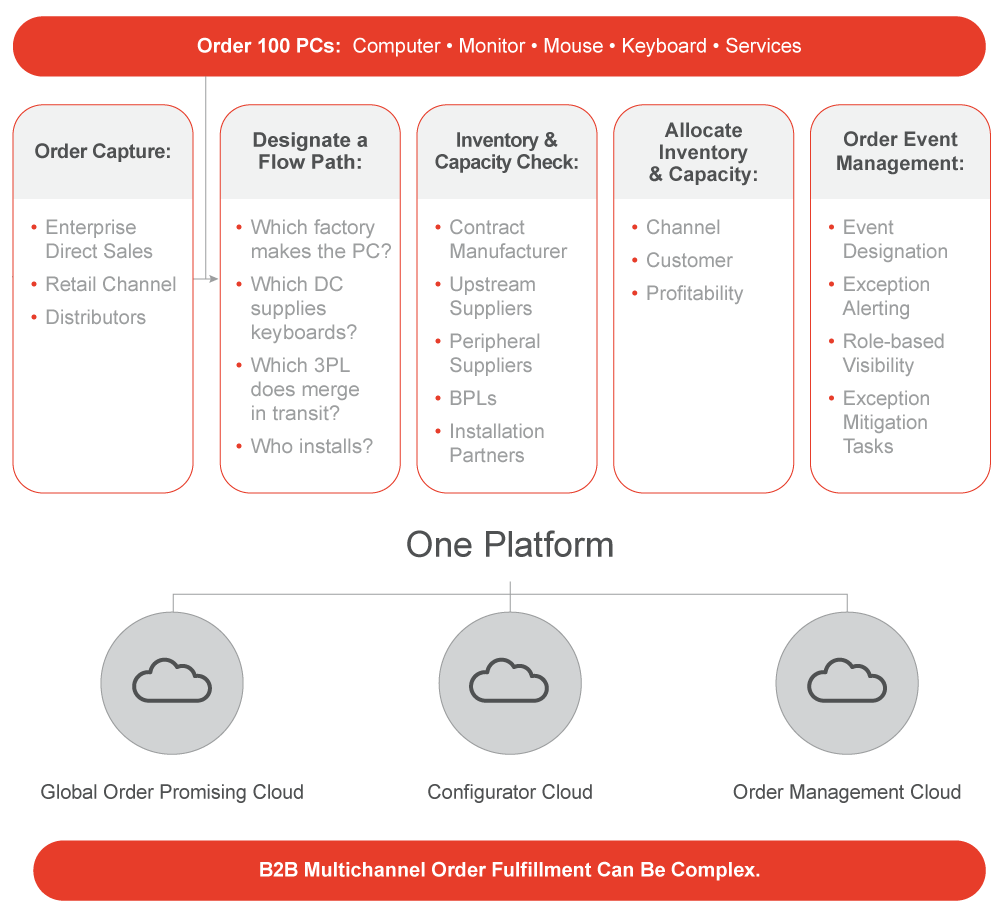
Oracle’s Solutions for Complex B2B Multichannel Order Synchronization
Because fulfillment can involve multiple products, sold in multiple channels, based on the need to synchronize operations with multiple partners, there is a plethora of internal and external systems and message streams that a DOM needs to integrate to in order to effectively orchestrate an order flow. A DOM will always need a variety of methods to integrate to, and process messages from, a variety of systems. All DOM solution sets do this. However, in B2B settings, there is a strong architectural advantage to having a configurator, an order promising engine, and the DOM reside on one platform built with a common database and data structures. This is the approach Oracle has taken. As these critical applications are reconfigured to support new business opportunities, or upgrades occur, the different systems remain tightly coupled and in synch. Oracle also has the advantage of having a broad and deep supply chain management application suite that its Oracle Global Order Promising Cloud, Oracle Configurator Cloud, and Oracle Order Management Cloud are preintegrated to.