
-
Estimated reading time: 1 minute
Automotive Industry Viewpoints
The automotive industry has never experienced a more exciting period of transformation. Vehicles are becoming more technologically advanced every day. They're fast becoming supercomputers on wheels, linked to our homes and cities. And once just the stuff of comic books and science fiction movies, driverless electric vehicles have already logged well over a million test miles.
In many cases, software is either enhancing or completely replacing mechanical operations. This means vehicles are generating and receiving huge amounts of data every second. As all of this must be captured, managed, and analyzed—much of it in the local environment—edge computing will play a key role.
"Each [autonomous] car will be powered by over 150 million lines of software code (more than is currently required by Google Chrome or the Mars Curiosity Rover) and generate 4,000 GB of data a day1." —"AI: The New Driving Force in the Automotive Industry," Information Age
This is driving a shift in the industry, as original equipment manufacturers (OEMs) need to become experts in software and data. To do this, they're competing in a battle for talent, as they fight to attract, develop, and retain a new digital-native workforce.
At the same time, customers are becoming more demanding, expecting flexible and personalized digital experiences. Mobility services like ride sharing, pay-by-plate, and automated delivery are becoming core offerings. And as new ownership models disrupt the industry and cause traditional vehicle sales to stagnate, established industry players are under pressure to respond.
In this ebook, we'll look at the emerging technologies at the heart of this transformation. We'll discuss how today's vehicles—and the infrastructure they rely on—are evolving to embrace the four elements of CASE: connected, autonomous, shared, and electric.
"Connected, Autonomous, Shared, Electric: Each of these has the power to turn our entire industry upside down. But the true revolution is in combining them in a comprehensive, seamless package." —Dr. Dieter Zetsche, Chairman of the Board of Management, Daimler AG
1information-age.com/ai-new-driving-force-automotive-industry-123468560/
-
Estimated reading time: 5 minutes
A CASE for Disruption
Electric vehicles. Autonomous transportation. New models for vehicle use and ownership. As cloud-native start-ups disrupt the marketplace, established manufacturers are seeking ways to safeguard their futures. There are numerous innovations in play, but they can be categorized into one of the following:
Connected.
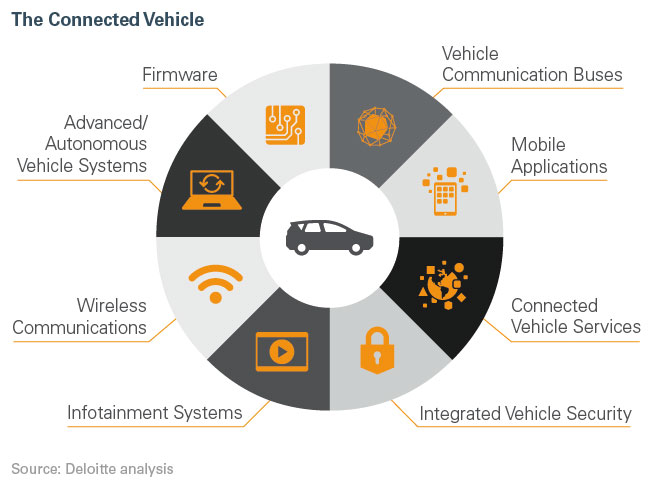
As the world becomes more connected, people want their vehicles to follow suit and offer more personalized experiences. In fact, 64 percent of 18- to 24-year-olds expect their vehicle's technology to be able to do all the things a smartphone can2. Even now, cars and trucks are linking with our smart homes, enabling mobility to jump to the next level.
Vehicles can be enabled with biometrics that detect whether drivers fall asleep at the wheel as well as neuro-sensors that provide feedback to in-vehicle adaptive intelligence (AI) for continuously optimized personalization. They'll be connected to systems within smart cities—communicating with everything from other cars to traffic lights, pedestrian crossings, and road signs, increasing safety for both drivers and citizens.
"Now is the time for all of us to be looking at vehicles the same way we look at smart phones, laptops, and tablets: as pieces of a much bigger, richer network." —Bill Ford, Executive Chairman, Ford Motor Company
We'll also see rapid development in connected features, with 72 percent of drivers saying they want new vehicles to feature maintenance updates on everything from tire pressure to engine health. Connected Internet of Things (IoT)-enabled technologies are also creating new functionalities, like getting real-time updates on traffic flow, incident reports, parking availability, or local fuel prices—all requested via voice command.
"About one in five vehicles on the road worldwide will have some form of wireless network connection by 2020, amounting to more than 250 million connected vehicles.3" —Gartner.com
There are, however, concerns that vehicles could be prone to software attacks, as connected vehicle systems provide a direct interface to the telematics software environment—the brains controlling the vehicles' safety-critical and operations systems. Indeed, 75 percent of respondents in a recent survey say they're worried about the potential risks of vehicle hacking.4
Autonomous.
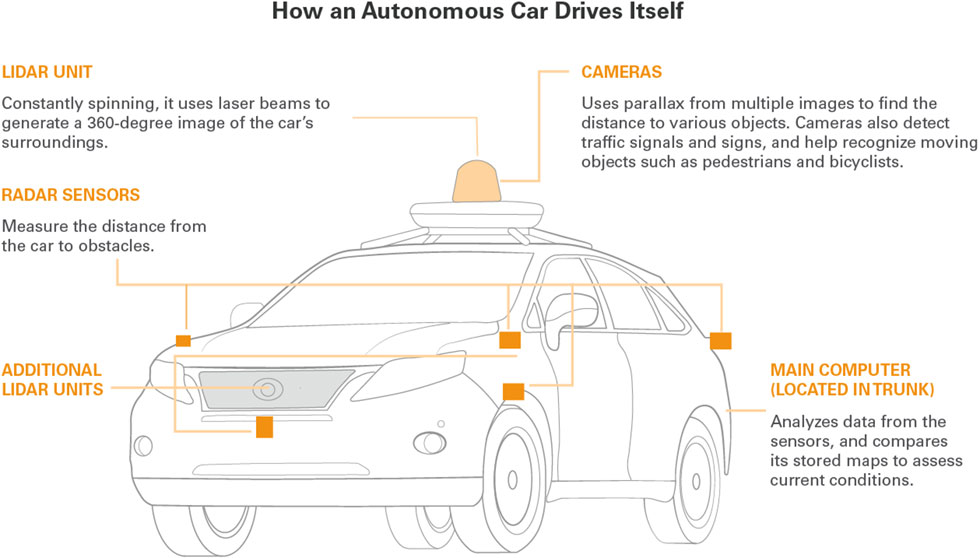
Companies such as Waymo, General Motors (GM), and Toyota are battling to make the most affordable, desirable, and safest autonomous vehicle. Cars currently operate at level 3 autonomy, meaning the driver is still required, but the vehicle controls safety-critical functions. Level 4 autonomy—or full automation—could be achieved as early as 2019, with GM announcing plans5 to release a car with no steering wheel or pedals.
Investment from OEMs and suppliers is increasing significantly—currently around US$80 billion6—with a focus on everything from the cars themselves to interior design, electronics, connectivity, and integrated digital services.
Autonomous vehicles are disrupting several areas, from public transportation to long-haul trucking, and even the vehicles that deliver your pizza. Toyota is currently pioneering automated transportation as a service (TaaS), with fully automated, battery-operated, driverless vehicles. Similarly, in the UK, Ocado has conducted early trials7 of driverless grocery deliveries, with a vehicle developed by Oxbotica. In the cities of the future, buses, taxis, and delivery vehicles could be replaced by autonomous cubes, capable of operating reliably, promptly, and to predefined schedules.
Shared.
In the shared economy, the very nature of vehicle ownership is changing as TaaS grows in popularity. Thanks to disrupters like Lyft, Uber, and Zipcar, many people are now thinking differently about car ownership. Indeed, of those currently using ride-hailing services, 63 percent expect their usage to increase in the next two years—with 67 percent saying they would do the same with car sharing8. But car ownership will not cease to exist.
"Overall, global car sales will continue to grow, but the annual growth rate is expected to drop from the 3.6 percent over the last five years to around 2 percent by 20309." —"Disruptive Trends That Will Transform the Auto Industry," Paul Gao, Hans-Werner Kaas, Detlev Mohr, and Dominik Wee
To remain profitable, OEMs including Porsche, Audi, and GM are experimenting with new tactics, including monthly subscriptions, pay-per-mile, and fractional-ownership models. Traditional manufacturers are even acquiring or investing in tech-savvy startups with the digital expertise to help them think in new and different ways.
Audi launched an on-demand car rental service back in 2016. Customers order via smartphone, with price plans ranging from a single hour up to a week. Ford is taking a unique approach, with its GoBike bicycle rental service in San Francisco.
Electrified.
With increasing environmental concerns, another key area of progression is the move away from the internal combustion engine (ICE) to electrified vehicles. It's expected that, by 2030, one-third of vehicle sales will be electric, one-third hybrid, and one-third traditional. In fact, Paris, London, and China are moving to impose bans on ICE vehicles by 2030, further encouraging the migration to hybrid and electric cars.
Disrupters like Tesla led the way in developing electrified vehicles by embracing an innovation-driven approach to optimize the customer experience. In 2015, the company took an early lead in the march toward autonomous driving with its autopilot driver-assist feature. And in 2017, Tesla announced its intention to disrupt the trucking industry with its heavy-duty, all-electric truck program, Tesla Semi.
"The Tesla Semi will deliver a substantial reduction in the cost of cargo transport, while increasing safety and making it really fun to operate10." —Elon Musk, CEO, Tesla
While electrified vehicles are becoming more viable, they'll struggle to take off until a robust infrastructure is in place—but investment is coming. Electrify America, for example, is investing US$2 billion in zero-emission vehicle (ZEV) infrastructure and education in the United States by 202711. Adoption of electric vehicle use will be quicker in dense, populated areas where the cars' range will be less of an issue, and slower in more rural regions. However, manufacturers are addressing this by increasing the effectiveness of their vehicles, with the Nissan Leaf offering a range of 235 miles, Tesla's Model 3 promising 220 miles, and the Jaguar I-Pace predicted to offer 311 miles12.
Globalization and supply chains.
As automotive vehicles transform, naturally so are the dynamics of the supply chain, as electric vehicles have far fewer moving parts than traditional cars. Changes to the drivetrain component requirements will change the supplier landscape, with countries such as China becoming more dominant players in vehicle and parts manufacturing. Vehicles are also becoming more reliant on software, so OEMs are working to train themselves in new disciplines.
The war for talent.
Emerging technology is at the heart of transformation in the automotive industry. For OEMs to keep up with the pace of change, they need people who understand the latest technology and the software that commands it. As a result, there is a growing war for talent, with traditional manufacturers vying to attract a new generation of digital-native workers with the skills to develop and exploit new technology and drive new manufacturing techniques.
In an attempt to make themselves attractive to this talent, many vehicle manufacturers have opened offices in the San Francisco Bay Area, absorbing more of the high-tech culture and even acquiring start-ups.
Indeed, Hyundai Motor Group has gone as far as to build a university campus in Mabuk, Korea, where it is teaching high-tech vocational skills to the next generation of automotive industry professionals, and educating them on the modern corporate dynamics of the automotive industry. As well as empowering students with the latest digital and high-tech vocational skills, this corporate campus also provides them with modern, comfortable amenities and recreational facilities typically found on a traditional college campus.
2campaignlive.co.uk/article/future-holds-connected-cars-2017-beyond/1442835
3gartner.com/newsroom/id/2970017
4deloitte.com/insights/us/en/industry/automotive/advanced-vehicle-technologies-autonomous-electric-vehicles.html
5arstechnica.com/tech-policy/2018/01/why-analysts-put-gm-and-waymo-far-ahead-of-tesla-in-driverless-car-race/
6brookings.edu/research/gauging-investment-in-self-driving-cars/
7theguardian.com/business/2017/jun/27/ocados-self-drive-vehicle-makes-deliveries-in-first-uk-trials
8mckinsey.com/industries/automotive-and-assembly/our-insights/how-shared-mobility-will-change-the-automotive-industry
9mckinsey.com/industries/automotive-and-assembly/our-insights/disruptive-trends-that-will-transform-the-auto-industry
10electrek.co/guides/tesla-semi/
11electrifyamerica.com/our-plan
12https://www.rac.co.uk/drive/advice/emissions/are-electric-cars-actually-worse-for-the-environment/ -
Estimated reading time: 4 minutes
Automotive and Digital Disruption
Technology is not only enabling automotive organizations to embrace rapid transformation, it's helping to redefine the industry.
Internet of Things (IoT).
IoT is the very backbone of connected and autonomous vehicles. It's also an essential ingredient of the smart cities in which these vehicles operate. IoT is at the heart of the connected experience for drivers, enabling vehicles to communicate with smart devices, wearables, and the vehicle-to-everything (V2X) technology that manages traffic lights and transportation infrastructure.
IoT also enables marketers to provide an excellent customer experience. All of the data available from these many devices and sensors can be aggregated with data from other sources—such as third parties or social media. It can then be used to build a 360-degree view of customers, so marketers can predict what they want, before they want it.
"This triangulation of data coming from these myriad devices…provides a comprehensive and cohesive customer experience13." —"Who Owns the Road? The IoT-Connected Car of Today—and Tomorrow," Simon Ninan, Bharath Gangula, Matthias von Alten, Brenna Sniderman
This wealth of data can also be used to improve vehicle reliability, and even create new business models—enabling instant over-the-air firmware updates to vehicles, remote maintenance services, and aftersales features.
Adaptive Intelligence (AI).
When you think of autonomous vehicles, AI naturally comes to mind. It's the fundamental technology that enables driverless vehicles to learn from real-world experiences, so they can assess and react to hazards in real time. It's also essential for the effective use of driver-assist features, such as automatic braking and collision avoidance.
Inside the car, AI enables richer, more-connected passenger experiences. It can act as a call-center agent or in-vehicle assistant, as well as many other possibilities. AI-enabled biometrics can be used to increase vehicle security. Eye-tracking technology senses whether drivers are tired or distracted. AI is even taking GPS-based navigation to the next level, providing smart, real-time route updates to avoid traffic—tied into the autonomous driver, of course.
AI also benefits manufacturers, who can use it to proactively reduce lead times in production and enhance quality and efficiency—both in the factory and in aftersales situations. For example, through cognitive, predictive maintenance, AI can identify patterns in performance data that show whether parts or features are prone to fail. OEMs can then proactively address the issue, improving quality and increasing safety.
"Cognitive predictive maintenance provides exactly what manufacturers are looking for: actionable insights14." —Sundeep Sanghavi, Cofounder and CEO, DataRPM
Big data and real-time analytics.
As vehicles become smarter and more connected, the amount of data they generate is growing exponentially. In the case of autonomous vehicles, this could equate to 340 exabytes per year. Supported by 5G bandwidth and ultrareliable connections, this data can be analyzed to provide highly valuable insights and constant product feedback. OEMs can make the most of this opportunity by adjusting their resources to act on such data and make improvements to vehicles in production.
Cloud enablement.
The cloud is enabling new players to enter the automotive landscape. Cloud-native startups can now have the same capabilities as more established companies from day one. Indeed, disrupters—like Tesla—can emerge seemingly from nowhere, and challenge the status quo. With the cloud, automotive companies can be more agile and innovative. They can take advantage of powerful consumption and delivery models that enable them to adapt easily to consumer demand and accelerate time to market for new product and mobility services.
As automotive companies migrate from large, complex, on-premises solutions, and benefit from the flexibility of the cloud, they're realizing the cost savings to be made—along with the ability to streamline internal operations and manage their businesses more effectively.
Augmented reality (AR) and virtual reality (VR).
Vehicle development and customer experience are being revolutionized with VR and AR technology. In luxury and performance vehicles, drivers can make use of heads-up displays, which provide valuable information that increases safety and enhances the driving experience. OEMs can also use VR to simulate real-world conditions, then test concepts against them to enhance product quality, reliability, and service—before even having to build a prototype.
VR is also enabling marketers to offer more-immersive customer experiences. Using VR headsets, potential buyers can customize any make or model to their own specification—then walk around the vehicle or step into the driver's seat. Or they can test cars remotely, without even going to the showroom. Audi has already rolled out this approach with its Audi VR experience, and is also planning to offer prerecorded virtual test drives. And as with Toyota's ZeroLight VR15, cars can be virtually launched before the physical version is even built.
Autonomous everything.
Autonomy is the new watchword for the automotive industry. A number of companies, including Waymo—founded from Google's self-driving car project—Tesla, and GM, are breaking ground in bringing autonomous vehicles to life. Indeed, Waymo's early rider program is already in tests in the US. And one of its cars recently drove 5,000 miles before needing human intervention16.
Requiring a great deal of computing power, many companies are investing in and developing the technology to make autonomous vehicles a reality. NVIDIA recently announced its new supercomputer, which is capable of handling more than 320 trillion operations per second. The computer processes information about vehicles' surroundings and turns it into driving instructions, enabling the operation of true level 5 vehicles—with no human drivers, steering wheels, pedals, or mirrors.
13deloitte.com/insights/us/en/focus/internet-of-things/iot-in-automotive-industry.html
14forbes.com/sites/brianrashid/2017/05/16/how-ai-pioneers-will-affect-the-car-industry-and-why-its-a-good-thing/#642553c557c2
15zerolight.com/projects/toyota/toyota-c-hr-virtual-reality-car-launch
16toptal.com/virtual-reality/virtual-reality-in-the-automotive-industry -
Estimated reading time: 6 minutes
Cloud Is the Destination
Wherever automotive companies are in their cloud journey, Oracle has the products and expertise to help.
Improving the digital customer experience.
Customers will always be at the very heart of the automotive industry. As such, providing the best customer experience remains one of the highest priorities.
"Mazda's vision is to have a customer experience at every touchpoint that is as good as our award-winning products." —Robert David, Senior Vice President, US Operations, Mazda North American Operations
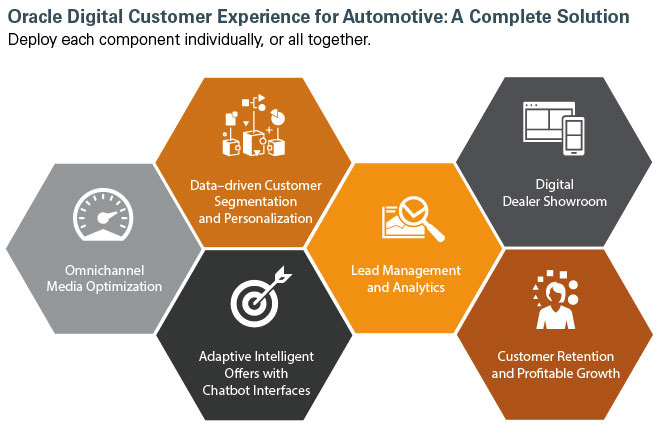
Oracle is enabling OEMs and dealers to provide customers with richer experiences to increase their customer lifetime value. Powered by Oracle Marketing Cloud and Oracle Data Cloud, Oracle ID Graph delivers 360-degree insights into customers—aggregating data from service and sales history to personal profiles. Armed with this knowledge, salespeople can have more meaningful interactions with customers and understand more about what they want.
Connecting vehicles.
Today, people don't just think of cars as transportation. Instead, they think of them as an extension of their connected lives. They want to control features via their mobile device—from remote start to air-conditioning. Drivers can now connect their vehicles directly with their smart home, enjoying uninterrupted, seamless entertainment and information from their house to their chosen destination. Customer experiences are also being improved with AI that learns from the driver's behavior.
Powered by Oracle Internet of Things (IoT) Cloud, connected vehicles are connecting to smart cities, and communicating with other vehicles and with city infrastructure to improve driver and citizen safety. Customers are also being empowered with new, easier payment methods, such as pay-by-plate, which lets drivers pay for tolls or parking when their license plate is photographed.
Intuitive servicing.
Connected cars are able to collect and stream huge amounts of data, making servicing and vehicle maintenance smarter and more efficient. With tools such as digital twin technology, it's possible to identify issues before the customer does, then proactively alert the customer with a predetermined plan for repairs or problem avoidance. This helps to drive customer satisfaction and retention, reduce potentially bigger problems, and increase driver safety.
Optimizing the digital supply chain.
As vehicles become smarter, they require more and different types of sensors, microsensors, and other components. In the case of electric vehicles, they require a different manufacturing process. To facilitate this, OEMs are making their supply chains more digital and streamlined. Using integrated business planning, they're taking advantage of Oracle Supply Chain Management (Oracle SCM) to increase flexibility and efficiency, while reducing inventory.
This integrated approach to supply chain management enables OEMs to reduce costs through just-in-time inventory. They can also access a wealth of analytics and insights to improve the speed of production and ensure supply chain performance is closely aligned with the organization's business strategy.
Connecting smart factories.
Futuristic vehicles are being built in connected factories, which utilize cloud technology. OEMs are using the cloud to reduce maintenance downtime, lower their costs, increase efficiency, and improve vehicle performance.
OEMs can also use Oracle Manufacturing Cloud to improve quality and process flexibility across manufacturing plants, suppliers, and contract manufacturers. And with IoT production monitoring, they can improve equipment utilization, quality, and deliveries.
"By harnessing the powerhouse of information generated by Industrial Internet of Things (IIoT), manufacturers can develop deep insights into results that were never possible earlier with human intervention17." —Sundeep Sanghavi, Cofounder and CEO, DataRPM
Managing core financials and human resources.
As with any industry, automotive is only as strong as the people it employs. And as emerging technologies continue to disrupt and transform, the need to employ digital-native employees with the right skills becomes even more important. Organizations can benefit from Oracle Talent Management Cloud solutions to optimize employee performance, streamline recruitment, and improve staff retention.
Companies can ensure they're utilizing assets and resources as efficiently as possible with Oracle Enterprise Resource Planning (ERP) Cloud—improving efficiency throughout the company and consolidating financial data across multiple business entities. The cloud is enabling automotive businesses to reduce costs, streamline processes, and gain greater insights, which helps improve the quality and safety of vehicles and customer experiences. It's also making the industry more agile, enabling new players to enter the field and disrupting traditional methods in a number of ways. If OEMs don't have a robust cloud strategy in place, they'll lose out to those who do.
17forbes.com/sites/brianrashid/2017/05/16/how-ai-pioneers-will-affect-the-car-industry-and-why-its-a-good-thing/#642553c557c2
-
Estimated reading time: 3 minutes
The Latest News and Updates
To keep up with all of the latest trends and innovations, and understand the emerging technologies disrupting the automotive industry, you'll need all of the insights and information available to you. But it's impossible to read everything. That's why we've handpicked a selection of links to provide you with the best information and opinions on the hottest topics in automotive.
What does the future really hold for automotive?
Automotive is transforming. Emerging technologies are disrupting everything from manufacturing to marketing and sales, and even ownership models. So, what does the future really hold? When will autonomous vehicles be ready for rollout? And how are manufacturers addressing consumer demand for new modes of mobility?
Check out "Redesigning the Industry" from Automotive News, and read insightful articles from industry experts on everything from automotive retail to new subscription models, and see how OEMs are exploring technology to remain profitable in a changing landscape.
Are connected cockpits the future?
To fully embrace the opportunities of IoT, connected cars of the future won't have driver's seats—they'll have digital cockpits, with all of the tools and information the driver needs at their fingertips. Samsung and Harman recently unveiled their concept for this future driving solution. With a suite of OLED and QLED screens, the digital cockpit provides infotainment and IoT services, offering the driver a simpler, safer, more-connected driving experience. Read the article to find out more.
Toyota painting with a new palette.
As the industry moves from traditional vehicle ownership to more flexible multimode transportation, Toyota has announced its new e-Palette Alliance mobility service and concept vehicle. The service uses Toyota's proprietary Mobility Services Platform (MSPF) to develop a suite of connected mobility solutions, along with a purpose-built vehicle. It's also creating an ecosystem of hardware and software support, designed to aid other companies in taking advantage of advanced mobility technology. Read the article to find out more.
Building smarter, connected factories.
By connecting devices such as tracking sensors, microprocessors, and other high tech components to processes, automotive manufacturers and makers of electric cars can build smart connected factories capable of delivering deep insights across the product lifecycle. Find out how Oracle’s Smart Connected Factory solution can transform vehicle manufacturing, better predict and resolve maintenance requirements, correlate quality issues to machine and environmental factors, cut downtime, and improve quality.
Adapting manufacturing for the digital age.
Digitalization is forcing change upon manufacturers and automotive companies, and businesses in the sector must be prepared to adapt—or perish. Read John Barcus’ exploration of how the automotive industry is being transformed, and how manufacturers are responding with new business and revenue models, smarter integration between machines and manufacturing processes, and streamlined supply chains, aligned with the organization’s business strategy.
-
Estimated reading time: 3 minutes
Customer Stories
A harmonious new mobility solution.
Toyota is changing the face of public transportation with its new Ha:mo RIDE mobility sharing service. Standing for Harmonious Mobility Network, Ha:mo comprises compact, space-saving, and eco-friendly electric vehicles, which can be hired for use in modern cities. Rides can be ordered via smartphone, and used for as long as the driver needs. And because the vehicles are fully electric, they have less impact on the environment. Testing is currently underway in Tokyo and Toyota City, Japan, and Grenoble, France.
Toyota selected Oracle Data Visualization Cloud Service to analyze the usage trends of Ha:mo RIDE. With just a few clicks, it enabled Toyota to identify patterns from a wealth of data, which it could then turn into actionable business insights to develop and perfect the vehicles and its TaaS offering.
"We use Oracle Data Visualization Cloud Service to analyze usage trends to advance the Ha:mo next-generation transportation system and verify its effectiveness as a sharing service to meet all kinds of needs." —Makoto Tamura, General Manager, Ha:mo Business Planning Department ITS Planning Division, Connected Company, Toyota Motor Corporation
Better team experience for Ford.
Ford Motor Company is using Oracle HCM Cloud Suite to streamline its human resources (HR) and provide better experiences for its employees and managers. The solution provides Ford with a single platform through which the HR team accesses all employee records and information, enabling it to cut costs and save time, and focus on more strategic decision-making. With Oracle HCM Cloud Suite, Ford can access detailed reporting and data analytics that help it manage employees and predict recruiting needs.
"Oracle is extremely excited to be working with Ford and others in the auto industry," says Gretchen Alarcon, group vice president of HCM product strategy for Oracle. "We work hard to listen and deliver modern, unified cloud solutions that get at the heart of what will ultimately offer an all-encompassing service to save a business money and offer a strategic approach to business practices."
Hyundai's data-driven approach.
Hyundai has tackled the problem of diminishing sales in the midsize sedan market by partnering with Oracle to develop a new, insight-driven marketing approach. In association with marketing agencies Canvas Worldwide and Innocean Worldwide, Hyundai used Oracle Data Cloud to analyze and better understand key audience behavior. This meant the company could target consumers most likely to purchase the Sonata—one of Hyundai's flagship midsize vehicles—with direct marketing communications.
By carefully reviewing the data after several campaigns had run, Hyundai has been able to develop new recommendations and strategies for future campaigns. "The accidental learnings of this campaign helped us shift the way we look at and measure success to get our key performance indicators (KPIs) aligned with our actual business goals," says Brian Diamond, VP group director of strategy at Canvas.
Cutting the cost of supply-chain stability.
Volvo Group Logistics Services is a wholly owned subsidiary of AB Volvo. It provides inbound, outbound, and packaging material logistics services for the Volvo Group all over the world, including Volvo Truck, Volvo Buses, Volvo Construction Equipment, Renault Trucks, Mack Trucks, UD Trucks, and Volvo Powertrain.
Volvo Group Logistics chose Oracle Transportation Management to cut costs and streamline inbound transportation flows —including by truck and ocean—to Volvo's factories and warehouses around the world. By implementing dynamic planning, Volvo Group Logistics enabled an increase in competition between carriers, and the optimization of each shipment.
"The strength of Oracle Transportation Management is that the system can simultaneously process large volumes of data and enable optimal routes-allowing us to achieve our goal: supply chain stability at low transport cost." —Anna-Karin Hjerpe, Solution Leader Atlas/OTM, Volvo Group IT