
The CIO Cloudbook


THE CLOUD MARKET IS MADE
UP OF A BEWILDERING ARRAY
OF SERVICES AND CAPABILITIES,
WHILE ‘CLOUDWASHING’
BY VENDORS BRINGS FURTHER
CONFUSION. THIS GUIDE FROM
ORACLE HELPS THE MODERN
CIO CUT THROUGH THE NOISE,
GET CLARITY ON THE CLOUD AND
OFFERS PRACTICAL ADVICE FOR
BUILDING YOUR CLOUD AGENDA.
ENTERPRISE CLOUDIFICATION:
EMBRACING CULTURAL CHANGE FOR
BUSINESS GROWTH AND INNOVATION
Cloud is digital-ready
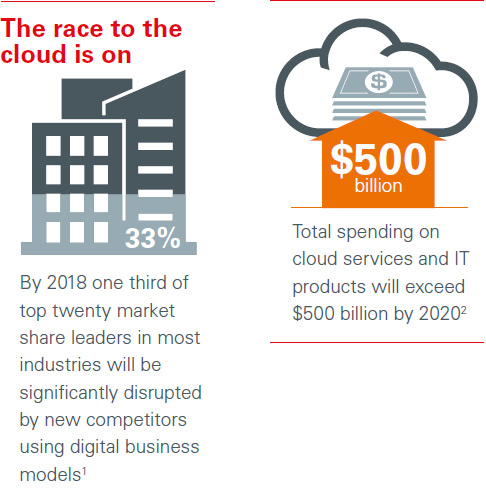
Our world is digital. Over the past decade new business models, digital-centric, and data-driven businesses have emerged to challenge established players. These businesses offer different forms of innovative services centred on a new breed of empowered consumer. A consumer that expects their brands to deliver meaningful data-driven interactions across a range of devices and platforms, and where the new ROI is Return-on-Interaction.
The challenge for today’s businesses is clear: innovate by embracing digital and rethinking your business models or run the risk of losing out to more agile competitors. According to Tim O’Reilly: “In the Next Economy, new kinds of technology platforms become the infrastructure of prosperity.”
A cloud platform for transformation
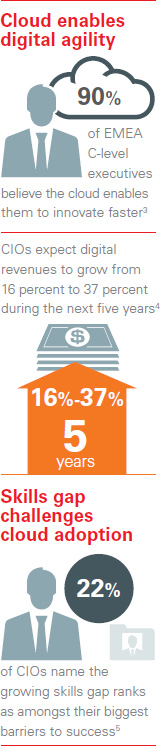
CIOs serious about transforming their businesses for the digital age have already realised that the cloud must underpin enterprise IT. Cloud provides the best method to cost-effectively and efficiently turn customer and other data into new insights that fuel rapid and continual innovation, in infinite iteration cycles, which in turn helps drive growth.
Cloud has also proven itself to be the most effective accelerator of digital transformation, paving the way for new ecosystem collaborations and profitable ‘as-a-Service’ business models.
CONCERNS OLD AND NEW
A new cloud culture
To enjoy the benefits of cloud computing, CIOs understand that their teams must undergo significant cultural change. The cloud disrupts the way IT has traditionally gone about its business and as a result IT must rethink its strategy, processes and structure. As it does so, IT and the business will need to overcome potential risks, particularly around cloud proliferation, inefficiencies and security.
Every cloud has its own DNA
The cloud can come in many forms and no two businesses will go about adopting cloud technologies in exactly the same way. In this complex environment it is essential to find the right technology partner to assist you in the journey to the enterprise cloud. While enterprise IT has undergone unprecedented change over the past decade, the underlying concerns of CIOs have remained constant:
- Still focused on aligning the IT value proposition with business goals.
- Facing the ongoing challenges of accelerating IT delivery and reducing time-to-market for new services.
- Continuing to be tasked with boosting agility and enhancing innovation – all whilst ensuring security and reducing costs.
What’s changed is that, thanks to the cloud, the CIO is now better placed than ever to deliver against these challenges.
Connecting the dots: IT business goals
The cloud helps tie technology more directly to business goals; indeed, by enabling big data analytics the cloud now plays an important role in generating the customer and market insights that inform such goals. Meanwhile, the virtualisation of software, platform and infrastructure which enables cloud computing means businesses can move faster than ever, innovate more and reduce costs.
At Oracle we believe the cloud is much more than the sum of its parts. The cloud needs to be seen as an integrated enterprise architecture that enables agile business processes. Cloud computing can be constituted from a mix of a number of technologies, including Infrastructure, and Platform and Software as a Service, by delivering them in a number of ways - the important thing is that it is fully integrated across the enterprise and able to help the business join data to applications in order to fuel transformational digital services.
Of course, CIOs understand that the cloud is not a panacea, just as they are aware that cloud for cloud’s sake is not an approach any business should take (even if ordered by the CEO). But there is now a clear appreciation that the cloud is an important tool in supporting next-level, game-changing services and business models which will enable the business to compete more effectively.
4 Ibid
5 Gartner, Building the Digital Platform, 2016
THE NEW STRATEGIC CIO: FROM IT GATEKEEPER TO BUSINESS ENABLEMENT OFFICER
Revolutionising IT leadership to unlock the transformative power of cloud
As cloud computing increasingly dominates enterprise IT, the CIO role and the role of the IT department is transforming. The ease of cloud implementation means that both are moving away from technical oversight towards a partnership/consulting role with their line-of-business counterparts.
The early era of the cloud, where services were bought by business unit leads, often without the knowledge of IT, is now in the past. Today, CIOs are turning IT into a strategic value-add to the business; working to advise them on the best possible solution to their business challenges – whether that solution ends up being public cloud, private cloud, on-premises or a mixture of all three.
A new operational model for IT teams
To operate in the cloud era, CIOs must put in place robust cloud management capabilities. Day-to-day management should be undertaken by relevant business unit leads.
After all, cloud services are rarely deployed in isolation from other business changes, and if they’re not sponsored and managed by their business owners they risk delays. A move toward self-service, supported by a shared-service centre within the HR, finance, or other business function, will therefore prove a powerful operational model for most businesses.
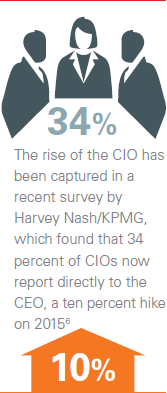
With the ongoing maturation of the enterprise cloud, the role of the CIO is changing. From being simply a custodian of technology the CIO is now a strategic driver for innovation, and as entrenched in the business as the CEO.
The CIO job is no longer only to support the business, it is to direct the business. CIOs are now much more than information officers; they are Chief Information Officers or even Business Strategy and Enablement Officers.
Blending the old and new world
We operate in a world where legacy IT and the cloud will coexist for some time. As a result, CIOs still need to focus energy on ensuring legacy systems operate optimally and can be unified with newer, transformational IT systems
in what Gartner refers to as bimodal IT. For Gartner, many CIOs today need to focus on agility and speed on the one hand (the cloud) and stability and accuracy on the other (legacy). In the new bimodal IT world, the CIO needs to keep the lights on and at the same time be a light bulb of new thinking, moving from operations to transformations.
From vendor relationships to partnerships
As CIOs and IT take on their new roles, the way in which vendor relationships develop will be important. CIOs should aim to create a transformational partnership built on trust, which aims to secure wholesale positive change for your business. A single-vendor approach may be the most expedient, especially at the beginning, because it minimises the time and effort involved in transitioning from the non-cloud world to the cloud world, but each business will have an approach that works best for them. If the right SLAs are in place, multi-vendor approaches can be just as effective.
The cloud means the end of the 1990s’ approach to vendor management, where enterprises worked with a number of vendors in order to create a healthy competitive environment within the procurement process. Similarly, with the subscription models enabled by the cloud the days of vendor lock-in are behind us.
In this new world, only cloud providers that deliver simple, easy-to-use, easy-to-integrate platforms with open interfaces will prevail.
The cloud frees CIOs to become cloud service brokers, setting SLAs and managing vendor relationships to ensure each service delivers maximum value to internal business stakeholders.
CLOUD BENEFITS: NOT ONE SIZE FITS ALL

Reduced to the bare essentials, cloud computing is important because it helps meet your company’s central business objectives: maximizing revenue and minimizing cost. Cloud computing is able to achieve this because it reduces complexity across the business.
As enterprises look to realise profitable revenue growth, there are five core areas where efficiency and simplicity directly correlate to improved performance:
- Product & service
- Platforms & operations
- Process
- People & partners
- Competition & regulation
The greater the complexity of the processes, applications and IT in each of these five areas, the harder it is for a business to be best-in-class. The relative importance of each of the five areas will, of course, depend largely on the sector in which the business operates. For example, companies in heavily-regulated industries such as finance or manufacturing will need to reduce the complexity of compliance and governance more than industries with a lighter-touch regulatory regime. Also, the state of a particular business will play a large role in determining which of these five key areas needs to be addressed most urgently.
Strategic CIOs are using cloud computing to bring simplicity to these five areas. Progressing from there with a phased cloud implementation, these CIOs have found they can deliver the following wider benefits of the cloud to their business:
- Less complexity
- Reduced cost
- Accelerated speed and agility
- Better employee engagement
- Faster response times to market changes
- Improved compliance and governance
- Higher margins and profitability
DISPELLING CLOUD MYTHS7

The economics of Cloud
Cloud will not always save money. Just 14 percent of organisations cite cost savings as their reason for moving to the public cloud. Don’t assume you will save money: build a business case and understand the implications of moving from capex to opex.

Cloud is less secure than on-premises
The best cloud vendors live and breathe security and deliver highly-secure solutions you can rely on. However, you must conduct due diligence to understand your vendor’s approach to security.

Cloud is not “mission-critical” fit
What is considered mission critical will vary from business to business. Cloud may be suitable for some mission critical uses but not for others. Again, it comes down to understanding your unique business needs and the wider considerations of your industry.

“The CEO said so” as a cloud strategy
If a cloud solution does not meet your business goals it should not be deployed, regardless of what the CEO says. When deploying a cloud solution keep the business objectives at front of mind.

Not all Cloud that shines is gold
Just because something is in the cloud it does not automatically mean it is good. Similarly, not all workloads should sit in the cloud; use non-cloud solutions when the business case stacks up.
Virtualization = Private Cloud
Virtualisation enabled the cloud but it is not synonymous with it – there are other ways to implement cloud computing.
Cloud = Data Center
Cloud decisions need to be made on a workload-by-workload basis. It may still make sense to keep some data centres on-premises.

Cloud Monogamy vs Cloud Polygamy
There are many types of cloud and many types of cloud service. You will only know the best approach for your business (multi- or single-vendor) once you understand what you are hoping to achieve.
SECURING THE CLOUD
HOW TO ENSURE THE CLOUD SERVICES
YOU USE ARE SECURE:
1. Conduct due diligence
Investigate the security measures your cloud partner has in place and clearly outline the division of responsibilities between your IT team and that of the service provider.
2. Understand your risk
There may be some data you do not wish to store in public clouds, such as regulated or highly-sensitive data. This is where hybrid cloud can help, allowing you to tier your data according to security considerations and store it in whichever environment makes most sense.
3. Move at the right speed
Yes, you want to gain a competitive edge through the cloud, but make sure you take the time to do it right. Being first to market is important, but only if the right security framework is in place.
“If you think you’ve seen this movie before, you are right. Cloud computing is based on the time-sharing model we leveraged years ago before we could afford our own computers. The idea is to share computing power among many companies and people, thereby reducing the cost of that computing power to those who leverage it. The value of time share and the core value of cloud computing are pretty much the same, only the resources these days are much better and more cost effective”.
David Linthicum, Author of “Cloud Computing and SOA Convergence in Your Enterprise: A Step-by-Step Guide”
CLOUD AS THE FOUNDATION OF EMERGING ENTERPRISE-AS-A-SERVICE BUSINESS MODELS
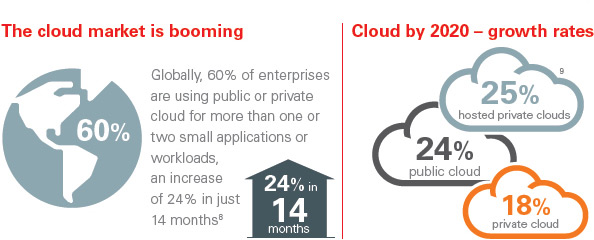
Today many businesses have already started their cloud journeys. Most will have begun with SaaS implementations; many of these will have started life as discreet projects initiated and run by business unit managers. As SaaS deployments increased, businesses then looked for additional ways to encourage innovation, bringing PaaS into play. A number of CIOs have already deployed PaaS to create flexible, low cost development environments where companies can quickly develop, test, launch and scale applications. Indeed, PaaS is proving so popular that IDC predicts the European PaaS market will be worth $55 billion a year by 202010.
We have therefore moved well beyond the first phase of cloud computing where it was used only for specific applications such as storage or server availability. Today, the cloud is revolutionising the enterprise and opening a new universe of possibilities for businesses. Welcome to the era of Enterprise-as-a-Service.
Enterprise-as-a-Service
Enterprise-as-a-Service is emerging as an enabler of total digital transformation. Regardless of industry, businesses are facing up to the need to create gamechanging digital services. The most strategic CIOs realise that they must be ready to constantly pivot their business models to keep the competition off balance while reacting to fast-changing customer requirements and market trends. This approach requires a cloud-first strategy that shifts the enterprise focus from product to service and which enables continuous and infinite innovation cycles as businesses search for the services that will allow them to disrupt and move into new markets.
Strategic CIOs use the Cloud across their innovation cycles to disrupt and grow into new markets with new digital services.
CLOUD AS THE FOUNDATION OF EMERGING ENTERPRISE-AS-A-SERVICE BUSINESS MODELS
CIOs need to take the lead in creating a ‘fast fail’ approach to innovation in the organisation. Today, thanks to PaaS, if a business wants to rapidly evaluate an application, it can do so in the cloud using pre-existing toolsets to build and test it. If successful, the business can then easily scale up, either by buying more capacity from cloud providers or moving the application to their on-premises or private cloud resources if preferred.
Finally, businesses adopting an Enterprise-as-a-Service mentality need to design their business around composable, flexible and personalised services, and rethink their past value chain in the new context of a bigger, much more open and extended ecosystem of partners, digital technologies and physical things that interact among them, all of which are fuelled by data. Only the cloud has the ability to provide this at scale and at low cost.
DIFFERENT SHADES OF CLOUD
If you want to transform your enterprise operations to an Enterprise-as-a-Service model it is essential to understand the many subtleties of the cloud. Your business goals, industry imperatives and current stage in your journey to the cloud will all impact what your next step should be and should only be taken after discussing your options with a trusted advisor. However, the below provides some useful guidance on the many different shades of the cloud.
Public, private, hybrid: understanding the pros and cons
Much has been written about whether businesses should look to public or private cloud services or a mixture of the two.
Public and private clouds come with relative pros and cons. For some workloads it will make sense to use public services, while for others a private cloud will be suitable. For example, the public cloud works well for core services such as HR and Finance which require little customisation.
The private cloud, meanwhile, is ideal for data that needs to be stored on-premises to comply with regulations. Hybrid cloud, on the other hand, is not so much a deployment model as a means of managing a number of different environments, applications and systems, including private and public clouds, and services and applications, as well as on-premise systems and applications. As such it’s ideal for the multicloud future.
Planning for a multicloud future
In the past, your job as CIO was to control the IT in your organisation. With the cloud, this gatekeeper role transforms into an enabler role. In part, this involves embracing a multicloud future.
Your business needs the ability to take any service that best meets a specific need and integrate it seamlessly into the wider IT architecture – regardless of whether that service is public cloud, private cloud or on-premises.
DIFFERENT SHADES OF CLOUD
This is because while public cloud deployments generally offer the lowest cost points and greatest efficiencies, most businesses will deploy hybrid models to manage the mix of infrastructures at hand; a mix which will likely include legacy and even private cloud technology.
The hybrid cloud model is the best approach we have to managing a multiplicity of cloud and on-premises systems. Through the hybrid cloud you can treat all your disparate legacy and cloud systems as a single unified whole, moving data seamless across the entire architecture to enable a faster and more agile business. The benefit here is cloud portability: the ability to move workloads between different cloud and on-premises systems at will; a feature that directly enhances an organisation’s ability to innovate.
In a hybrid solution, as with any cloud deployment, CIOs must focus on maximising the benefits on offer. This can only be achieved through a seamless integration, a laser focus on the principles of good cloud implementation and, critically, a ubiquitous operating model.
Horizontal or vertical? Finding the right cloud
Linked to the need to prepare for the MultiCloud future is your decision on how to deploy cloud: either vertically across core applications such as ERP and HR or horizontally across several areas at once. Whichever approach is best suited to your enterprise, you must deploy it in such a way that you can easily flex your approach in the future as business requirements change.
“While security was often cited as the number one obstacle to cloud implementations, increasingly some customers see cloud as more secure, cost effective, and customer responsive than in-house capabilities. Consistent with this trend, data centres are moving quickly to a mix of private, hybrid, and public cloud-based data centres.”
IDC, Security Solutions: Security in the Cloud
Cloud cost containment
Cloud is not always cheaper. However, cloud charging is transparent and can deliver cost savings over large long-term capital investments. It’s important to ensure the business case for each and every cloud deployment stacks up with a clear ROI in sight. It’s also important for you to keep oversight of any business unit cloud spend to avoid cloud proliferation and to ensure your business clients are using the best – and most effective – solution to every requirement.
Cloud SLAs: making, measuring and managing
With the best cloud providers, the entire service can be covered by an SLA – from infrastructure to application. However, where multi-vendor solutions are in place, you need to ensure that you are fully covered. Some SLAs will be dependent on components from various providers and you must work with your cloud partners to create an integrated SLA. The alternative is that you are forced to manage more than you might want to.
Shadow IT – embrace or eliminate?
While the shadow IT environment which emerged outside the control of CIOs and the IT department was traditionally seen as a threat, cloud-first Enterprise-as-a-Service businesses need not fear it.
By seizing the role of business enabler you can use the cloud to create an open environment in the enterprise, where the IT department becomes a service enabler: working as a strategic partner to business unit leads to deliver ideal solutions to each and every requirement – regardless of where the solution comes from. In this environment business unit leads will have no need to circumvent IT; indeed, it would be against their interests to do so.
YOUR CLOUD, YOUR WAY:
A SYSTEMATIC APPROACH TO CLOUD MIGRATION
While most CIOs are looking to embrace the cloud as fully as possible, a number of questions remain: which parts of the IT estate are the best candidates for the cloud? How can you address security, regulatory and compliance issues? What impact will cloud migration have on operations? And how can you avoid cloud silos?
Oracle’s Journey to the Cloud Workshop helps CIOs answer these questions and more. By identifying your business need, the workshop will systematically raise awareness of the right cloud solutions for your unique requirements. The end result is a bespoke cloud execution roadmap that will help you prove the business case for cloud to your CEO and other business stakeholders.
“
There was a time when every household, town, farm or village had its own water well. Today, shared public utilities give us access to clean water by simply turning on the tap; cloud computing works in a similar fashion. Just like water from the tap in your kitchen, cloud computing services can be turned on or off quickly as needed. Like at the water company, there is a team of dedicated professionals making sure the service provided is safe, secure and available on a 24/7 basis. When the tap isn’t on, not only are you saving water, but you aren’t paying for resources you don’t currently need.
Vivek Kundra, Federal CIO,
United States Government.
”
ORACLE JOURNEY TO THE CLOUD


Cloudify your business
Achieve fast, high-value cloud adoption within a broader strategic growth plan
- Work through the seven Rs of cloud migration: rebuild, rehost, refactor, replace, revise, remain, retire
- Realise the benefits of a fast start in key application areas
- Bolster with a clear prioritised cloud strategy to maintain momentum


Initiate your cloud journey
Put in place the right foundation for cloud success
- Uncover your cloud business drivers – speed to market? Business agility? Scalability?
- See how business value increases as the cloud moves from datacentre to application


Iterate and innovate
Make the cloud work harder for your business
- Extend cloud adoption to new business functions and use cases
- Plug into new cloud capabilities and features
- Continue to adapt and refine your cloud strategy


Enhance and refine
Realise the full benefits of the cloud against your business objectives
- Learn from your cloud implementation and improve
- Measure and review your cloud performance and ROI
- Drive further efficiencies and improve performance


Build your cloud roadmap
Align your business journey across the cloud continuum
- Shape a low-risk iterative strategy that lets legacy systems coexist with the cloud
- Identify and plan for challenges such as data sovereignty and cloud security
- Develop a roadmap, clear action plan and solid business case that’s fit for your CEO
CLOUD ASSESSMENT CHECKLIST
A quick checklist of questions to bear in mind when thinking of cloud solutions:
THE ORACLE ENTERPRISE CLOUD
Over the past decade we have seen cloud computing emerge to completely disrupt enterprise IT.
Today we are at a point where the benefits of the cloud clearly outweigh the risks. Indeed, businesses that do not move to the cloud in time risk losing out to cloud-enabled competitors which are faster, more innovative and better placed to meet customer demands. If you were starting a business today, you’d absolutely build it with cloud as core. So why would you not have the same vision for an existing business?
As you ramp up your journey to the cloud, speak to Oracle to find out how we can help accelerate the transformation of your business. The Oracle Enterprise Cloud is the most complete, end-to-end and intuitive enterprise cloud available. It is built for your complex and evolving business requirements but just as importantly it’s also simple to deploy, simple to manage and simple to work across every area of your digital business operations, strategy and innovation.
We deliver out-of-the-box industry cloud models, tested and ready to go, with the functions in place that are precisely modelled on how individual industries need to connect, develop and drive their cloud strategy. Working in close partnership with your business we can show you how you can simplify your operations through the cloud to increase profitable revenue.
A complete, integrated, and open cloud capability is a remarkable accomplishment. Oracle’s unique history and leadership across the spectrum of enterprise technology offers enterprises more features, deployment options, and value than any other option on the market.
