Table of Contents
Table of Contents
and IoT18
and Performance22
Platform as a Service 28
-
-
Table of ContentsChapter 1: The Integration Quandary 2Chapter 2: Hybrid Cloud Integration 8Chapter 3: Mobile Enablement 14Chapter 4: Real-Time Events, Fast Data, and IoT 18Chapter 5: Management, Security, and Performance 22Chapter 6: Introducing Oracle Platform as a Service 28Resources 361
-

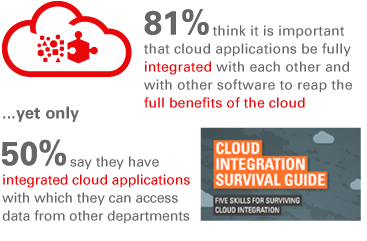
Private clouds and Software-as-a-Service (SaaS) applications are becoming pervasive across the corporate computing landscape. The sun is rising on a new era of enterprise computing, but integration challenges are casting a shadow on many otherwise successful projects. Dynamic Markets conducted a survey with more than 1,300 senior business managers to uncover trends in these technology implementations. The researchers came away with some alarming statistics. Frustration is rampant, especially when trying to integrate cloud apps from multiple vendors.
 2
2 -
Escalating Difficulty
Even in the precloud era, when software integration mainly involved linking on-premises applications along with some B2B connections, integration was a complex undertaking. Standards such as web services and Business Process Execution Language (BPEL) helped standardize these integration projects, but there was still a great deal of variability in how these standards were implemented by each application vendor. It has never been easy to support many different enterprise applications across several different hardware and software platforms—plus develop and maintain separate interfaces among them.
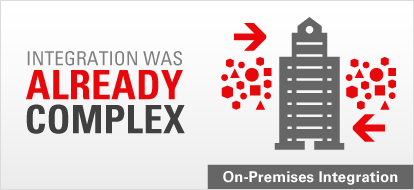
Yesterday’s on-premises integration challenges remain, and now they include a broad array of new applications, deployment strategies, interfaces, and business rules as well.
4Each SaaS vendor and cloud provider enforces unique application programming interface (API) frameworks, security standards, session management practices, and maintenance procedures. It’s no wonder that one out of every two companies have abandoned the use of at least one departmental cloud application in the last three years due to integration problems, according to Dynamic Markets.
Making a Smooth Transition to Hybrid
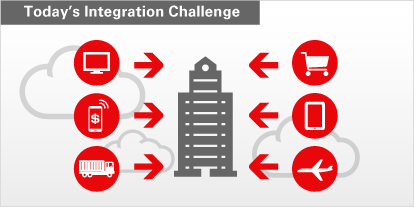
Cloud IntegrationCloud integration is just one of the complexities facing today’s IT managers. How do you make a smooth transition to a hybrid model that incorporates cloud and on-premises information systems, new types of mobile access mechanisms, and a growing set of intelligent devices within the Internet of Things?
 5
5 -
Many companies are wrestling with these questions. They may find themselves in the early phases of these transitions but struggling to keep up with the changes. It’s important to establish an agile yet comprehensive foundation for current and future integration projects. In the remainder of this e-book, we’ll show you how to develop a cohesive integration strategy that upholds your hard-won security policies, development standards, and deployment options while opening the door to a new world of opportunities in the future.
6 -

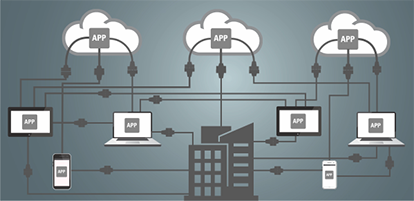
The collision of cloud and on-premises information systems has introduced new layers of complexity for IT professionals. Most organizations still depend on well-entrenched enterprise applications in their data centers, but they are gradually supplementing them with SaaS applications. These organizations are also starting to utilize public cloud services for some IT functions and private cloud models for new
enterprise deployments.New business ventures can cause rapid change for IT departments. For example, an enterprise that relies on an on-premises Customer Relationship Management (CRM) application might acquire a company that uses a cloud-based CRM application. Account managers need to be able to access data from both systems cohesively, share data between these systems, and ultimately establish an authoritative system of record. HR systems, payroll systems, and incentive compensation systems also need to work in unison and exchange information so that employees are properly compensated and paid.
8Putting all this information together in a unified way is essential to delivering a consistent experience for employees, customers, partners, and citizens.
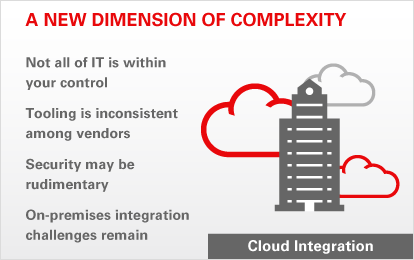
Unfortunately, there is typically very little standardization among cloud application vendors, which means developers have to contend with unique toolkits and APIs to connect all the pieces. Each vendor enforces its own mechanisms for security, message delivery, metadata definitions, query criteria, object semantics, and object schema.
9 -
Some of these vendors don’t maintain rigorous security requirements, which makes it difficult for customers to uphold their service level agreements or comply with industry and governmental regulations.
Ricoh Americas Corporation used Oracle technology to create a unified integration platform that spans cloud, mobile, and on-premises applications. Leveraging Oracle to integrate its information systems brought new efficiencies to Ricoh’s sales, service, finance, supply chain, and HR departments. Ricoh now has a flexible architecture that reduces the overall time and cost of creating application interfaces.

 Webcast and White Paper: Learn howView the Webcast Read the White Paper
Ricoh differentiates its business by unifying cloud and on-premises information systems.10Adapting to Change
 Brocade Communications chose Oracle SOA Suite to integrate its on-premises and cloud-based services, and is planning to use Oracle Cloud Adapters to simplify these interfaces. Oracle’s ready-made connectors mask the differences between applications and data models, simplifying session management, user authentication, and all types of maintenance procedures.
 Video: Brocade Communications and Oracle partners Rubicon Red and Bluenog describe how Oracle SOA Suite can eliminate the cloud/on-premises application divide.Maulik Shah, Technical Lead, Oracle Software Integration Team,Watch the Video (2:28)
Brocade Communications11 -
B2B Integration via Managed File Transfer
Managed File Transfer (MTF) technology streamlines the process of passing files from one application to another. Widespread adoption of internet services simplifies these activities, even as it creates a performance bottleneck for exchanging large files. Government regulations such as HIPAA and Sarbanes-Oxley require many organizations to document, audit, and account for these exchanges, MFT) technologies an increasingly important part of an overall integration strategy.
Oracle SOA Suite 12c enables dynamic, just-in-time exchange of files of all sizes with many types of payloads, and includes complete, built-in auditing and security functions. This mature MFT utility automates many aspects of this process, including encrypting-decrypting files and configuring the
associated metadata.12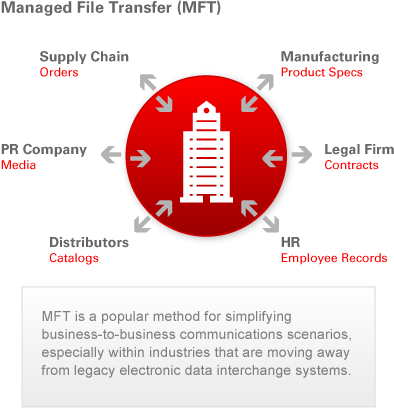 13
13 -

Today’s business systems are no longer tied to the desktop. Many employees want to use their smart phones and tablets to access corporate data and applications. However, some IT departments are having a hard time accommodating requests for unique mobile interfaces while preserving enterprise computing standards. In response to specific requests from individual lines of business, there is a tendency to implement unique mobile applications that are tactical in nature and that solve very specific problems. This has created a separation between new mobile architectures and the prevailing enterprise systems of record.
Rather than continuing to develop applications first for the desktop and then again for mobile devices, forward-thinking organizations are establishing a consistent IT architecture that accommodates all possible channels in a cohesive way. Because these companies require standardized access management and governance procedures for single sign on, authentication, and provisioning they must create their own services-based architecture that leverages reusable integration components.
14 One such company, Agilent, used Oracle Fusion Middleware to create a personalized portal that enables customers to utilize their mobile devices to check orders, peruse products, and participate in discussion forums. Agilent depends on Oracle SOA Suite and Oracle Identity and Access Management Suite to integrate its enterprise systems with mobile services such as field sales and purchase approvals.
Oracle SOA Suite reduced the time it takes Agilent to build new interfaces and lowered the IT budget devoted to interface maintenance by 60 percent. In addition, Agilent accelerated business transaction processing by 20 percent and increased throughput by 30 percent. Over the long term, Agilent plans to use its SOA platform to streamline business-to-business and partner integrations as well.
 Video: Agilent transforms IT with Oracle SOA Suite.Rajesh Gathwala, Enterprise Architect,Watch the Video (2:14)
Agilent Technologies15 -

 Cisco Systems used Oracle SOA Suite to integrate two different order entry systems following its acquisition of WebEx. Rather than treating mobile applications as a new development and deployment channel, developers were able to treat mobile integration as an extension of the SOA integration methods they already had in place.
 Video:Cisco
mobile-enables
enterprise applications.Paras Jain, Senior Manager of IT, CiscoWatch the Video (2:24)16As your organization embraces mobile computing, instead of adopting a new mobile integration platform, take the time to establish one centralized platform that can handle disparate interfaces and automate both inbound and outbound communications. Having a universal way to mask technical differences among mobile platforms simplifies development and lowers long-term maintenance costs.
One new area to consider is API management, a rapidly growing option for mobile enablement. API management involves exposing enterprise applications as Representational State Transfer (REST) JavaScript Object Notation (JSON)–based APIs for developers to build mobile applications. Oracle SOA Suite provides native support for REST/JSON. In addition, Oracle Platform as a Service (PaaS) offerings including Mobile Cloud Service and Integration Cloud Service combine to expose the underlying enterprise applications through a mediation layer so that the back-end services can change independently of the front end apps. This solution forms the basis of a “write once, run anywhere” model for Java front ends on iOS or Android devices. To find out more about Oracle Mobile Suite visit oracle.com/mobile.
17 -

As the volume, variety, and velocity of data increases—and the number of intelligent devices proliferates—it becomes progressively more difficult to maintain effective communication among all elements of the architecture. The growing base of intelligent devices, from thermostats to cardiac monitors, requires new types of event-processing capabilities. Can your integration platform accommodate the many combinations and permutations of the Internet of Things (IoT)?
 18
18Just as you expose and orchestrate application interfaces as services, you can model your IoT architecture as a set of layered services that can be combined to create business applications or simply trigger business events. For example, dozens of sensors in a shop-floor automation system might relay status updates such as temperature fluctuations or oil pressure variations to a data warehouse. Or a telemedicine application might collect real-time data from thousands of patients wearing cardiac monitors, and then correlate the results to spot patterns that impact treatments. A complete integration solution combines all the elements of data connectivity and integration into a unified environment that supports real-time and bulk data movement, data synchronization, big data transformation, and fast data. To learn more about Oracle’s fast data solutions please visit oracle.com/fastdata.
 Canon created a remote diagnostics system to collect maintenance information from more than 1 million multifunction printers. Created with Oracle SOA Suite and hosted on Oracle’s engineered systems, the diagnostics system gathers tens of millions of transactions from devices all over the world, with intelligent filtering through Oracle Event Processing.19
 -
 Video: Canon delivers on the Internet of Things.Greg Ryan, Senior Marketing Director,Watch the Video (2:29)
Canon Information and Imaging SolutionsFrom real-time marketing to fraud detection, organizations are making split-second business decisions by detecting rapidly changing situations from the massive volumes and various sources of big data. Your integration platform needs high-performance event processing and filtering capabilities to take advantage of these business opportunities.
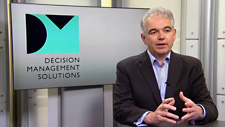 Analyst Video: James Taylor discusses how to seize new opportunities with fast data.Watch the Video (8:02)20
 -

Consistent Management
 Creating seamless integration between applications is just one of many challenges facing today’s IT professionals. With the majority of IT budgets devoted to maintenance activities, IT leaders need universal management solutions that simplify troubleshooting, monitoring, and administration of these applications—as well as the interfaces between them. As the middleware administrators at IDEXX learned, having a common management layer minimizes the time spent on maintenance activities, and enables one consistent view of the front, middle, and back ends of the technology stack.
 22
22Secure APIs
 Deploying interconnected web services increases flexibility and simplifies integration, but proper attention must be given to security. It’s important to have an API gateway that can secure these services at each phase of the request/response cycle, both internally among clients and externally with service providers. Beachbody established multiple channels to reach different types of consumers with unique offers and promotions. Having a robust API gateway helps connect these channels to Beachbody’s back-end information systems in a secure and consistent way, reducing integration costs and minimizing deployment risks.
 Video: Beachbody gets security, scalability, and flexibility to simplify integration with Oracle API Gateway.Arnaud Robert,Watch the Video (2:37)
CTO, Beachbody23 -
Exceptional Runtime Performance
Traditional IT architectures may not be sufficient to accommodate the diversity and complexity of today’s integration scenarios, which often entail processing huge volumes of data at high speeds to gain actionable insight or generate events. The underlying runtime platform must ensure low latency, high throughput, and tremendous scalability to meet these demanding requirements.
By leveraging an engineered system that has been optimized from the hardware layer to the application layer, customers often see a 2x performance improvement when processing large files—and 15x throughput gains are not uncommon for complex orchestration scenarios. SOA performance on a virtual node closely matches the performance on a physical node. A preintegrated environment speeds up the process of migrating to a virtual environment, and prebuilt templates simplify application deployment and lifecycle management. Oracle Event Processing ensures very high throughput and low latency to deliver on fast data business imperatives.
These business dynamics have led customers such as
Emdeon and NCS to adopt Oracle’s engineered systems to run their applications.24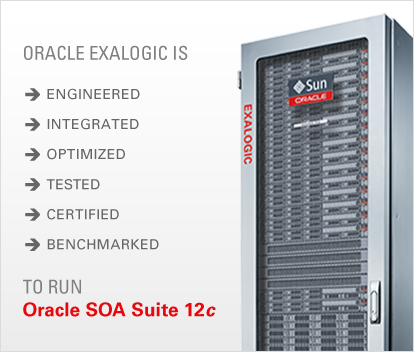 25
25 -
Rapidly Deploy and Manage Your PaaS
 Integration environments often grow in unpredictable ways, causing administrative and compliance challenges. The use of home-grown, ad hoc management scripts increases maintenance costs and makes it difficult to deploy new middleware environments. Developers need a shared, consolidated platform that dramatically simplifies provisioning. 7-Eleven used Oracle SOA Suite, Oracle Exalogic, and Oracle Exadata, with Oracle Enterprise Manager to power it all as a platform as a service.
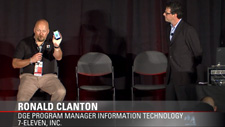 Video: 7-Eleven goes mobile with PaaS.Ronald Clanton, DGE Program Manager Information Technology,Watch the Video (3:48)
7-Eleven, Inc.26 -

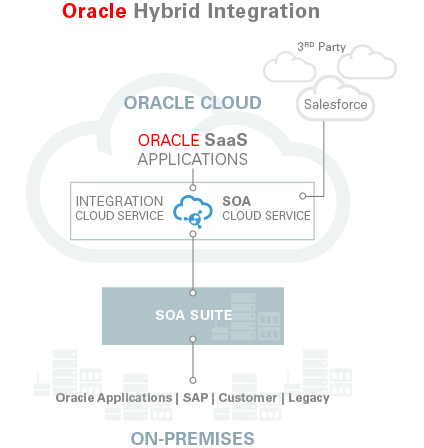
The new integration demands of cloud, mobile, and IoT technologies require a unified approach to integration that spans multiple integration channels. Oracle’s unified hybrid cloud integration solution provides the ease of use for lines of business and applications IT as well as the comprehensive breadth and depth of features required by enterprise architects and
developers alike.For cloud-based PaaS deployments, Oracle offers Integration Cloud Service to make integration simple. Pre-integration with Oracle SaaS applications removes the complexity for the most common types of integration. A point-and-click development environment requiring minimal configuration and zero coding, using concepts and terminology familiar to application users simplifies the user experience for new integrations. The interface runs in a web browser, enabling development and administration even on mobile devices. Simply choose applications for integration endpoints and optionally enrich integrations with more advanced configurations. The interface also features a graphical data mapper that lets users drag and drop how data maps from one application to another.
28Most importantly, instead of guessing how to map data, the Oracle Recommends™ feature provides intelligent mapping recommendations based on successful integrations from others who have done similar integrations before you.
Targeting the more advanced needs of integration developers, Oracle SOA Suite minimizes the complexity associated with managing APIs from many different applications, service providers, and cloud vendors. Oracle also simplifies connections to mobile applications and automates event-processing activities to accommodate all types of intelligent devices. For example, Oracle SOA Suite enables developers to use the same service bus to integrate messages for all types of applications, channels, and paradigms, including on-premises, cloud, mobile, and IoT—regardless of the types of applications in question or where those applications are deployed. Oracle SOA Suite is available as an on-premises solution or (soon to be released) in the Oracle Cloud to eliminate the need for installation, configuration, and
patch-set updates.These integration options all built on a common foundation of standards, architecture, and components to ensure deployment flexibility to choose the right solution for the right user and right business requirement.
29 -
 30
30Boost Productivity
Oracle Integration Cloud Service gets your new business services into production faster and easier than traditional integration. Lines of business (sales, marketing, support, etc.) are empowered to create integrations. As long as you understand the application and how the application stores information in its business objects, then start dragging and dropping in Integration Cloud Service. No need for complexity.
When it comes to building process and service abstractions in a more advanced service-oriented style of integration, Oracle offers SOA templates to jumpstart productivity. Oracle SOA Suite 12c also features a single package installer, improved debugging capabilities, a lighter footprint, quicker startup, and optimized database profiles.
31 -
Oracle Cloud Adapters mask the technical differences between applications and data models, which dramatically streamlines connectivity, session management, authentication, and authorization. The SOA environment comes with a highly available MFT infrastructure with integrated security and advanced workflow formats. SOA management packs for Oracle Enterprise Manager provide Java VM diagnostics on an as-needed basis.
Leverage a Unified Integration Solution
Application integration projects often require complementary middleware components for business activity monitoring,
event processing, business rule creation, and B2B integration. Oracle offers a unified development, runtime, monitoring, and management environment that incorporates all these components.In addition, customers can use Oracle SOA Suite 12c with Oracle Business Process Management Suite 12c to build workflow and process extensions to extend the value of their applications wherever they reside: on-premises, on mobile devices, or in
the cloud.32Oracle SOA Suite 12c runs natively on Oracle WebLogic Server 12c and supports in-memory computing with Oracle Coherence—a proven combination for customers that require extreme performance and scale. Oracle SOA Suite 12c is the middleware platform your organization needs to resolve a wide variety of integration challenges, now and in the future.
 Webcast: Learn
more about Oracle
SOA Suite 12c.Join Amit Zavery, Oracle’sWatch the Webcast
Group Vice President of
Oracle Fusion Middleware Product Development, and
hear from customers and partners Dell, JDSU,
and Keste.33 -

Webcasts and Vidoes
White Papers
- White Paper: Oracle SOA Suite 12c - A Detailed Look
- White Paper: A Brave New Integration World
- White Paper: Five Ways to Simplify Cloud Integration
- Booklet: Oracle Service Integration Customer Reference
34Customers and Partners Talk about Oracle Integration
35 -
Data Sheets
- Data Sheet: Oracle SOA Suite 12c
- Data Sheet: Oracle Managed File Transfer
- Data Sheet: Oracle Enterprise Repository
- Data Sheet: Oracle Event Processing
- Data Sheet: Oracle Service Bus
- Data Sheet: Mobile Integration Using Oracle Service Bus
Oracle SOA Suite 12c Podcast Series
- Website: More podcasts...
Downloads from Oracle Technology Network
- Website: Oracle SOA Suite 12c
36 -
 Copyright © 2015, Oracle and/or its affiliates. All rights reserved. Oracle and Java are registered trademarks of Oracle and/or its affiliates. Other names may be trademarks of their respective owners. Intel and Intel Xeon are trademarks or registered trademarks of Intel Corporation. All SPARC trademarks are used under license and are trademarks or registered trademarks of SPARC International, Inc. AMD, Opteron, the AMD logo, and the AMD Opteron logo are trademarks or registered trademarks of Advanced Micro Devices. UNIX is a registered trademark of The Open Group.
 -