
 Copying Data from an HTTP(S) Server with Oracle Big Data Manager
 Before You
Begin
Before You
Begin
In this 15-minute tutorial, you learn how to use Oracle Big Data Manager to copy data files hosted on a Hyper Text Transfer Protocol Secure (HTTPS) server to the Hadoop Distributed File System (HDFS) on your cluster.
Background
This is the first tutorial in the Working with Oracle Big Data Manager series. Read them sequentially.
- Copying Data from an HTTP(S) Server with Oracle Big Data Manager
- Analyzing Data with Oracle Big Data Manager Notebook
- Creating a Personal Dashboard in Oracle Big Data Manager
What Do You Need?
- Access to an HTTP server such as Apache HTTP server, Oracle HTTP Server (OHS), or Oracle Weblogic Server.
- Access to an instance of Oracle Big Data Cloud Service and the required login credentials.
- Access to Oracle Big Data Manager on a non-secure Oracle Big Data Cloud Service instance. A port must be opened to permit access to Oracle Big Data Manager, as described in Enabling Oracle Big Data Manager.
- The required sign in credentials for Oracle Big Data Manager.
- Read/Write privileges to the
/user/demoHDFS directory. - Basic familiarity with HDFS, Spark, and optionally, Apache Zeppelin.
 Access the Oracle Big Data Manager Console
- Sign in to Oracle Cloud and open your Oracle Big Data Cloud Service console.
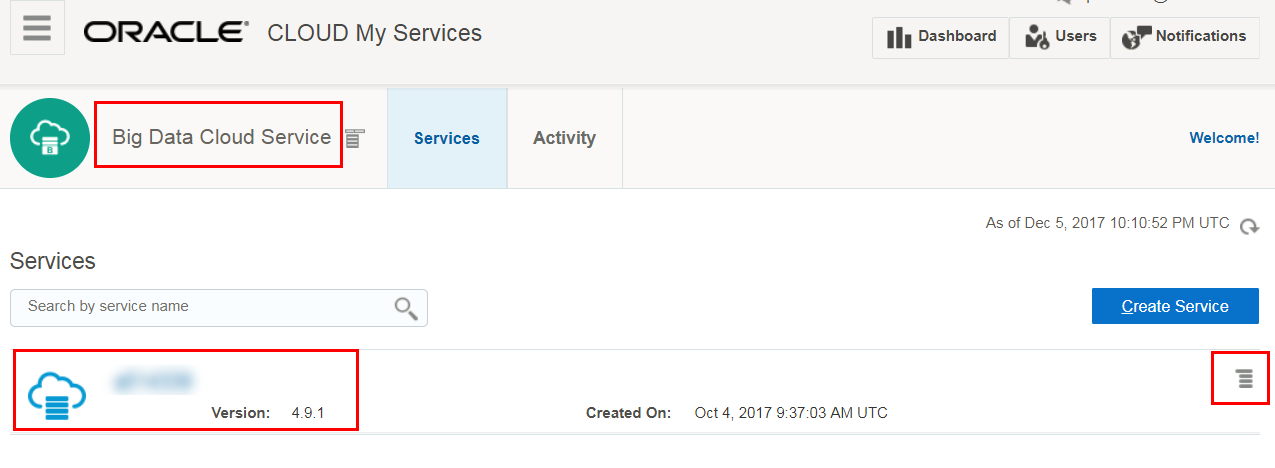
Description of the illustration bdcs-console.png - In the row for the cluster, click Manage this service
 , and then click
Oracle Big Data Manager console from the context menu to display the Oracle Big Data
Manager Home page.
, and then click
Oracle Big Data Manager console from the context menu to display the Oracle Big Data
Manager Home page.
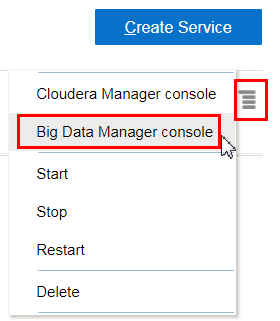
Description of the illustration select-bdm-console.png
 Configure and Run Your HTTP(S) Server
In this section, you copy two files to a new HTTP(S) web server directory on your cluster. Next, you configure and run your HTTP(S) server which will host the data files.
- Copy the taxidropoff_files.zip file to a new directory named
taxi_telemetryon your machine where you will run the HTTP(S) server. This file contains (12).csvdata files that were created from several datasets on the NYC Taxi & Limousine Commission website. Thetaxi_telemetrydirectory will be accessible via web browsers, HTTP(S), and Oracle Big Data Manager. - Extract the
taxidropoff_files.zipfile into thetaxi_telemetrydirectory. - Make sure that you have the following files in your
taxidropoff_filesHTTP(S) web server directory.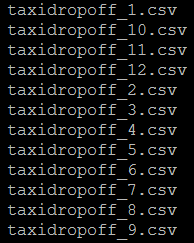
Description of the illustration files-on-cluster.png - Right-click the list_of_files.txt file, select Save link as from
the context menu, and then save it in your
taxi_telemetrydirectory on your machine where you will run the HTTP(S) server. Edit thelist_of_files.txtfile. Replace the occurrences of your_host_name with your host name. Replace the occurrences of your_port_number with your port number. Save the file. - In this tutorial, we are using the
SimpleHTTPServermodule that is available when you install Python. You can use this built-in HTTP(S) server (or your own HTTP(S) server) to turn any directory in your cluster into a web server directory. In your terminal window,cdinto thetaxi_telemetrydirectory.$ cd taxi_telemetry -
You can use any port that is available to you with your HTTP(S) server. Your HTTP(S) server will listen to HTTP(S) requests
for the data hosted on your web server directory using this port. In this tutorial, we will use port 17777. For example, to
make sure that your port is available, enter the following
command:
$ netstat -tlnp 2>/dev/null | grep [port#]Note: In the preceding command, substitute
[port#]with your port number. - Start-up the HTTP(S) server. For example, to start the HTTP(S) server on port 17777, enter the
following command at the
$prompt:$ python -m SimpleHTTPServer 17777
Description of the illustration start-http-server.png Note: In the preceding command, substitute port
17777with your port number.
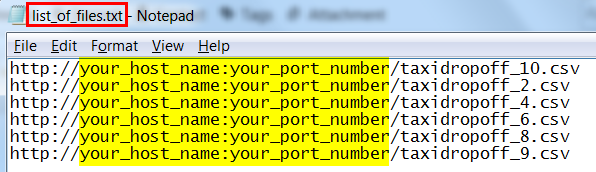
Note: Your taxi_telemetry HTTP(S) web server directory should contain the
list_of_files.txt file and the (12) .csv data files.
 Copy a Data File from an HTTP(S) Server to HDFS
In this section, you copy the taxidropoff_1.csv data file from the
taxi_telemtry directory to HDFS using the Copy here from
HTTP(S) feature in Data explorer.
- On the Oracle Big Data Manager page, click the Data tab.

Description of the illustration data-tab.png - In the Data explorer section, select HDFS storage (hdfs)
from the Storage drop-down list. Navigate to the
/user/demodirectory, and then click Copy here from HTTP(S) on the toolbar.
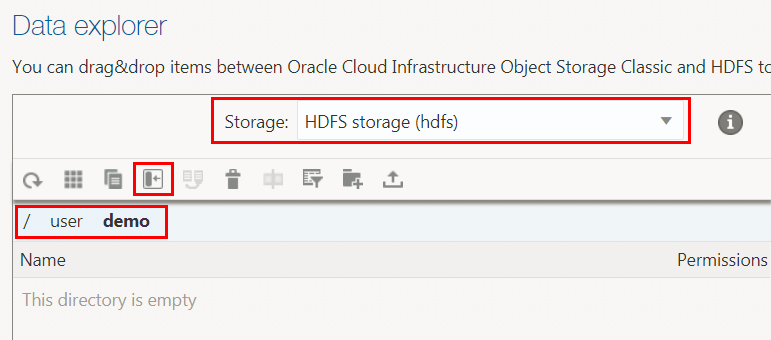
Description of the illustration copy-from-http.png The New copy data job dialog box is displayed. It has the Sources and Destination sections and the General and Advanced tabs.
- In the Sources section, accept the default Direct link
from the Source type drop-down list. Select HTTP(S) from the
Source location drop-down list.
In the Enter a valid HTTP(S) URI field, enter a URI using the following format.
Substitute your_host_name with your actual host name. Substitute your_port_number
with your port number that you are using with your HTTP server.
http://your_host_name:your_port_number/taxidropoff_1.csv
Description of the illustration sources-section.png - In the Destination section, make sure that the
/user/demoHDFS destination directory is displayed. To make any changes to the destination directory, click Edit destination .
.

Description of the illustration destination-section.png - In the General tab, accept the defaults for all the fields, and then click
Create.
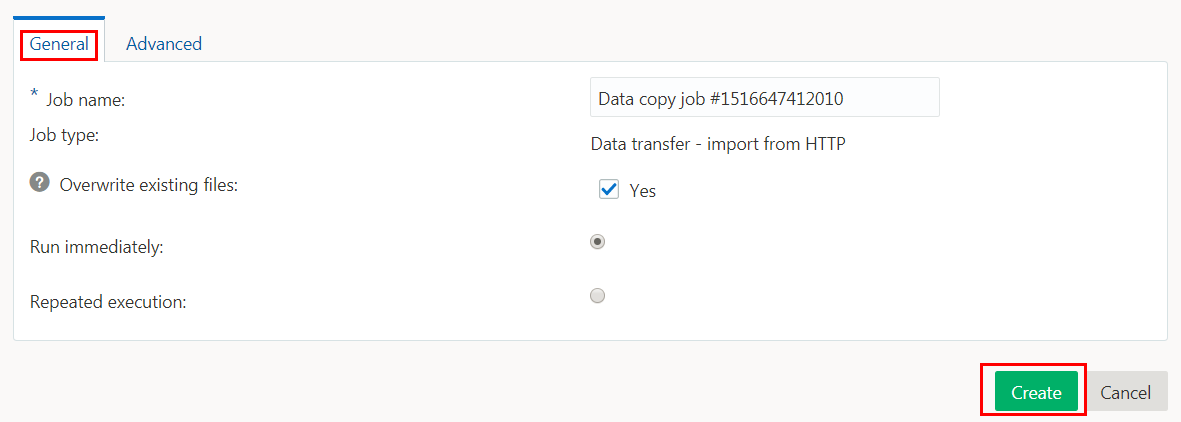
Description of the illustration general-tab.png - A Data Copy Job Created window is displayed for the requested data transfer (copy). The window displays the job details such as the job number, start time, progress, start date and time, and duration. To display additional details about the data copy job, click View more details. When the file is copied successfully to HDFS, a Succeeded window is displayed.
- In the Data explorer section, select HDFS storage (hdfs)
from the Storage drop-down list. Navigate to the
/user/demodirectory, and then click Refresh on the toolbar. The
taxidropoff_1.csvfile is now displayed in the/user/demoHDFS directory.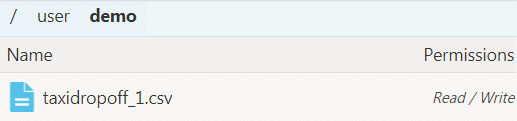
Description of the illustration file-in-hdfs.png
Note: You can click Add source to add more source locations to this copy data job. In addition to HTTP(S), you can specify other storage source locations such as HDFS storage (hdfs) and Oracle Object Storage Classic (bdcs). In this example, we will only include the HTTP(S) source.

 Copy Multiple Data Files from an HTTP(S) Server to HDFS
In this section, you copy seven .csv data files from the taxi_telemetry
directory to HDFS using the Link to list of files option in the New copy data job dialog box. You will use the list_of_files.txt
file which contains the urls for the seven .csv data files.
- On the Oracle Big Data Manager page, click the Data tab.
- In the Data explorer section, select HDFS storage (hdfs)
from the Storage drop-down list. Navigate to the
/user/demodirectory, and then click Copy here from HTTP(S) on the toolbar. The New copy data job
dialog box is displayed.
- In the Sources section, select the Link to list of files
from the Source type drop-down list. Select HTTP(S) from the
Source location drop-down list.
In the Enter a valid HTTP(S) URI field, enter a URI that references the
list_of_files.txtfile using the following format:http://your_host_name:your_port_number/list_of_files.txtNote: In the preceding URI, substitute your_host_name with your actual host name. Substitute your_port_number with your port number that you are using with your HTTP server.

Description of the illustration sources-section-2.png To display the contents of the
list_of_files.txtfile in thetaxi_telemetrydirectory, enter the following command:$ cat list_of_files.txt - In the Destination section, make sure that the
/user/demoHDFS destination directory is displayed. - In the General tab, accept the defaults for all the fields, and then click Create.
- A Data Copy Job Created window is displayed for the requested data transfer. When the files are copied successfully to HDFS, a Succeeded window is displayed. Click Close to close the window.
- The copied
.csvfiles are now displayed in the/user/demoHDFS directory. If the files are not displayed, click Refresh
on the toolbar.
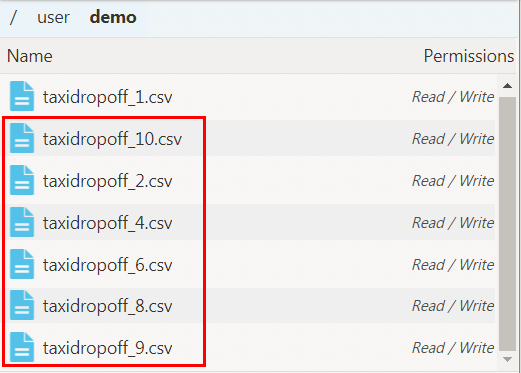
Description of the illustration files-in-hdfs.png
 Next Tutorial
Analyzing Data with Oracle Big Data Manager Notebook