
| Date | Feature | Notes |
|---|---|---|
| 12 APR 2019 | Created initial document. |
This document outlines the features in Oracle Adaptive Intelligent Apps for Customer Experience and describes any tasks you might need to perform for this service. Each section includes a brief description of the feature, the steps you need to take to enable or begin using the feature, any tips or considerations that you should keep in mind, and the resources available to help you.
Give Us Feedback
We welcome your comments and suggestions to improve the content. Please send us your feedback at oracle_aiapps_doc_feedback_grp@oracle.com.
Column Definitions:
Report = New or modified, Oracle-delivered, ready to run reports.
UI or Process-Based: Small Scale = These UI or process-based features are typically comprised of minor field, validation, or program changes. Therefore, the potential impact to users is minimal.
UI or Process-Based: Larger Scale* = These UI or process-based features have more complex designs. Therefore, the potential impact to users is higher.
Features Delivered Disabled = Action is needed BEFORE these features can be used by END USERS. These features are delivered disabled and you choose if and when to enable them. For example, a) new or expanded BI subject areas need to first be incorporated into reports, b) Integration is required to utilize new web services, or c) features must be assigned to user roles before they can be accessed.
| Ready for Use by End Users Reports plus Small Scale UI or Process-Based new features will have minimal user impact after an update. Therefore, customer acceptance testing should focus on the Larger Scale UI or Process-Based* new features. |
Customer Must Take Action before Use by End Users Not disruptive as action is required to make these features ready to use. As you selectively choose to leverage, you set your test and roll out timing. |
|||||
|---|---|---|---|---|---|---|
| Feature |
Report |
UI or |
UI or |
|
||
Oracle Adaptive Intelligent Apps for Customer Experience provides personalized, dynamic, and continuously adaptive offers across B2C commerce and marketing platforms. It delivers the product recommendations and promotions through commerce storefronts and marketing channels.
Widget Templates for Trending Items
Create Trending Items carousel widgets on your commerce site using templates. For Oracle Commerce Cloud, use the predefined widget templates. For third-party commerce applications, copy and paste the provided code snippets into your widget code.
You can use the Trending Items widget to highlight products that are gaining popularity. The recommendation algorithms identify trending items by comparing products purchased in a specified interval to the previous interval.
ORACLE COMMERCE CLOUD
The following screen capture shows the Trending Items widget templates to download for Oracle Commerce Cloud.
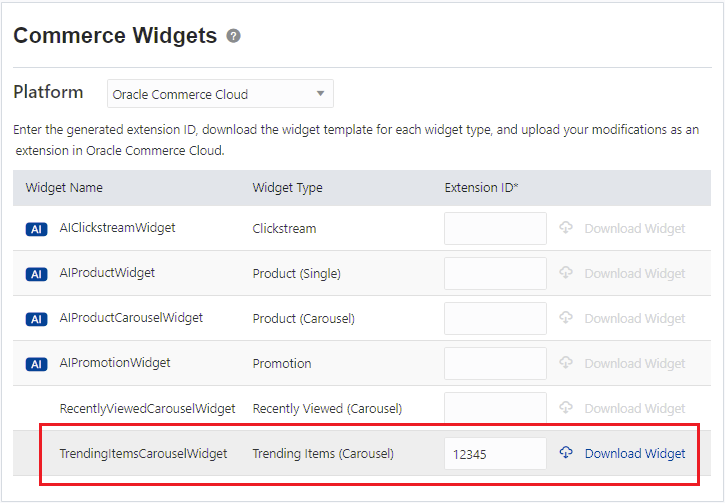
Commerce Widgets Page for Oracle Commerce Cloud
OTHER COMMERCE APPLICATIONS
To create a trending items widget for a third-party commerce application, copy the code and use the sample snippets as desired. The following screen capture shows the trending items widget code to copy for other commerce applications.
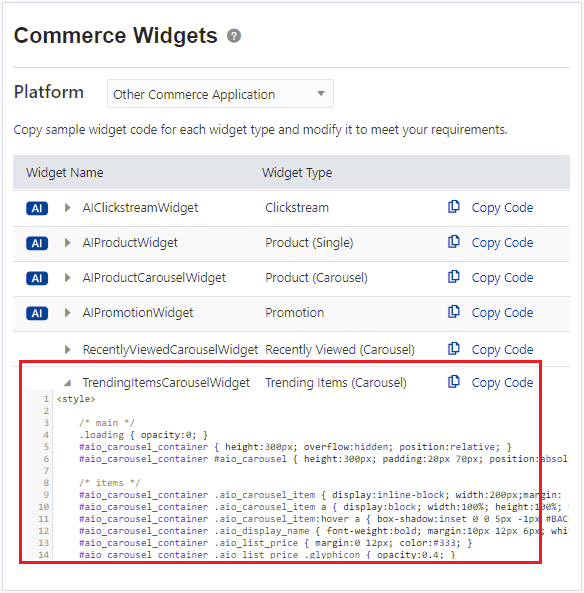
Commerce Widgets Page for Other Commerce Applications
Steps to Enable
No steps are required to enable this feature, but to use it, you must configure widgets as described in the documentation.
Tips And Considerations
- If you’re using the REST API, refer to the Change History for this update to see how which resources and methods were changed or added for this feature.
Key Resources