
This document will continue to evolve as existing sections change and new information is added. All updates appear in the following table:
| Date | Module | Feature | Notes |
|---|---|---|---|
| 31 OCT 2023 | Create Article Templates to Streamline the Authoring Process | Updated document. Revised documentation links. | |
| 20 MAY 2022 | Created initial document. |
This guide outlines the information you need to know about new or improved functionality in Oracle B2C Knowledge Management and describes any tasks you might need to perform for the update. Each section includes a brief description of the feature, the steps you need to take to enable to begin using the feature, any tips or considerations that you should keep in mind, and the resources available to help you.
For a listing of hardware and software requirements for Oracle products, log in to our support site and access Answer ID 31.
 HAVE AN IDEA?
We’re here and we’re listening. If you have a suggestion on how to make our cloud services even better then go ahead and tell us. There are several ways to submit your ideas, for example, through the Ideas Lab on Oracle Customer Connect. Wherever you see this icon after the feature name it means we delivered one of your ideas.
GIVE US FEEDBACK
We welcome your comments and suggestions to improve the content. Please send us your feedback.
DISCLAIMER
The information contained in this document may include statements about Oracle’s product development plans. Many factors can materially affect Oracle’s product development plans and the nature and timing of future product releases. Accordingly, this Information is provided to you solely for information only, is not a commitment to deliver any material, code, or functionality, and should not be relied upon in making purchasing decisions. The development, release, and timing of any features or functionality described remains at the sole discretion of Oracle.
This information may not be incorporated into any contractual agreement with Oracle or its subsidiaries or affiliates. Oracle specifically disclaims any liability with respect to this information. Refer to the Legal Notices and Terms of Use for further information.
Column Definitions:
Report = New or modified, Oracle-delivered, ready to run reports.
UI or Process-Based: Small Scale = These UI or process-based features are typically comprised of minor field, validation, or program changes. Therefore, the potential impact to users is minimal.
UI or Process-Based: Larger Scale* = These UI or process-based features have more complex designs. Therefore, the potential impact to users is higher.
Features Delivered Disabled = Action is needed BEFORE these features can be used by END USERS. These features are delivered disabled and you choose if and when to enable them. For example, a) new or expanded BI subject areas need to first be incorporated into reports, b) Integration is required to utilize new web services, or c) features must be assigned to user roles before they can be accessed.
| Ready for Use by End Users Reports plus Small Scale UI or Process-Based new features will have minimal user impact after an update. Therefore, customer acceptance testing should focus on the Larger Scale UI or Process-Based* new features. |
Customer Must Take Action before Use by End Users Not disruptive as action is required to make these features ready to use. As you selectively choose to leverage, you set your test and roll out timing. |
|||||
|---|---|---|---|---|---|---|
| Feature |
Report |
UI or |
UI or |
|
||
Create Article Templates to Streamline the Authoring Process |
||||||
Create Article Templates to Streamline the Authoring Process
You can create and store templates for content fields within articles. Authors can use these templates to quickly and easily create articles that meet your organization's standards for completeness and consistency. Templates store layout and color schemes to apply to rich text fields, which saves authors time and effort and enables them to focus on content when they create and update articles. Knowledge managers and document designers can create templates based on your organization's needs, and authors can easily access them directly from an icon in the editor.
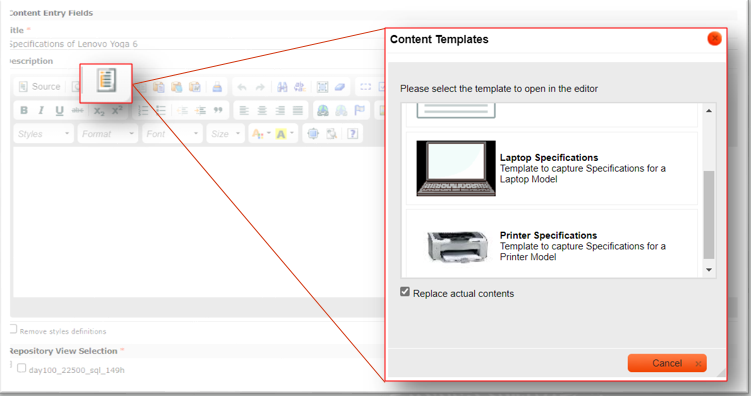
Authors Access Your Organization's Templates from the Editor
Article templates make your knowledge base easier to use. Authors can use templates specifically designed by experts in your organization, which saves them time and frees them from design and layout tasks, enabling them to focus on important content. Agents and end users benefit from a consistent look and feel that helps them quickly find the most relevant information to answer their question.
Steps to Enable
You don't need to do anything to enable this feature.
Tips And Considerations
- You can create up to 50 templates.
- Templates only in rich text fields.
Key Resources
- See the "Manage Content" chapter in the Administering Knowledge Advanced guide, and the "Author Content" chapter in the Using Knowledge Advanced guide.
Access Requirements
- Administrators, Knowledge Managers, or designers who have permission can create templates.
- Authors can use templates when they create or update articles.
Browse Answer for Agents in BUI
Browse answers allows agents to discover relevant answers using article attributes like content type, product and category, as filter criteria.
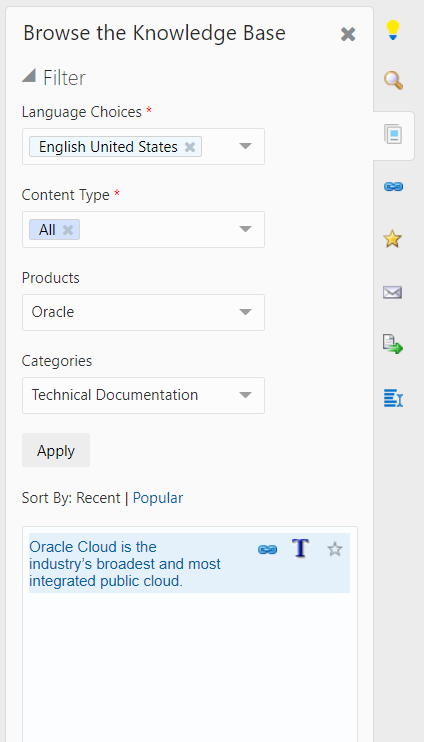
Browse Answer Module As Seen in BUI
Improves Service Responsiveness for agents by enabling them to find more relevant answers in a shorter time span.
Steps to Enable
You don't need to do anything to enable this feature.
Tips And Considerations
- Only Published answers are displayed.
- Filters are applied based on ‘AND’ criteria. If user selects ‘English’ as locale, ‘FAQ’ as Content Type, ‘Modem’ as Product, ‘Trouble Shooting’ as Category, then only articles that are tagged with all of these attributes are displayed.
- Only 50 Content Type can be displayed in Content Type Filter.
- Visibility rules set in Right Now console is honored for display of Product and Category values to an Agent. Visibility rules set in Knowledge Advanced is not supported.
Key Resources
- Oracle® B2C Service Using Knowledge Advanced
Access Requirements
- Agent in BUI