
This document will continue to evolve as existing sections change and new information is added. All updates appear in the following table:
| Date | Product | Feature | Notes |
|---|---|---|---|
| 31 AUG 2020 | Created initial document. |
This guide outlines the information you need to know about new or improved functionality in this update.
GIVE US FEEDBACK
We welcome your comments and suggestions to improve the content. Please send us your feedback at omcdocumentation_ca@oracle.com.
Column Definitions:
Features Delivered Enabled
Report = New or modified, Oracle-delivered, ready to run reports.
UI or Process-Based: Small Scale = These UI or process-based features are typically comprised of minor field, validation, or program changes. Therefore, the potential impact to users is minimal.
UI or Process-Based: Larger Scale* = These UI or process-based features have more complex designs. Therefore, the potential impact to users is higher.
Features Delivered Disabled = Action is needed BEFORE these features can be used by END USERS. These features are delivered disabled and you choose if and when to enable them. For example, a) new or expanded BI subject areas need to first be incorporated into reports, b) Integration is required to utilize new web services, or c) features must be assigned to user roles before they can be accessed.
| Ready for Use by End Users Reports plus Small Scale UI or Process-Based new features will have minimal user impact after an update. Therefore, customer acceptance testing should focus on the Larger Scale UI or Process-Based* new features. |
Action is Needed BEFORE Use by End Users Not disruptive as action is required to make these features ready to use. As you selectively choose to leverage, you set your test and roll out timing. |
|||||
|---|---|---|---|---|---|---|
| Feature |
Report |
UI or |
UI or |
|
||
Audience Analytics allows you to visualize the transactional custom tables that you upload into CX Audience. Using Oracle Business Intelligence (BI), any attribute that is within your Profile Extension Table (PET) or transactional table records can be used to slice and dice your data with Oracle BI's wide range of data visualization tools.
This enhancement allows you more flexibility in the types of custom reports you can create and the insights you can gain. For example, if you have uploaded transactional web events and have a PET with loyalty status, then you could break down the unique web events by the referring domain to see from which acquisition channel you are getting the most traffic.
Steps to Enable
You don't need to do anything to enable this feature.
Key Resources
Visit our Help Center to learn more.
Profile Cascade Bulk Delete allows you to upload an external file containing profile IDs that you would like to have deleted. This purges records from your system all at once, instead of having to delete records individually.
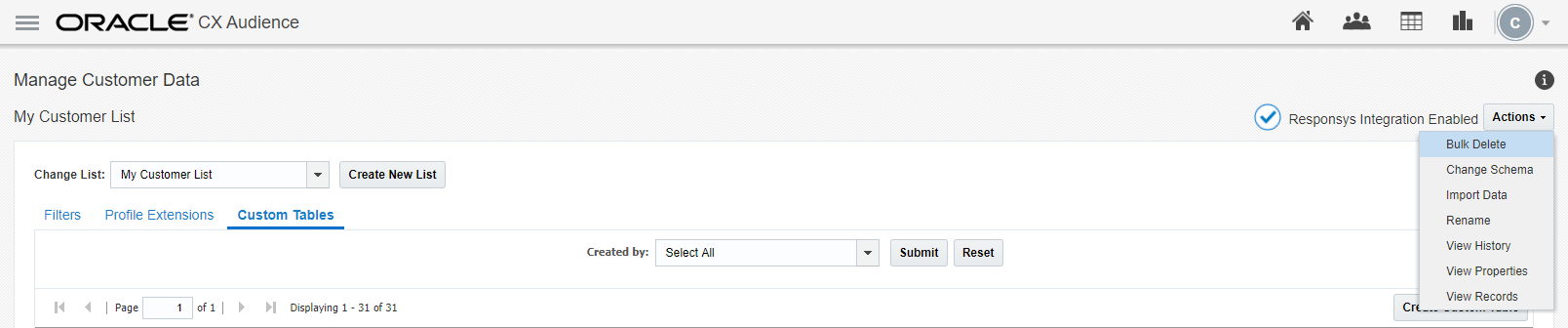
If privacy records or individual requests require you to delete customer data from Oracle CX Audience, you can delete records from profile lists and Profile Extension Tables (PETs) more efficiently.
Steps to Enable
You don't need to do anything to enable this feature.
Key Resources
Visit our Help Center to learn more.
An integration between CX Audience and CrowdTwist is now available. This allows you to easily incorporate loyalty attributes into your segmentation and marketing strategies.
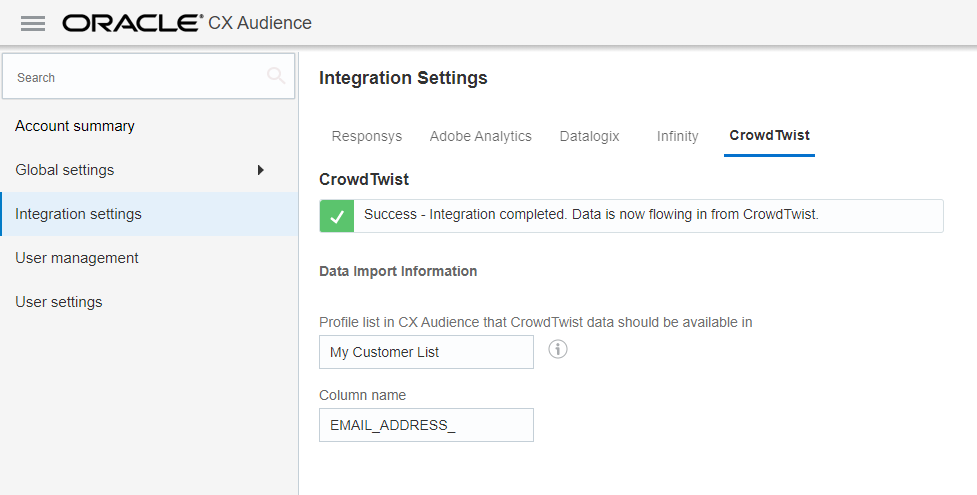
Loyalty programs, such as CrowdTwist, help keep customers engaged.
Steps to Enable
Oracle CrowdTwist is required to use this feature.
Key Resources
Visit our Help Center to learn more.