
This document will continue to evolve as existing sections change and new information is added. All updates appear in the following table:
| Date | Product | Feature | Notes |
|---|---|---|---|
| 25 JUN 2020 | Created initial document. |
This document outlines the upcoming Enterprise Data Management Cloud update.
Column Definitions:
Features Delivered Enabled
Report = New or modified, Oracle-delivered, ready to run reports.
UI or Process-Based: Small Scale = These UI or process-based features are typically comprised of minor field, validation, or program changes. Therefore, the potential impact to users is minimal.
UI or Process-Based: Larger Scale* = These UI or process-based features have more complex designs. Therefore, the potential impact to users is higher.
Features Delivered Disabled = Action is needed BEFORE these features can be used by END USERS. These features are delivered disabled and you choose if and when to enable them. For example, a) new or expanded BI subject areas need to first be incorporated into reports, b) Integration is required to utilize new web services, or c) features must be assigned to user roles before they can be accessed.
| Ready for Use by End Users Reports plus Small Scale UI or Process-Based new features will have minimal user impact after an update. Therefore, customer acceptance testing should focus on the Larger Scale UI or Process-Based* new features. |
Action is Needed BEFORE Use by End Users Not disruptive as action is required to make these features ready to use. As you selectively choose to leverage, you set your test and roll out timing. |
|||||
|---|---|---|---|---|---|---|
| Feature |
Report |
UI or |
UI or |
|
||
ENTERPRISE DATA MANAGEMENT CLOUD
Test Environments: Oracle will apply this monthly update during the first daily maintenance that occurs at or after 22:00 UTC on Friday, July 3, 2020.
Production Environments: Oracle will apply this monthly update during the first daily maintenance that occurs at or after 22:00 UTC on Friday, July 17, 2020.
The Oracle Help Center provides access to updated documentation. The updates will be available in the Help Center on Friday, July 3, 2020. Some of the links to new feature documentation included in this readiness document will not work until after the Oracle Help Center update is complete.
NOTE: Backing up the daily maintenance snapshot and restoring the environment as needed are self-service operations. Oracle strongly recommends that you download the maintenance snapshot every day to a local server.
Please Join Oracle Cloud Customer Connect
Please take a moment to join the Cloud Customer Connect forums for EPM Cloud services. Oracle Cloud Customer Connect is a community gathering place for members to interact and collaborate on common goals and objectives. This is where you will find the latest release information, upcoming events, or answers to use-case questions. Joining takes just a few minutes. Join now!
https://cloud.oracle.com/community
NOTE: The Settings and Actions menu now contains a link to Cloud Customer Connect. To access this link, from the Home page, click the down arrow next to the user name (in the upper right-hand corner of the screen), and select Cloud Customer Connect.
Give Us Documentation Feedback
We welcome your comments and suggestions to improve the content of the What's New document and the product documentation. Please send us your feedback at EPMdoc_ww@oracle.com. In the body or title of the email, state that you are inquiring or providing feedback, and indicate for which EPM Cloud service and the monthly update cycle.
For the latest updates and information about EPM Cloud, follow us on YouTube, Twitter, Facebook, and LinkedIn at Hyperion EPM Info.
Defects Fixed and Considerations
Software issues addressed each month and considerations will be posted to My Oracle Support.
New Topics in EPM Cloud Operations Guide
The EPM Cloud Operations Guide has been enhanced with additional topics.
New topics include the following:
- Diagnosing Performance Issues After Deploying Configurable Consolidation Rules
- Diagnosing REST API Issues
- Handling Issues Related to Large Data Exports
Key Resources
A new version of EPM Automate, which contains the createGroups and deleteGroups commands, is now available. Other changes in this version include changes to the use of IDENTITY_DOMAIN as a required parameter in the login command and support for the recomputeOwnershipData command in Tax Reporting.
createGroups Command
Adds groups to Access Control using an ANSI or UTF-8 encoded CSV file that was uploaded to the environment. This command applies to all business processes except Account Reconciliation.
deleteGroups Command
Removes groups from Access Control based on the information available in an ANSI or UTF-8 encoded CSV file that was uploaded to the environment. This command applies to all business processes except Account Reconciliation.
login Command Usage Change
The login command usage has been changed to not require IDENTITY_DOMAIN name as a required paramter. Instead, it has been made an optional parameter, which is ignored even if you specify it. Instead, the command now calculates the name of your identity domain from the URL.
recomputeOwnershipData Command support for Tax Reporting
The recomputeOwnershipData command, which allows you to recompute ownership data, is now available for Tax Reporting. Previously, this command was available only for Financial Consolidation and Close.
Key Resources
- Working with EPM Automate for Oracle Enterprise Performance Management Cloud:
Operations Guide Links in the Provide Feedback Utility
The Provide Feedback Utility in EPM Cloud now contains links that connect you to different types of troubleshooting information published in the Oracle Enterprise Performance Management Cloud Operations Guide. These links provide you information to self-diagnose your issue. Additionally, they list the mandatory information that you must submit to Oracle when you seek help for an issue that you cannot solve yourself. The information that you must submit to Oracle is tailored for each issue explored in the guide so that Oracle can expeditiously diagnose the issue and suggest corrective actions. Similarly, the link for requests explores various EPM Cloud-related requests you can make and the information you must provide while making such requests. Additionally, the link for questions point to some available information sources that you can explore and the information that you must include while asking a question.
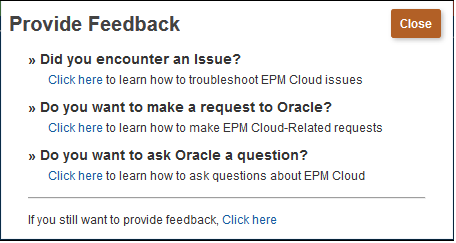
Provide Feedback Screen Displaying Troubleshooting Links
Add and Remove Groups Using REST APIs
You can now use REST APIs to add and remove a batch of groups listed in an ANSI or UTF-8 encoded CSV file that was uploaded to the environment. Use the Upload REST API to upload the file. This gives you the freedom to manage groups outside of the user interface.
NOTE: This applies to Enterprise Data Management, Financial Consolidation and Close, Planning, Planning Modules, Profitability and Cost Management, and Tax Reporting.
Key Resources
- Managing Users in REST API for Oracle Enterprise Performance Management Cloud
Role Information
- Service Administrators
Consistent Column Labels and Search in Access Control
Access Control now uses a consistent, intelligent search function across screens that supports search for artifacts such as users and groups. You now can enter a search string to search all searchable attributes. Previously, you had to select an attribute; for example First Name, from a drop down list before running a search. Additionally, Access Control now uses consistent artifact names and labels across screens.
Exception: In the Users tab of the Create Groups screen, you can search only for User Names. Search for other attributes is not currently supported.
Key Resources
Important Actions and Considerations
DEPRECATION OF THE IDENTITY_DOMAIN PARAMETER FROM THE LOGIN COMMAND
In an upcoming release, Oracle will deprecate the use of IDENTITY_DOMAIN as parameter for the login EPM Automate command. Instead, the name of the identity domain will be calculated automatically from the URL. Existing scripts that contain this value have to be updated after this parameter is deprecated.
This change is expected to be implemented in the 20.10 update. If you have any concerns about this change, please contact Oracle Support.
USABILITY ENHANCEMENTS FOR HORIZONTAL TABS IN NAVIGATION FLOWS
In an update within the next few months, we are introducing a few usability enhancements to the horizontal tab feature within navigation flows. As part of these usability improvements, we will be placing the horizontal tabs at the bottom of the page instead of at the top of the page where they are currently located. The vertical tabs will stay where they are.
Customers will benefit from a clear separation of the EPM Cloud horizontal tabs from their browser tabs at the top of the window. Another benefit of this change will be to keep the navigation flow tab names distinct from the name of the artifacts (such as forms and dashboards) rendered within the horizontal tabs.
These changes will be the default for all customer environments where horizontal tabs are being used within navigation flows. The effective date of the release will be announced in the month prior to the release. It is expected in the next 2-4 months’ timeframe.
INTERNET EXPLORER BROWSER SUPPORT
For Internet Explorer browser users, Microsoft recommends using the new Microsoft Edge as your default browser. With this guidance in mind, the 20.08 update will be the last release to support Internet Explorer. EPM Cloud will no longer support Internet Explorer starting with the 20.09 update. If you have any questions regarding de-support, please create a Service Request. For additional guidance on Internet Explorer Lifecycle, please reach out to Microsoft.
REMOVAL OF INSTANCE NAME FROM PREDEFINED ROLE NAMES
Currently, the predefined role names displayed in the Access Control screens of EPM Cloud environments prefix the instance name to the role name in INSTANCE_NAME ROLE_NAME format. They are also stored in this format in the snapshots, making it difficult to migrate snapshots from one instance to another.
To facilitate the migration of security across EPM Cloud environments, Oracle plans to rename predefined role names displayed within EPM Cloud applications by removing the instance name prefix. For example, if the instance name is Planning1, predefined role names are Planning1 Service Administrator, Planning1 Power User, Planning1 User, and Planning1 Viewer, the new role names will be Service Administrator, Power User, User, and Viewer.
NOTE: This change does not affect how the role names are displayed in the MyServices customer portal.
This change won't impact customers who currently use predefined roles for managing application-level provisioning and access to artifacts. Oracle will ensure that all application role assignments and artifact security assignments are automatically updated after the roles are renamed. This change makes it easy to migrate EPM Cloud artifacts across environments.
This change is being implemented to address customer feedback. If you have any concerns about this change, please contact Oracle Support.
EPM MOBILE APP STATEMENT OF DIRECTION
EPM Mobile App is a downloadable application for the phone that is purpose built to perform approval actions for iOS and Android based phone devices. It was purpose built to help users perform Approval and Workflow activities. It is currently only supported for Oracle EPM Cloud for the Planning business process.
The terminal release of EPM Mobile App is September 2020. EPM Mobile App will not be available for download in the Apple and iOS App Stores effective October 2020. Oracle’s strategic direction is to have customers use the Approval and workflow capabilities using the mobile browser interface on mobile devices.
Oracle will continue to support Oracle EPM Mobile App in its current supported versions until September 2020. Oracle recommends that users using Oracle EPM Mobile App prepare to instead use the approval functionality using supported mobile browser in tablet devices.