
This document will continue to evolve as existing sections change and new information is added. All updates appear in the following table:
| Date | Module | Feature | Notes |
|---|---|---|---|
| 28 AUG 2023 |
HR Help Desk | Use Intelligent Advisor to create Help Desk requests | Updated document. Feature delivered in update 23C. |
| 28 AUG 2023 | HCM Communicate | Reach Employees Using Alternative Contact Details | Updated document. Feature delivered in update 23C. |
| 02 JUN 2023 | Created initial document. |
HCM Cloud applications have two types of patches you can receive that are documented in this What’s New:
- Release Updates (23A, 23B, 23C, and 23D)
- Optional Monthly Maintenance Packs to each update
It is important for you to know what Release Update your environment is on. You can find this in your Cloud Portal.
____________________
 HAVE AN IDEA?
We’re here and we’re listening. If you have a suggestion on how to make our products better, please let us know. To enter an idea go to the Ideas Lab on Oracle Customer Connect. In this document wherever you see the light bulb icon after the feature name it means we delivered one of your ideas.
____________________
Suggested Reading for all HCM Products:
- HCM Common What's New - In this What's New you will find feature that are used across applications.
- Human Resources What’s New – In the Global Human Resources section you will find features on the base application in which other application are built upon.
NOTE: Not all Global Human Resource features are available for Talent and Compensation products.
- Oracle Human Capital Management Cloud Functional Known Issues and Maintenance Packs (Document ID 1554838.1). These documents identify bug fixes and possible known issues. You will also need to review these documents based in the release update version you are currently on or will be moving to.
- Oracle Help Center – Here you will find guides, videos and searchable help.
- Release Readiness – New Feature Summary, What’s New, Feature Listing Spreadsheet, Spotlights and Release Training
GIVE US FEEDBACK
We welcome your comments and suggestions to improve the content. Please send us your feedback at oracle_fusion_applications_help_ww_grp@oracle.com. Indicate you are inquiring or providing feedback regarding the HCM Cloud What’s New in the body or title of the email.
We’re here and we’re listening. If you have a suggestion on how to make our products better, please let us know. To enter an idea go to the Ideas Lab on Oracle Customer Connect. In this document wherever you see the light bulb icon after the feature name it means we delivered one of your ideas.
Column Definitions:
Report = New or modified, Oracle-delivered, ready to run reports.
UI or Process-Based: Small Scale = These UI or process-based features are typically comprised of minor field, validation, or program changes. Therefore, the potential impact to users is minimal.
UI or Process-Based: Larger Scale* = These UI or process-based features have more complex designs. Therefore, the potential impact to users is higher.
Features Delivered Disabled = Action is needed BEFORE these features can be used by END USERS. These features are delivered disabled and you choose if and when to enable them. For example, a) new or expanded BI subject areas need to first be incorporated into reports, b) Integration is required to utilize new web services, or c) features must be assigned to user roles before they can be accessed.
| Ready for Use by End Users Reports plus Small Scale UI or Process-Based new features will have minimal user impact after an update. Therefore, customer acceptance testing should focus on the Larger Scale UI or Process-Based* new features. |
Customer Must Take Action before Use by End Users Not disruptive as action is required to make these features ready to use. As you selectively choose to leverage, you set your test and roll out timing. |
|||||
|---|---|---|---|---|---|---|
| Feature |
Report |
UI or |
UI or |
|
||
Lookup an Employee and View the Employee's Existing Requests |
||||||
Perform Mass Updates to Help Desk Requests in the Redwood User Experience |
||||||
Transactional Business Intelligence Enterprise for Oracle Me |
||||||
Gain Deeper Insights into Help Desk Performance with New Subject Areas |
||||||
Gain Visibility into Help Desk Milestone Attainment and Knowledge Article Usage |
||||||
HCM Communicate provides communication teams a powerful way to create, target and track company communications sent to employees. The product allows teams to granularly target communications to their employees, as well as retarget future communications based on employee engagement. HCM Communicate provides an intuitive templated WYSWYG content creator that allows communication teams to quickly create engaging content. The system allows communication teams to send out communication on behalf of others in the organization. HCM Communicate provides a robust toolkit that allows organizations to engage effectively with their employees. HCM Communicate requires a subscription to Fusion HCM Communicate Cloud Service. Customers must first subscribe to this service prior to using HCM Communicate.
View Campaign Response Details
See more info about a Get Response campaign in the new View Response page. As a campaign manager, when you set up the Get Response campaign, you have the choice to either view more details about the respondents and their responses or just an aggregated total of the responses, after the campaign runs. When you choose to see more details, you can click on the View Responses link and see this info:
- Employee names
- Business units
- Work locations
- Work email addresses
- Work mobile phone numbers
- Response Choices
You can also search and filter on the details, as well as see a total count of employees. For example, you can select Yes for the response choice filter to see all the employees who responded to the campaign with Yes.
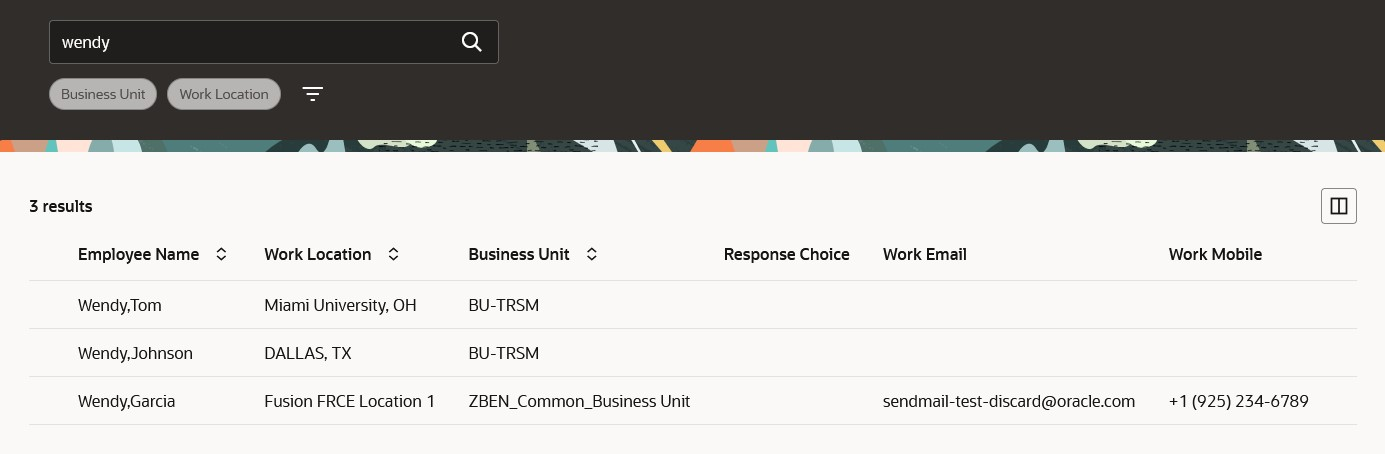
View Responses for Get Response Campaign
View response details for a Get Response campaign and learn how employees responded.
Steps to Enable
You don't need to do anything to enable this feature.
Reach Employees Using Alternative Contact Details
Target employees with a HCM Communicate campaign even if they don't have a work email address or work phone number. Add alternate contact preferences for audience members that are part of a campaign. Campaign admins can set up to three alternative contact preferences to use for communicating to campaign audiences in the Manage Communication Teams page.
Reach out to employees who don't have a work email address or work phone number by using alternative contact details.
Steps to Enable
Here's how you set up alternative contacts:
- The administrator enables the ORA_IRC_COMMUNICATE_CONTACT_PREFERENCE profile option by setting the site level option to Yes. Enabling this profile option displays the Contact Order Preference section in the Communication Teams page. This section gives you the ability to add, delete, and reorder email and SMS preferences.
- Go to the Manage Communication Teams page:
- Offering HCM Communicate
- Functional Area: Employee Communications
- Task: Manage Communication Teams
- In the Contact Order Preference section, the campaign admin can add more contact details for an employee. The different types of email and SMS available are configured in core HR.
- The campaign admin can add up to 3 different email preferences and 3 different SMS preferences for each communication team. The order of the contact details determines the order in which the campaign sends a communication. For example, set the order of preference for email to Work, Home, and then Campus. When sending a communication, the application would look for each employee's work email first, and if they don't have a work email address configured, then it would look for their home email and then their campus email.
Find out more information about the audience you targeted for a General or Get Response Campaign. Access a detailed list by selecting the Preview button in the Audience Breakdown section of the Audience tab. You can now look at this info:
- Employee names
- Business units
- Work locations
- Work email addresses
- Work mobile phone numbers
You can also search and filter on the details, as well as see a total count of employees. The application refreshes the audience preview daily and until it sends the first set of campaign communications.
Previously, as a campaign manager, you could see a breakdown of a selected audience by worker location and business unit.
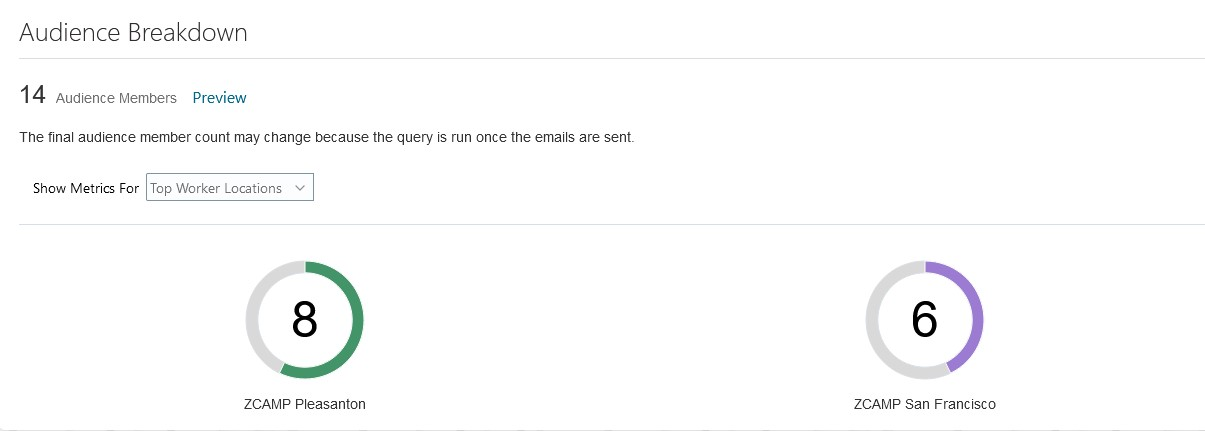
Audience Preview Button
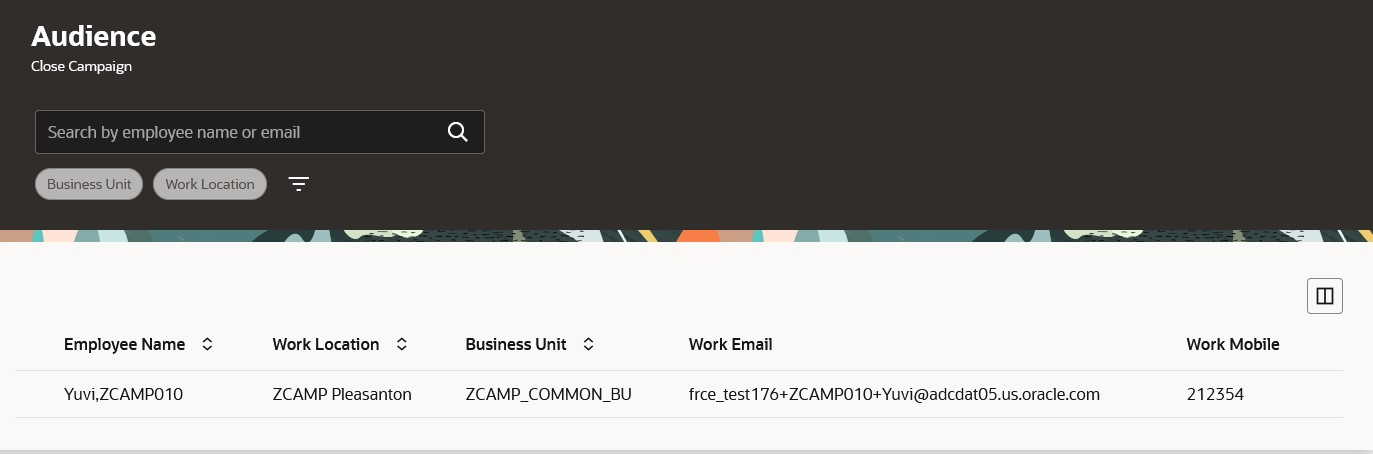
Audience Details
Gain a deeper understanding of the audience by accessing a detailed list of employees you targeted in a campaign.
Steps to Enable
You don't need to do anything to enable this feature.
View Email and SMS Delivery Details
View specific delivery information for any email or SMS communication within a campaign. Access the details by clicking on the new Email Delivery Details and SMS Delivery Details actions in the Content tab. For both email and SMS, you can view a list of recipients who received the communication, along with their delivery status, work location, business unit, and work email. Additionally for email communications, you can see whether the recipients opened the email, whether they clicked on a link in the email, and the date it was delivered.
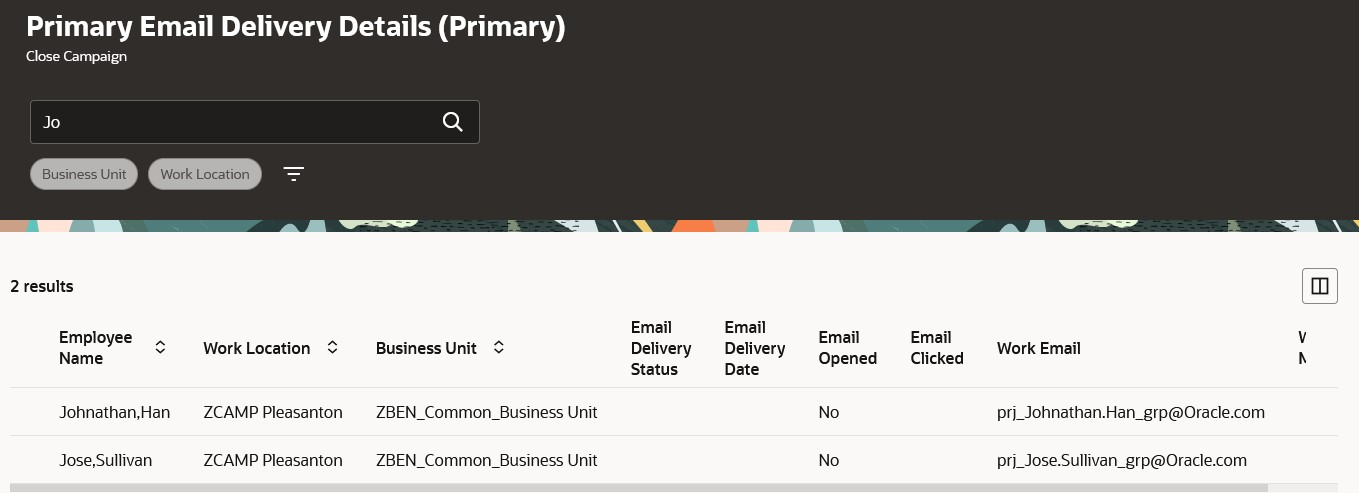
View Email Delivery Details
Easily track the success of a campaign by accessing specific delivery details about email and SMS communications. Follow up with recipients who haven’t received or engaged with the communication.
Steps to Enable
You don't need to do anything to enable this feature.
Set up an ongoing General or Get Response campaign and select a date when you want the campaign to run until. For example, you want to send an email communication to all your employees who work in the London office about a summer event. You can set the eligibility criteria to London as the work location and set the campaign to run until the end of August. If an employee transfers to the London office in August or if a new employee joins the London office, then they’ll receive the email about the summer event because they’ve become eligible. The application automatically identifies employees who meet the criteria you set and adjusts the audience over time. This feature enables you to continuously send campaign communications to target newly eligible employees.
Automatically reach employees who become eligible for an email communication by setting up an ongoing campaign.
Steps to Enable
You don't need to do anything to enable this feature.
Oracle Grow, a part of the Oracle ME employee experience platform, combines learning, skill development, and career mobility to drive individual and organizational success. It brings together all the elements that your employees need to excel in their current roles and for career growth including learning, skill development, gigs to develop competence and expertise.
Oracle Grow, a part of the Oracle ME employee experience platform, combines learning, skill development, and career mobility to drive individual and organizational success. It brings together all the elements that your employees need to excel in their current roles and for career growth including learning, skill development, gigs to develop competence and expertise. Oracle Grow:
- Consolidates employee growth preferences, such as, skills, learning topics, careers, and jobs, as well as manager-assigned development, such as, core skills, all in one place.
- Delivers personalized development recommendations, such as, learning, skills, development journeys, and connections, based on those growth preferences and assignments.
- Continuously adapts recommendations based on the employee’s own actions as well as actions occurring elsewhere in the system.
- Supports in-context actions on recommendations, for ease and efficiency.
- Is accessible on a user’s device of choice, including desktop and mobile.
An employee can access their own Grow page through:
- The global search available across all applications.
- The Quick Action available under Me > Grow in the Career and Performance section.
With Oracle Grow, you can propel employee and organizational growth.
- Employees can leverage a connected experience across all development and growth resources, as well as visibility into role expectations and career growth.
- Organizations can support employees in adapting to new priorities and expectations, and ensure consistency and success.
Steps to Enable
You don't need to do anything to enable this feature.
Tips And Considerations
Grow requires that are you are live on Oracle Learning. You should also implement these for users to derive the maximum, targeted value:
- Dynamic Skills
- Career Development
- Job profiles with key specifications, such as, skills and competencies, for jobs they are associated with
- Up-to-date skills, qualifications, profiles, and job associations for employees
- A robust set of profile item libraries, such as competencies, that can tie together profiles with outcomes and recommendation
Key Resources
Access Requirements
The Grow page is available through a duty role, Career Growth Access Worker Duty (ORA_HRD_CAREER_GROWTH_ACCESS_BY_WORKER_DUTY), assigned to the Employee and Contingent Worker abstract roles (ORA_PER_EMPLOYEE_ABSTRACT, ORA_PER_CONTINGENT_WORKER_ABSTRACT). If you had made copies of the seeded Employee and Contingent Worker roles prior to this release, you need to add the new duty role to these copies.
Use Intelligent Advisor to create Help Desk requests
Users can now create Help Desk requests through an interview-style format using Intelligent Advisor.
Integrating with Intelligent Advisor allows decisions to be made on what information to collect, based on answers previously provided, and can be as simple or as complex as necessary for the particular situation. When using Intelligent Advisor, the "Create by Interview" action can be given as an option to agents and can be the default method of opening a help desk request for employees. This provides step-by-step guidance which can help make certain that employees provide all of the necessary information to agents during the first interaction, reducing overall resolution time.
Steps to Enable
The basic steps to enable and use the Create Request by Interview button on the Help Desk List page is as follows:
1. Create an interview using Oracle Policy Modeler and deploy the interview to your Oracle Intelligent Advisor hub.
2. Configure the Create by Interview button in the Redwood Case List page in Visual Builder Studio..Open the Help Desk List page in Visual Builder Studio and locate the Constants tab in the right-hand panel.
3. Click the Constants tab.
There are three variables on the Constants tab:
- showCreateRequestByInterviewButtonOnListPage
- opaSiteURL
- createRequestInterviewDeploymentName
4. Click on the variable name and select a variable value from the drop-down list.
5. Alternatively, you can click the Show in Variables link to open the Constants page and enter the variables there.
6. Once the variables are entered, click Publish.
Tips And Considerations
Note that Intelligent Advisor is licensed separately, and this feature requires a license for Oracle Intelligent Advisor.
Key Resources
Refer to the Implementing Help Desk guide. For more information about Oracle Intelligent Advisor, see the "Configuring Oracle Intelligent Advisor" chapter of the Implementing Your Cloud Integrations guide.
Access Requirements
Your Oracle Intelligent Advisor administrator and Visual Builder developer should work together to configure this feature.
The list of Smart Actions that are shown in the Action Bar can be customized to add new actions or remove standard actions that are not needed.
This allows Help Desk agents to only be presented the Smart Actions that are relevant to your business processes
Steps to Enable
You don't need to do anything to enable this feature.
Tips And Considerations
To configure the Smart Actions that should be available in Help desk, use the Smart Actions setup area in Application Composer. To remove a Smart Action from appearing in the Action Bar, you will need to be in a Sandbox.
Key Resources
Please refer to the instructions found at https://docs.oracle.com/en/cloud/saas/applications-common/23c/oacex/overview-of-smart-actions.html.
Access Requirements
In order to customize Smart Actions, users must have the privilege "Manage Smart Actions" (ZCA_MANAGE_SMART_ACTIONS_PRIV).
This privilege is granted to the Help Desk Administrator roles:
- HR Service Request Administration
- Internal Service Request Administration
Lookup an Employee and View the Employee's Existing Requests
Help Desk in the Redwood experience now provides a page to search for an employee and then drill into an employee service summary page that includes basic information about the employee along with a list of the five most recently created requests. The information on the page, such as email address or manager's name, can also be used to confirm a caller's identity.
Agents save time by being able to search for an employee using name or email address. This single search allows the agent to validate the employee's identity, view the list of open requests so that an existing request can be found without needing the request number, and see the history of recent requests to be able to assist the employee in an efficient manner.
Steps to Enable
You don't need to do anything to enable this feature.
Tips And Considerations
Searches can be done using the email address, person number, or display name.
To access the Search page, go under the Help Desk tab and click on Employee Search under the Quick Links.
Access Requirements
All agents have access to this feature.
This is controlled by the privileges:
- SVC_VIEW_AGENT_HR_HD_PRIV (HR Help Desk Agent)
- SVC_VIEW_AGENT_ISR_HD_PRIV (Internal Help Desk Agent)
Perform Mass Updates to Help Desk Requests in the Redwood User Experience
Help Desk agents can now use the list page in the Redwood Experience to perform updates to multiple help desk requests concurrently for select fields. Mass updates can be completed for either Internal Service Request or HR Help Desk Requests.
Mass update saves time and effort for agents needing to update multiple help desk requests at once. For example:
- To reassign all open requests from an employee going on vacation to their backup.
- To change the status to close many requests at once.
- When an update is needed to other commonly used fields.
Steps to Enable
Enabling Mass Update requires a one-time set up.
First, the Configure Adaptive Search parameter Enable Mass Update must be set to Y. To do this:
- Go to Setup and Maintenance.
- Click on the Tasks icon on the right-hand side of the page.
- Click Search.
- Type "Configure Adaptive Search" in the search box.
- Click the Search magnifying glass icon.
- Click the Configure Adaptive Search link.
- Click on the Parameters tab.
- Highlight the Enable Mass Update line.
- Click Edit.
- When prompted if you want to continue, say Yes.
- Change the current value to Y.
- Click Save and Close.
Now, we must configure those fields that will be allowed to be mass updated.
- Click the Configure Adaptive Search link.
- Click on the Configure UI tab.
- In the left panel, click on either HR Help Desk Request or Internal Service Request, depending on which you wish to configure.
- In the far right-hand column is Enable for Mass Update.
- Check the boxes for those Fields that agents should be able to update on multiple requests at once.
- Click Save and Close.
Finally, a variable must be set within Visual Builder Studio on the Agent's List Page:
- Navigate to the Agent's List Page (Help Desk Requests card under the Help Desk tab).
- On the lefthand panel, expand the following options:
- Click on elastic-search-sr-list.
- Under the Variables tab, select enableMassUpdate.
- On the right-hand side panel, change the Value to true.
Preview your changes before publishing.
Tips And Considerations
By default, there is a limit of 10 items that can be changed at once. To change this limit up to a value between 1 and 25 (inclusive), you can change the current value of the Configure Adaptive Search parameter Maximum Number of Records that can be Selected.
Mass update should not be used for Queue or Product, even though these possibilities are shown.
Do not attempt to do a Mass Update for help desk requests which span multiple Business Units for the item you are attempting to update, as this will not work appropriately.
The amount of time it takes to update the multiple requests is directly related to the number of requests selected.
Mass update is not currently available on smaller resolution (i.e., mobile) devices.
Access Requirements
All Help Desk administrators have the ability to enable Mass Update.
Once Mass Update is enabled, the feature is available to all Help Desk agents. This is controlled by the privileges:
- SVC_VIEW_AGENT_HR_HD_PRIV (HR Help Desk Agent)
- SVC_VIEW_AGENT_ISR_HD_PRIV (Internal Help Desk Agent)
Service Workflow and Automation
Notify All Members Of A Queue For Help Desk Related Events
Notifications can now be sent to all members of a queue for Help Desk related events. When a notification event is defined, you can now identify all members of a queue as recipients of the notification.
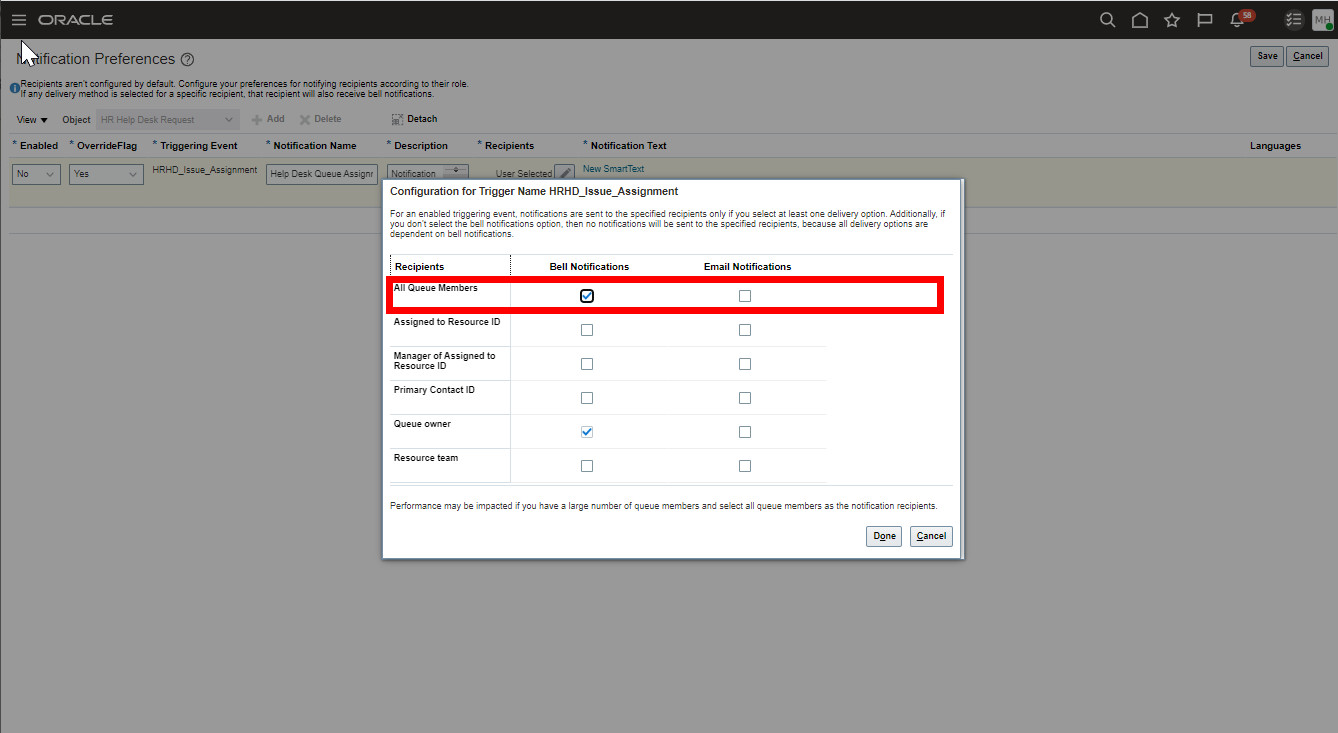
Organizations that assign Help Desk requests to a queue and then have their agents take ownership of new requests can now easily notify all agents in that queue that a new issue has been routed to them. This enables agents to quickly respond to new requests and contact impacted users promptly.
Steps to Enable
To enable this feature, there are two profile options available:
- To enable this feature for HR Help Desk - set the following profile option to Yes at the site level: ORA_ENABLE_QUEUE_MEMBER_HELPDESK_NOTIFICATIONS
- To enable this feature for ISR Help Desk - set the following profile option to Yes at the site level: ORA_ENABLE_QUEUE_MEMBER_INTERNAL_SR_NOTIFICATIONS
Once you have enabled the appropriate profile option, define a notification trigger as you typically would through Application Composer.
After defining the notification trigger:
- From the Navigator menu access the Tools section
- Select Notification Preference Manager
- From the Object drop down menu select either HR Help Desk Request or ISR Help Desk Request
- Create a new notification
- Under recipients you will see the option for All Queue Members
Tips And Considerations
If you have queues that have a large number of Agents, defining a notification that is sent to all members may have a slight impact on performance in the delivery of the notification. It is strongly recommended that you not use this notification recipient option for queues with a large membership.
Key Resources
For additional information on setup and configuration of notifications, please reference the documentation available here:
Access Requirements
To define a notification trigger in Application Composer, you will need to have a user with the appropriate privileges.
Transactional Business Intelligence Enterprise for Oracle Me
Oracle Transactional Business Intelligence is a real time, self service reporting solution offered to all Oracle® Cloud application users to create ad hoc reports and analyze them for daily decision-making. Oracle Transactional Business Intelligence provides human resources managers and specialists, business executives, and line managers the critical workforce information to analyze workforce costs, staffing, compensation, performance management, talent management, succession planning, and employee benefits. Don’t want to start from scratch building a report or analytics? Check out the library of sample reports for all products on Customer Connect on the Report Sharing Center.
Analyze Conversations in Internal Help Desk
An agent can start an internal conversation with her fellow agents (or subject matter experts) to assist her in resolving a help desk request, through various channels. Managers and agents can gain insights into the extent of collaboration happening via internal conversations during the course of resolving a help desk request. In-depth analysis supported by key metrics such as counts of incoming/outgoing conversation messages, conversation recipients help managers are possible at the level of each help desk request, if required.
A new subject area, "Help Desk - Internal Service Request Conversation Messages Real Time" has been added.
Visibility into internal conversation recipient information, volumes and other aspects help understand the extent of collaboration occurring both within and outside the organization. An analysis of resolution times of closed requests together with their categories, queues or business units and the nature and volume of conversation messages would help uncover opportunities for improvement.
Steps to Enable
Leverage new subject area(s) by adding to existing reports or using in new reports. For details about creating and editing reports, see the Creating and Administering Analytics and Reports book (available from the Oracle Help Center > your apps service area of interest > Books > Administration).
Key Resources
Subject Areas for Transactional Business Intelligence in Fusion Sales and Fusion Service guide.
Analyze HR Help Desk Performance for Affected Parties
An HR Help Desk Request may be filed on behalf of an affected party, who is not the primary point of contact of the request. Visibility into the affected party's details such as name, department, location, job title, and other key attributes will help pinpoint the specific employee groups, locations or positions where issues have been occurring.
A new folder called 'HR Service Request Affected Party' exposing key attributes of the Affected Party has been added to the 'Help Desk - HR Service Requests Real Time' subject area.
Gain visibility into the origins of HR help desk requests raised on behalf of affected parties to uncover common patterns and plan suitable remedial actions.
Steps to Enable
You don't need to do anything to enable this feature.
Gain Deeper Insights into Help Desk Performance with New Subject Areas
Your employee help desk requests often need to be routed to multiple agents, who are on the resource team of various queues. Managers would like to gain insights into service delivery performance in the context of agents being part of a queue. The subject area can be used in conjunction with other help desk subject areas to obtain these insights.
Two subject areas are provided to fulfill the analysis needs:
1. Help Desk - HR Help Desk Queue Resources Real Time
2. Help Desk - Internal Help Desk Queue Resources Real Time.
By gaining visibility into agent engagements across queues, managers can make better decisions on queue load balancing.
Steps to Enable
Leverage new subject area(s) by adding to existing reports or using in new reports. For details about creating and editing reports, see the Creating and Administering Analytics and Reports book (available from the Oracle Help Center > your apps service area of interest > Books > Administration).
Key Resources
Subject Areas for Transactional Business Intelligence in Fusion Sales and Fusion Service guide.
Gain Visibility into Help Desk Milestone Attainment and Knowledge Article Usage
Analyses built using these new subject areas enable managers to gain visibility into service request milestone target completions and compliance. Other areas of analysis include knowledge article usage in requests and their influence on issue resolution as well as HR Help Desk requests involving affected parties.
- Help Desk - HR Service Request Summary
- Help Desk - Internal Service Request Summary
Help desk managers can monitor knowledge article usage in requests as well their effectiveness in reducing resolution times. The frequency, location and other details of HR help desk issues raised on behalf of affected parties is a key input for managers to plan measures or alert other groups to prevent their occurrence.
Steps to Enable
Leverage new subject area(s) by adding to existing reports or using in new reports. For details about creating and editing reports, see the Creating and Administering Analytics and Reports book (available from the Oracle Help Center > your apps service area of interest > Books > Administration).
Tips And Considerations
Run the 'Aggregate Service Requests' scheduled process for refreshed data in reports built out of this subject area.
Key Resources
Subject Areas for Transactional Business Intelligence in Fusion Sales and Fusion Service guide.