
This document will continue to evolve as existing sections change and new information is added. All updates appear in the following table:
| Date | Product | Feature | Notes |
|---|---|---|---|
| 21 MAY 2021 | Created initial document. |
This guide outlines the information you need to know about new or improved functionality in this update.
GIVE US FEEDBACK
We welcome your comments and suggestions to improve the content. Please send us your feedback at omcdocumentation_ca@oracle.com.
Column Definitions:
Report = New or modified, Oracle-delivered, ready to run reports.
UI or Process-Based: Small Scale = These UI or process-based features are typically comprised of minor field, validation, or program changes. Therefore, the potential impact to users is minimal.
UI or Process-Based: Larger Scale* = These UI or process-based features have more complex designs. Therefore, the potential impact to users is higher.
Features Delivered Disabled = Action is needed BEFORE these features can be used by END USERS. These features are delivered disabled and you choose if and when to enable them. For example, a) new or expanded BI subject areas need to first be incorporated into reports, b) Integration is required to utilize new web services, or c) features must be assigned to user roles before they can be accessed.
| Ready for Use by End Users Reports plus Small Scale UI or Process-Based new features will have minimal user impact after an update. Therefore, customer acceptance testing should focus on the Larger Scale UI or Process-Based* new features. |
Customer Must Take Action before Use by End Users Not disruptive as action is required to make these features ready to use. As you selectively choose to leverage, you set your test and roll out timing. |
|||||
|---|---|---|---|---|---|---|
| Feature |
Report |
UI or |
UI or |
|
||
This updated feature helps you implement your organization's client ID persistence strategy. Your persistent client ID can coexist with your CX Tag out-of-the-box.
You will be able to set a custom string as a client ID and retrieve and read a client ID that has been set.
This capability allows you to persist user identifiers from internal systems. You can pass Client IDs to the tag and append to the behavioral events captured from user interactions with your web applications. The Client ID can be persisted in the cookies for the time allowed by the browsers. This way, you can easily track the returning behavior of visitor(s) to your web apps and analyze their behavior.
Steps to Enable
Please contact your account representative to enable this feature.
The Data Collection app has been updated to include capabilities for cloning, deleting, and publishing the CX Tag configuration(s) to production on demand.
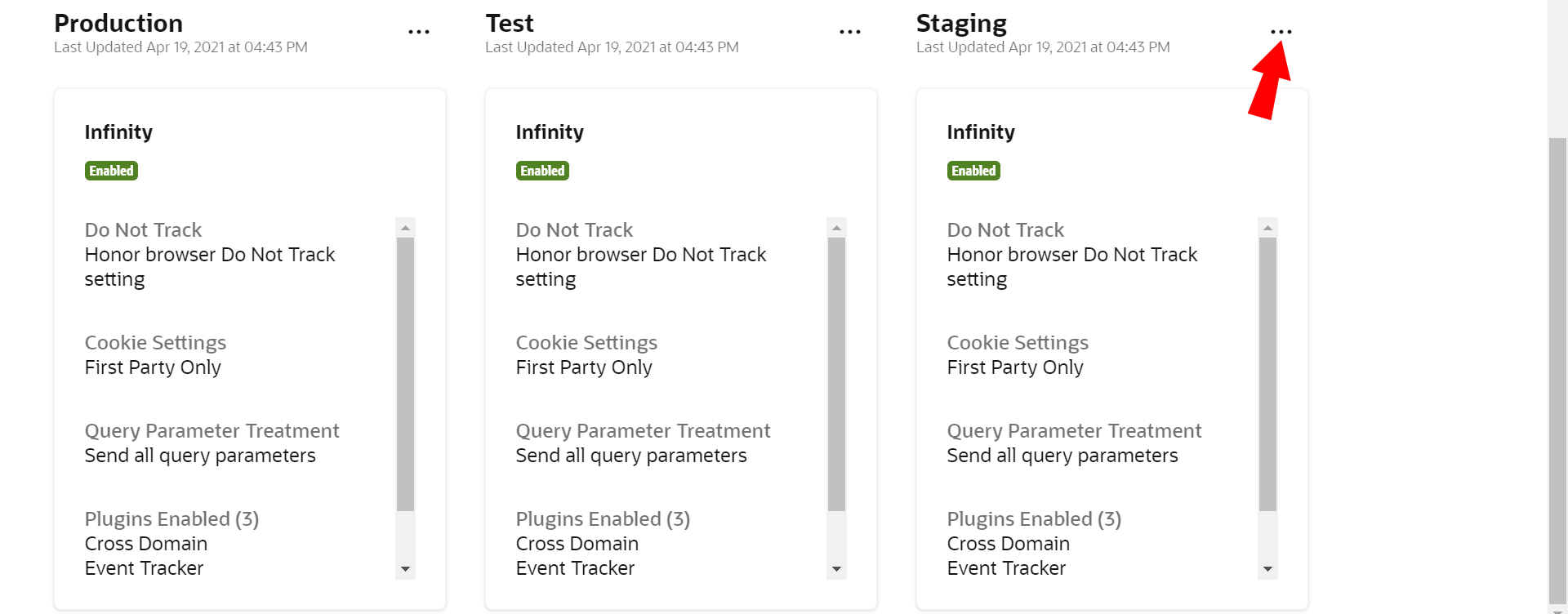
This enhancement helps you administer your tag with cloning and deleting configurations. You can test a tag configuration in a lower environment and then publish the successfully tested changes to the production configuration.
Steps to Enable
You don't need to do anything to enable this feature.
Key Resources
The new Actions feature enables you to configure a set of rules based on behavioral data collected and streamed through Infinity's real-time data pipeline. The Infinity platform will listen for these rules in real time and then deliver behavioral data to your designated action system for retargeting, personalization, recommendations, and more.
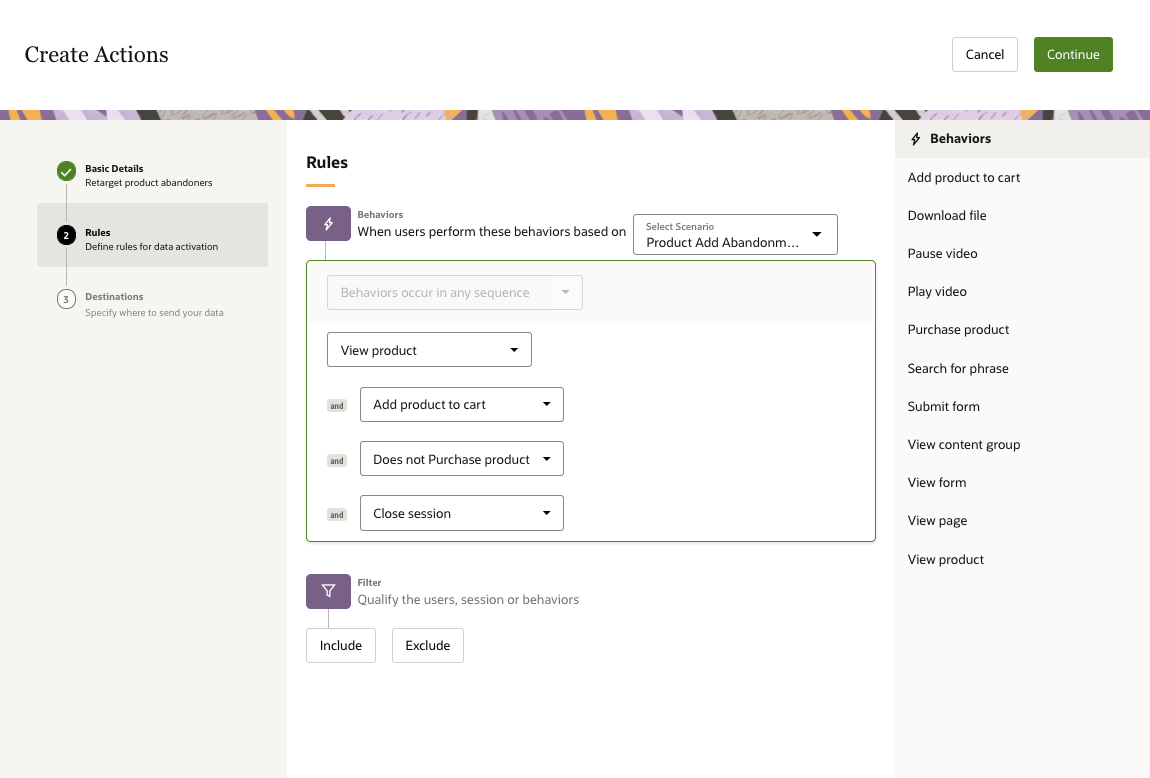
The new Actions feature provides an intuitive interface for configuring a set of rules using behaviors and filters. The Infinity platform then listens for these rules in real time. Once these rules are detected, the Infinity platform delivers relevant, contextualized data to your selected action system, such as Responsys. This way, you can optimize your customer's digital experience through better recommendations and personalization while your customer is still engaged. The result is increased online conversion rates, enhanced digital experiences, and improved business outcomes.
Steps to Enable
You must have Infinity Streams or Infinity IQ to use this feature.
Key Resources