
This document will continue to evolve as existing sections change and new information is added. All updates appear in the following table:
| Date | Module | Feature | Notes |
|---|---|---|---|
| 27 NOV 2023 | EPM Cloud Platform | New Connector Option For EPM Cloud To NetSuite Connections | Updated document. Updated feature description and key resources. |
| 27 OCT 2023 | Created initial document. |
 HAVE AN IDEA?
We’re here and we’re listening. If you have a suggestion on how to make our cloud services even better then go ahead and tell us. There are several ways to submit your ideas, for example, through the Ideas Lab on Oracle Customer Connect. Wherever you see this icon after the feature name it means we delivered one of your ideas.
GIVE US FEEDBACK
We welcome your comments and suggestions to improve the content. Please send us your feedback at oracle_fusion_applications_help_ww_grp@oracle.com.
DISCLAIMER
The information contained in this document may include statements about Oracle’s product development plans. Many factors can materially affect Oracle’s product development plans and the nature and timing of future product releases. Accordingly, this Information is provided to you solely for information only, is not a commitment to deliver any material, code, or functionality, and should not be relied upon in making purchasing decisions. The development, release, and timing of any features or functionality described remains at the sole discretion of Oracle.
This information may not be incorporated into any contractual agreement with Oracle or its subsidiaries or affiliates. Oracle specifically disclaims any liability with respect to this information. Refer to the Legal Notices and Terms of Use for further information.
Column Definitions:
Report = New or modified, Oracle-delivered, ready to run reports.
UI or Process-Based: Small Scale = These UI or process-based features are typically comprised of minor field, validation, or program changes. Therefore, the potential impact to users is minimal.
UI or Process-Based: Larger Scale* = These UI or process-based features have more complex designs. Therefore, the potential impact to users is higher.
Features Delivered Disabled = Action is needed BEFORE these features can be used by END USERS. These features are delivered disabled and you choose if and when to enable them. For example, a) new or expanded BI subject areas need to first be incorporated into reports, b) Integration is required to utilize new web services, or c) features must be assigned to user roles before they can be accessed.
| Ready for Use by End Users Reports plus Small Scale UI or Process-Based new features will have minimal user impact after an update. Therefore, customer acceptance testing should focus on the Larger Scale UI or Process-Based* new features. |
Customer Must Take Action before Use by End Users Not disruptive as action is required to make these features ready to use. As you selectively choose to leverage, you set your test and roll out timing. |
|||||
|---|---|---|---|---|---|---|
| Feature |
Report |
UI or |
UI or |
|
||
OCI Migration: Oracle-Managed Migration Ending; Customer-Managed Migration Not Available Any Longer |
||||||
Support Region Specific SPF Records for Email Delivery On OCI |
||||||
Group Attributes in Reconciliation Compliance and Transaction Matching |
||||||
Additional Profile Attributes in Search Bar, Filters, and Dashboards |
||||||
Test Environments: Oracle will apply this monthly update during the first daily maintenance that occurs at or after 22:00 UTC on Friday, November 3, 2023.
Production Environments: Oracle will apply this monthly update during the first daily maintenance that occurs at or after 22:00 UTC on Friday, November 17, 2023.
NOTE: The monthly update will not be applied to any environment for which this monthly update is requested to be skipped using the EPM Automate skipUpdate command or service request to Oracle.
NOTE: Backing up the daily maintenance snapshot and restoring the environment as needed are self-service operations. Oracle strongly recommends that you download the maintenance snapshot every day to a local server.
The Oracle Help Center provides access to updated documentation. The updates will be available in the Help Center on Friday, November 3, 2023.
NOTE: Some of the links to new feature documentation included in this readiness document will not work until after the Oracle Help Center update is complete.
Documentation Updates Available One Week After Readiness Documents
Updated documentation is published on the Oracle Help Center on the first Friday of each month, coinciding with the monthly updates to Test environments. Because there is a one week lag between the publishing of the readiness documents (What's New and New Feature Summary) and Oracle Help Center updates, some links included in the readiness documents will not work until the Oracle Help Center update is complete.
https://docs.oracle.com/en/cloud/saas/epm-cloud/index.html
Fixed Issues and Considerations for EPM Cloud Platform
Software issues addressed each month and considerations are posted to a knowledge article on My Oracle Support. Click here to review. You must have a My Oracle Support login to access the article.
NOTE: Fixed issues for EPM Cloud Platform components (Smart View for Office, EPM Automate, REST API, Migration, Access Control, Data Management/Data Integration, Reports, Financial Reporting, and Calculation Manager) are available in a separate document on the My Oracle Support “Release Highlights” page.
This provides visibility into EPM Cloud release contents.
Business Benefit: These resources can help you optimize your EPM implementation and user experience by providing valuable information and user assistance.
Oracle Cloud Infrastructure Migration
OCI Migration: Oracle-Managed Migration Ending; Customer-Managed Migration Not Available Any Longer
One of Oracle's latest advancements, Oracle Cloud Infrastructure (OCI) is the foundation of Oracle's second generation cloud. OCI, a purpose-built, best-in-class platform for running enterprise applications, is engineered from the ground up to run mission-critical databases, workloads, and applications while providing end-to-end security. Oracle's data centers around the globe are standardizing on the new OCI architecture which will deliver even greater performance and reliability. There are a lot of EPM Cloud features that are available only in OCI. See Features Available only in OCI EPM Cloud Environments in Getting Started with Oracle Enterprise Performance Management Cloud for Administrators.
Oracle has been migrating all Classic Commercial environments to OCI and will finish this activity during this monthly update.
Oracle has sent notifications for Oracle-managed migrations specifying the migration schedule. By now, you must have received notifications for all Classic Commercial environments that were not scheduled for migration in earlier waves or migrated through the Customer-Managed Migration option. Follow the instructions in the notification. For Migration waves schedule information, see EPM Cloud Classic to OCI Migration Schedule in the Oracle Enterprise Performance Management Cloud Operations Guide.
For customers whose environments were included in Wave 8 (August 2023 Migration Notification): The migration of application data and users from Classic to OCI environments and the DNS configuration change to route the existing Classic service URLs to OCI environments will occur in the 23.11 (November) monthly update. You cannot use the skipUpdate EPM Automate command, the Skip Updates REST API or a service request to Oracle to delay this migration.
Wave 8 is the last migration wave. If your environments are included in this wave, data and user migration on the test environments will take place during the first daily maintenance that occurs at or after 22:00 UTC on Friday, November 3, 2023. Data and user migration on the production environments will take place during the first daily maintenance that occurs at or after 22:00 UTC on Friday, November 17, 2023.
-
If the Classic environment is on a one-off patch not merged in 23.11: The migration of the Classic environment to OCI environment will occur during the 23.11 update. The resulting OCI environments will then have the same one-off patch as the Classic environment.
-
If you are skipping the 23.11 monthly update on a Classic environment (by using the skipUpdate EPM Automate command, the Skip Updates REST API, or by submitting a service request to Oracle): The migration of this Classic environment to OCI environment will still occur during the 23.11 update. The resulting OCI environment will then have the same monthly update as the Classic environment; skip update will be active on this OCI environment.
All Customer-Managed Migrations must finish by these deadlines:
- Amsterdam (EM2) Data Center: End of October 2023. Oracle is terminating Classic environments in the Amsterdam (EM2) Data Center in November 2023.
- All other data centers: End of November 2023. Oracle will terminate Classic environments in other data centers in December 2023.
NOTE: At this time, the environments hosted in US-Gov and UK-Gov data centers are not eligible for migration to OCI.
Business Benefit: OCI provides you a purpose-built, best-in-class platform that is engineered from the ground up to run mission-critical databases, workloads, and business processes while providing end-to-end security. This new architecture delivers greater performance and reliability, and a number of EPM Cloud features that are not available in Classic EPM Cloud.
Steps to Enable
Review and follow instructions: EPM Cloud Classic to Oracle Cloud Infrastructure (OCI) Migration in Oracle Enterprise Performance Management Cloud Operations Guide
Key Resources
- EPM Cloud Classic to Oracle Cloud Infrastructure (OCI) Migration in Oracle Enterprise Performance Management Cloud Operations Guide
- Features Available only in OCI EPM Cloud Environments in Getting Started with Oracle Enterprise Performance Management Cloud for Administrators
Support Region Specific SPF Records for Email Delivery On OCI
Oracle publishes the Sender Protection Framework (SPF) policy that identifies the Oracle server IP addresses and subnets that are permitted to send cloud services emails. With this update, In OCI (Gen 2), you can add regions in your SPF records based on where your environment is located.
| Americas |
v=spf1 include:rp.oracleemaildelivery.com ~all |
| Asia/Pacific |
v=spf1 include:ap.rp.oracleemaildelivery.com ~all |
| Europe |
v=spf1 include:eu.rp.oracleemaildelivery.com ~all |
| All Commercial Regions |
v=spf1 include:rp.oracleemaildelivery.com include:ap.rp.oracleemaildelivery.com include:eu.rp.oracleemaildelivery.com ~all |
Business Benefit: You can use the SPF policy information to assess the validity of the messages to determine whether or not to accept them. Additionally, you can use the information as a part of the message protection services.
Key Resources
- Configuring SPF Record for Oracle Fusion Cloud EPM Email Verification in Getting Started with Oracle Enterprise Performance Management Cloud for Administrators
Standardized Application Role Names
In this update, application role names have been standardized across EPM Cloud. Here are the changes:
| Existing Application Role Name | New Application Role Name |
|---|---|
| Access Control Manager | Access Control - Manage |
| Ad Hoc Grid Creator | Ad Hoc - Create |
| Ad Hoc Read Only User | Ad Hoc - Read Only User |
| Ad Hoc User | Ad Hoc - User |
| Announcements Manage | Announcements - Manage |
| Application Creator | Application - Create |
| Approvals Administrator | Approvals - Administer |
| Approvals Ownership Assigner | Approvals - Assign Ownerships |
| Approvals Process Designer | Approvals - Design Process |
| Approvals Supervisor | Approvals - Supervise |
| Auditor | Audit |
| Clear POV Data | POV Data - Clear |
| Consolidation Journals - Approve | Consolidation Journals - Approve |
| Consolidation Journals - Auto-Post After Approval | Consolidation Journals - Auto-Post After Approval |
| Consolidation Journals - Create | Consolidation Journals - Create |
| Consolidation Journals - Manage Periods | Consolidation Journals - Manage Periods |
| Consolidation Journals - Post | Consolidation Journals - Post |
| Consolidation Journals - Submit | Consolidation Journals - Submit |
| Consolidation Journals - Un-Post | Consolidation Journals - Un-Post |
| Copy POV Data | POV Data - Copy |
| Create/ Edit Rule | Rule - Create/Edit |
| Create Integration | Data Integration - Create |
| Create Model | Model - Create |
| Create POV | POV- Create |
| Create Profit Curve | Profit Curve - Create |
| Data Integration Administrator | Data Integration - Administrator |
| Delete Calculation History | Calculation History - Delete |
| Delete Model | Model - Delete |
| Delete POV | POV - Delete |
| Delete Rule | Rule - Delete |
| Documents - Manage | Documents - Manage |
| Drill Through | Data Integration - Drill Through |
| Edit POV Status | POV Status - Edit |
| Edit Profit Curve | Profit Curve - Edit |
| Manage Alert Types | Alert Types - Manage |
| Manage Announcements | Announcements - Manage |
| Manage Data Loads | Data Loads - Manage |
| Manage Organizations | Organizations - Manage |
| Manage Periods | Periods - Manage |
| Manage Profiles and Reconciliations | Profiles and Reconciliations - Manage |
| Mass Allocation | Application - Mass Allocate |
| Mass Edit of Rules | Rules - Mass Edit |
| Migration Administrator | Migrations - Administer |
| Reconciliation Commentator | Reconciliation - Commentator |
| Reconciliation Manage Currencies | Currencies - Manage |
| Reconciliation Manage Dashboards | Dashboards - Manage |
| Reconciliation Manage Public Filters and Lists | Public Filters and Views - Manage |
| Reconciliation Manage Reports | Reports - Manage |
| Reconciliation Manage Teams | Teams - Manage |
| Reconciliation Manage Users | Users - Manage |
| Reconciliation Preparer | Reconciliation - Preparer |
| Reconciliation Reviewer | Reconciliation - Reviewer |
| Reconciliation View Jobs | Jobs - View |
| Reconciliation View Profiles | Profiles - View |
| Run Calculation | Calculation - Run |
| Run Integration | Data Integration - Run |
| Run Profit Curve | Profit Curve - Run |
| Run Rule Balancing | Rule Balancing - Run |
| Run Trace Allocation | Trace Allocation - Run |
| Run Validation | Model Validation - Run |
| Task List Access Manager | Task List - Manage Access |
| Task Manager - Approver | Task Manager - Approver |
| Task Manager - Assignee | Task Manager - Assignee |
| Task Manager - Manage Artifacts | Task Manager - Artifacts - Manage |
| Task Manager - Manage Dashboards | Task Manager - Operational Dashboards - Manage |
| Task Manager - Manage Public Filters and Lists | Task Manager - Public Filters and Views - Manage |
| Task Manager - Manage Reports | Task Manager - Custom Reports - Manage |
| Task Manager - Manage System Services and Settings | Task Manager - System Services and Settings - Manage |
| Task Manager - Manage Tasks | Task Manager - Tasks - Manage |
| Task Manager - Manage Users and Teams | Task Manager - Users and Teams - Manage |
| Task Manager - View Audit | Task Manager - Audit - View |
| View Audit | Audit - View |
| View Calculation History | Calculation History - View |
| View Creator | Views - Create |
| View Model | Model - View |
| View Periods | Periods - View |
Business Benefit: With standardized application role names, the functionality assigned to the user with an application role is easier to understand.
Key Resources
In Administering Access Control for Oracle Enterprise Performance Management Cloud, see:
- Account Reconciliation
- Enterprise Profitability and Cost Management
- Planning, Financial Consolidation and Close, Tax Reporting
- Profitability and Cost Management
- Oracle Enterprise Data Management Cloud
New Connector Option For EPM Cloud To NetSuite Connections
Customers who wish to load data from NetSuite to their application in the EPM Cloud can now use the Oracle EPM Connector SuiteApp to do so. The new connector facilitates the connection between NetSuite and applications in the Oracle Enterprise Performance Management (EPM) Cloud. The Oracle EPM Connector Suite App is available for all EPM Cloud business processes except Oracle NetSuite Planning and Budgeting (NSPB).
This Oracle EPM Connector SuiteApp option is available when the Consumer Key Type is selected as Custom on the NetSuite Connection page when setting up token-based authentications (TBA) as shown below:
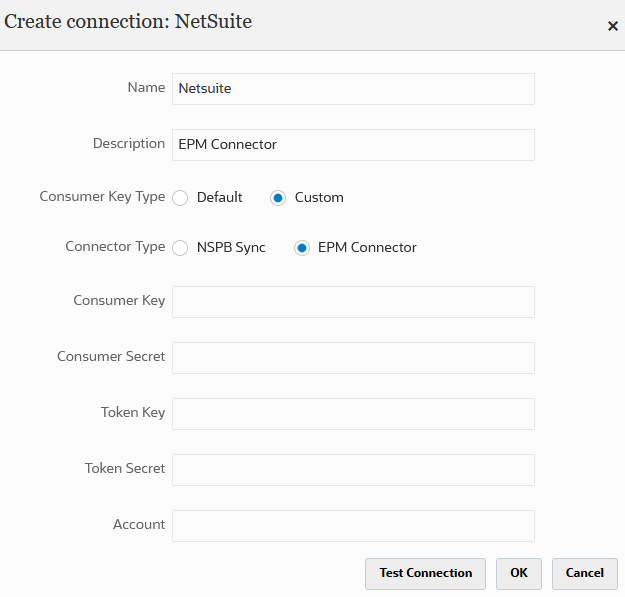
Image Shows the Netsuite Connection Page
For customers who already load data to their EPM Cloud application using NetSuite, the Consumer Key Type default value is NSPB Sync on the NetSuite Connection page.
If you already use NSPB Sync, you should continue to use the NSPB Sync. Otherwise, you should use the EPM Connector.
Business Benefit: The Oracle EPM Connector is a managed SuiteApp. When a new version is available, NetSuite automatically updates the account.
Tips And Considerations
Customers who already use Oracle NetSuite Planning and Budgeting (NSPB) Sync Suite App are not impacted by the new Oracle EPM Connector type.
Key Resources
NetSuite Applications Suite
- If you need to set up TBA in NetSuite Planning and Budgeting to facilitate the connection to NetSuite, you need to check the NSPB Sync Connection Type. See Setting Up Token-based Authentication in Planning and Budgeting.
- If you need to set up TBA in NetSuite Account Reconciliation to facilitate the connection to NetSuite, you need to check EPM Connector Connection Type. See Setting Up Token-based Authentication in Account Reconciliation.
Group Attributes in Reconciliation Compliance and Transaction Matching
A group attribute is a set of dependent custom attributes, in which each attribute is called a member attribute. An example is a group attribute named Store with member attributes such as Store ID, Store Name, Store Location, Contact Number, and so on. The Store group attribute contains details of multiple stores.
Once a group attribute is defined, one or more of its member attributes can be used when:
- defining profiles
- working with reconciliations
- selecting columns and adding filters
- defining data sources
- validating data during transaction matching loads
- creating adjustment and support attributes
- analyzing data using charts and dashboards
Business Benefit: Group attributes provide an easy and effective way of managing dependent attributes that are related to a single entity. Using group attributes prevents errors when loading or updating a set of dependent attributes.
Key Resources
- Defining Group Attributes in Setting Up and Configuring Account Reconciliation
Additional Profile Attributes in Search Bar, Filters, and Dashboards
Certain additional profile attributes can be used when searching and filtering transactions in the Transactions tab of Transaction Matching. When creating dashboards using the Match Types object, these attributes are available for selection in the Attribute drop-down in the Layout tab.
Business Benefit: This feature enhances search and filter operations by providing additional criteria that can specified.
Key Resources
- Searching Transactions in Transaction Matching in Administering Account Reconciliation
- Selecting Columns While Searching Transactions in Transaction Matching in Administering Account Reconciliation
- Creating Custom Dashboards in Administering Account Reconciliation
New Application Roles for Managing and Viewing Match Types
Two new application roles, Match Types – Manage and Match Types – View, can be assigned to Power Users, Users, or Viewers.
The Match Type – Manage role enables users to manage match types, adjustment attributes, support attributes, journal columns, and group attributes. The Match Type – View role enables users to view details of the match types, adjustment attributes, support attributes, and journal columns.
Business Benefit: Organizations that require certain non-administrative users to manage match types, attributes, and journal columns can use these new roles instead of assigning these users the Service Administrator role.
Key Resources
- Creating Match Types in Setting Up and Configuring Account Reconciliation
IMPORTANT Actions and Considerations
One-Week Lag Between Readiness Documents Live and Help Center Live
Because Oracle readiness documents (What's New and New Feature Summary) are live one week before the monthly update is applied to Test environments, some links to documentation included in the readiness documents will not work until after the Oracle Help Center update is complete when the monthly update is applied to Test environments.
This update includes Important Actions and Considerations for:
- EPM Cloud Platform
- Account Reconciliation
EPM CLOUD PLATFORM
Plan to Discontinue Support for Non-Redwood Experience Themes
Oracle's Redwood UX Design is helping organizations improve user productivity, reduce training costs, and increase user satisfaction. As such, it has gained wide adoption across our Oracle Cloud user base.
Within Cloud EPM the Redwood Theme has had significant adoption, and major new platform innovations over the past few years have primarily been released only within the Redwood theme.
Going forward, future innovations in Cloud EPM and Redwood UX Design patterns are likewise targeted to be available within the Redwood theme only. Customers are encouraged to deploy their applications using Redwood theme only.
Towards the end of first quarter of 2024 (subject to change, safe harbor applies), the Redwood Experience will offer a default Oracle theme and these two additional appearance options: Custom Light and Custom Dark. The appearance of all EPM Cloud environments that currently use the Redwood Experience will automatically be shifted to either the default Oracle theme or the Custom Dark theme based on currently deployed background appearance of these environments.
In a later update planned for the second quarter of 2024, Oracle will automatically convert non-Redwood theme environments to the Redwood Experience.
If you're a customer and you're not already using Redwood Experience, you're encouraged to move to the Redwood Experience as soon as possible to take advantage of its user experience advantages.
Customers are encouraged to watch the Cloud Customer Connect session in April 2023: EPM – Why You Should Be Using The Redwood Theme in EPM Cloud
This session covers why users should be adopting the Redwood theme, customizations available within the theme (such as company logo), and the future plans around non-Redwood themes for Cloud EPM.
Transition from Identity Cloud Service (IDCS) to Identity and Access Management (IAM)
EPM Cloud environments on OCI (Gen 2) are transitioning from Identity Cloud Service (IDCS) to Identity and Access Management (IAM) domains. For information on IAM, see Overview of Identity and Access Management.
After this transition, existing IDCS administration and My Profile functionalities remain the same, but are hosted on Oracle Cloud Console. The Oracle Cloud sign-in page has an updated design to match the latest Oracle Cloud design guidelines. To learn more on what to expect with this transition, see Introducing OCI IAM Identity Domains: What customers need to know.
Announcement: Data Management Feature Migration to Data Integration
The user interface pages listed in the table below are no longer available in Data Management, but are available in Data Integration. Data Integration is available from the Data Exchange card from the home screen in the Cloud EPM Business Process, and users can access these features in the current Cloud EPM update. Data Management is not going away – we are only moving a few features now that have 100% parity with Data Integration. Profitability and Cost Management customers are not affected by the migration and do not see a change in their Data Management user interface. REST APIs are not impacted by this change.
| Data Management | Data Integration | Data Integration Navigation Path |
|---|---|---|
| Source System |
Configure Connections |
From the Data Integration UI, select the Actions drop down, and then Applications. In Applications, there is an icon next to the drop down labeled Configure Connections. |
| Target Application |
Applications |
From the Data Integration UI, select the Actions drop down, and then Applications. |
| Period Mapping |
Period Mapping |
From the Data Integration UI, select the Actions drop down, and then Period Mapping. |
| Category Mapping |
Category Mapping |
From the Data Integration UI, select the Actions drop down, and then Category Mapping. |
Data Integration is the next generation of the Data Management user interface, enabling users to easily build and manage Cloud EPM integrations. As feature parity between Data Integration and Data Management becomes complete, Data Management features will be turned off, and users will use the new Data Integration user interface instead.
This transition is gradual; future What's New documents will include information about the first set of planned changes as well as updates about additional changes planned for the future.
All Data Integration features discussed in this document are currently generally available in the Cloud EPM business processes.
Integration definitions built with Data Management are also visible in Data Integration, which enables an easy transition. (Data Integration is a new user interface on the Data Management data model and does not require migration of content from Data Management to Data Integration).
Please note that additional new integration features will only be included in Data Integration, and will not be back-ported to Data Management. Critical bug fixes and security fixes will still be made to Data Management until all features are fully migrated. In addition, all features from Data Management will be migrated to Data Integration with the exception of the following:
- The batch feature will be replaced by the new Pipeline feature. The Pipeline feature was available in the June (23.06) update.
- The Report Definition feature will not be migrated, only the Report Execution feature. Please note that Account Reconciliation, Financial Consolidation and Close, Planning and Tax Reporting provide a feature to report against the Data Integration relational tables using a custom SQL and a BI Publisher report template via Task Manager.
- The ability to create new Custom Applications in Data Management will no longer available, and customers should use the “Data Export to File” application type instead. (Existing integrations using a custom application will not be impacted.) See Custom Application in Data Management under EPM Cloud Platform in the Important Actions and Considerations section of this document.
For reference, please see the Data Integration guide available from the documentation library for your specific EPM business process. Select the desired business process, then Books, and then scroll down to the Administering Data Integration for Oracle Enterprise Performance Management Cloud documentation link.
See Administering Data Integration for Oracle Enterprise Performance Management Cloud for more information.
Removal of Support for Custom Application in Data Management
Since the September (23.09) update, custom target applications can no longer be added in Data Management. (Existing integrations that use a custom target application will not be impacted, and will still run without any changes.) This type of application was used to extract data from the EPM Cloud, and then the data was pushed into a flat file instead of being loaded to an EPM Cloud application. The custom application was superseded by the Data Export to File feature in an earlier update. The Data Export to File feature has enhanced functions and capabilities.
If you still have a custom target application, it is recommended that you use the Upgrade Custom Applications option to migrate your existing custom target application to a data export to file application. For more information, see Upgrade Custom Applications at: https://docs.oracle.com/en/cloud/saas/enterprise-performance-management-common/erpia/upgrade_custom_applications_100x438d5119.html.
The migration converts existing file formats from the custom target application to the file formats used in the data export to file option and retains all the existing setup. When the custom target application has been converted, you can run same integration as before. Data export file applications are available both in Data Management and Data Integration.
Oracle Financial Reporting Statement of Direction
Please refer to the Statement of Direction for Oracle Financial Reporting:
Oracle Support Document 2910806.1 (EPM Cloud Financial Reporting Statement of Direction)
Please note that the Oracle Financial Reporting tentative deprecation dates have been moved to mid-to-late CY24.
For more information:
- See Appendix B in the Designing with Reports Guide: Migrating Reports from Financial Reporting.
- On June 8, the most recent Oracle Cloud Customer Connect event, Migrating Your Financial Reporting to Reports, was presented. There is a presentation, an event recording, and an FAQ sheet accessible. In order to view the event recording and documentation, you must log in to Cloud Customer Connect.
ACCOUNT RECONCILIATION
Reverse Adjustments in Transaction Matching
Starting in a future update, when you unmatch a transaction that was matched with an adjustment, Account Reconciliation will create a reverse adjustment. This reverse adjustment can be posted to ERP using Export Journals.
Change to the Unmatched Transactions Tab
Starting with the October (23.10) update, in the Unmatched Transactions tab of the Matching dialog, the View Supporting Details icon has been removed. To view the supporting details for a transaction, click the link in the Support ID column. The details are displayed in the Supporting Details dialog.