
This document will continue to evolve as existing sections change and new information is added. All updates appear in the following table:
| Date | Module | Feature | Notes |
|---|---|---|---|
| 25 AUG 2023 | Created initial document. |
 HAVE AN IDEA?
We’re here and we’re listening. If you have a suggestion on how to make our cloud services even better then go ahead and tell us. There are several ways to submit your ideas, for example, through the Ideas Lab on Oracle Customer Connect. Wherever you see this icon after the feature name it means we delivered one of your ideas.
GIVE US FEEDBACK
We welcome your comments and suggestions to improve the content. Please send us your feedback at oracle_fusion_applications_help_ww_grp@oracle.com.
DISCLAIMER
The information contained in this document may include statements about Oracle’s product development plans. Many factors can materially affect Oracle’s product development plans and the nature and timing of future product releases. Accordingly, this Information is provided to you solely for information only, is not a commitment to deliver any material, code, or functionality, and should not be relied upon in making purchasing decisions. The development, release, and timing of any features or functionality described remains at the sole discretion of Oracle.
This information may not be incorporated into any contractual agreement with Oracle or its subsidiaries or affiliates. Oracle specifically disclaims any liability with respect to this information. Refer to the Legal Notices and Terms of Use for further information.
Column Definitions:
Report = New or modified, Oracle-delivered, ready to run reports.
UI or Process-Based: Small Scale = These UI or process-based features are typically comprised of minor field, validation, or program changes. Therefore, the potential impact to users is minimal.
UI or Process-Based: Larger Scale* = These UI or process-based features have more complex designs. Therefore, the potential impact to users is higher.
Features Delivered Disabled = Action is needed BEFORE these features can be used by END USERS. These features are delivered disabled and you choose if and when to enable them. For example, a) new or expanded BI subject areas need to first be incorporated into reports, b) Integration is required to utilize new web services, or c) features must be assigned to user roles before they can be accessed.
| Ready for Use by End Users Reports plus Small Scale UI or Process-Based new features will have minimal user impact after an update. Therefore, customer acceptance testing should focus on the Larger Scale UI or Process-Based* new features. |
Customer Must Take Action before Use by End Users Not disruptive as action is required to make these features ready to use. As you selectively choose to leverage, you set your test and roll out timing. |
|||||
|---|---|---|---|---|---|---|
| Feature |
Report |
UI or |
UI or |
|
||
getEssbaseQryGovExecTime and setEssbaseQryGovExecTime Commands |
||||||
REST APIS to Get and Set Essbase Query Governor Execution Time |
||||||
Groovy Feature to Run a Scenario Rollup in an Application That Has Strategic Modeling Enabled |
||||||
Announcement: Data Management Feature Migration to Data Integration |
||||||
Support for Passing Substitution Variable as Input Parameter in Pipeline Variables |
||||||
Documentation Updates Available One Week After Readiness Documents
Updated documentation is published on the Oracle Help Center on the first Friday of each month, coinciding with the monthly updates to Test environments. Because there is a one week lag between the publishing of the readiness documents (What's New and New Feature Summary) and Oracle Help Center updates, some links included in the readiness documents will not work until the Oracle Help Center update is complete.
https://docs.oracle.com/en/cloud/saas/epm-cloud/index.html
Fixed Issues and Considerations for EPM Cloud Platform
Software issues addressed each month and considerations are posted to a knowledge article on My Oracle Support. Click here to review. You must have a My Oracle Support login to access the article.
NOTE: Fixed issues for EPM Cloud Platform components (Smart View for Office, EPM Automate, REST API, Migration, Access Control, Data Management/Data Integration, Reports, Financial Reporting, and Calculation Manager) are available in a separate document on the My Oracle Support “Release Highlights” page.
This provides visibility into EPM Cloud release contents.
Business Benefit: These resources can help you optimize your EPM implementation and user experience by providing valuable information and user assistance.
Test Environments: Oracle will apply this monthly update during the first daily maintenance that occurs at or after 22:00 UTC on Friday, September 1, 2023.
Production Environments: Oracle will apply this monthly update during the first daily maintenance that occurs at or after 22:00 UTC on Friday, September 15, 2023.
NOTE: The monthly update will not be applied to any environment for which this monthly update is requested to be skipped using the EPM Automate skipUpdate command or service request to Oracle.
NOTE: Backing up the daily maintenance snapshot and restoring the environment as needed are self-service operations. Oracle strongly recommends that you download the maintenance snapshot every day to a local server.
The Oracle Help Center provides access to updated documentation. The updates will be available in the Help Center on Friday, September 1, 2023.
NOTE: Some of the links to new feature documentation included in this readiness document will not work until after the Oracle Help Center update is complete.
A new tutorial is available:
Setting Up Security in Cloud EPM Business Processes
This tutorial describes the layers of security in Cloud EPM business processes and shows you how to manage security using Access Control and access permissions.
Business Benefits: Tutorials provide instructions with sequenced videos and documentation to help you learn a topic.
OCI Migration: Oracle-Managed Migration Continues; Customer-Managed Migration Not Available Any Longer
One of Oracle's latest advancements, Oracle Cloud Infrastructure (OCI) is the foundation of Oracle's second generation cloud. OCI, a purpose-built, best-in-class platform for running enterprise applications, is engineered from the ground up to run mission-critical databases, workloads, and applications while providing end-to-end security. Oracle's data centers around the globe are standardizing on the new OCI architecture which will deliver even greater performance and reliability. There are a lot of EPM Cloud features that are available only in OCI. See Features Available only in OCI EPM Cloud Environments in Getting Started with Oracle Enterprise Performance Management Cloud for Administrators.
Oracle will migrate all Classic Commercial environments to OCI by the end of 2023 using monthly migration waves.
Oracle has sent notifications for Oracle-managed migrations specifying the migration schedule. Follow the instructions in the notification.
For customers whose environments were included in Wave 6 (June 2023 Migration Notification): The migration of application data and users from Classic to OCI environments and the DNS configuration change to route the existing Classic service URLs to OCI environments will occur in the 23.09 (September) monthly update. If you prefer not to have the migration take place in the 23.09 monthly update, please run the skipUpdate EPM Automate command to skip the 23.09 update.
- All Classic environments in the Amsterdam (EM2) Data Center must be migrated by Wave 6. If your environment in Amsterdam Data Center is scheduled to be migrated in Wave 6, you can skip the migration for up to one month only.
- If your environments are included in Wave 7 (July 2023 Migration Notification), you must already have received your OCI environments. You should go through the optional migration steps, which include setting up SSO and IP Allowlist, and testing based on your requirements. See these information sources:
- Oracle-Managed Migration in Oracle Enterprise Performance Management Cloud Operations Guide
- Tasks to Perform After Cloning Environments in Administering Migration for Oracle Enterprise Performance Management Cloud
- If your environments are included in Wave 8 (August 2023 Migration Notification), you will receive your OCI environments in September 2023. Because your OCI environments may be provisioned at different times, you may not receive notification emails for all the environments at the same time.
-
By Wave 8, you must have received notifications for all Classic Commercial environments that were not scheduled for migration in earlier waves or migrated through the Customer-Managed Migration option.
For Migration waves schedule information, see EPM Cloud Classic to OCI Migration Schedule in Oracle Enterprise Performance Management Cloud Operations Guide.
Oracle is no longer accepting any service request for Customer-Managed Migration, and expects all Customer-Managed Migrations to finish by these deadlines:
- Amsterdam (EM2) Data Center: Finish migration by the end of October 2023. Oracle will terminate Classic environments in the Amsterdam (EM2) Data Center in November 2023.
- All other data centers: Finish migration by the end of November 2023. Oracle will terminate Classic environments in other data centers in December 2023.
NOTE: At this time, the environments hosted in US-Gov and UK-Gov data centers are not eligible for migration to OCI.
Business Benefit: OCI provides you a purpose-built, best-in-class platform that is engineered from the ground up to run mission-critical databases, workloads, and business processes while providing end-to-end security. This new architecture delivers greater performance and reliability, and a number of EPM Cloud features that are not available in Classic EPM Cloud.
Steps to Enable
Review and follow instructions: EPM Cloud Classic to Oracle Cloud Infrastructure (OCI) Migration in Oracle Enterprise Performance Management Cloud Operations Guide
Key Resources
- EPM Cloud Classic to Oracle Cloud Infrastructure (OCI) Migration in Oracle Enterprise Performance Management Cloud Operations Guide
- Features Available only in OCI EPM Cloud Environments in Getting Started with Oracle Enterprise Performance Management Cloud for Administrators
getEssbaseQryGovExecTime and setEssbaseQryGovExecTime Commands
The new version of EPM Automate introduces the getEssbaseQryGovExecTime and setEssbaseQryGovExecTime commands.
getEssbaseQryGovExecTime Command
This command retrieves the maximum amount of time, in seconds, that an Essbase query can run to retrieve and deliver information before the query is terminated.
setEssbaseQryGovExecTime Command
This command sets the maximum amount of time, in seconds, that an Essbase query can run to retrieve and deliver information before the query is terminated.
Business Benefit: These commands help you fine-tune the time allocated for running Essbase queries to avoid them being terminated.
Key Resources
- Working with EPM Automate for Oracle Enterprise Performance Management Cloud:
REST APIS to Get and Set Essbase Query Governor Execution Time
Two new REST APIs are available to get and set the Essbase Query Governor Execution time.
- Get Essbase Query Governor Execution Time returns the Essbase Query Governor Execution Time (maximum number of seconds that a query can run before Essbase Server terminates it) of all the Essbase cubes.
- Set Essbase Query Governor Execution Time sets the Essbase Query Governor Execution Time (maximum number of seconds that a query can run before Essbase Server terminates it) for all the Essbase cubes.
Business Benefit: These REST APIs help you fine-tune the time allocated for running Essbase queries to avoid their termination.
Key Resources
- Rest API for Oracle Enterprise Performance Management Cloud
Access Requirements
- Service Administrator
Groovy Feature to Run a Scenario Rollup in an Application That Has Strategic Modeling Enabled
You can now use EPM Groovy rules to run a Scenario Rollup in an application that has Strategic Modeling enabled. The instance of the ScenarioRollup class can be used to perform multiple operations on a Scenario Rollup along with the passed model as selected model.
Operations supported by this object include the following:
- Add a new root business case
- Remove an existing root business case
- Verify whether a business case is available
- Obtain a list of all defined business cases
- Obtain a list of all leaf node scenarios
- Add a business case to the execute list
- Execute a scenario rollup with selected business cases
For details and examples, see ScenarioRollup in EPM Cloud Groovy Rules Java API Reference.
Business Benefit: Using Groovy rules gives you flexibility and allows you to automate running the scenario rollup.
Tips And Considerations
- To get a quick introduction to Groovy business rules, watch the Learning Groovy in EPM Cloud video.
-
To get started quickly using Groovy examples, click the examples link under Example Groovy Scripts in EPM Groovy Rules Java API Reference.
Key Resources
- Learning Groovy in EPM Cloud video
- Creating a Groovy Business Rule in Designing with Calculation Manager for Oracle Enterprise Performance Management Cloud
- Introduction to Groovy Business Rules
- Groovy Tutorials
- EPM Cloud Groovy Rules Java API Reference
- About Strategic Modeling in Administering Planning
- Creating and Running Scenario Rollups in Working with Planning
Access Requirements
-
Calculation Manager Business Rule Designer
Updated EPM Books Extension for Smart View
An updated EPM Books extension for Oracle Smart View for Office is now available to download and install. This update includes general improvements and bug fixes.
Business Benefit: Downloading and installing the latest EPM Books extension for Smart View gives you access to the latest features, improvements, and defect fixes.
Steps to Enable
To take advantage of the features, improvements, and defect fixes in the EPM Books extension:
From within Smart View, in the Options dialog, Extensions tab, click the Check for Updates, New Installs, and Uninstalls link.
Select your business process instance, then follow the prompts.
Key Resources
- Working with Oracle Smart View for Office:
Export Groups to CSV Functionality in Access Control
Service Administrators and Access Control Managers can now export all EPM Cloud Group names and descriptions to a Groups.csv file using the Export to CSV button in Manage Groups tab of Access Control. The Export to CSV button is disabled if there is no group in Access Control to export.
Business Benefit: You can now export and review group information using Groups.csv file.
Key Resources
- Exporting EPM Cloud Groups to a CSV File in Administering Access Control for Oracle Enterprise Performance Management Cloud
New Locations Page in Data Integration
A Location page is now available in Data Integration. Customers can view available locations and optionally delete any unused locations.
The Locations page can be accessed by selecting Locations from the Action menu.
On the Locations page, you can view all available locations.
Business Benefit: Customers can view location detail such as the import format, or the source and target for the location. Additionally, customers can delete unused locations on the Locations page.
Key Resources
- Viewing Locations in Administering Data Integration for Oracle Enterprise Performance Management Cloud
System Settings Supported in Data Integration
Predefined system-level options can now be set in Data Integration. You can set, update and clear values that apply to the entire system.
System-level options can be accessed by selecting System Settings from the Action menu.
On the System Settings page, select the option to add or change.
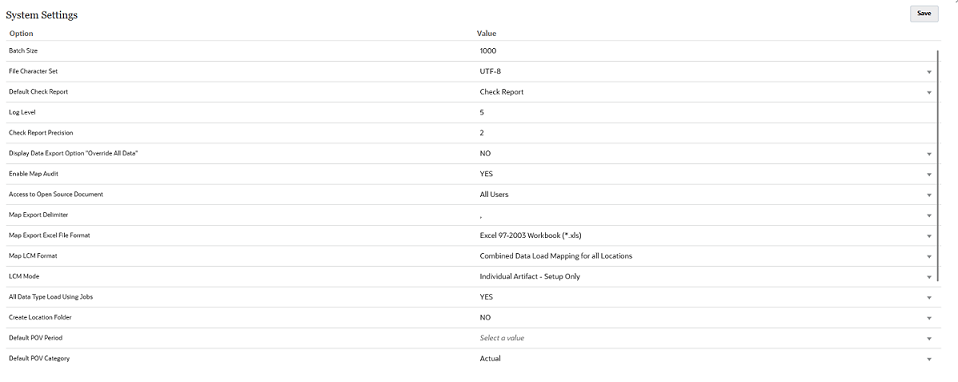
Image Shows The System Settings Page.
Application-level settings and User-level settings can only be set in Data Management.
Business Benefit: You can set system-level values on the fly to accommodate various business needs in Data Integration. Previously system-level options could only be specified in Data Management.
Key Resources
- System Settings in Administering Data Integration for Oracle Enterprise Performance Management Cloud
Announcement: Data Management Feature Migration to Data Integration
The user interface pages listed in the table below are no longer available in Data Management, but are available in Data Integration. Data Integration is available from the Data Exchange card from the home screen in the Cloud EPM Business Process, and users can access these features in the current Cloud EPM update. Data Management is not going away – we are only moving a few features now that have 100% parity with Data Integration. Profitability and Cost Management customers are not affected by the migration and do not see a change in their Data Management user interface. REST APIs are not impacted by this change.
| Data Management | Data Integration | Data Integration Navigation Path |
|---|---|---|
| Source System |
Configure Connections |
From the Data Integration UI, select the Actions drop down, and then Applications. In Applications, there is an icon next to the drop down labeled Configure Connections. |
| Target Application |
Applications |
From the Data Integration UI, select the Actions drop down, and then Applications. |
| Period Mapping |
Period Mapping |
From the Data Integration UI, select the Actions drop down, and then Period Mapping. |
| Category Mapping |
Category Mapping |
From the Data Integration UI, select the Actions drop down, and then Category Mapping. |
Data Integration is the next generation of the Data Management user interface, enabling users to easily build and manage Cloud EPM integrations. As feature parity between Data Integration and Data Management becomes complete, Data Management features will be turned off, and users will use the new Data Integration user interface instead.
This transition is gradual; future What's New documents will include information about the first set of planned changes as well as updates about additional changes planned for the future.
All Data Integration features discussed in this document are currently generally available in the Cloud EPM business processes.
Integration definitions built with Data Management are also visible in Data Integration, which enables an easy transition. (Data Integration is a new user interface on the Data Management data model and does not require migration of content from Data Management to Data Integration).
Please note that additional new integration features will only be included in Data Integration, and will not be back-ported to Data Management. Critical bug fixes and security fixes will still be made to Data Management until all features are fully migrated. In addition, all features from Data Management will be migrated to Data Integration with the exception of the following:
- The batch feature will be replaced by the new Pipeline feature. The Pipeline feature was available in the June (23.06) update.
- The Report Definition feature will not be migrated, only the Report Execution feature. Please note that Account Reconciliation, Financial Consolidation and Close, Planning and Tax Reporting provide a feature to report against the Data Integration relational tables using a custom SQL and a BI Publisher report template via Task Manager.
- The ability to create new Custom Applications in Data Management will no longer available, and customers should use the “Data Export to File” application type instead. (Existing integrations using a custom application will not be impacted.) See Custom Application in Data Management under EPM Cloud Platform in the Important Actions and Considerations section of this document.
For reference, please see the Data Integration guide available from the documentation library for your specific EPM business process. Select the desired business process, then Books, and then scroll down to the Administering Data Integration for Oracle Enterprise Performance Management Cloud documentation link.
Business Benefit: Data Integration is the next generation of the Data Management user interface. It enables users to build and manage EPM Cloud integrations more easily.
Key Resources
New File Operations Job Type in Pipeline
The new File Operations job type in the Pipeline enables you to run the following operations at run time:
- Copy a file.
- Move a file.
- Unzip a file.
All file operations enable you to specify the source directory, source file name, target directory and target file name (not required for an unzip file operation).
Business Benefit: The File Operations job type enables customer to copy, move, and unzip a file at runtime.
Key Resources
- Using a File Operations Job Type in Administering Data Integration for Oracle Enterprise Performance Management Cloud
New Continue and Stop Pipeline Execution Options
When running a Pipeline, you now have options to continue or stop the processing of a stage when a step in a stage fails.
Use the “On Success” option to continue processing a stage when steps in the Pipeline definition are executed successfully. You can also skip a stage in the case where you want to bypass a stage that is only executed on failure, and proceed to the following stage.
Use the On Failure option to continue or stop processing a stage when a step in a stage fails. You can either continue processing the subsequent steps in the stage or stop processing the current stage, and skip to perform any cleanup step.
Business Benefit: The new On Success and On Failure options provide you with a way to stop processing when a step in a a stage fails or continue to the next stage.
Key Resources
- Pipeline Process Description in Administering Data Integration for Oracle Enterprise Performance Management Cloud
Support for Passing Substitution Variable as Input Parameter in Pipeline Variables
You can now use a substitution variable as an input value in Pipeline Variables. The substitution variable must be defined for all cubes to be used as an input value.
Business Benefit: In prior updates, variables in a Month#Year format were supported for data loads only. In this update, you can use a single substitution variable as an input for all pipelines.
Key Resources
- Adding a Substitution Variable as an Input Parameter in Administering Data Integration for Oracle Enterprise Performance Management Cloud
Forms, Reports, Dashboards, and Infolets
Copy URL Option Now Available for Non-Administrative Users
The Copy URL option, formerly only available to Service Administrators, is now available to all users so that direct URLs to artifacts can be shared.
Use the Copy URL option on the artifact listing page to copy the unique URL for the following artifacts in your EPM Cloud business process:
- Dashboards
- Forms
- Infolets
- Reports
For example, the primary report builders in your organization might be non-administrative users. These users can create and modify reports. Now they can then use the Copy URL option to share reports with other users by providing them with a direct URL link. Sharing direct URLs is an easier and simpler approach than having other users log in, navigate to reports, and then search for the correct report.
To copy the unique URL for an EPM Cloud artifact, open the listing page for the artifact, click the Actions icon (...) next to the artifact, and then select Copy URL.
NOTE: Only users with access to the targeted artifact can perform actions on it.
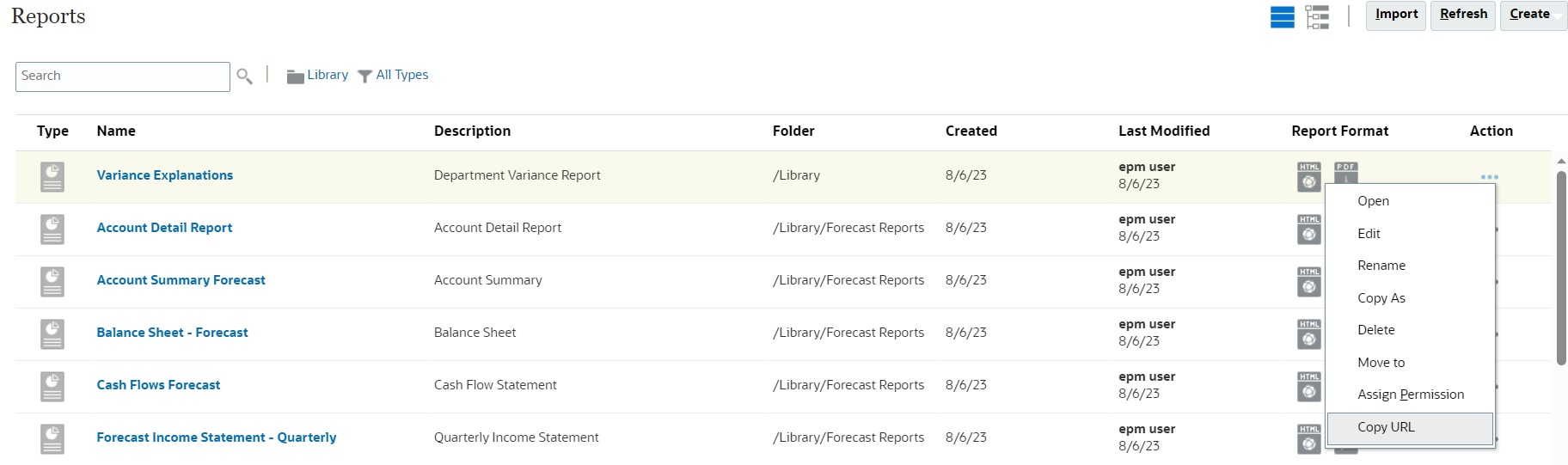
Reports Listing Page Showing the Copy URL Option Under Actions
Business Benefit: Allowing all users to use the Copy URL option to share a direct URL link to a report, dashboard, form, or infolet, provides a better user experience.
Key Resources
- Planning and Planning Modules
- Working with Planning
Task Manager is enhanced with a new task system attribute called Ever Been Late, which automatically updates to indicate if the task has ever missed a scheduled due date within its workflow. This new attribute allows you to easily identify any task, which missed one or more of its scheduled due dates. Even if the task is currently not late but if the Assignee or any Approver has ever been late with their workflow, then the Ever Been Late attribute is set to Yes.
Business Benefit: The Ever Been Late attribute allows you better visibility into task execution by easily identifying the tasks which missed scheduled due dates.
Key Resources
- Planning
- Administering Planning
There are no new features in this update except for the applicable features listed in the EPM Cloud Platform section.