
This document will continue to evolve as existing sections change and new information is added. All updates appear in the following table:
| Date | Product | Feature | Notes |
|---|---|---|---|
| 20 DEC 2021 | Created initial document. |
 HAVE AN IDEA?
We’re here and we’re listening. If you have a suggestion on how to make our cloud services even better then go ahead and tell us. There are several ways to submit your ideas, for example, through the Ideas Lab on Oracle Customer Connect. Wherever you see this icon after the feature name it means we delivered one of your ideas.
GIVE US FEEDBACK
We welcome your comments and suggestions to improve the content. Please send us your feedback at oracle_fusion_applications_help_ww_grp@oracle.com.
DISCLAIMER
The information contained in this document may include statements about Oracle’s product development plans. Many factors can materially affect Oracle’s product development plans and the nature and timing of future product releases. Accordingly, this Information is provided to you solely for information only, is not a commitment to deliver any material, code, or functionality, and should not be relied upon in making purchasing decisions. The development, release, and timing of any features or functionality described remains at the sole discretion of Oracle.
This information may not be incorporated into any contractual agreement with Oracle or its subsidiaries or affiliates. Oracle specifically disclaims any liability with respect to this information. Refer to the Legal Notices and Terms of Use for further information.
Pre-Update and Post-Update Tasks
Depending on the features you're using in your Cloud applications, you may be required to perform certain steps immediately before or after your quarterly update. For details of these pre-update and post-update steps and the product areas that are affected, refer to Oracle SCM Cloud: Performing Your Quarterly Update (doc ID 2337485.1) on My Oracle Support.
Optional Uptake of New Features (Opt In)
Oracle Cloud Applications delivers new updates every quarter. This means every three months you'll receive new functionality to help you efficiently and effectively manage your business. Some features are delivered Enabled meaning they are immediately available to end users. Other features are delivered Disabled meaning you have to take action to make available. Features delivered Disabled can be activated for end users by stepping through the following instructions using the following privileges:
- Review Applications Offering (ASM_REVIEW_APPLICATIONS_OFFERINGS_PRIV)
- Configure Oracle Fusion Applications Offering (ASM_CONFIGURE_OFFERING_PRIV)
Here’s how you opt in to new features:
- Click Navigator > My Enterprise > New Features.
- On the Features Overview page, select your offering to review new features specific to it. Or, you can leave the default selection All Enabled Offerings to review new features for all offerings.
- On the New Features tab, review the new features and check the opt-in status of the feature in the Enabled column. If a feature has already been enabled, you will see a check mark. Otherwise, you will see an icon to enable the feature.
- Click the icon in the Enabled column and complete the steps to enable the feature.
In some cases, you might want to opt in to a feature that's not listed in the New Features work area. Here's how to opt in:
- Click Navigator > My Enterprise > Offerings.
- On the Offerings page, select your offering, and then click Opt In Features.
- On the Opt In page, click the Edit Features (pencil) icon for the offering, or for the functional area that includes your feature.
- On the Edit Features page, complete the steps to enable the feature.
For more information and detailed instructions on opting in to new features for your offering, see Offering Configuration.
Opt In Expiration
Occasionally, features delivered Disabled via Opt In may be enabled automatically in a future update. This is known as an Opt In Expiration. If your cloud service has any Opt In Expirations you will see a related tab in this document. Click on that tab to see when the feature was originally delivered Disabled, and when the Opt In will expire, potentially automatically enabling the feature. You can also click here to see features with Opt In Expirations across all Oracle Cloud Applications.
Column Definitions:
Report = New or modified, Oracle-delivered, ready to run reports.
UI or Process-Based: Small Scale = These UI or process-based features are typically comprised of minor field, validation, or program changes. Therefore, the potential impact to users is minimal.
UI or Process-Based: Larger Scale* = These UI or process-based features have more complex designs. Therefore, the potential impact to users is higher.
Features Delivered Disabled = Action is needed BEFORE these features can be used by END USERS. These features are delivered disabled and you choose if and when to enable them. For example, a) new or expanded BI subject areas need to first be incorporated into reports, b) Integration is required to utilize new web services, or c) features must be assigned to user roles before they can be accessed.
| Ready for Use by End Users Reports plus Small Scale UI or Process-Based new features will have minimal user impact after an update. Therefore, customer acceptance testing should focus on the Larger Scale UI or Process-Based* new features. |
Customer Must Take Action before Use by End Users Not disruptive as action is required to make these features ready to use. As you selectively choose to leverage, you set your test and roll out timing. |
|||||
|---|---|---|---|---|---|---|
| Feature |
Report |
UI or |
UI or |
|
||
Use Resource Requirements to Analyze and Connect with Assembly Production |
||||||
Hide Empty Rows and Columns in Planning Tables
You can increase your efficiency in making quick decisions by displaying only rows or columns with meaningful data. With this update, in planning tables you can hide rows and columns that have either zero or null in the entire column or row.
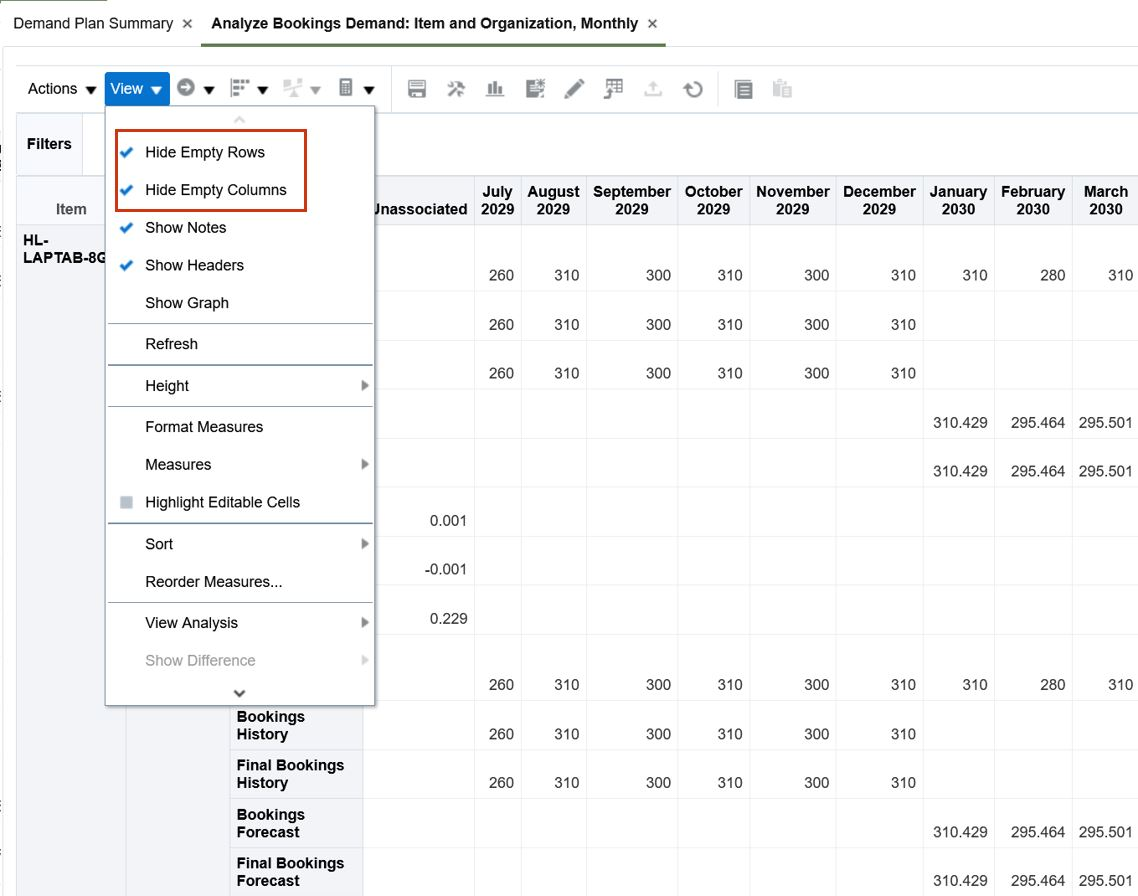
Hide Empty Rows and Hide Empty Columns options in View Menu
Improve planner productivity by increasing the density of meaningful data displayed.
Watch a Demo.
Steps to Enable
You don't need to do anything to enable this feature.
Tips And Considerations
- Import from Microsoft Excel is disabled if the Hide Empty Rows or Hide Empty columns options are enabled.
- The Hide Empty Rows and Hide Empty Columns options aren't considered for Publish or REST.
- The Hide Empty Rows and Hide Empty Columns settings are saved as part of the table layout.
- Editable measures with no values will be hidden when either the Hide Empty Rows or Hide Empty Columns option is enabled. To manually enter values you must first deselect these options.
- Indicator measures that have only values of 0 or 1 will be hidden when all values are 0 and either the Hide Empty Rows or Hide Empty Columns option is enabled.
Key Resources
Role Information
You have a couple options for giving people access to this feature, depending on whether you're assigning them predefined job roles or your own configured job roles.
- Users who are assigned any of these predefined job roles are automatically able to access this feature:
- Supply Chain Planner (ORA_MSC_SUPPLY_CHAIN_PLANNER_JOB)
- Demand Planner (ORA_MSC_DEMAND_PLANNER_JOB)
- Materials Planner (ORA_MSC_MATERIALS_PLANNER_JOB)
- Sales and Operations Planner (ORA_MSC_SALES_AND_OPERATIONS_PLANNER_JOB)
- Replenishment Planner (ORA_MSC_REPLENISHMENT_PLANNER_JOB)
- Users who are assigned configured job roles that contain these privileges are able to access this feature:
- View Planning Tables (MSC_VIEW_PLANNING_TABLES_PRIV)
- Maintain Planning Tables (MSC_MAINTAIN_PLANNING_TABLES_PRIV)
Use Resource Requirements to Analyze and Connect with Assembly Production
You can now analyze resource or work center requirements by assembly items or product categories. This new table complements the aggregate build plan which displays critical components and resources for an assembly's bill of resources. Previously, the sales and operations planning process didn’t compute the specific resource usages for assembly items or product categories which could make it difficult to analyze and adjust resource loading.
The new Resource Requirements by Assembly Item measure has both resource and product as conforming dimensions and reports resource requirements by produced assembly items. A new table named Resource Plan by Category and Quarter also includes two additional measures that combine the resource and product dimensions to help you adjust resource loading:
- The Resource Quantity by Assembly Item measure reports the resource usage quantity from an assembly item's bill of resources.
- The Production Plan by Resource measure reports the production plan for assembly items associated with a resource.
A new graph named Resource Plan by Category and Quarter Graph compares Resource Requirements by Assembly Item with Resource Availability. Resource Requirements by Assembly Item is displayed as a bar chart stacked by product category. Resource Availability is an existing measure that has resource as a conforming dimension, not product, so it isn't associated with assembly items. By using the graph to analyze resource loading, you can use both the Net Resource Availability (also an existing resource measure not conforming to the product dimension) and Resource Quantity by Assembly Item measures in the table to determine how many more assembly items could be produced.
For example, if Net Resource Availability for a resource is 30 hours in a time period and Resource Quantity by Assembly Item for assembly item X is 0.05, then it's possible to increase resource requirements to produce 600 units (30 / 0.05) of item X. Alternatively, if assembly item Y also runs on the same resource and requires 0.04 hours per unit, then it's possible to produce 750 units (30 / 0.04) of item Y.
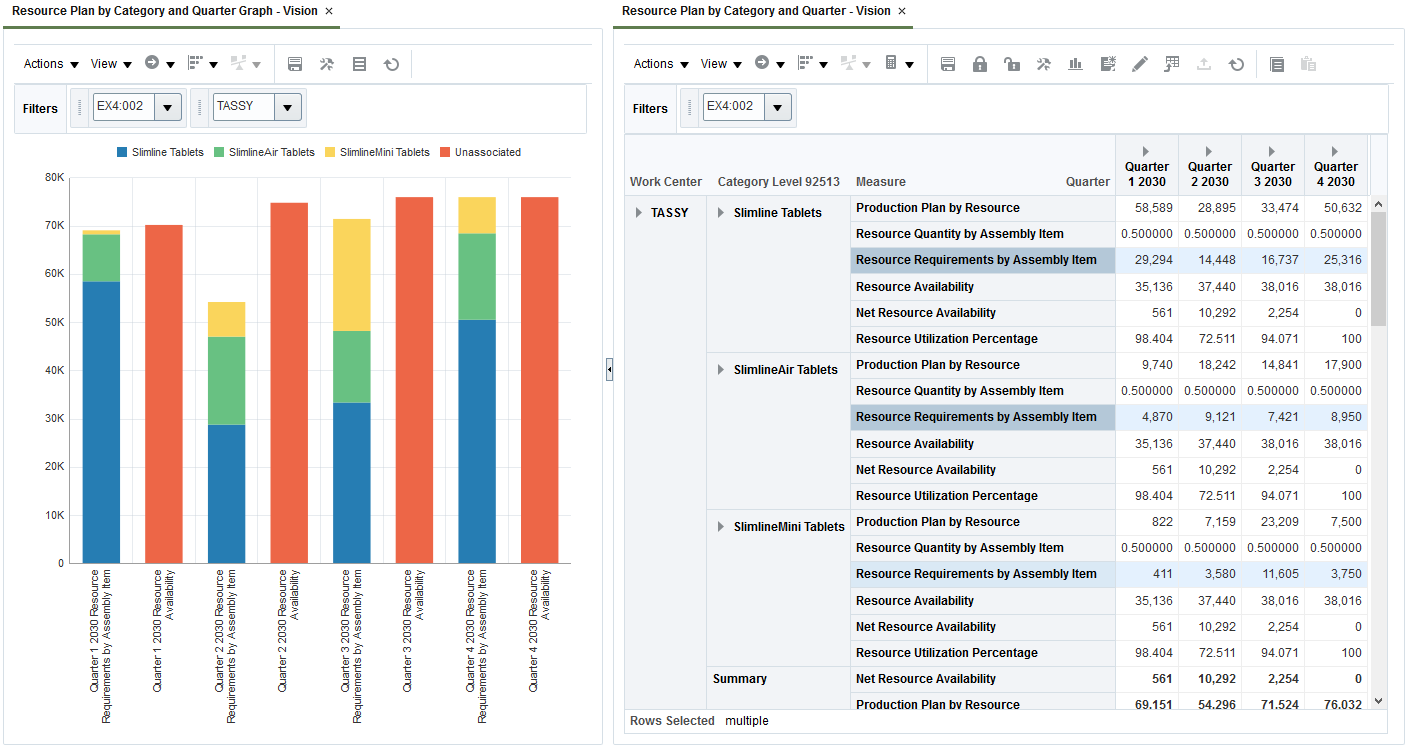
Navigation: In the Open Table, Graph, or Tile Set Dialog Box, Search for Resource Plan by Category and Quarter
You can now adjust resource loading in constrained work centers which significantly improves rough-cut capacity planning in a sales and operation plan.
Watch a Demo.
Steps to Enable
You don't need to do anything to enable this feature.
Tips And Considerations
-
Add the Resource Requirements by Assembly Item, Production Plan by Resource, and Resource Quantity by Assembly Item measures to the user-defined measure catalogs assigned to your sales and operations plans. The Review Plan Messages page identifies missing required measures when running a plan.
-
When creating new measures that conform to both resource and product dimensions, best practice is to duplicate an existing measure that also has the same dimensionality.
-
If you prefer to run your sales and operations plans without these new measures then a plan option is available to turn off the feature. Navigate to Edit Plan Options > Supply tab > Click the Advanced Options button, and then deselect the Report resource requirements by assembly option.
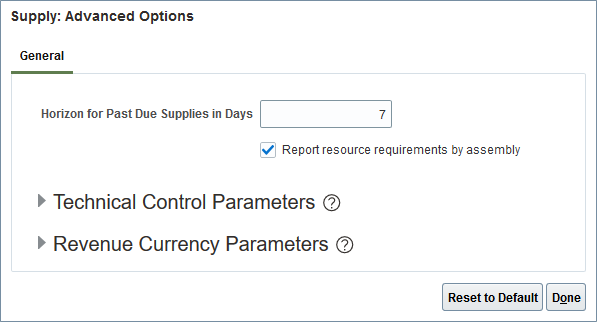
Navigation: Edit Plan Options > Supply tab > Select Advanced Options Button
Key Resources
- Watch Use Resource Requirements to Analyze and Connect with Assembly Production Readiness Training
Role Information
You have a couple options for giving people access to this feature, depending on whether you're assigning them predefined job roles or your own configured job roles.
- Users who are assigned this predefined job role are automatically able to access this feature:
- Sales and Operations Planner (ORA_MSC_SALES_AND_OPERATIONS_PLANNER_JOB)
- Users who are assigned configured job roles that contain these privileges are able to access this feature:
- Run Plan with Snapshot (MSC_RUN_PLAN_WITH_SNAPSHOT_PRIV)
- Monitor Sales and Operations Planning Work Area (MSC_MONITOR_SALES_AND_OPERATIONS_PLANNING_WORK_AREA_PRIV)