
This document will continue to evolve as existing sections change and new information is added. All updates appear in the following table:
| Date | Product | Feature | Notes |
|---|---|---|---|
| 18 JUL 2022 | Sales and Operations Planning | Selected Sales and Operations Planning Bug Fixes in This Update | Updated document. Added a bug fix. |
| 01 JUL 2022 | Sales and Operations Planning | Selected Sales and Operations Planning Bug Fixes in This Update | Updated document. Added section. |
| 18 MAR 2022 | Created initial document. |
IMPORTANT NOTE: If you are being updated directly from 21D to 22B you should review the content of both 22A and 22B sections to ensure you see all the changes included in the update.
 HAVE AN IDEA?
We’re here and we’re listening. If you have a suggestion on how to make our cloud services even better then go ahead and tell us. There are several ways to submit your ideas, for example, through the Ideas Lab on Oracle Customer Connect. Wherever you see this icon after the feature name it means we delivered one of your ideas.
GIVE US FEEDBACK
We welcome your comments and suggestions to improve the content. Please send us your feedback at oracle_fusion_applications_help_ww_grp@oracle.com.
DISCLAIMER
The information contained in this document may include statements about Oracle’s product development plans. Many factors can materially affect Oracle’s product development plans and the nature and timing of future product releases. Accordingly, this Information is provided to you solely for information only, is not a commitment to deliver any material, code, or functionality, and should not be relied upon in making purchasing decisions. The development, release, and timing of any features or functionality described remains at the sole discretion of Oracle.
This information may not be incorporated into any contractual agreement with Oracle or its subsidiaries or affiliates. Oracle specifically disclaims any liability with respect to this information. Refer to the Legal Notices and Terms of Use for further information.
Pre-Update and Post-Update Tasks
Depending on the features you're using in your Cloud applications, you may be required to perform certain steps immediately before or after your quarterly update. For details of these pre-update and post-update steps and the product areas that are affected, refer to Oracle SCM Cloud: Performing Your Quarterly Update (doc ID 2337485.1) on My Oracle Support.
Optional Uptake of New Features (Opt In)
Oracle Cloud Applications delivers new updates every quarter. This means every three months you'll receive new functionality to help you efficiently and effectively manage your business. Some features are delivered Enabled meaning they are immediately available to end users. Other features are delivered Disabled meaning you have to take action to make available. Features delivered Disabled can be activated for end users by stepping through the following instructions using the following privileges:
- Review Applications Offering (ASM_REVIEW_APPLICATIONS_OFFERINGS_PRIV)
- Configure Oracle Fusion Applications Offering (ASM_CONFIGURE_OFFERING_PRIV)
Here’s how you opt in to new features:
- Click Navigator > My Enterprise > New Features.
- On the Features Overview page, select your offering to review new features specific to it. Or, you can leave the default selection All Enabled Offerings to review new features for all offerings.
- On the New Features tab, review the new features and check the opt-in status of the feature in the Enabled column. If a feature has already been enabled, you will see a check mark. Otherwise, you will see an icon to enable the feature.
- Click the icon in the Enabled column and complete the steps to enable the feature.
In some cases, you might want to opt in to a feature that's not listed in the New Features work area. Here's how to opt in:
- Click Navigator > My Enterprise > Offerings.
- On the Offerings page, select your offering, and then click Opt In Features.
- On the Opt In page, click the Edit Features (pencil) icon for the offering, or for the functional area that includes your feature.
- On the Edit Features page, complete the steps to enable the feature.
For more information and detailed instructions on opting in to new features for your offering, see Offering Configuration.
Opt In Expiration
Occasionally, features delivered Disabled via Opt In may be enabled automatically in a future update. This is known as an Opt In Expiration. If your cloud service has any Opt In Expirations you will see a related tab in this document. Click on that tab to see when the feature was originally delivered Disabled, and when the Opt In will expire, potentially automatically enabling the feature. You can also click here to see features with Opt In Expirations across all Oracle Cloud Applications.
Column Definitions:
Report = New or modified, Oracle-delivered, ready to run reports.
UI or Process-Based: Small Scale = These UI or process-based features are typically comprised of minor field, validation, or program changes. Therefore, the potential impact to users is minimal.
UI or Process-Based: Larger Scale* = These UI or process-based features have more complex designs. Therefore, the potential impact to users is higher.
Features Delivered Disabled = Action is needed BEFORE these features can be used by END USERS. These features are delivered disabled and you choose if and when to enable them. For example, a) new or expanded BI subject areas need to first be incorporated into reports, b) Integration is required to utilize new web services, or c) features must be assigned to user roles before they can be accessed.
| Ready for Use by End Users Reports plus Small Scale UI or Process-Based new features will have minimal user impact after an update. Therefore, customer acceptance testing should focus on the Larger Scale UI or Process-Based* new features. |
Customer Must Take Action before Use by End Users Not disruptive as action is required to make these features ready to use. As you selectively choose to leverage, you set your test and roll out timing. |
|||||
|---|---|---|---|---|---|---|
| Feature |
Report |
UI or |
UI or |
|
||
Selected Sales and Operations Planning Bug Fixes in This Update |
||||||
Simulate Adjustments to Production Levels
In some situations, you may want to adjust the sales and operations production plan based on up-to-date tactical plan data received from Oracle Fusion Cloud Supply Planning or other sources. With this update, you can make overrides, such as manually smoothing and adjusting the production levels of assembly items and their product categories, over the planning horizon. The adjusted production plan also serves as a better basis for improving aggregate supply planning.
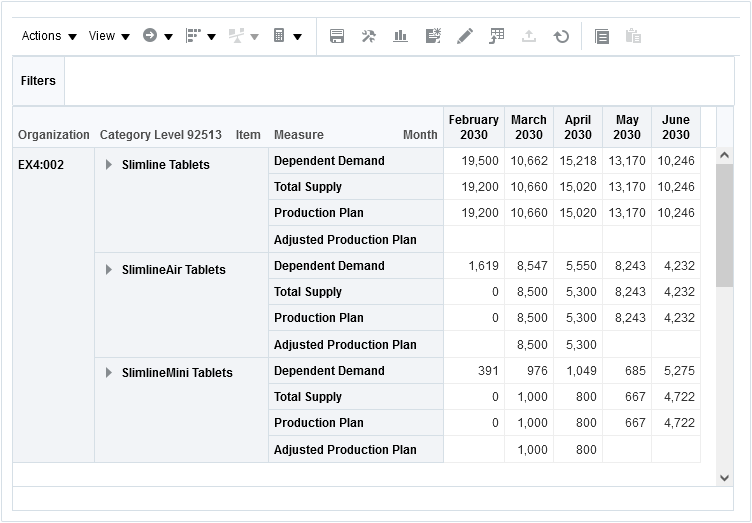
Adjusted Production Plan Measure in a User-Defined Table
Adjust your production plans with ease and plan strategic capacity and supply better.
Watch a Demo.
Steps to Enable
You don't need to do anything to enable this feature.
Tips And Considerations
-
Add the Adjusted Production Plan and Final Production Plan measures to the user-defined measure catalogs assigned to your sales and operations plans. The Review Plan Messages page identifies missing required measures when running a plan.
-
Use the Load Measures from Other Plans process to copy Production Plan measure data from a Supply Plan to the Adjusted Production Plan measure in your Sales and Operations Plan, then simulate.
Key Resources
Role Information
You have a couple options for giving people access to this feature, depending on whether you're assigning them predefined job roles or your own configured job roles.
- Users who are assigned this predefined job role are automatically able to access this feature:
- Sales and Operations Planner (ORA_MSC_SALES_AND_OPERATIONS_PLANNER_JOB)
- Users who are assigned configured job roles that contain these privileges are able to access this feature:
- Monitor Sales and Operations Planning Work Area (MSC_MONITOR_SALES_AND_OPERATIONS_PLANNING_WORK_AREA_PRIV)
- Edit Data in Planning Tables (MSC_EDIT_DATA_IN_PLANNING_TABLES_PRIV)
- Run Plan without Snapshot (MSC_RUN_PLAN_WITHOUT_SNAPSHOT_PRIV)
Refresh Collected Measure Data
You can now refresh data for a specific measure or a subset of measures in a plan that are collected by file-based data import (FBDI) without having to rerun the plan. This functionality streamlines the inbound measure data flow from sources, such as Oracle Fusion Cloud Enterprise Performance Management, into Oracle Fusion Cloud Sales and Operations Planning to orchestrate integrated business planning. It’s also useful for tracking updates to sales history while preserving current statistical forecasts.
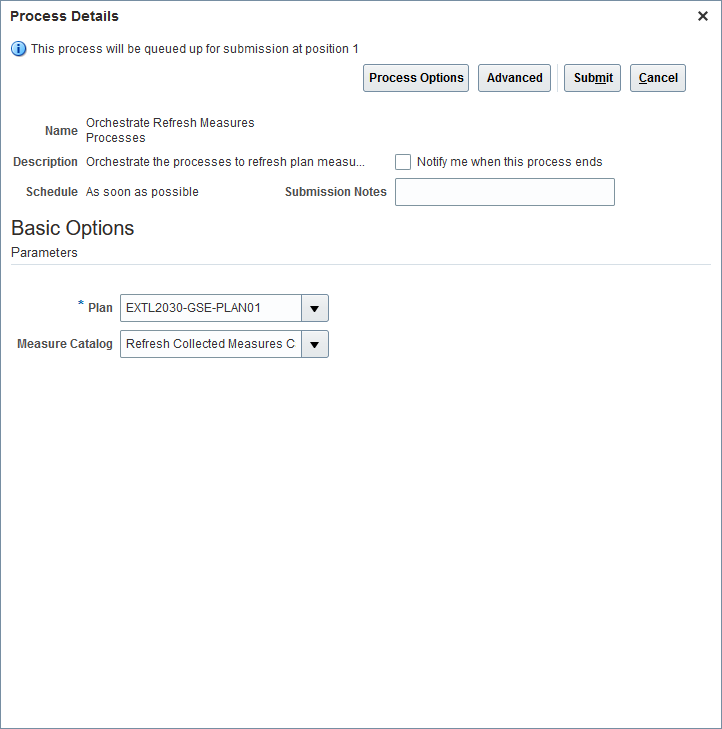
Orchestrate Refresh Measures Processes Job in Scheduled Processes (Navigation: Tools > Scheduled Processes > Schedule New Process > Orchestrate Refresh Measures Processes)
Quickly streamline your sales and operations plan with up-to-date data for planning measures and orchestrate integrated business planning using collected financial measures.
Steps to Enable
You don't need to do anything to enable this feature.
Tips And Considerations
- The scheduled process considers measures loaded using the file-based data import template for Supply Chain Planning Measures.
- Create and use a measure catalog that contains a subset of measures to refresh.
- Include both the Shipments History (or Bookings History) measure and the default measure used to refresh Shipments History in your measure catalog. For example, if the default measure used for the Default Shipments History Measure profile option is Shipments History: Requested Item by Shipped Date, then include this measure and the Shipments History measure in your measure catalog.
- When introducing a new measure to a plan, you must first run the plan to refresh with current data before you can refresh that measure's data using this new scheduled process.
Key Resources
Role Information
You have a couple options for giving people access to this feature, depending on whether you're assigning them predefined job roles or your own configured job roles.
- Users who are assigned any of these predefined job roles are automatically able to access this feature:
- Supply Chain Planner (ORA_MSC_SUPPLY_CHAIN_PLANNER_JOB)
- Demand Planner (ORA_MSC_DEMAND_PLANNER_JOB)
- Materials Planner (ORA_MSC_MATERIALS_PLANNER_JOB)
- Sales and Operations Planner (ORA_MSC_SALES_AND_OPERATIONS_PLANNER_JOB)
- Replenishment Planner (ORA_MSC_REPLENISHMENT_PLANNER_JOB)
- Users who are assigned configured job roles that contain this privilege are able to access this feature:
- Run Plan with Snapshot (MSC_RUN_PLAN_WITH_SNAPSHOT_PRIV)
Configure Color by Measure to Display in Tiles
Now when you configure a graph color for a measure, that color will be used in tiles that contain the measure as well as in graphs. This usage provides consistency across graphs and tiles and makes it easy to visualize the same measure in multiple analytics.
Control the colors to be displayed for measures in graphs and tiles to readily convey the impact of a measure.
Steps to Enable
You don't need to do anything to enable this feature.
Tips And Considerations
- You may have to change which color you select for a measure. If the color you configure for a measure is the same color as one of the colors automatically assigned to a measure in a specific graph, then you have to select a different color for the measure you're configuring.
- In bar, line, and radar graphs, a measure must be the only one located in the Y-Axis to display the configured graph color.
Role Information
You have a couple options for giving people access to this feature, depending on whether you're assigning them predefined job roles or your own configured job roles.
- Users who are assigned any of these predefined job roles are automatically able to access this feature:
- Supply Chain Planner (ORA_MSC_SUPPLY_CHAIN_PLANNER_JOB)
- Materials Planner (ORA_MSC_MATERIALS_PLANNER_JOB)
- Demand Planner (ORA_MSC_DEMAND_PLANNER_JOB)
- Sales and Operations Planner (ORA_MSC_SALES_AND_OPERATIONS_PLANNER_JOB)
- Replenishment Planner (ORA_MSC_REPLENISHMENT_PLANNER_JOB)
- Users who are assigned configured job roles that contain these privileges are able to access this feature:
- Maintain Planning Tables (MSC_MAINTAIN_PLANNING_TABLES_PRIV)
Selected Sales and Operations Planning Bug Fixes in This Update
This update includes some bug fixes that can change the way Oracle Sales and Operations Planning works. This isn't a full list of all the bug fixes in this update. This list includes the bug fixes that can cause a noticeable change in application behavior.
Select Relative Time Range for Analysis in Tables and Graphs
With the 22B update, the behavior of the relative time filter in tables, graphs, tiles, and analysis sets is revised. The relative time filter is configured using the Advanced Filter icon on the Members tab in the Selector Tool. Prior to this update, the relative time filter would always include the current time period, even if the Time Periods After setting was set to zero. The behavior was changed to include the current time period only if the Time Periods After setting is set to at least 1. For example, a filter of 3 months prior to today and 0 months after today would previously return the prior 3 months and the current month. Now, a filter of 3 months prior to today and 0 months after today will return only the prior 3 months and not include the current month. To obtain the same results for your relative time filter as before this update, you must increase the value of the Time Periods After setting by 1.
Contact Oracle Support if you want to revert to pre-22B behavior.
Oracle reference: 27708234
Enforce Work Center and Supplier Capacity Constraints
With the 22B update, the default behavior of capacity constraints is revised. You can configure capacity constraints on the Plan Options page, Supply tab, General subtab. Prior to this update, capacity utilization couldn’t exceed 100 percent for constrained work centers or supplier component categories. The behavior was changed to allow capacity utilization to exceed 100 percent for constrained work centers or supplier component categories depending on the optimization parameters configured in the Supply: Advanced Options dialog box. For example, enforcing demand due dates to avoid demand backordering or adjusting the production plan can overload capacity.
To obtain the same results for your capacity constraints as before this update, you must change the values of the Penalty Cost Multiplier for Resource Capacity Overloading and Penalty Cost Multiplier for Supplier Capacity Overloading parameters. In your plan options, navigate to the Supply: Advanced Options dialog box, Optimization Parameters tab and change the value of Penalty Cost Multiplier for Resource Capacity Overloading to -1. Similarly, change the value of Penalty Cost Multiplier for Supplier Capacity Overloading to -1 if capacity for supplier component categories must be strictly enforced. With these changes, the planning process enforces capacity constraints during the plan run to not overload.
Oracle reference: 33552231
Steps to Enable
You don't need to do anything to enable this feature.