
This document will continue to evolve as existing sections change and new information is added. All updates appear in the following table:
| Date | Module | Feature | Notes |
|---|---|---|---|
| 29 SEP 2023 | Common Financials | Updated document. Revised Key Resources section. | |
| 07 SEP 2023 | Common Financials | Updated document. Revised Key Resources section. | |
| 02 JUN 2023 | Created initial document. |
 HAVE AN IDEA?
We’re here and we’re listening. If you have a suggestion on how to make our cloud services even better then go ahead and tell us. There are several ways to submit your ideas, for example, through the Ideas Lab on Oracle Customer Connect. Wherever you see this icon after the feature name it means we delivered one of your ideas.
GIVE US FEEDBACK
We welcome your comments and suggestions to improve the content. Please send us your feedback at oracle_fusion_applications_help_ww_grp@oracle.com.
DISCLAIMER
The information contained in this document may include statements about Oracle’s product development plans. Many factors can materially affect Oracle’s product development plans and the nature and timing of future product releases. Accordingly, this Information is provided to you solely for information only, is not a commitment to deliver any material, code, or functionality, and should not be relied upon in making purchasing decisions. The development, release, and timing of any features or functionality described remains at the sole discretion of Oracle.
This information may not be incorporated into any contractual agreement with Oracle or its subsidiaries or affiliates. Oracle specifically disclaims any liability with respect to this information. Refer to the Legal Notices and Terms of Use for further information.
Optional Uptake of New Features (Opt In)
Oracle Cloud Applications delivers new updates every quarter. This means every three months you'll receive new functionality to help you efficiently and effectively manage your business. Some features are delivered Enabled meaning they are immediately available to end users. Other features are delivered Disabled meaning you have to take action to make available. Features delivered Disabled can be activated for end users by stepping through the following instructions using the following privileges:
- Review Applications Offering (ASM_REVIEW_APPLICATIONS_OFFERINGS_PRIV)
- Configure Oracle Fusion Applications Offering (ASM_CONFIGURE_OFFERING_PRIV)
Here’s how you opt in to new features:
- Click Navigator > My Enterprise > New Features.
- On the Features Overview page, select your offering to review new features specific to it. Or, you can leave the default selection All Enabled Offerings to review new features for all offerings.
- On the New Features tab, review the new features and check the opt-in status of the feature in the Enabled column. If a feature has already been enabled, you will see a check mark. Otherwise, you will see an icon to enable the feature.
- Click the icon in the Enabled column and complete the steps to enable the feature.
For more information and detailed instructions on opting in to new features for your offering, see Configure Offerings.
Opt In Expiration
Occasionally, features delivered Disabled via Opt In may be enabled automatically in a future update. This is known as an Opt In Expiration. If your cloud service has any Opt In Expirations in this update, you will see a related tab in this document. Click on that tab to see when the feature was originally delivered Disabled, and when the Opt In will expire, potentially automatically enabling the feature. You can also click here to see features with current Opt In Expirations across all Oracle Cloud Applications. Beyond the current update, the Financials forums on Cloud Customer Connect have details of Opt In Expirations upcoming in future updates.
Column Definitions:
Report = New or modified, Oracle-delivered, ready to run reports.
UI or Process-Based: Small Scale = These UI or process-based features are typically comprised of minor field, validation, or program changes. Therefore, the potential impact to users is minimal.
UI or Process-Based: Larger Scale* = These UI or process-based features have more complex designs. Therefore, the potential impact to users is higher.
Features Delivered Disabled = Action is needed BEFORE these features can be used by END USERS. These features are delivered disabled and you choose if and when to enable them. For example, a) new or expanded BI subject areas need to first be incorporated into reports, b) Integration is required to utilize new web services, or c) features must be assigned to user roles before they can be accessed.
| Ready for Use by End Users Reports plus Small Scale UI or Process-Based new features will have minimal user impact after an update. Therefore, customer acceptance testing should focus on the Larger Scale UI or Process-Based* new features. |
Customer Must Take Action before Use by End Users Not disruptive as action is required to make these features ready to use. As you selectively choose to leverage, you set your test and roll out timing. |
|||||
|---|---|---|---|---|---|---|
| Feature |
Report |
UI or |
UI or |
|
||
Enforcement of Limits for Entertainment Policies Based on Employee Grade |
||||||
Expense Template and Payment Method Selection in Expenses Mobile Application |
||||||
Simplified Workflow Rules Configuration
Use the Simplified Workflow Rules Configuration feature to create workflow rules using spreadsheets for Payables Invoice Approval and General Ledger Journal Approval workflows. Download the templates using the Manage Workflow Rules in Spreadsheet task to create and manage workflow rules according to your approval policies.
This feature was introduced in update 18C. In addition to the existing features, the 23C update also lets you do the following:
- Lists feature, to define customized approval rules with more flexibility.
- Advanced configuration, with an expanded range of functions and more information about each function.
- Optional enablement and disablement of rules and rule blocks.
- Add multiple approval actions on the same rule conditions.
Use Lists to create customized approval rules based on specific business needs, such as associating a department or project with an invoice or setting threshold limits. This provides greater flexibility and control over the approval process, reduces the need for creating and maintaining a large number of rules, and helps improve both efficiency and compliance.
Enable or disable rules and rule blocks as needed to improve efficiency by eliminating the unnecessary steps of copying rules. Disabled rules do not affect approval processing.
Steps to Enable
You don't need to do anything to enable this feature.
Key Resources
- For an overview of the Simplified Workflow Rules Configuration feature, refer to the Manage Workflow Rules Using a Spreadsheet topic on the Oracle Help Center.
Access Requirements
To use simplified workflow rules configuration, you need this role:
- Financial Application Administrator
Workflow Transaction Console for Account Coding Workflow
Use the Workflow Transaction Console to monitor workflow tasks and resolve exceptions for the Account Coding workflow.
Use the Workflow Transaction Console to:
- View the latest status of all the Account Coding workflow tasks in the system.
- Search based on the task name and user-defined criteria.
- Review the issue description and resolution for failed Account Coding workflow tasks.
- Take appropriate actions based on the issue description and resolution. For example, you can recover a failed Account Coding workflow task after correcting the rule.
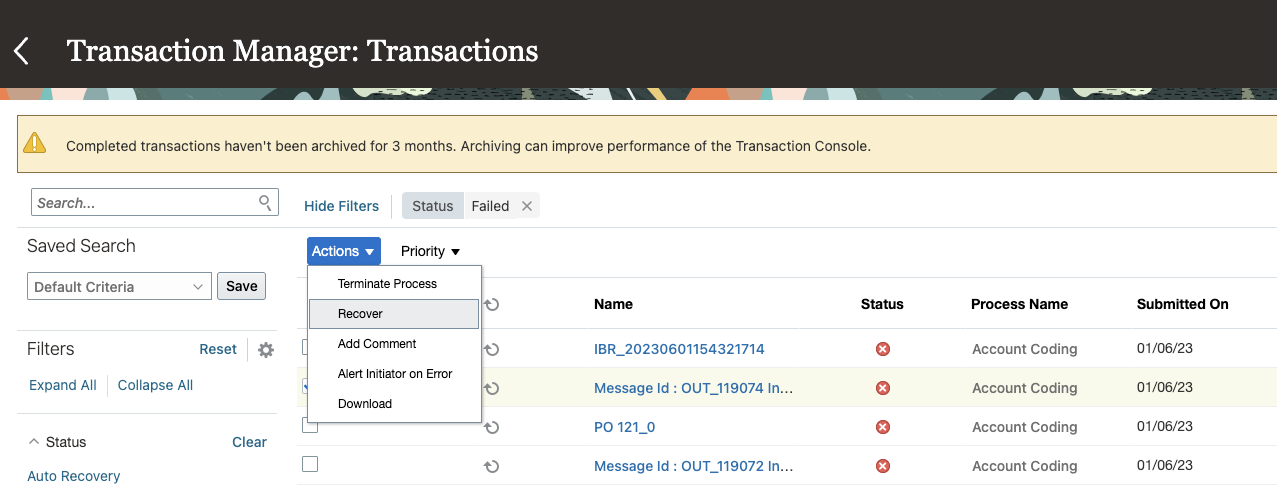
- Download the search results to a spreadsheet in the CSV format.
Steps to Enable
Use the Opt In UI to enable this feature. For instructions, refer to the Optional Uptake of New Features section of this document.
Offering: Financials
Tips And Considerations
To display only financial-related tasks in the Workflow Transaction Console, enable the transaction security feature by performing the following steps:
- Go to Navigator > Setup and Maintenance > Manage Enterprise HCM Information.
- Click Edit > Correct.
- In the Transaction Console Information section, select Enable Transaction Security.
Key Resources
- For an overview of the Workflow Transaction Console feature, refer to the Manage Workflow Transactions topic on the Oracle Help Center.
Access Requirements
To use simplified workflow rules configuration, you need this role:
- Financial Application Administrator
Enforcement of Limits for Entertainment Policies Based on Employee Grade
Enforce single, daily and yearly limits for entertainment expenses based on employee grades. If multiple employee attendees are present at an entertainment, enforce limits based on each attendee's grade.
Administrators can enable this option using the Manage Policies by Expense Categories task.

Create Entertainment Policy page in the Manage Policies by Expense Category task
To enable this, the administrator needs to select 'Employee' and 'Role' as Rate Determinants. Once enabled, the administrators can then define the rates for each employee grade in the Create Rates page.
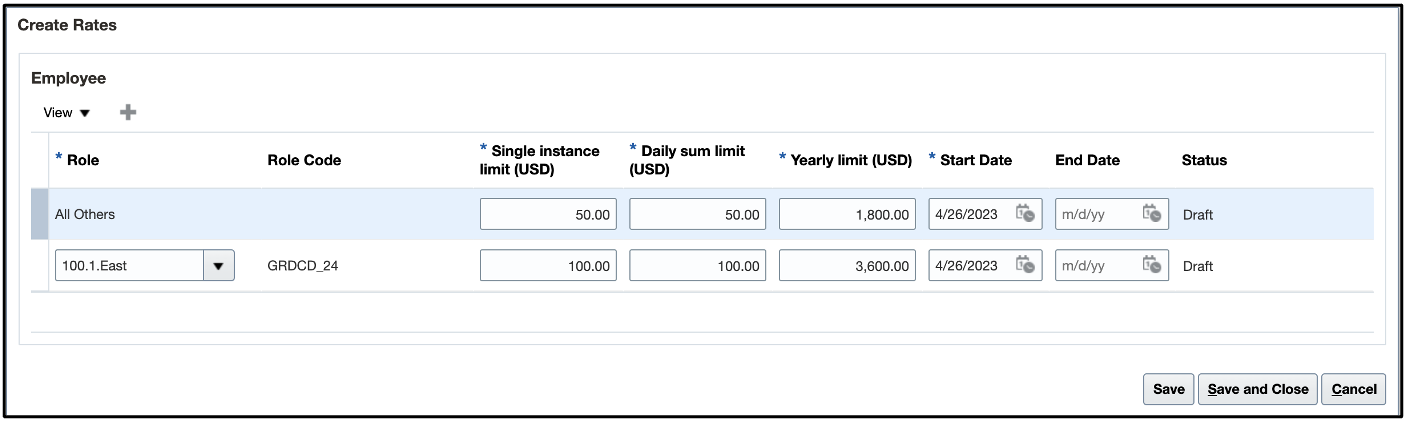
Create Rates Page
The administrator must provide a value for the rates for a role type of ‘All Other’s apart from the rates that they define for individual grades.
This feature allows different rates based on the employee grade, thus allowing granular and flexible control on the business expenses incurred by employees.
Steps to Enable
You don't need to do anything to enable this feature.
Tips And Considerations
- Entertainment policies only support the creation of employee role-based rates for the role type Grade. The role types Job and Position are not supported.
- You cannot reconfigure or update an existing policy to use the role type Grade as a rate determinant.
Key Resources
- This feature originated from the Idea Labs on Oracle Customer Connect : Idea 626053 (https://community.oracle.com/customerconnect/discussion/626053)
Access Requirements
To define entertainment policies, you need one of these roles:
- Expense Manager
- Application Implementation Consultant
Expense Template and Payment Method Selection in Expenses Mobile Application
Select an expense template during expense entry and select a payment method during expense report creation using the Expenses Mobile Application.
For Expenses Mobile Application
- Users can now select the Expense Template from a drop-down in the 'Add Expense' screen.
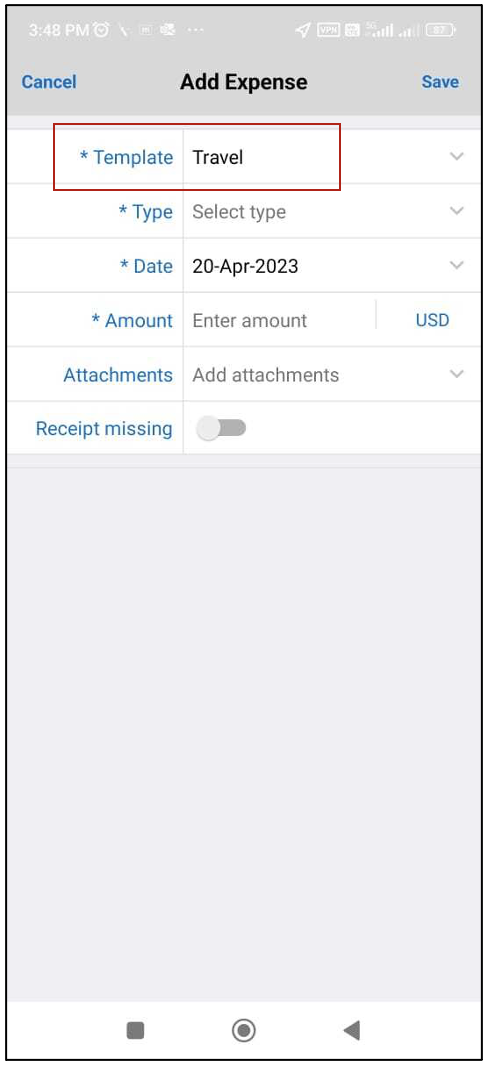
Template Selection Drop-down in Add-Expense Screen
- Users can now select the payment method from a drop-down in the 'View Report' screen and they can see the payment method selected in the 'Submit Report' screen.
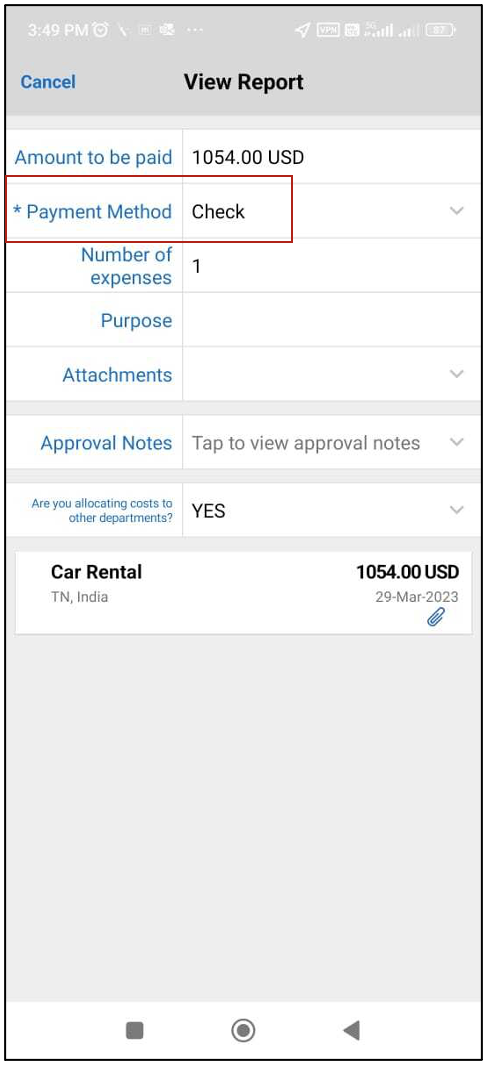
Payment Method Selection Drop-down in View Report Screen
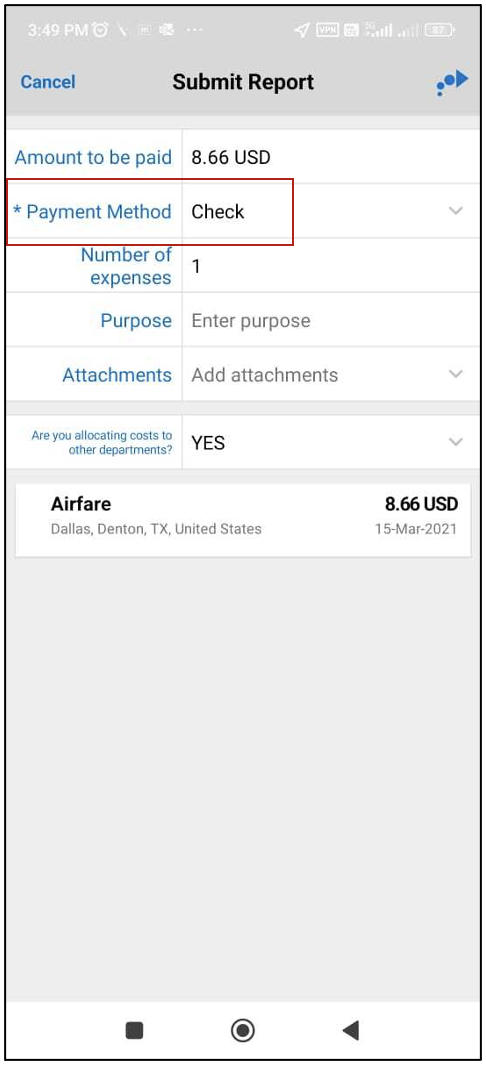
Payment Method Selection Drop-down in Submit Report Screen
Business benefits include:
- Expense Template Selection: It allows users a choice of expense templates that they can use to create their expense. Prior to this, the template selection was in 'Settings' screen. Having the template in 'Add expense' screen improves discoverability and improves consistency with the web application.
-
Payment Method Selection: Employees can now choose the payment method by which they wish to be reimbursed. This brings parity with the web application.
Steps to Enable
You don't need to do anything to enable this feature.
Tips And Considerations
Expense Template Selection:
- Expense template selection was removed from the Settings screen.
- The default expense template is the last template selected.
Payment Method Selection:
-
To make payment method selection available in the View report screen, a Financial Application Administrator must enable the Enable Payment Method option in the Manage Expense System Options task in "Functional Setup manager."