- Revision History
- Overview
- Feature Summary
- Strategic Workforce Planning
-
- Strategic Workforce Planning
- Features
-
- Oracle-Managed OCI Migration for Classic UK Government Environments
- IDCS Administrator Roles Outlined in Getting Started Guide
- Information on Strategic Workforce Planning Cloud Compliance with Oracle's Global Trade Policies in Getting Started Guide
- Updated Application Role Descriptions and Mapping in the Administering Access Control Guide
- Information on Restricted Operations During Daily Maintenance in Getting Started Guide
- New Optional Query Parameters for the User Group Report (v2) REST API
- Runtime Parameters for the SimulateConcurrentUsage EPM Automate Command for Save Form
- Forms and Ad Hoc Grids Smart View Options for the SimulateConcurrentUsage EPM Automate Command
- Updates to the Simulate Concurrent Usage REST API
- Loading Oracle ERP Cloud Exchange (FX) Rates to Strategic Workforce Planning Cloud
- Submit Numeric Zero as Replacement for Missing Values in Smart View (Mac and Browser)
- Add More Dimension Rows in Function Builder in Smart View (Mac and Browser)
- User Interface Improvements in Smart View (Mac and Browser)
- Display Member Names and Aliases in Separate Columns in Smart View (Mac and Browser) Ad Hoc Grids
- Custom Template Now Supports More Templates for Easier Customization and Updates
- Workforce Batch Rules Updated to Improve Performance
- Workforce Now Limits the Number of Editable Rows In Mass Update Forms
-
- IMPORTANT Actions and Considerations
May 2024 Update
Revision History
This document will continue to evolve as existing sections change and new information is added. All updates appear in the following table:
| Date | Module | Feature | Notes |
|---|---|---|---|
| 03 MAY 2024 |
Strategic Workforce Planning | Updated Application Role Descriptions and Mapping in the Administering Access Control Guide | Updated document. Added a feature description. |
| 03 MAY 2024 |
IMPORTANT Actions and Considerations | Upgrade to the Redwood Experience and the Removal of Non-Redwood Themes |
Updated document. Updated feature description. |
| 26 APR 2024 | Created initial document. |
Overview
 HAVE AN IDEA?
We’re here and we’re listening. If you have a suggestion on how to make our cloud services even better then go ahead and tell us. There are several ways to submit your ideas, for example, through the Ideas Lab on Oracle Customer Connect. Wherever you see this icon after the feature name it means we delivered one of your ideas.
GIVE US FEEDBACK
We welcome your comments and suggestions to improve the content. Please send us your feedback at oracle_fusion_applications_help_ww_grp@oracle.com.
DISCLAIMER
The information contained in this document may include statements about Oracle’s product development plans. Many factors can materially affect Oracle’s product development plans and the nature and timing of future product releases. Accordingly, this Information is provided to you solely for information only, is not a commitment to deliver any material, code, or functionality, and should not be relied upon in making purchasing decisions. The development, release, and timing of any features or functionality described remains at the sole discretion of Oracle.
This information may not be incorporated into any contractual agreement with Oracle or its subsidiaries or affiliates. Oracle specifically disclaims any liability with respect to this information. Refer to the Legal Notices and Terms of Use for further information.
Feature Summary
Column Definitions:
Features Delivered Enabled
Report = New or modified, Oracle-delivered, ready to run reports.
UI or Process-Based: Small Scale = These UI or process-based features are typically comprised of minor field, validation, or program changes. Therefore, the potential impact to users is minimal.
UI or Process-Based: Larger Scale* = These UI or process-based features have more complex designs. Therefore, the potential impact to users is higher.
Features Delivered Disabled = Action is needed BEFORE these features can be used by END USERS. These features are delivered disabled and you choose if and when to enable them. For example, a) new or expanded BI subject areas need to first be incorporated into reports, b) Integration is required to utilize new web services, or c) features must be assigned to user roles before they can be accessed.
Strategic Workforce Planning
Strategic Workforce Planning
Monthly Update Schedule
Test Environments: Oracle will apply this monthly update during the first daily maintenance that occurs at or after 22:00 UTC on Friday, May 3, 2024.
Production Environments: Oracle will apply this monthly update during the first daily maintenance that occurs at or after 22:00 UTC on Friday, May 17, 2024.
NOTE: The monthly update will not be applied to any environment for which this monthly update is requested to be skipped using the EPM Automate skipUpdate command or service request to Oracle. The monthly update will also not be applied to any environment on a one-off patch where the fix for the underlying issue is not in this monthly update.
NOTE: Backing up the daily maintenance snapshot and restoring the environment as needed are self-service operations. Oracle strongly recommends that you download the maintenance snapshot every day to a local server.
The Oracle Help Center provides access to updated documentation. The updates will be available in the Help Center on Friday, May 3, 2024.
NOTE: Some of the links to new feature documentation included in this readiness document will not work until after the Oracle Help Center update is complete.
Helpful Information
Documentation Updates Available One Week After Readiness Documents
Updated documentation is published on the Oracle Help Center on the first Friday of each month, coinciding with the monthly updates to Test environments. Because there is a one week lag between the publishing of the readiness documents (What's New and New Feature Summary) and Oracle Help Center updates, some links included in the readiness documents will not work until the Oracle Help Center update is complete.
https://docs.oracle.com/en/cloud/saas/epm-cloud/index.html
Fixed Issues and Considerations
Software issues addressed each month and considerations are posted to a knowledge article on My Oracle Support. Click here to review. You must have a My Oracle Support login to access the article.
NOTE: Fixed issues for EPM Cloud Platform components (Smart View for Office, EPM Automate, REST API, Migration, Access Control, Data Management/Data Integration, Reports, Financial Reporting, and Calculation Manager) are available in a separate document on the My Oracle Support “Release Highlights” page.
This provides visibility into EPM Cloud release contents.
Give Us Documentation Feedback
We welcome your comments and suggestions to improve the content of the What's New document and the product documentation.
Please send us your feedback at EPMdoc_ww@oracle.com. In the body or title of the email, state that you are inquiring or providing feedback, and indicate for which EPM Cloud service and the monthly update cycle.
Create and Run an EPM Center of Excellence
A best practice for EPM is to create a Center of Excellence (CoE). An EPM CoE is a unified effort to ensure adoption and best practices.
Business Benefit: A CoE drives transformation in business processes related to performance management and the use of technology-enabled solutions.

Learn more:
- Visit the EPM Center of Excellence web page to learn about the benefits.
- Watch the webinars on Cloud Customer Connect: Creating and Running a Center of Excellence (CoE) for EPM Cloud and Planning Your Success with EPM Center of Excellence.
- Watch the videos: Overview: EPM Center of Excellence, Creating a Center of Excellence.
- Get best practices, guidance, and strategies for your own EPM CoE: Creating and Running an EPM Center of Excellence
Join Oracle Cloud Customer Connect
Please take a moment to join Cloud Customer Connect and its EPM Cloud forums. Customer Connect is a community gathering place for members to interact and collaborate on common goals and objectives. It's where you will find the latest release information, discussion forums, upcoming events, and answers to use-case questions. Joining takes just a few minutes. Join now!
To join, go to https://community.oracle.com/customerconnect/ and select Register in the upper right.
After you have joined and logged in, to access the forums (Categories), from the Cloud Customer Connect home page, select Categories, then Enterprise Resource Planning, and then make your selection under Enterprise Performance Management.
To ensure that you are always in the know, confirm that you have your notification preferences set for EPM Announcements as well as each Category you're following.
- To set notification preferences for EPM Announcements, go to Categories, then Announcements, and then Enterprise Performance Management. Next, select the Notification preferences drop down.
- To set notification preferences for each Category, navigate to the Category page and select the Notification preferences drop down. You must go to each category page separately and select the Notification preferences drop down.
NOTE: The Settings and Actions menu contains a link to Cloud Customer Connect. To access this link, from the Home page, click the down arrow next to the user name (in the upper right-hand corner of the screen), and select Cloud Customer Connect.
TIP: Bookmark the Enterprise Performance Management Resource Center to quickly find useful information on all things EPM. As a community member, you have access to important product announcements, best practices, known issues, training highlights, and more.
Follow Us on Social Media
Follow EPM Cloud on YouTube, Twitter, Facebook, and LinkedIn.
These are great resources for the latest updates and information about EPM Cloud.
Business Benefit: These resources can help you optimize your EPM implementation and user experience by providing valuable information and user assistance.
Oracle Cloud Readiness App
Use the Readiness App available on the Oracle Cloud Application Update Readiness site to review information about features released for Oracle Cloud. The app provides an .xlsx file listing all features released for one or more Cloud product(s), module(s) and update(s) that you designate. The EPM Cloud Features tool will not be updated beginning in this update.
From the Readiness site, click the red Try Our Readiness App! button in the upper right, or use this URL to access the app:
https://www.oracle.com/webfolder/technetwork/tutorials/tutorial/readiness/app/index.html
NOTE: To ensure a complete feature listing, select EPM Common in addition to the business process(es) you wish to view. To determine whether an EPM Common feature applies to your business process, review the Applies To information in the Short Description column of the .xlsx file.
NOTE: The Readiness App includes features from Oct 2021 and later. The EPM Cloud Features tool includes EPM features from March 2018 through June 2, 2023 only.
Business Benefit: The Readiness App is an interactive tool that allows you to view a comprehensive listing of all features that have been released for one or more product(s), module(s) and update(s) that you designate.
Features
Oracle-Managed OCI Migration for Classic UK Government Environments
One of Oracle's latest advancements, Oracle Cloud Infrastructure (OCI) is the foundation of Oracle's second-generation cloud. OCI, a purpose-built, best-in-class platform for running enterprise applications, is engineered from the ground up to run mission-critical databases, workloads, and applications while providing end-to-end security. Oracle's data centers around the globe are standardizing on the new OCI architecture which will deliver even greater performance and reliability. There are a lot of features that are available only in OCI. See Features Available only in OCI EPM Cloud Environments in Getting Started with Oracle Enterprise Performance Management Cloud for Administrators.
Oracle has already sent, in the beginning of April 2024, notifications about the upcoming migration. Please follow the instructions in the notification. Your OCI environments will be available in May 2024. When you receive the OCI environments, complete the optional activities documented at Oracle-Managed Migration before July 2024.
In July 2024, while applying the monthly update 24.07 during the daily maintenance window, Oracle will automatically clone your OCI environments from Classic environments, change the DNS configuration so that the existing Classic service URLs are routed to the OCI environments, and terminate Classic environments. Cloning of test environments will be done on the first Friday of July 2024. Cloning of production environments will take place on the third Friday of July 2024.
Business Benefit: OCI provides you a purpose-built, best-in-class platform that is engineered from the ground up to run mission-critical databases, workloads, and business processes while providing end-to-end security. This new architecture delivers greater performance and reliability, and a number of features that are not available in Classic EPM Cloud.
Steps to Enable
Review and follow instructions in EPM Cloud Classic to Oracle Cloud Infrastructure (OCI) Migration in Oracle Enterprise Performance Management Cloud Operations Guide.
Key Resources
- Features Available only in OCI EPM Cloud Environments in Getting Started with Oracle Enterprise Performance Management Cloud for Administrators
- Oracle-Managed Migration in Oracle Enterprise Performance Management Cloud Operations Guide
IDCS Administrator Roles Outlined in Getting Started Guide
The Getting Started with Oracle Enterprise Performance Management Cloud for Administrators outlines the available IDCS administrator roles in the Strategic Workforce Planning Cloud environments and their privilege and limitations.
Business Benefit: The Getting Started with Oracle Enterprise Performance Management Cloud for Administrators now provides comprehensive details on all available IDCS administrator roles within the Strategic Workforce Planning Cloud environment.
Key Resources
- Managing EPM Cloud Users and Roles in Getting Started with Oracle Enterprise Performance Management Cloud for Administrators
Information on Strategic Workforce Planning Cloud Compliance with Oracle's Global Trade Policies in Getting Started Guide
The Getting Started Guide for Administrators is now updated with information on Strategic Workforce Planning Cloud compliance with the Oracle’s worldwide trade compliant business policies listed at Oracle Global Trade Policy (GTC). This includes restricting access from the Embargo countries.
Business Benefit: Oracle Global Trade Compliance (GTC) is responsible for import and export oversight, guidance, and enforcement to enable worldwide trade compliant business processes across Oracle, in order to uphold and protect Oracle's global trade privileges and ensure the success of Oracle's business.
Key Resources
- Understanding EPM Cloud Security Compliance Features in Getting Started with Oracle Enterprise Performance Management Cloud for Administrators
Updated Application Role Descriptions and Mapping in the Administering Access Control Guide
The Administering Access Control for Oracle Enterprise Performance Management Cloud guide has been updated with detailed descriptions of all application roles. it also maps these application roles to the predefined roles in which they are included.
Business Benefit: This detailed descriptions of application roles and their mapping to predefined roles will help you in deciding and designing the application roles to assign to specific users or groups to achieve segregation of duties.
Key Resources
- Managing Role Assignments at the Application Level in Administering Access Control for Oracle Enterprise Performance Management Cloud
Information on Restricted Operations During Daily Maintenance in Getting Started Guide
Some operations are restricted during the daily maintenance of Strategic Workforce Planning Cloud environments. Information on all restricted operations during the daily maintenance of Strategic Workforce Planning Cloud environments is now outlined in Getting Started with Oracle Enterprise Performance Management Cloud for Administrators.
Business Benefit: The details about operational restrictions during Daily Maintenance will help manage expectations and minimize potential disruptions.
Key Resources
- Daily Maintenance Operations in Getting Started with Oracle Enterprise Performance Management Cloud for Administrators
New Optional Query Parameters for the User Group Report (v2) REST API
The User Group Report (v2) REST API now supports the following optional query parameters:
- userlogin: Generates a User Group Report for the specified user.
- groupname: Generates a User Group Report for the users belonging to the specified group name.
The structure of the JSON response has also been modified.
Business Benefit: These parameters help generate the User Group Report only for selected users or groups.
Steps to Enable
Review the REST service definition in the REST API guides to leverage (available from the Oracle Help Center > your apps service area of interest > APIs & Schema). If you are new to Oracle's REST services you may want to begin with the Quick Start section.
Tips And Considerations
Benefit from the Implementation Best Practices for EPM Cloud REST APIs in REST API for Oracle Enterprise Performance Management Cloud.
Key Resources
- User Group Report (v2) in REST API for Oracle Enterprise Performance Management Cloud
Access Requirements
- Service Administrators
Runtime Parameters for the SimulateConcurrentUsage EPM Automate Command for Save Form
The SimulateConcurrentUsage EPM Automate command now accepts runtime parameter values from the input file for the Save Form operation. Specifically, the command execution has been enhanced to accept runtime parameter values for the business rules associated with a form.
Business Benefit: This change helps you validate the response time while saving forms that have business rules associated with them.
Key Resources
- Working with EPM Automate for Oracle Enterprise Performance Management Cloud
Forms and Ad Hoc Grids Smart View Options for the SimulateConcurrentUsage EPM Automate Command
The SimulateConcurrentUsage EPM Automate command now accepts the Smart View options (for example, missing block suppression, and page member indent) for the Open Form, Save Form, and Ad Hoc Grid use cases. Forms related options can be specified in the options.xml file included with the input ZIP file and ad hoc grids options can be specified in the options.xml file.
Business Benefit: Smart View options may affect the response times of the Open Form, Save Form, and Ad Hoc Grid use cases. This change allows you to validate the response times more accurately.
Key Resources
- Working with EPM Automate for Oracle Enterprise Performance Management Cloud
Updates to the Simulate Concurrent Usage REST API
The Simulate Concurrent Usage REST API can now also optionally contain a userVarMemberMapping.csv file to provide user variable member mapping. It can also contain an options.xml file to provide Smart View options for some use cases.
Business Benefit: Smart View options may affect the response times of some use cases. The userVarMemberMapping.csv file helps you validate the response time while saving forms that have business rules associated with them. The options.xml file allows you to validate the response times more accurately.
Steps to Enable
Review the REST service definition in the REST API guides to leverage (available from the Oracle Help Center > your apps service area of interest > APIs & Schema). If you are new to Oracle's REST services you may want to begin with the Quick Start section.
Tips And Considerations
Benefit from the Implementation Best Practices for EPM Cloud REST APIs in REST API for Oracle Enterprise Performance Management Cloud.
Key Resources
- Simulate Concurrent Usage in REST API for Oracle Enterprise Performance Management Cloud
Access Requirements
- Service Administrators
Loading Oracle ERP Cloud Exchange (FX) Rates to Strategic Workforce Planning Cloud
In Data Integration, customers can now extract exchange rates (FX rates) from the Oracle ERP Cloud using an ERP Cloud FX Rate adapter. The adapter is used as a data source in Data Integration. The adapter enables customers to select daily conversion rates for specific combinations of foreign currency, dates, and conversion rate types. This feature is only available for the standard load method.
The ERP FX Rate adapter supports period mapping requirements for the FX rate. The source data from the Oracle ERP Cloud is provided by the conversion date. Date-based FX Rate data is converted to Strategic Workforce Planning periods so it can be easily mapped and loaded to Strategic Workforce Planning Cloud applications.
Customers who want to use the new adapter are required to be on Oracle Fusion Cloud Financials Update24B in order to extract FX rates from the Oracle ERP Cloud.
Business Benefit: The ERP Cloud FX Rate Adapter is a purpose-built adapter, which enables customers to pull FX rates from Oracle ERP Cloud without having to build custom BI Publisher reports. Using this feature, organizations have ready access to exchange rate values when determining revenue allocation for currency-denominated revenue streams.
Key Resources
- Loading ERP Cloud Exchange (FX) Rates to the Oracle EPM Cloud in Administering Data Integration for Oracle Enterprise Performance Management Cloud
Submit Numeric Zero as Replacement for Missing Values in Smart View (Mac and Browser)
With the new Submit Zero option, you can choose to submit numeric zero values in place of #Missing label.
In Smart View Options, you can enter #NumericZero as a value for replacing missing data values with zeros (0). With #NumericZero, you can use functions but cannot submit zeros to the database. With the new Submit Zero option enabled, cells with the #NumericZero label are considered as actual zero (0) value for calculations and are submitted to the database correctly.
To enable submitting zeros as replacement for missing values:
- Open the Smart View Option panel, and then go to the Data Options tab.
- Under Replacement, enter #NumericZero in the #Missing/NoData Label field.
- Select the Submit Zero check box.
Business Benefit: The new Submit Zero check box enables you to submit zero as a replacement for missing values to the database for calculations.
Steps to Enable
To use the Submit Zero option, Service Administrators deploy a new or reuse an existing Smart View (Mac and Browser) manifest file.
To deploy a new or existing manifest file:
- Create a new manifest file or reuse an existing manifest file.
- In the Create Manifest File page, make any other selections and modifications, as you require.
- Deploy the manifest file to Smart View (Mac and Browser) users.
Key Resources
- Working with Oracle Smart View for Office (Mac and Browser)
- Deploying and Administering Oracle Smart View for Office (Mac and Browser)
Add More Dimension Rows in Function Builder in Smart View (Mac and Browser)
For HsGetValue and HsSetValue functions, you can now add more dimension rows to the Members List in the Function Builder.
Earlier, the number of rows in a function were limited to 10. Now, you can add more rows and enter additional dimensions as per your requirement. Click the Add button to add a new row at the bottom of the Member List.
Business Benefit: The new Add button gives you the flexibility to add and use more dimensions while using HsGetValue and HsSetValue functions.
Steps to Enable
To use the new Add button in the Function Builder, Service Administrators deploy a new or reuse an existing Smart View (Mac and Browser) manifest file.
To deploy a new or existing manifest file:
- Create a new manifest file or reuse an existing manifest file.
- In the Create Manifest File page, make any other selections and modifications, as you require.
- Deploy the manifest file to Smart View (Mac and Browser) users.
Key Resources
-
Creating Functions in the Function Builder in Working with Oracle Smart View for Office (Mac and Browser)
User Interface Improvements in Smart View (Mac and Browser)
User interface improvements have been done in the Home panel and User Preferences panel in Smart View (Mac and Browser).
The improvements are as follows:
- Right-click menu in Smart View Home panel: You can now right-click on forms, ad hoc grids, and other artifacts in the Smart View Home panel to open forms or ad hoc grids and launch other functionalities such as Job Console, Copy Version, Business Rules, Task List, Approvals, and User Preferences. These options are additionally available under the Action menu in the Smart View Home panel.
- Variables tab in User Preferences panel: The associated dimension of a user variable is now seen up-front below the user variable name, instead of as a tool tip. Earlier, the user variable name acted as a button to open the Member Selector dialog, which was not intuitive. Now, a dedicated ellipses menu is introduced for opening the Member Selector dialog.
Business Benefit: These user interface improvements facilitate easy navigation and better viewing of details in panels.
Steps to Enable
To take advantage of the new interface improvements, Service Administrators deploy a new or reuse an existing Smart View (Mac and Browser) manifest file.
To deploy a new or existing manifest file:
- Create a new manifest file or reuse an existing manifest file.
- In the Create Manifest File page, make any other selections and modifications, as you require.
- Deploy the manifest file to Smart View (Mac and Browser) users.
Key Resources
- Working with Oracle Smart View for Office (Mac and Browser)
Display Member Names and Aliases in Separate Columns in Smart View (Mac and Browser) Ad Hoc Grids
A new Member display option, Member Name and Alias, allows you to display both the member names and their aliases in separate columns on row dimensions in ad hoc grids.
The Member Name and Alias display option allows users to see the member name and the alias side by side during ad hoc zoom interactions within the grid. This provides additional member level alias information that is useful during ad hoc operations.
For example, in the Vision database, the alias name for the Product member P_110 is Sentinal Standard Notebook. By selecting the Member Name and Alias option in Smart View, you can display both the P_110 member name and the Sentinal Standard Notebook alias on the same row in two columns in your ad hoc grid. At a quick glance, you can view the product code along with the product name, side by side in two columns along the row dimensions.
You may display both member names and their aliases when connected to a Standard-mode application. In Standard-mode, the application setting, Smart View Ad Hoc Behavior, is set to Standard.
To display both member names and their aliases in an ad hoc grid:
- In Smart View, place an ad hoc grid on a worksheet. You may have more than one row dimension in the grid.
- In the Smart View ribbon, select Options to display the Options panel.
- In the Member tab, select Member Name and Alias, then click OK.
- In either the Smart View ribbon or the provider Ad Hoc ribbon, click Refresh.
For row members, both member names and their corresponding aliases are displayed in the ad hoc grid.
Business Benefit: In Standard-mode applications, the Member Name and Alias display option allows users to see the member name and the alias side by side, providing additional member level alias information that is useful during ad hoc operations.
Steps to Enable
To take advantage of the Member Name and Alias display option, Service Administrators set the business process application option, Smart View Ad Hoc Behavior, to Standard. All new and recreated applications are automatically set to Standard. Then, Service Administrators deploy a new or reuse an existing Smart View (Mac and Browser) manifest file.
For existing and migrated applications, to set the application option, Smart View Ad Hoc Behavior, to Standard:
- Click Application, and then click Settings.
- For the Smart View Ad Hoc Behavior option, select Standard.
- Click Save.
To deploy a new or existing manifest file:
- Create a new manifest file or reuse an existing manifest file.
- In the Create Manifest File page, make any other selections and modifications, as you require.
- Deploy the manifest file to Smart View (Mac and Browser) users
Key Resources
- Enterprise Profitability and Cost Management
- Administering and Working with Enterprise Profitability and Cost Management
- Financial Consolidation and Close
- Administering Financial Consolidation and Close
- FreeForm
- Administering and Working with FreeForm
- Planning
- Administering Planning
- Tax Reporting
- Administering Tax Reporting
- Smart View (Mac and Browser)
- Deploying and Administering Oracle Smart View for Office (Mac and Browser)
- Working with Oracle Smart View for Office (Mac and Browser)
Custom Template Now Supports More Templates for Easier Customization and Updates
The Strategic Workforce Planning custom template, OWP_Custom Template, now supports more templates.
The following additional templates now support OWP_Custom Template and will read any of the modifications you make to the custom script blocks:
- OWP_Calculate Employee Compensation_Te
- OWP_Process Loaded Data_T
- OWP_Synchronize Defaults_T
- OWP_Synchronize Definition_T
Additionally, OWP_Custom Template was updated to include three blank script blocks for each supported rule, instead of only two.
Business Benefit: OWP_Custom Template is not considered for updates, so it’s easier for you to write and maintain your custom, flexible code in one place. Because you make your customizations in OWP_Custom Template, you don’t need to edit the other provided rules or templates. This makes the other provided rules and templates easier to maintain during updates because you don’t need to reapply any customizations you have made. Additionally, the addition of a third script block in OWP_Custom Template provides support for more use cases.
Tips And Considerations
If you've already modified OWP_Custom Template, it is not automatically updated to support the newly added third script block. If you have a use case that requires the third script block, restore the OWP_Custom Template to its original state so that it is updated, and then re-apply your modifications.
Key Resources
- Administering and Working With Strategic Workforce Planning
Workforce Batch Rules Updated to Improve Performance
In our continued effort to improve overall performance, Oracle has modified several Workforce batch rules to further optimize performance. If you have modified any of these rules, Oracle recommends restoring the impacted rules in your Test environment and re-applying your modifications to leverage these performance enhancements.
Business Benefit: Workforce batch rules now run faster.
Key Resources
- Administering and Working with Strategic Workforce Planning
Workforce Now Limits the Number of Editable Rows In Mass Update Forms
Workforce now limits the number of rows that can be edited at one time in the Mass Update forms. If you attempt to edit more rows than the limit, you'll receive an error message. If you see this message, you can reduce the number of rows you are editing and re-submit the form.
Business Benefit: Limiting the number of rows improves performance of the Mass Update forms.
IMPORTANT Actions and Considerations
One-Week Lag Between Readiness Documents Live and Help Center Live
Because Oracle readiness documents (What's New and New Feature Summary) are live one week before the monthly update is applied to Test environments, some links to documentation included in the readiness documents will not work until after the Oracle Help Center update is complete when the monthly update is applied to Test environments.
Upgrade to the Redwood Experience and the Removal of Non-Redwood Themes
In the July update (24.07) of EPM Cloud, Oracle will automatically update all EPM Cloud environments that use a non-Redwood theme to the Redwood Experience. As a result, themes outside of the Redwood Experience will no longer be supported.
Customers who are currently using non-Redwood themes are encouraged to switch to the Redwood Experience as soon as possible to take advantage of its numerous features, including compact navigation and theme background choices with support for custom logos and background. Oracle recommends that you use a maximum Windows display scale setting of 125% when using the Redwood Experience.
For more information on the Redwood Experience, see these information sources in Getting Started with Oracle Enterprise Performance Management Cloud for Administrators:
NOTE: Non-Redwood themes will no longer be supported starting in the May (24.06) release for Enterprise Data Management only.
Allow access to static.oracle.com
Customers are reminded to allow access to static.oracle.com. For the Oracle Redwood Experience to work, Customers must allow access to static.oracle.com, which provides image files, JavaScript, and other static content.
See About Redwood Experience in Getting Started with Oracle Enterprise Performance Management Cloud for Administrators.
Forms 2.0 to Become Default for New and Recreated Applications
Effective June 2024 (24.06 update), all newly created and recreated applications will, by default, use Forms 2.0. Forms 1.0 will continue to be an available option in the Settings page.
Fixed Issues in Forms 2.0 and Dashboard 2.0
Many of the gaps and issues that customers have raised for Forms 2.0 and Dashboard 2.0 through Cloud Customer Connect forums have been addressed. We encourage you to use Forms 2.0 and Dashboard 2.0 to ensure that your use cases are being met.
The issues that were addressed are posted to a knowledge article on My Oracle Support. Click here to review. You must have a My Oracle Support login to access the article.
Plan to Upgrade All Environments from Non-Hybrid Essbase Version to Hybrid Essbase Version
Oracle plans to upgrade environments on a non-hybrid Essbase version to a hybrid Essbase version in the July (24.07) update.
This change affects the Essbase version used in Strategic Workforce Planning Cloud; it does not affect the cube configuration in your application. For example, if the application is configured to use non-hybrid cubes, this update will not change it to use hybrid cubes. For detailed information on the use of Essbase in Strategic Workforce Planning Cloud, see About Essbase in EPM Cloud in Getting Started with Oracle Enterprise Performance Management Cloud for Administrators.
To ensure that your application is compatible with hybrid Essbase version, we've implemented a new utility which verifies your member formulas and provides a report so you can fix any issues. The Essbase Outline Validation menu option is in the Application Overview Actions menu. Select the Pre validate Outline option to perform a validation of your application, and then select Outline Pre-validation Report to view a list of member formulas that need to be fixed to be compatible with hybrid Essbase version. After you have fixed the member formulas, you can use the Pre validate Outline option again to make sure that all issues are resolved.
To verify member formulas:
- From the Home page, click Application, and then click Overview.
- Click Actions, select Essbase Outline Validation, then select Pre validate Outline.
- To view the validation report, select Outline Pre-validation Report.
If your environment is on a non-hybrid Essbase version, make sure to use the Essbase Outline Validation option to resolve all issues as soon as possible to avoid any issues after your environment is upgraded to the hybrid Essbase version. If your environment is already on hybrid Essbase version, you don’t need to take any action.
To check whether your environment is on a hybrid or non-hybrid Essbase version, look at the value of Essbase Version supports Hybrid Block Storage Option in the Activity Report. If the value is Yes, it means that your environment is on hybrid Essbase version. If the value is No, it means that your environment is on a non-hybrid Essbase version.
- In Administering Planning, see Validating the Essbase Outline.
- in Getting Started with Oracle Enterprise Performance Management Cloud for Administrator, see About Essbase in EPM Cloud
Plan to Remove Users Administration and Groups Administration from Audit Reports
Currently, you can get information on Users Administration and Groups Administration from the Audits Reports available in the Identity Console. You can also get this information using EPM Automate and EPM Cloud REST APIs. In an upcoming monthly release, information on Users Administration and Groups Administration will no longer be included in audit reports.
In the Enable Audit dialog box, the Users Administration and Groups Administration options will remain available for some time to allow customers who already have these records to view any existing user and group provisioning records. However, after this change, no new records will be displayed in the Audits Report.
- Auditing Overview in Administering Planning
- Working with EPM Automate for Oracle Enterprise Performance Management Cloud:
- REST API for Oracle Enterprise Performance Management Cloud:
Additional Execution Sequencing Routines for Task Manager Jobs
In a future update, Task Manager Jobs will include additional execution sequencing routines to ensure application and data integrity. When potential conflicting jobs are executed simultaneously, the service will sequence the jobs to ensure application integrity. While the individual job’s execution times will not be impacted, the job’s start time may be delayed due to the optimization sequencing.
Change in the Default Format When Exporting to Microsoft Excel
In a future update, the default format for exporting table data to Microsoft Excel from Task Manager will be changed to .XLSX instead of .XLS.
Plan to Discontinue Support for Infolets
Oracle plans to stop supporting the creation of infolets later this year. Applications using the Redwood Experience will no longer see the option to create infolets on the listing pages. In applications using non-Redwood themes, the Create button on the Infolets page will be disabled. There will be no future enhancements or support for infolets.
Future Deprecation of Native Mode Option for Smart View Ad Hoc Behavior Application Setting
Native Smart View Ad Hoc Behavior mode is currently still available for EPM Cloud.
Standard is the ad hoc mode upon which all enhancements in the EPM Cloud are being delivered.
Oracle plans to stop supporting Native mode by the end of year 2024. Customers on Native mode are advised to convert the Smart View Ad Hoc Behavior application setting for their environments to Standard mode and test their use cases. Any gaps found should to be logged as an enhancement to Standard mode. Enhancements should be logged on the Customer Connect EPM Platform Idea Lab by end of April 2024 for Oracle to review.
Perform the following steps to begin working with Standard mode in your test environment:
- In Application Settings, change Smart View Ad Hoc Behavior to Standard.
- Open worksheets from Smart View and reconnect.
- Refresh the sheets.
NOTES:
-
The expectation for existing Native-mode worksheets is that they will work “as is” when the setting is changed to Standard. New ad hoc sheets will only be created in Standard mode using Standard features.
-
Smart Forms are not supported in Standard mode and there is no plan to support them in Standard mode.
Removal of Enhanced Integration API and Drill Type UI Options in Data Management System Settings
As of the June (23.06) update, the Enhanced Integration API and Drill Type UI options have been removed from the list of options in the System Settings option of Data Management.
Formerly, the Enhanced Integration API setting was added temporarily to address backward compatibility considerations.
The Drill Type UI setting formerly enabled users to select either the Classic or Simplified user interface when drilling down in Oracle Enterprise Performance Management. The default drill type user interface is now the Simplified User Interface and the Classic option for the user interface of Drill Landing Page is no longer available.
Announcement: Data Management Feature Migration to Data Integration
The user interface pages listed in the table below are no longer available in Data Management, but are available in Data Integration. Data Integration is available from the Data Exchange card from the home screen in the Cloud EPM Business Process, and users can access these features in the current Cloud EPM update. Data Management is not going away – we are only moving a few features now that have 100% parity with Data Integration.REST APIs are not impacted by this change.
| Data Management | Data Integration | Data Integration Navigation Path |
|---|---|---|
| Source System |
Configure Connections |
From the Data Integration UI, select the Actions drop down, and then Applications. In Applications, there is an icon next to the drop down labeled Configure Connections. |
| Target Application |
Applications |
From the Data Integration UI, select the Actions drop down, and then Applications. |
| Period Mapping |
Period Mapping |
From the Data Integration UI, select the Actions drop down, and then Period Mapping. |
| Category Mapping |
Category Mapping |
From the Data Integration UI, select the Actions drop down, and then Category Mapping. |
Data Integration is the next generation of the Data Management user interface, enabling users to easily build and manage integrations. As feature parity between Data Integration and Data Management becomes complete, Data Management features will be turned off, and users will use the new Data Integration user interface instead.
This transition is gradual; future What's New documents will include information about the first set of planned changes as well as updates about additional changes planned for the future.
All Data Integration features discussed in this document are currently generally available.
Integration definitions built with Data Management are also visible in Data Integration, which enables an easy transition. (Data Integration is a new user interface on the Data Management data model and does not require migration of content from Data Management to Data Integration).
Please note that additional new integration features will only be included in Data Integration, and will not be back-ported to Data Management. Critical bug fixes and security fixes will still be made to Data Management until all features are fully migrated. In addition, all features from Data Management will be migrated to Data Integration with the exception of the following:
- The batch feature will be replaced by the new Pipeline feature. The Pipeline feature was available in the June (23.06) update.
- The Report Definition feature will not be migrated, only the Report Execution feature.
- The ability to create new Custom Applications in Data Management will no be longer available, and customers should use the “Data Export to File” application type instead. (Existing integrations using a custom application will not be impacted.) See Custom Application in Data Management under EPM Cloud Platform in the Important Actions and Considerations section of this document.
For reference, please see the Data Integration guide available from the documentation library. Select the desired business process, then Books, and then scroll down to the Administering Data Integration for Oracle Enterprise Performance Management Cloud documentation link.
See Administering Data Integration for Oracle Enterprise Performance Management Cloud for more information.
Removal of Support for Custom Application in Data Management
Since the September (23.09) update, custom target applications can no longer be added in Data Management. (Existing integrations that use a custom target application will not be impacted, and will still run without any changes.) This type of application was used to extract data from EPM Cloud, and then the data was pushed into a flat file instead of being loaded to an EPM Cloud application. The custom application was superseded by the Data Export to File feature in an earlier update. The Data Export to File feature has enhanced functions and capabilities.
If you still have a custom target application, it is recommended that you use the Upgrade Custom Applications option to migrate your existing custom target application to a Data Export to File application. For more information, see Upgrade Custom Applications at: https://docs.oracle.com/en/cloud/saas/enterprise-performance-management-common/erpia/upgrade_custom_applications_100x438d5119.html.
The migration converts existing file formats from the custom target application to the file formats used in the Data Export to File option and retains all the existing setup. When the custom target application has been converted, you can run the same integration as before. Data Export to File applications are available both in Data Management and Data Integration.
Calculation Manager Errors and Considerations Enforcement
In a future update, Calculation Manager will enforce the execution of the Errors & Considerations diagnostic tool for any rule being launched, validated, or deployed. This enhancement is scheduled to coincide with the enhancement to the Rules listing page. Administrators will see the Rule Status indicating if there are Errors and/or Considerations in the listing page in addition to the Errors & Considerations tab in Calculation Manager.
Rules will continue to deploy and execute even with Errors or Considerations. In all cases, existing rules that are already deployed will continue to run as-is without any change in behavior. However, Oracle Support will require all Errors to be cleared before reviewing any issues submitted for such rules. Any remaining Considerations will require justification for why they are not cleared before Oracle Support will review any such rules.
Change in Behavior for Grids Created from Groovy and REST APIs for ASO Cubes
In a future update, the suppression behavior for grids created via Groovy DataGridDefinitionBuilder and the exportdataslice REST API for ASO cubes will be made consistent with that of the run time data grids created using the Form Designer. Previously, if a grid was built for an ASO cube in Groovy or REST API, then the system used the NON EMPTY MDX clause to suppress missing rows when the suppressMissingBlocks flag was true. Now, when a grid is built for an ASO cube, it will use the NON EMPTY MDX clause when suppressMissingRows is true, and suppressMissingBlocks will be ignored. This means that ASO grids with suppressMissingRows true and suppressMissingBlocks false will now start using MDX. Likewise, ASO grids with suppressMissingRows false and suppressMissingBlocks true will no longer use MDX. Grids where the suppressMissingRows and suppressMissingBlocks flags had the same value will not be impacted. These changes may result in a change in behavior or performance for some ASO grids. If this happens and is undesirable, consider toggling the value of suppressMissingRows from the builder or the JSON payload in case of the REST API.
Report Import/Export to Excel: Font Installation Requirements for Text Boxes in Excel
Due to performance and rendering quality enhancements to Report text boxes when exported to Excel, Report text boxes may appear distorted or with overlapping text while importing or exporting to Excel when the fonts used within the text boxes are not installed on the client machine. To fix this, install the missing fonts used within the text boxes on the client machine.
Oracle Financial Reporting Statement of Direction
Please refer to the announcement on Cloud Customer Connect in the EPM Cloud Platform category: Announcing Updated Guidance on Cloud EPM Financial Reports Deprecation
Please refer to the Statement of Direction for Oracle Financial Reporting:
Oracle Support Document 2910806.1 (EPM Cloud Financial Reporting Statement of Direction)
Please note that the Oracle Financial Reporting tentative deprecation dates have been moved to mid-to-late CY25.
For more information:
- See Appendix B in the Designing with Reports Guide: Migrating Reports from Financial Reporting.
- On June 8, the most recent Oracle Cloud Customer Connect event, Migrating Your Financial Reporting to Reports, was presented. There is a presentation, an event recording, and an FAQ sheet accessible. In order to view the event recording and documentation, you must log in to Cloud Customer Connect.
Updated User Interface for Editing Text Boxes and Notes in Reports
The editor user interfaces for Text Boxes and Notes are updated. While the functionality remains the same, the Toolbar buttons, color picker, and shortcut key information have a new look and feel.

New Text Box Editor
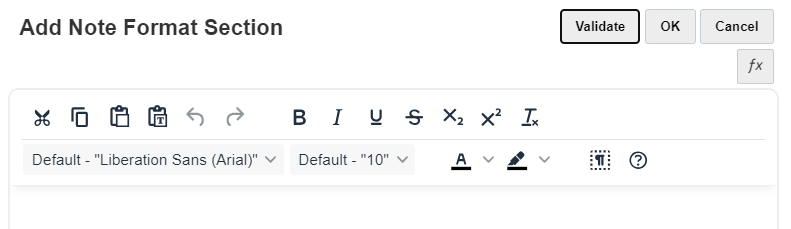
New Note Text Box Editor