
- Revision History
- Overview
- Feature Summary
- Strategic Workforce Planning
-
- Strategic Workforce Planning
- Features
-
- New Video
- OCI Migration: Oracle-Managed Migration Continues; Customer-Managed Migration Not Available Any Longer
- Allow Connections from Specific Countries Only to OCI (Gen 2) Environments
- Change in Sender Email Address on OCI (Gen 2) Environments
- REST APIs for Deleting Substitution Variables
- New Version of Oracle Smart View for Office
- Additional Properties Viewable in Member Information Dialog in Smart View
- Use Validate Metadata During the Database Refresh Process to Resolve Member ID Mismatches
- New Import Mapping Pipeline Job Type
- New Export Mapping Pipeline Job Type
- New Delete File Option for File Operations Job Type
- New Task Summary Option
- Claim and Release Multiple Tasks
- Large Profile Pictures Are Automatically Resized
- Ability to Manage Alias Tables
- More Additional Earnings, Benefits, and Taxes Available in Workforce
- Workforce Rules and Templates Updated to Include Descriptions and Comments
- Workforce Members Added Only When Features Are Enabled
-
- IMPORTANT Actions and Considerations
This document will continue to evolve as existing sections change and new information is added. All updates appear in the following table:
| Date | Module | Feature | Notes |
|---|---|---|---|
| 29 SEP 2023 | Created initial document. |
 HAVE AN IDEA?
We’re here and we’re listening. If you have a suggestion on how to make our cloud services even better then go ahead and tell us. There are several ways to submit your ideas, for example, through the Ideas Lab on Oracle Customer Connect. Wherever you see this icon after the feature name it means we delivered one of your ideas.
GIVE US FEEDBACK
We welcome your comments and suggestions to improve the content. Please send us your feedback at oracle_fusion_applications_help_ww_grp@oracle.com.
DISCLAIMER
The information contained in this document may include statements about Oracle’s product development plans. Many factors can materially affect Oracle’s product development plans and the nature and timing of future product releases. Accordingly, this Information is provided to you solely for information only, is not a commitment to deliver any material, code, or functionality, and should not be relied upon in making purchasing decisions. The development, release, and timing of any features or functionality described remains at the sole discretion of Oracle.
This information may not be incorporated into any contractual agreement with Oracle or its subsidiaries or affiliates. Oracle specifically disclaims any liability with respect to this information. Refer to the Legal Notices and Terms of Use for further information.
Column Definitions:
Report = New or modified, Oracle-delivered, ready to run reports.
UI or Process-Based: Small Scale = These UI or process-based features are typically comprised of minor field, validation, or program changes. Therefore, the potential impact to users is minimal.
UI or Process-Based: Larger Scale* = These UI or process-based features have more complex designs. Therefore, the potential impact to users is higher.
Features Delivered Disabled = Action is needed BEFORE these features can be used by END USERS. These features are delivered disabled and you choose if and when to enable them. For example, a) new or expanded BI subject areas need to first be incorporated into reports, b) Integration is required to utilize new web services, or c) features must be assigned to user roles before they can be accessed.
| Ready for Use by End Users Reports plus Small Scale UI or Process-Based new features will have minimal user impact after an update. Therefore, customer acceptance testing should focus on the Larger Scale UI or Process-Based* new features. |
Customer Must Take Action before Use by End Users Not disruptive as action is required to make these features ready to use. As you selectively choose to leverage, you set your test and roll out timing. |
|||||
|---|---|---|---|---|---|---|
| Feature |
Report |
UI or |
UI or |
|
||
Allow Connections from Specific Countries Only to OCI (Gen 2) Environments |
||||||
Additional Properties Viewable in Member Information Dialog in Smart View |
||||||
Use Validate Metadata During the Database Refresh Process to Resolve Member ID Mismatches |
||||||
More Additional Earnings, Benefits, and Taxes Available in Workforce |
||||||
Workforce Rules and Templates Updated to Include Descriptions and Comments |
||||||
Test Environments: Oracle will apply this monthly update during the first daily maintenance that occurs at or after 22:00 UTC on Friday, October 6, 2023.
Production Environments: Oracle will apply this monthly update during the first daily maintenance that occurs at or after 22:00 UTC on Friday, October 20, 2023.
NOTE: The monthly update will not be applied to any environment for which this monthly update is requested to be skipped using the EPM Automate skipUpdate command or service request to Oracle.
NOTE: Backing up the daily maintenance snapshot and restoring the environment as needed are self-service operations. Oracle strongly recommends that you download the maintenance snapshot every day to a local server.
The Oracle Help Center provides access to updated documentation. The updates will be available in the Help Center on Friday, October 6, 2023.
NOTE: Some of the links to new feature documentation included in this readiness document will not work until after the Oracle Help Center update is complete.
Documentation Updates Available One Week After Readiness Documents
Updated documentation is published on the Oracle Help Center on the first Friday of each month, coinciding with the monthly updates to Test environments. Because there is a one week lag between the publishing of the readiness documents (What's New and New Feature Summary) and Oracle Help Center updates, some links included in the readiness documents will not work until the Oracle Help Center update is complete.
https://docs.oracle.com/en/cloud/saas/epm-cloud/index.html
Fixed Issues and Considerations
Software issues addressed each month and considerations are posted to a knowledge article on My Oracle Support. Click here to review. You must have a My Oracle Support login to access the article.
NOTE: Fixed issues for EPM Cloud Common components (Smart View for Office, EPM Automate, REST API, Migration, Access Control, Data Management/Data Integration, Reports, Financial Reporting, and Calculation Manager) are available in a separate document on the My Oracle Support “Release Highlights” page.
This provides visibility into EPM Cloud release contents.
Give Us Documentation Feedback
We welcome your comments and suggestions to improve the content of the What's New document and the product documentation.
Please send us your feedback at EPMdoc_ww@oracle.com. In the body or title of the email, state that you are inquiring or providing feedback, and indicate for which EPM Cloud service and the monthly update cycle.
Create and Run an EPM Center of Excellence
A best practice for EPM is to create a Center of Excellence (CoE). An EPM CoE is a unified effort to ensure adoption and best practices.
Business Benefit: A CoE drives transformation in business processes related to performance management and the use of technology-enabled solutions.

Learn more:
- Visit the EPM Center of Excellence web page to learn about the benefits.
- Watch the webinars on Cloud Customer Connect: Creating and Running a Center of Excellence (CoE) for EPM Cloud and Planning Your Success with EPM Center of Excellence.
- Watch the videos: Overview: EPM Center of Excellence, Creating a Center of Excellence.
- Get best practices, guidance, and strategies for your own EPM CoE: Creating and Running an EPM Center of Excellence
Join Oracle Cloud Customer Connect
Please take a moment to join Cloud Customer Connect and its EPM Cloud forums. Customer Connect is a community gathering place for members to interact and collaborate on common goals and objectives. It's where you will find the latest release information, discussion forums, upcoming events, and answers to use-case questions. Joining takes just a few minutes. Join now!
To join, go to https://community.oracle.com/customerconnect/ and select Register in the upper right.
After you have joined and logged in, to access the forums (Categories), from the Cloud Customer Connect home page, select Categories, then Enterprise Resource Planning, and then make your selection under Enterprise Performance Management.
To ensure that you are always in the know, confirm that you have your notification preferences set for EPM Announcements as well as each Category you're following.
- To set notification preferences for EPM Announcements, go to Categories, then Announcements, and then Enterprise Performance Management. Next, select the Notification preferences drop down.
- To set notification preferences for each Category, navigate to the Category page and select the Notification preferences drop down. You must go to each category page separately and select the Notification preferences drop down.
NOTE: The Settings and Actions menu contains a link to Cloud Customer Connect. To access this link, from the Home page, click the down arrow next to the user name (in the upper right-hand corner of the screen), and select Cloud Customer Connect.
TIP: Bookmark the Enterprise Performance Management Resource Center to quickly find useful information on all things EPM. As a community member, you have access to important product announcements, best practices, known issues, training highlights, and more.
Follow Us on Social Media
Follow EPM Cloud on YouTube, Twitter, Facebook, and LinkedIn.
These are great resources for the latest updates and information about EPM Cloud.
Business Benefit: These resources can help you optimize your EPM implementation and user experience by providing valuable information and user assistance.
Use the Readiness App available on the Oracle Cloud Application Update Readiness site to review information about features released for Oracle Cloud. The app provides an .xlsx file listing all features released for one or more Cloud product(s), module(s) and update(s) that you designate. The EPM Cloud Features tool will not be updated beginning in this update.
From the Readiness site, click the red Try Our Readiness App! button in the upper right, or use this URL to access the app:
https://www.oracle.com/webfolder/technetwork/tutorials/tutorial/readiness/app/index.html
NOTE: To ensure a complete feature listing, select EPM Common in addition to the business process(es) you wish to view. To determine whether an EPM Common feature applies to your business process, review the Applies To information in the Short Description column of the .xlsx file.
NOTE: The Readiness App includes features from Oct 2021 and later. The EPM Cloud Features tool includes EPM features from March 2018 through June 2, 2023 only.
Business Benefit: The Readiness App is an interactive tool that allows you to view a comprehensive listing of all features that have been released for one or more product(s), module(s) and update(s) that you designate.
A new video is available.
Introduction to Predicting with Events in Cloud EPM Planning
This video introduces you to how to include events into your prediction process. Considering events when running predictions improves the accuracy of the predictions and helps you plan well in advance for the impact on sales or volume demand caused by events. By incorporating seasonal, cultural and other types of events, you can take advantage of opportunities that allow you to see anticipated spikes and falls in the predicted data for those specific events. Historical spikes or declines due to events are also reflected in future predictions.
Business Benefit: Videos provide 3-5 minute overviews and step-by step instructions to perform tasks and achieve an outcome.
OCI Migration: Oracle-Managed Migration Continues; Customer-Managed Migration Not Available Any Longer
One of Oracle's latest advancements, Oracle Cloud Infrastructure (OCI) is the foundation of Oracle's second generation cloud. OCI, a purpose-built, best-in-class platform for running enterprise applications, is engineered from the ground up to run mission-critical databases, workloads, and applications while providing end-to-end security. Oracle's data centers around the globe are standardizing on the new OCI architecture which will deliver even greater performance and reliability. There are a lot of EPM Cloud features that are available only in OCI. See Features Available only in OCI EPM Cloud Environments in Getting Started with Oracle Enterprise Performance Management Cloud for Administrators.
Oracle will migrate all Classic Commercial environments to OCI by the end of 2023 using monthly migration waves.
Oracle has sent notifications for Oracle-managed migrations specifying the migration schedule. By now, you must have received notifications for all Classic Commercial environments that were not scheduled for migration in earlier waves or migrated through the Customer-Managed Migration option. Follow the instructions in the notification. For Migration waves schedule information, see EPM Cloud Classic to OCI Migration Schedule in the Oracle Enterprise Performance Management Cloud Operations Guide.
For customers whose environments were included in Wave 7 (July 2023 Migration Notification): The migration of application data and users from Classic to OCI environments and the DNS configuration change to route the existing Classic service URLs to OCI environments will occur in the 23.10 (October) monthly update. If you prefer not to have the migration take place in the 23.10 monthly update, please skip the 23.10 update using the skipUpdate EPM Automate command, the Skip Updates REST API or a service request to Oracle .
- All Classic environments in the Amsterdam (EM2) Data Center must be migrated by the 23.10 monthly update. If your environment in the Amsterdam Data Center is on a one-off patch not merged in 23.10, the cloning from this Classic environment to OCI environment will still occur during the 23.10 update. Similarly, If you are skipping the 23.10 monthly update on a Classic environment in the Amsterdam Data Center using the skipUpdate EPM Automate command, the Skip Updates REST API or a service request to Oracle, the cloning from the Classic environment to the OCI environment will still occur during the 23.10 update.
- If your environments are included in Wave 8 (August 2023 Migration Notification), you must already have received your OCI environments. You should go through the optional migration steps, which include setting up SSO and IP Allowlist, and testing based on your requirements. See these information sources:
- Oracle-Managed Migration in Oracle Enterprise Performance Management Cloud Operations Guide
- Tasks to Perform After Cloning Environments in Administering Migration for Oracle Enterprise Performance Management Cloud
Oracle is no longer accepting any service request for Customer-Managed Migration, and expects all Customer-Managed Migrations to finish by these deadlines:
- Amsterdam (EM2) Data Center: Finish migration by the end of October 2023. Oracle will terminate Classic environments in the Amsterdam (EM2) Data Center in November 2023.
- All other data centers: Finish migration by the end of November 2023. Oracle will terminate Classic environments in other data centers in December 2023.
NOTE: At this time, the environments hosted in US-Gov and UK-Gov data centers are not eligible for migration to OCI.
Business Benefit: OCI provides you a purpose-built, best-in-class platform that is engineered from the ground up to run mission-critical databases, workloads, and business processes while providing end-to-end security. This new architecture delivers greater performance and reliability, and a number of EPM Cloud features that are not available in Classic EPM Cloud.
Steps to Enable
Review and follow instructions: EPM Cloud Classic to Oracle Cloud Infrastructure (OCI) Migration in Oracle Enterprise Performance Management Cloud Operations Guide
Key Resources
- EPM Cloud Classic to Oracle Cloud Infrastructure (OCI) Migration in Oracle Enterprise Performance Management Cloud Operations Guide
- Features Available only in OCI EPM Cloud Environments in Getting Started with Oracle Enterprise Performance Management Cloud for Administrators
Allow Connections from Specific Countries Only to OCI (Gen 2) Environments
You can now request Oracle to allow connections originating from specific countries only to OCI (Gen 2) environments. After this request is implemented, any connection attempt originating from any other country will be blocked.
Business Benefit: This feature allows you to block connection attempts originating from unwanted countries.
Steps to Enable
See Requesting to Allow Only Connections Originating in Specific Countries to OCI (Gen 2) Environments in Oracle Enterprise Performance Management Cloud Operations Guide
Key Resources
- Allow Connections from Specific Countries Only to OCI (Gen 2) Environments in Getting Started Guide for Administrators
Change in Sender Email Address on OCI (Gen 2) Environments
Starting with this update, the sender email address for the emails sent from OCI (Gen 2) environments will be changed to no.reply@epm.oraclecloud.com.
Business Benefit: This change helps with the future support of other OCI realms. For example, the sender email address for OC2 realm will be different.
Key Resources
- Default EPM Cloud Email Address in Getting Started Guide for Administrators
- OCI (Gen 2) Geographical Regions and Identifiers in Oracle Enterprise Performance Management Cloud Operations Guide
REST APIs for Deleting Substitution Variables
You can now use a set of REST APIs to delete substitution variables in your applications. You can delete:
- Substitution variables for the application
- Substitution variables for the plan type
- A substitution variable for the application
- A substitution variable for the plan type
Business Benefit: Using REST APIs allows you to automate the task of deleting a substitution variable.
Steps to Enable
Review the REST service definition in the REST API guides to leverage (available from the Oracle Help Center > your apps service area of interest > APIs & Schema). If you are new to Oracle's REST services you may want to begin with the Quick Start section.
Tips And Considerations
Before deleting substitution variables, you can use REST APIs to get information on what substitution variables are defined for the application or plan type. See Getting and Setting Substitution Variables for Planning in REST APIs for Enterprise Performance Management.
Key Resources
- Planning REST APIs in REST API for Oracle Enterprise Performance Management Cloud.
Access Requirements
- Service Administrators
New Version of Oracle Smart View for Office
Oracle Smart View for Office version 23.200 is now available from My Oracle Support and Oracle Technical Resources (formerly Oracle Technology Network).
The following new features are included:
- Search for Reports, Documents, and Task Lists in Smart View
- Member Selection Available for POV and Prompts in Reports
- Insert Multiple Reports in the Same Workbook
- New Search Field in Business Rules Dialog
- Formula, Label, and Comment Rows and Columns Supported in Flex Forms
- Set Formatting for Numbers in Oracle Essbase
- Support for Special Characters in Oracle Essbase
- New Diagnostic Options Settings to Focus Data Collection
- New Health Check Setting to Enable Compatibility Between Smart View and Smart View (Mac and Browser)
- Compatibility of Oracle Essbase Ad Hoc Grids Between Smart View and Smart View (Mac and Browser)
- Support for Microsoft Office Themes (Including Dark Theme) for Extensions in Smart View
- Improved Experience when Submitting from Free-Form Grid with Scaling Options Enabled
- New VBA Functions: HypLoginEssbaseCloudBasicAuth and HypSetBasicAuthToken
Business Benefit: This Smart View release includes new features and defect fixes.
Steps to Enable
Download and install Smart View. See Downloading and Installing Clients in Getting Started with Oracle Enterprise Performance Management Cloud.
Key Resources
- Working with Oracle Smart View for Office
- Developing Applications for Oracle Smart View for Office
- Oracle Smart View for Office Readme
Additional Properties Viewable in Member Information Dialog in Smart View
In Smart View ad hoc grids, additional members properties are now included in the Member Information dialog.
In the Member Information dialog, member properties are grouped and displayed on the following tabs. Only the tabs that are applicable to the member and connection are displayed.
- Information: A list of general information about the member such as the Name, Dimension, Data Storage, Data Type, Scenario Rollup, Skip Value, and so on.
- The newly added properties include Smart List and Source Cube Information.
- The newly added properties specific to dimension type are as follows:
- Currency: Scale, Precision, Reporting Currency, Thousands Separator, Decimal Separator, Negative Sign, Negative Color
- Scenario: Exchange Rate Table
- Aliases: A list of alias tables and corresponding aliases associated with the member
- Attributes: A table of the dimensions, members, and types of attributes associated with the member
- Formula: The formula associated with the member
- Comments: A list of comments associated with the member
- User Defined Attributes: A list of user defined attributes (attributes of the member defined by the administrator)
You access the Member Information dialog from the provider ad hoc ribbon in Smart View. For example, in Smart View, connect to a Planning data source and create a new ad hoc grid or open a saved one. Select a member cell and then, from the Planning Ad Hoc ribbon, select Cell Information.
You can also use these methods to access the Member Information dialog:
- In the ad hoc grid, right-click the selected member cell, then select Smart View, and then select Cell Information.
- In the Member Selection dialog, select a member in the right pane, and then from the Options button drop-down menu, select Cell Information
The information you view in the Member Information dialog can also be saved to an Excel file by clicking the Save button.
Business Benefit: The Member Information dialog now provides you with more details about members in an ad hoc grid.
Key Resources
- Viewing Member Information in Working with Oracle Smart View for Office
Use Validate Metadata During the Database Refresh Process to Resolve Member ID Mismatches
The Validate Metadata setting (formerly called Autocorrect Errors) scans for member identity (ID) mismatches between the business process and Essbase during the database refresh process and automatically resolves them.
To refresh the database, click Application, and then click Overview. Click Actions, then Refresh Database, and then click Create to choose refresh options. You can start the Refresh Database process right away or schedule it to run later as a job. All of the options you've selected on the Refresh Database page, including Validate Metadata, will persist to the saved job. If the Validate Metadata setting is selected, expect extra time for the refresh process to complete.
After making member ID corrections, members might be deleted or moved. A report file detailing any member movement (to a different parent) or deletion is generated and placed in the Outbox in a csv (comma-delimited) file format. Review the report to reaggregate some of the stored parent members where the child hierarchy may have changed. For example:
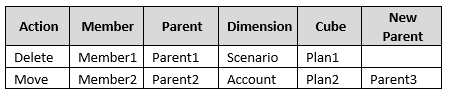
Example report showing member movement and deletions after validating metadata
The system generates a CSV file to the Outbox folder, and the filename is automatically generated with the application name followed by _autocorrect.csv; for example, vision_autocorrect.csv. This file is overwritten on each run.
Business Benefit: Resolving member ID mismatches allows corrected members, as well as their hierarchies along with properties and siblings, to be fully and correctly recognizable and usable within all the parts of the system without requiring additional user action. If you previously received a one-off patch for the Autocorrect feature, this Validate Metadata feature includes that same functionality. Additionally, any previous Autocorrect one-off patch-based release can be upgraded or migrated to this version with the usual existing processes.
Key Resources
- Administering Planning
New Import Mapping Pipeline Job Type
A new Import Mapping job type is available that enables you to import member mappings from a .CSV or .TXT file format. The Import Member Mapping job type supports merge or replace modes, along with validate or no validate options for target members.
The Import Mapping job type supports both local and remote executions. A drop-down lists the location names based on the selected connection where the mappings will be imported.
Business Benefit: The Import Mapping job type is used to derive the target members for each dimension based on source value when loading data enabling you to dimensionalize the data that is loaded to the target application.
Key Resources
- Using a Import Mapping Job Type in Administering Data Integration for Oracle Enterprise Performance Management Cloud
New Export Mapping Pipeline Job Type
A new Export Mapping job type in the Pipeline enables you to export member mappings to a .CSV or .TXT file format.
The Export Mapping job type supports both local and remote executions. A drop-down lists the location names based on the selected connection where the mappings will be exported;
Business Benefit: The Export Mapping job type enables you to export member mappings for the current dimension or all dimensions.
Key Resources
- Using an Export Mapping Job Type in Administering Data Integration for Oracle Enterprise Performance Management Cloud
New Delete File Option for File Operations Job Type
A new Delete option in the File Operations job type now enables you to delete a file from a source directory.
Business Benefit: The Delete option enables you to remove unused files and free up space in the source directory.
Key Resources
- Using a File Operations Job Type in Administering Data Integration for Oracle Enterprise Performance Management Cloud
The EPM Digital Assistant is now enhanced with a new option Show only my tasks that allows you to view the summary of your tasks under Task Summary.
Business Benefit: This option helps you to view your task summary.
Key Resources
-
Showing Task Summary in Getting Started with the Digital Assistant for Oracle Cloud Enterprise Performance Management
Claim and Release Multiple Tasks
You can now claim and release multiple tasks at a time in Task Manager. Users who are associated with tasks through a group or team assignment can claim and release multiple tasks at a time.
When the Claim or Release option is selected, a dialog displays that provides information about the status, tasks selected, tasks considered, and the number of tasks processed successfully and unsuccessfully. A visual indicator shows the completion percentage.
Business Benefit: This feature improves end user task processing for group and team assignments.
Key Resources
- Claiming or Releasing Tasks in Administering Planning
- Claiming or Releasing Tasks in Working with Planning
Large Profile Pictures Are Automatically Resized
Newly uploaded profile image files will automatically be resized to 100 x 100 pixels.
You can upload profile pictures of any size, but if the images are larger than a 100 x 100-pixel size, they will be resized automatically.
To upload a profile picture, click Tools, and then User Preferences. The image file can be of type .png, .jpg, .jpeg, or .gif.
NOTE: Automatic resizing only impacts new profile images that are uploaded in User Preferences. Existing profile pictures will not be resized.
Business Benefit: Reducing the size of large profile images improves performance and provides a consistent image presentation.
Key Resources
- Working with Planning
Ability to Manage Alias Tables
When you enable Strategic Workforce Planning, alias tables are now loaded only for the default language. In previous releases, when you enabled Strategic Workforce Planning, alias tables were loaded for twenty supported languages.
For new applications, after you enable Strategic Workforce Planning, you can use a new option, Manage Seeded Alias Tables, to load alias tables for other languages.
For existing applications, you can remove alias tables for languages you don’t need.
To add or delete alias tables:
- From the Navigator, under Create and Manage, click Alias Tables.
- From the Actions menu, click Manage Seeded Alias Tables (available after you have enabled a module).
- Select the languages you want to load, or clear the selection for languages you want to delete and then click OK.
- After the languages load, refresh the cube.
Business Benefit: For new applications, alias tables are now loaded only for languages you actually use. For existing applications, you can now remove alias tables for languages you don’t need.
Tips And Considerations
- You can load up to 30 alias tables in Strategic Workforce Planning.
- When you incrementally enable features or new modules, alias tables are loaded for your selected languages for any new members.
- If you’ve customized any labels in an alias table, those customizations are applied to any new members added when you incrementally enable features.
- As part of this enhancement, aliases for some members for certain languages have been added. If a module is updated in the future, these aliases will be loaded. If you have any custom members with the same alias this can cause a cube refresh error. Review the list of new aliases and make any changes as needed to your custom members.
- If you are importing a snapshot to 23.09 (or later) from a release earlier than 23.08, alias tables are created but they might be empty. To resolve this issue, use the Manage Seeded Alias Tables option to add aliases for the languages you want.
Key Resources
- Administering Strategic Workforce Planning
More Additional Earnings, Benefits, and Taxes Available in Workforce
In Workforce, you can now have a maximum of 30 members in any combination across Additional Earnings, Benefits, and Taxes.
When you enable Workforce features, select Expense Planning. Compensation Expenses, which includes salary planning, is selected by default. For Additional Earnings, Benefits, and Taxes, select an option to enable it, and then select the number of members to create. (By default, the minimum, one member, is selected for each enabled option.) You can have a maximum of 30 members across Additional Earnings, Benefits, and Taxes.
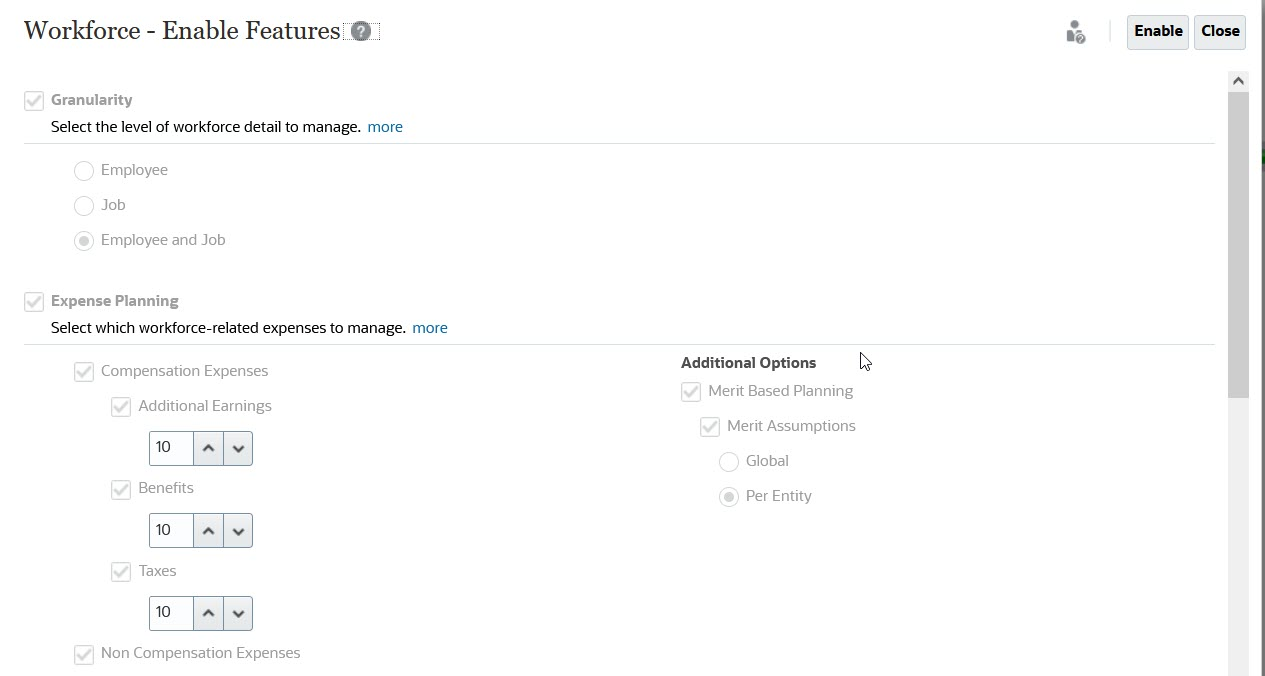
Workforce Enable Features
Configure Additional Earnings, Benefits, and Taxes based on the maximum number of components that an employee or job can receive. Set the number of Additional Earnings, Benefits, and Taxes based on your current needs, not your future needs, because you can change these values in the future.
For example, if "Employee 1" receives 3 additional earnings, 3 benefits, and 2 taxes while "Employee 2" receives 5 additional earnings, 2 benefits, and 4 taxes, then the configuration for the number of additional earnings, benefits, and taxes should be set to 5 additional earnings, 3 benefits, and 4 taxes.
Business Benefit: For new customers, this enhancement gives you more flexibility in creating the accounts you need. Previously, you could have only 10 Additional Earnings, 10 Benefits, and 10 Taxes. For existing customers, you can reduce or increase the number of members (up to 30 maximum, and a minimum of one) so you have only the accounts you need.
Tips And Considerations
-
You can incrementally increase or decrease the number of members for Additional Earnings, Benefits, and Taxes for both new applications and existing applications. This action adds or removes members from the Account dimension.
- If you reduce the number of Additional Earnings, Benefits, or Taxes, corresponding members are removed from the Account dimension. Before removing a component and its assigned expenses, back up by creating a snapshot. Additionally, review any customizations related to removed members on the forms, member formulas, or business rules (wherever the member is referenced) and make modifications as needed. Workforce won't remove members that are referenced in any customized artifacts such as forms, member formulas, and so on.
- After increasing the number of Additional Earnings, Benefits, or Taxes, which adds members, assign defaults to new members, and then run Synchronize Defaults to re-calculate compensation expenses.
- After decreasing the number of Additional Earnings, Benefits, or Taxes, which removes members, run Synchronize Definition to re-calculate compensation expenses.
- If you decrease the number of Additional Earnings, Benefits, or Taxes, line items are removed from the lower end of the hierarchy. For example, if you had 10 members for Additional Earnings, and you decrease it to 5, then Earning6 to Earning10 are removed.
- If you export a snapshot from an environment with this enhancement (for example, a test environment) and try to import it to an environment that does not have enhancement (for example, a production environment), note the following behavior:
- If you remove any members in the test environment and import the snapshot to the production environment, the production environment will still have 10 additional earnings,10 benefits, and 10 taxes, rather than the decreased number of members, and it will have no data about the removed members.
- If you increase the number of members in the test environment and import the snapshot to the production environment, the production environment will still have 10 additional earnings,10 benefits, and 10 taxes, rather than rather than the increased number of members, and it will have no data about the additional members.
Key Resources
- Administering Planning Modules
Workforce Rules and Templates Updated to Include Descriptions and Comments
Workforce rules and templates have been updated to include descriptions and comments. You can review these descriptions and comments in the Rules card or in Calculation Manager.
Business Benefit: The descriptions and comments can help customers and partners understand the purpose and structure of rules and templates to make it easier to determine whether and how to make modifications.
Key Resources
- Administering Planning Modules
Workforce Members Added Only When Features Are Enabled
For new customers with new applications and new Workforce customers, some members are tagged with their corresponding features, so that the members are added only if you enable the associated feature.
| Feature | Artifacts Added Only When Feature is Enabled | Dimension |
|---|---|---|
| Merit Based Planning |
OWP_Merit Month |
Account |
| Additional Earnings, Benefits, Taxes |
"OWP_Nonsalary Properties" hierarchy OWP_Calculated Max Value OWP_NextValue OWP_TierIndex OWP_Taxable Compensation OWP_Gross Earnings OWP_CYTD(Prior) OWP_Custom Expense |
Property |
| Additional Earnings, Benefits, Taxes, and Merit Based Planning |
OWP_Transferred Salary |
Account |
| Additional Earnings, Benefits, Taxes |
OWP_FYTD Gross Earnings OWP_CYTD Gross Earnings OWP_FYTD Taxable Compensation OWP_CYTD Taxable Compensation |
Account |
Business Benefit: Adding members only when a feature is enabled improves performance because unnecessary members are not added and do not increase the Essbase block size. This option also allows customers to more easily customize the model in areas where they don’t enable features.
Tips And Considerations
There is no change for existing applications or for existing Workforce customers. Existing customers who enable Workforce for the first time will see this enhancement.
IMPORTANT Actions and Considerations
One-Week Lag Between Readiness Documents Live and Help Center Live
Because Oracle readiness documents (What's New and New Feature Summary) are live one week before the monthly update is applied to Test environments, some links to documentation included in the readiness documents will not work until after the Oracle Help Center update is complete when the monthly update is applied to Test environments.
Strategic Workforce Planning Statement of Direction
Please refer to the Statement of Direction for Oracle Strategic Workforce Planning Cloud Service (SWPCS): Oracle Support Document 2963631.1 (Oracle Strategic Workforce Planning Cloud Service Statement of Direction). Oracle will discontinue offering Strategic Workforce Planning Cloud Service (SWPCS) in September 2023. The replacement product for SWPCS is Enterprise Performance Management (EPM) Enterprise Cloud. There will be no loss in functionality with this change in product licensing. Strategic Workforce Planning is scheduled to be a separate application type within the EPM Enterprise Cloud Planning Business Process.
The timing of this change and discontinuation of old price list product numbers is scheduled for September 2023. Customers should plan to replace their SWPCS subscriptions with EPM Enterprise Cloud. In order to avoid interruption to your SWPCS subscription, Oracle recommends executing a replacement order at least sixty (60) days in advance of the SWPCS Date of Termination. Customers should speak with their Oracle Sales Representative to prepare for this change.
You can migrate your existing applications to EPM Enterprise Cloud. See the Oracle Strategic Workforce Planning Cloud Service Statement of Direction for details.
Default Essbase Query Limit
Starting with the November (23.11) update, the default value of Essbase query limit (the maximum amount of time that an Essbase query can run to retrieve and deliver information) will be set to 900 seconds (15 minutes). Currently, Essbase queries are allowed to run indefinitely. Depending on your analysis of the Essbase query, you will be able to change this default setting using the setEssbaseQryGovExecTime EPM Automate command.
Change in Application Role Names
In a future update, Oracle will rename some application roles to align role names across business processes. The following application role name changes will be made:
| Current Application Role Name | Proposed Application Role Name |
|---|---|
| Access Control Manager |
Access Control - Manage |
| Ad Hoc Grid Creator |
Ad Hoc - Create |
| Ad Hoc Read Only User |
Ad Hoc - Read Only User |
| Ad Hoc User |
Ad Hoc - User |
| Manage Alert Types |
Alert Types - Manage |
| Announcements? Manage |
Announcements - Manage |
| Manage Announcements |
Announcements - Manage |
| Application Creator |
Application - Create |
| Mass Allocation |
Application - Mass Allocate |
| Approvals Administrator |
Approvals - Administer |
| Approvals Ownership Assigner |
Approvals - Assign Ownerships |
| Approvals Process Designer |
Approvals - Design Process |
| Approvals Supervisor |
Approvals - Supervise |
| Auditor |
Audit |
| View Audit |
Audit - View |
| Run Calculation |
Calculation - Run |
| Delete Calculation History |
Calculation History - Delete |
| View Calculation History |
Calculation History - View |
| Consolidation Journals - Approve |
Consolidation Journals - Approve |
| Consolidation Journals - Auto-Post after Approval |
Consolidation Journals - Auto-Post after Approval |
| Consolidation Journals - Create |
Consolidation Journals - Create |
| Consolidation Journals - Manage Periods |
Consolidation Journals - Manage Periods |
| Consolidation Journals - Post |
Consolidation Journals - Post |
| Consolidation Journals - Submit |
Consolidation Journals - Submit |
| Consolidation Journals - Un-Post |
Consolidation Journals - Un-Post |
| Reconciliation Manage Currencies |
Currencies - Manage |
| Data Integration Administrator |
Data Integration - Administrator |
| Create Integration |
Data Integration - Create |
| Drill Through |
Data Integration - Drill Through |
| Run Integration |
Data Integration - Run |
| Manage Data Loads |
Data Loads - Manage |
| Documents - Manage |
Documents - Manage |
| Reconciliation View Jobs |
Jobs - View |
| Migration Administrator |
Migrations - Administer |
| Create Model |
Model - Create |
| Delete Model |
Model - Delete |
| View Model |
Model - View |
| Task Manager - Manage Dashboards |
Operational Dashboards - Manage |
| Task Manager - Manage Reports |
Operational Reports - Manage |
| Manage Organizations |
Organizations - Manage |
| Manage Periods |
Periods - Manage |
| View Periods |
Periods - View |
| Create POV |
POV - Create |
| Delete POV |
POV - Delete |
| Clear POV Data |
POV Data - Clear |
| Copy POV Data |
POV Data - Copy |
| Edit POV Status |
POV Status - Edit |
| Reconciliation View Profiles |
Profiles - View |
| Manage Profiles and Reconciliations |
Profiles and Reconciliations - Manage |
| Create profit Curve |
Profit Curve - Create |
| Edit Profit Curve |
Profit Curve - Edit |
| Run Profit Curve |
Profit Curve - Run |
| Reconciliation Manage Public Filters and Views |
Public Filters and Views - Manage |
| Reconciliation Commentator |
Reconciliation - Commentator |
| Reconciliation Manage Teams |
Reconciliation - Manage Teams |
| Reconciliation Preparer |
Reconciliation - Preparer |
| Reconciliation Reviewer |
Reconciliation - Reviewer |
| Reconciliation Manage Reports |
Reports - Manage |
| Create / Edit Rule |
Rule - Create / Edit |
| Delete Rule |
Rule - Delete |
| Run Rule Balancing |
Rule Balancing - Run |
| Mass Edit of Rules |
Rules - Mass Edit |
| Task List Access Manager |
Task List - Manage Access |
| Task Manager - Approver |
Task Manager - Approver |
| Task Manager - Assignee |
Task Manager - Assignee |
| Task Manager - Manage Artifacts |
Task Manager - Manage Artifacts |
| Task Manager - Manage Public Filters and Views |
Task Manager - Manage Public Filters and Views |
| Task Manager - Manage System Services and Settings |
Task Manager - Manage System Services and Settings |
| Task Manager - Manage Tasks |
Task Manager - Manage Tasks |
| Task Manager - Manage Users and Teams |
Task Manager - Manage Users and Teams |
| Task Manager - View Audit |
Task Manager - View Audit |
| Run Trace Allocation |
Trace Allocation - Run |
| Reconciliation Manage Users |
Users - Manage |
| Run Validation |
Validation - Run |
| View Creator |
Views - Create |
Plan to Discontinue Support for Non-Redwood Experience Themes
Oracle's Redwood UX Design is helping organizations improve user productivity, reduce training costs, and increase user satisfaction. As such, it has gained wide adoption across our Oracle Cloud user base.
Within Cloud EPM the Redwood Theme has had significant adoption, and major new platform innovations over the past few years have primarily been released only within the Redwood theme.
Going forward, future innovations in Cloud EPM and Redwood UX Design patterns are likewise targeted to be available within the Redwood theme only. Customers are encouraged to deploy their applications using Redwood theme only.
Towards the end of first quarter of 2024 (subject to change, safe harbor applies), the Redwood Experience will offer a default Oracle theme and these two additional appearance options: Custom Light and Custom Dark. The appearance of all EPM Cloud environments that currently use the Redwood Experience will automatically be shifted to either the default Oracle theme or the Custom Dark theme based on currently deployed background appearance of these environments.
In a later update planned for the second quarter of 2024, Oracle will automatically convert non-Redwood theme environments to the Redwood Experience.
If you're a customer and you're not already using Redwood Experience, you're encouraged to move to the Redwood Experience as soon as possible to take advantage of its user experience advantages.
Customers are encouraged to watch the Cloud Customer Connect session in April 2023: EPM – Why You Should Be Using The Redwood Theme in EPM Cloud
This session covers why users should be adopting the Redwood theme, customizations available within the theme (such as company logo), and the future plans around non-Redwood themes for Cloud EPM.
Future Deprecation of Native Mode Option for Smart View Ad Hoc Behavior Application Setting
Many applications on the Oracle EPM Cloud Platform still support Native Smart View Ad Hoc Behavior mode apart from the Standard mode.
Standard is the ad hoc mode upon which all enhancements in the EPM Cloud Platform are being delivered.
Oracle is planning to stop supporting Native mode within the next 6-12 months (March-September 2024 timeframe). Customers on Native mode are advised to convert the Smart View Ad Hoc Behavior application setting for their environments to Standard mode and test their use cases. Any gaps found should to be logged as an enhancement to the Standard mode. Enhancements should be logged in the Customer Connect EPM Platform idea Labs by end of November 2023, for Oracle to review.
Embedding Google Sheets, Google Drive Files, and Microsoft Office 365 Files in Navigation Flows
Customers can embed the third-party pages listed below in Strategic Workforce Planning Cloud Application navigation flows. Though not supported by Oracle, using instructions provided by the third-party sites, you can now embed links to these resources within navigation flow cards, tabs, and sub tabs:
- Google Sheets
- Files stored in Google Drive (for example, PDF and Excel)
- Files stored in Microsoft Office 365
For more information about embedding third-party pages in Strategic Workforce Planning Cloud applications, see the following documentation:
- About Using URLs to Embed Third-Party Pages in EPM Cloud Applications in Administering Planning
Plan for the User Variables Dimension Column to Honor the Alias Setting in User Preferences
In a future update, the Dimension column on the User Variables page within User Preferences will honor the Alias Setting in User Preferences. So if an alias name is defined for a dimension, then the Dimension column on the User Variables page will show that dimension’s alias based on the alias table selected in User Preferences. If no alias is defined for the dimension, the dimension name will be displayed.
Transition from Identity Cloud Service (IDCS) to Identity and Access Management (IAM)
Strategic Workforce Planning Cloud environments on OCI (Gen 2) are transitioning from Identity Cloud Service (IDCS) to Identity and Access Management (IAM) domains. For information on IAM, see Overview of Identity and Access Management.
After this transition, existing IDCS administration and My Profile functionalities remain the same, but are hosted on Oracle Cloud Console. The Oracle Cloud sign-in page has an updated design to match the latest Oracle Cloud design guidelines. To learn more on what to expect with this transition, see Introducing OCI IAM Identity Domains: What customers need to know.
Removal of Enhanced Integration API and Drill Type UI Options in Data Management System Settings
As of the June (23.06) update, the Enhanced Integration API and Drill Type UI options have been removed from the list of options in the System Settings option of Data Management.
Formerly, the Enhanced Integration API setting was added temporarily to address backward compatibility considerations.
The Drill Type UI setting formerly enabled users to select either the Classic or Simplified user interface when drilling down in Oracle Enterprise Performance Management. The default drill type user interface is now the Simplified User Interface and the Classic option for the user interface of Drill Landing Page is no longer available.
Forms 2.0 and Dashboards 2.0
Within the next 6 months, Forms 2.0 and Dashboards 2.0 functionality will be available. Forms 2.0 and Dashboards 2.0 use Oracle JET technology for faster rendering, sophistication, ease of use, improved flexibility, better visualization, and additional designs. To work with Forms 2.0 and Dashboards 2.0, you must enable the Redwood Experience. Forms 1.0 and 2.0 and Dashboard 1.0 and 2.0 versions will continue to coexist in the same business process at the same time.
Forms 2.0 features:
- Forms runtime-only improvements
- Usability improvements
- Better scalability and enhanced performance
- Greater consistency between Web forms and Smart View forms
- Easily switch from Forms 1.0 to Forms 2.0 and back using an application setting
Dashboards 2.0 enhancements:
- Introduces a new Grid chart type which renders Forms 2.0 inside Dashboards 2.0
- New URL and Commentary types of Dashboard objects
- Custom formatting of titles and support for background colors in URL, Commentary, and Grid objects
- New user interface for associating business rules
- Ability to display multiple Gauge, Pie, and Doughnut charts inside one Dashboard object
- New menu options for opening and editing forms directly from the Dashboard
- New Information icon for the Dashboard and all Dashboard objects
- Ability to easily convert 1.0 Dashboards to 2.0 individually and at the folder level on the Dashboards listing page
Plan to Disable the Print Option in Web Ad Hoc Grids and Forms 2.0
Starting with the November (23.11) update, we are disabling the print option within Web ad hoc grids. Forms 2.0 (to be released soon) will also not have a print option. You can use the browser's print feature or the Excel Print feature in Smart View if you require printing.
Announcement: Data Management Feature Migration to Data Integration
The user interface pages listed in the table below are no longer available in Data Management, but are available in Data Integration. Data Integration is available from the Data Exchange card from the home screen in the Cloud EPM Business Process, and users can access these features in the current Cloud EPM update. Data Management is not going away – we are only moving a few features now that have 100% parity with Data Integration. Profitability and Cost Management customers are not affected by the migration and do not see a change in their Data Management user interface. REST APIs are not impacted by this change.
| Data Management | Data Integration | Data Integration Navigation Path |
|---|---|---|
| Source System |
Configure Connections |
From the Data Integration UI, select the Actions drop down, and then Applications. In Applications, there is an icon next to the drop down labeled Configure Connections. |
| Target Application |
Applications |
From the Data Integration UI, select the Actions drop down, and then Applications. |
| Period Mapping |
Period Mapping |
From the Data Integration UI, select the Actions drop down, and then Period Mapping. |
| Category Mapping |
Category Mapping |
From the Data Integration UI, select the Actions drop down, and then Category Mapping. |
Data Integration is the next generation of the Data Management user interface, enabling users to easily build and manage Cloud EPM integrations. As feature parity between Data Integration and Data Management becomes complete, Data Management features will be turned off, and users will use the new Data Integration user interface instead.
This transition is gradual; future What's New documents will include information about the first set of planned changes as well as updates about additional changes planned for the future.
All Data Integration features discussed in this document are currently generally available in the Cloud EPM business processes.
Integration definitions built with Data Management are also visible in Data Integration, which enables an easy transition. (Data Integration is a new user interface on the Data Management data model and does not require migration of content from Data Management to Data Integration).
Please note that additional new integration features will only be included in Data Integration, and will not be back-ported to Data Management. Critical bug fixes and security fixes will still be made to Data Management until all features are fully migrated. In addition, all features from Data Management will be migrated to Data Integration with the exception of the following:
- The batch feature will be replaced by the new Pipeline feature. The Pipeline feature was available in the June (23.06) update.
- The Report Definition feature will not be migrated, only the Report Execution feature. Please note that Account Reconciliation, Financial Consolidation and Close, Planning and Tax Reporting provide a feature to report against the Data Integration relational tables using a custom SQL and a BI Publisher report template via Task Manager.
- The ability to create new Custom Applications in Data Management will no longer available, and customers should use the “Data Export to File” application type instead. (Existing integrations using a custom application will not be impacted.) See Custom Application in Data Management under EPM Cloud Platform in the Important Actions and Considerations section of this document.
For reference, please see the Data Integration guide available from the documentation library for your specific EPM business process. Select the desired business process, then Books, and then scroll down to the Administering Data Integration for Oracle Enterprise Performance Management Cloud documentation link.
See Administering Data Integration for Oracle Enterprise Performance Management Cloud for more information.
Removal of Support for Custom Application in Data Management
Since the September (23.09) update, custom target applications can no longer be added in Data Management. (Existing integrations that use a custom target application will not be impacted, and will still run without any changes.) This type of application was used to extract data from the EPM Cloud, and then the data was pushed into a flat file instead of being loaded to an EPM Cloud application. The custom application was superseded by the Data Export to File feature in an earlier update. The Data Export to File feature has enhanced functions and capabilities.
If you still have a custom target application, it is recommended that you use the Upgrade Custom Applications option to migrate your existing custom target application to a data export to file application. For more information, see Upgrade Custom Applications at: https://docs.oracle.com/en/cloud/saas/enterprise-performance-management-common/erpia/upgrade_custom_applications_100x438d5119.html.
The migration converts existing file formats from the custom target application to the file formats used in the data export to file option and retains all the existing setup. When the custom target application has been converted, you can run same integration as before. Data export file applications are available both in Data Management and Data Integration.
Calculation Manager Errors and Warnings Enforcement
In a future update, Calculation Manager will enforce the execution of the Errors & Warnings diagnostic tool for any rule being launched, validated, or deployed from it. If there are errors that result from this new process, Calculation Manager will not execute, validate, or deploy the rule. This new process will apply to all new applications once released. Existing applications will have a finite period of time to bypass this new process to allow you to modify the rules that violate the new Errors & Warnings diagnostic analysis. In all cases, existing rules that are already deployed will continue to run as-is without any change in behavior.
Change in Behavior for Grids Created from Groovy and REST APIs for ASO Cubes
In a future update, the suppression behavior for grids created via Groovy DataGridDefinitionBuilder and the exportdataslice REST API for ASO cubes will be made consistent with that of the run time data grids created using the Form Designer. Previously, if a grid was built for an ASO cube in Groovy or REST API, then the system used the NON EMPTY MDX clause to suppress missing rows when the suppressMissingBlocks flag was true. Now, when a grid is built for an ASO cube, it will use the NON EMPTY MDX clause when suppressMissingRows is true, and suppressMissingBlocks will be ignored. This means that ASO grids with suppressMissingRows true and suppressMissingBlocks false will now start using MDX. Likewise, ASO grids with suppressMissingRows false and suppressMissingBlocks true will no longer use MDX. Grids where the suppressMissingRows and suppressMissingBlocks flags had the same value will not be impacted. These changes may result in a change in behavior or performance for some ASO grids. If this happens and is undesirable, consider toggling the value of suppressMissingRows from the builder or the JSON payload in case of the REST API.
Report Import/Export to Excel: Font Installation Requirements for Text Boxes in Excel
Due to performance and rendering quality enhancements to Report text boxes when exported to Excel, Report text boxes may appear distorted or with overlapping text while importing or exporting to Excel when the fonts used within the text boxes are not installed on the client machine. To fix this, install the missing fonts used within the text boxes on the client machine.
Oracle Financial Reporting Statement of Direction
Please refer to the Statement of Direction for Oracle Financial Reporting:
Oracle Support Document 2910806.1 (EPM Cloud Financial Reporting Statement of Direction)
Please note that the Oracle Financial Reporting tentative deprecation dates have been moved to mid-to-late CY24.
For more information:
- See Appendix B in the Designing with Reports Guide: Migrating Reports from Financial Reporting.
- On June 8, the most recent Oracle Cloud Customer Connect event, Migrating Your Financial Reporting to Reports, was presented. There is a presentation, an event recording, and an FAQ sheet accessible. In order to view the event recording and documentation, you must log in to Cloud Customer Connect.