

This document will continue to evolve as existing sections change and new information is added. All updates are logged below, with the most recent updates at the top.
| Date |
What's Changed |
Notes |
|---|---|---|
| 24 AUG 2017 |
Initial Document Creation. |
Oracle Tax Reporting Cloud, September Update
This document outlines the announcements in the upcoming Oracle Tax Reporting Cloud update.
Announcements and New Features
Oracle will apply the latest updates to your test environment on Friday, September 1, 2017 and to your production environment on Friday, September 15, 2017. The update will be applied during your normal daily maintenance window.
The Oracle Help Center, which provides access to updated documentation, will also be available on September 1, 2017.
NOTE: You can migrate maintenance snapshots from the current version of the service instance to the preceding version or to the next version. For example, snapshots from 17.08 can be imported into 17.07 and 17.09 service instances. Migration between the same versions is always supported.
Creating Alternate Hierarchies for the Entity Dimension
In the Entity dimension, you can now create alternate hierarchies, where a single entity can have multiple parents. The parent members may use different currencies and the translation that happens in the parent currency member will be different for these entities.
For more information, see “Creating Alternate Hierarchies” in the Administering Oracle Tax Reporting Cloud guide.
When setting FX rates for Oracle Tax Reporting Cloud applications, you can now apply a specific FX rate to any of the base entities. This feature provides you with an additional level of control for calculations in your application.
For instructions, see “Working with FX Rates” in the Working with Oracle Tax Reporting Cloud guide.
Rollover for Country by Country Reporting (CbCR)
After closing a period, the Tax Rollover process can now be used to perform a rollover of the CbCR Filing. The relevant data is copied from the previous period as a starting point for the CbCR filing process with the new period. With the exception of Table 1 which needs to be calculated/manually entered for the new period, all the CbCR forms are rolled over.
For more information, see “Learn About Tax Rollover” in the Administering Oracle Tax Reporting Cloud guide.
Support for Single Sign-on Using Oracle Identity Cloud Services (IDCS)
You can configure single sign-on (SSO) access to Oracle Enterprise Performance Management Cloud using Oracle Identity Cloud Services (IDCS), which provides a comprehensive cloud-based identity management and security platform that supports a universal set of access controls, permissions, and password security constraints.
Configuring SSO requires you to configure a SAML 2.0 link between Oracle Identity Cloud Service and Oracle Enterprise Performance Management Cloud. See "Configuring Single Sign-On" in Getting Started with Oracle Tax Reporting Cloud guide for information on configuring SSO using IDCS.
Automatic Application Snapshot Uploads to Facilitate Troubleshooting
While submitting feedback, Service Administrators can consent to submit the last maintenance snapshot of the instance to Oracle to expeditiously troubleshoot the issue and test fixes.
Oracle uses the submitted application snapshot for testing purposes only; no changes will be made to the application or data. If you consent to submit the maintenance snapshot, Oracle automatically encrypts and copies the log files and maintenance snapshot to Oracle Support. For detailed instructions, see “Helping Oracle Collect Diagnostic Information Using the Provide Feedback Utility” in Getting Started with Oracle Tax Reporting Cloud guide.
Integrated Business Process Navigation Flows
Service Administrators can set up connections that enable users to navigate across Oracle Enterprise Performance Management Cloud subscriptions to create unified business process flows across multiple subscriptions which can belong to any combination of EPM subscriptions. The following subscriptions are supported within this feature:
- Oracle Planning and Budgeting Cloud
- Oracle Enterprise Planning and Budgeting Cloud
- Oracle Financial Consolidation and Close Cloud
- Oracle Tax Reporting Cloud
- Oracle Account Reconciliation Cloud
- Oracle Profitability and Cost Management Cloud
- Oracle Enterprise Performance Reporting Cloud
Considerations:
- Connections can be created using any of the following services as a source for the connection:
- Oracle Planning and Budgeting Cloud
- Oracle Enterprise Planning and Budgeting Cloud
- Oracle Financial Consolidation and Close Cloud
- Oracle Tax Reporting Cloud
- All EPM service subscriptions can be connected into from these source connections. Connections can also be created between subscriptions of the same service type. Following connections are supported with this feature:
- Connections where services are in same domain within the same data center
- Connection across multiple subscriptions when services are in different domains and different data centers if an identity provider is set up for federated SSO
Connection across multiple subscriptions when services are in different domains within the same data center will be supported in a future update.
For detailed information about integrated EPM Cloud subscriptions and navigating across subscriptions, see “Connecting Subscriptions in EPM Cloud” in Administering Oracle Tax Reporting Cloud guide.
Customizing the Application Interface with Navigation Flows
Navigation flows give application designers control over how various roles, or groups, interact with the application. The Navigation Flow Designer enables you to customize the application interface. For example, you can change the names of the cards and clusters that display on the Home page and the order in which they are displayed. You can hide cards, create new cards, and group cards into clusters. You can also customize the vertical and horizontal tabs that display on a card.
To work with navigation flows, click Tools, and then click Navigation Flow.
See “Designing Custom Navigation Flows” in Administering Oracle Tax Reporting Cloud guide.
Enhancements to the Activity Report
To help understand the processes that may impact the service performance, Oracle has updated the Activity Report, which now contains information on the top 15 user interface requests that took the most time to execute.

The sign in process no longer requires you to select an identity domain while accessing the service. To simplify the sign in process, the name of your identity domain is now derived from the URL that you specify.
NOTE: This is an Oracle Cloud enhancement, which may already have been rolled out through Oracle Cloud data centers.
You can now use a REST API to copy an application snapshot. See “Copy Application Snapshot” in the Oracle® Cloud REST API for Oracle Enterprise Performance Management Cloud guide.
Simplified Provisioning Report
This release includes a simplified Provisioning Report that provides a concise view of the roles assigned to each user. In addition to providing the number of provisioned users, the enhanced report presents information on each provisioned user in one row to provide a comprehensive view of all assigned roles.
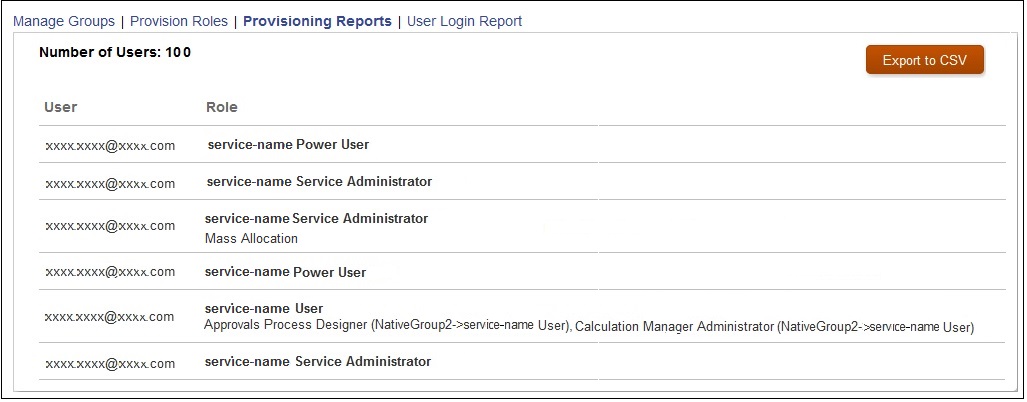
For information on viewing the Provisioning Report, see “Generating Service-Level Provisioning Report” in Administering Access Control for Oracle Enterprise Performance Management Cloud guide.
Give Us Documentation Feedback
We welcome your comments and suggestions to improve the content of the Whats New document and the product documentation. Please send us your feedback at EPMdoc_ww@oracle.com. State that you are inquiring or providing feedback, and indicate for which EPM Cloud service as well as the monthly patch cycle, in the body or title of the email.
| Defect |
Description |
|---|---|
| 25780133 |
When building reports in Financial Reporting Web Studio, custom text in column headers is now displayed correctly in the report output. |
| 26421993 |
In Financial Reporting Web Studio, when a default member for a prompt is left blank, you no longer receive an "unable to process request" error. |
| 26614891 |
In Financial Reporting, the vertical scroll bar is now displayed correctly in the "Respond to Prompts" popups. |
| 26540610 |
In Financial Reporting Web Studio, if you have a grid with more than 20 columns and you click Save after making a change, you are no longer returned to the far left of the report. |
| 26522684 |
Action menus now work consistently in simple forms that are included in a composite form. |
| 26309094 |
Shared members that are set to include their descendents with IDescendants now correctly include all members in rows and columns, even if the Suppress Missing Blocks option is enabled. |
| 26531423 |
You can now delete children of the member OFS_Adjustment to Revenue. |
| 26445428 |
Forms now display correctly if an attribute name contains “BR”. |
| 26583972 |
Smart List value now displays correctly in the Excel formula bar when using a custom replace value function with mixed alpha/numeric characters. |
| 25963632 |
Export step executes even when no data has been imported. |
| 26520503 |
After refreshing an aggregate storage (ASO) cube in Smart View, members display as expected. |
| 25464144 |
Intermittent display issues (for example, flickering) when navigating in forms are resolved. |
| 26357870 |
The browser freezing intermittently when navigating task lists is resolved. |
| 26630426 |
In Tax Reporting Cloud, payments and refund members are now included during roll forwards. |
| 26495800 |
In Tax Reporting Cloud, once the database is refreshed, you are no longer losing the ICP attribute value. |
| 26560381 |
In Tax Reporting Cloud, refreshing the database no longer fails when the application has an excess of 50 currency members. |
| 26649736 |
From the Notifications menu under Tools, users can select whether to receive Close Manager email notifications immediately, every few hours, or daily. |
| 25554729 |
With Internet Explorer 11, you can now enter data into multiple cells and use Tab without intermittent issues, such as the window closing. |
| 25249659 |
Business rules that are set to run on Save and that populate the form now successfully execute before Smart Push is started. |
| 26417313 |
The @MDSHIFT Essbase calculation function now works correctly after an Oracle Planning and Budgeting Cloud update. |
| 26585244 |
In Tax Reporting Cloud, rollover now copies domicile specific rules |
File-Based Integration of Data Management with Oracle Fusion Financials Cloud
Oracle Fusion Financial Cloud Budgetary Control and Encumbrance Accounting is now fully integrated with Data Management.
This enhancement brings the integration of Oracle Fusion Financials Cloud with Oracle Enterprise Performance Management Cloud on par with the current, out of the box, file-based integration. As a result, the file-based integration will be phased out starting the September update to the service.
If you are using file-based integration between Oracle Fusion Financials Cloud and Oracle Enterprise Performance Management Cloud, Oracle recommends that you adopt this new integration as soon as possible.
Financial Reporting Studio Desktop Client
Oracle is committed to providing a simple and intuitive user experience. To achieve this, Financial Reporting Web Studio, available since March 2016, will become the only environment for designing and building reports.
Oracle is providing additional time for users to transition from Financial Reporting Desktop Studio to Financial Reporting Web Studio. Tentative plans call for functional parity between Financial Reporting Web Studio and Financial Reporting Desktop Studio in late 2017, at which time, support for the desktop Studio will transition to the Web Studio and distribution of the Desktop Studio will cease.
Oracle recommends that you transition to using Financial Reporting Web Studio at the earliest opportunity. Please send questions and concerns to Oracle using the Provide Feedback option in the service.
When using EPM Automate, log out and log in again after importing a Financial Close Management (FCM) snapshot to refresh the icons on the Home page.
You may receive inaccurate messages from Navigator if pop-up blockers are enabled. Disable pop-up blockers in your browser to avoid this.
In the Academy, some pages and icons may appear different in the video and the Cloud service.
---

Copyright © 2017, Oracle and/or its affiliates. All rights reserved.
This document is provided for information purposes only, and the contents hereof are subject to change without notice. This document is not warranted to be error-free, nor subject to any other warranties or conditions, whether expressed orally or implied in law, including implied warranties and conditions of merchantability or fitness for a particular purpose. We specifically disclaim any liability with respect to this document, and no contractual obligations are formed either directly or indirectly by this document. This document may not be reproduced or transmitted in any form or by any means, electronic or mechanical, for any purpose, without our prior written permission.
Oracle and Java are registered trademarks of Oracle and/or its affiliates. Other names may be trademarks of their respective owners.
Intel and Intel Xeon are trademarks or registered trademarks of Intel Corporation. All SPARC trademarks are used under license and are trademarks or registered trademarks of SPARC International, Inc. AMD, Opteron, the AMD logo, and the AMD Opteron logo are trademarks or registered trademarks of Advanced Micro Devices. UNIX is a registered trademark of The Open Group.

17.09