
This document will continue to evolve as existing sections change and new information is added. All updates appear in the following table:
| Date | Product | Feature | Notes |
|---|---|---|---|
| 26 OCT 2022 | Created initial document. |
 HAVE AN IDEA?
We’re here and we’re listening. If you have a suggestion on how to make our cloud services even better then go ahead and tell us. There are several ways to submit your ideas, for example, through the Ideas Lab on Oracle Customer Connect. Wherever you see this icon after the feature name it means we delivered one of your ideas.
GIVE US FEEDBACK
We welcome your comments and suggestions to improve the content. Please send us your feedback at omcdocumentation_ca@oracle.com.
DISCLAIMER
The information contained in this document may include statements about Oracle’s product development plans. Many factors can materially affect Oracle’s product development plans and the nature and timing of future product releases. Accordingly, this Information is provided to you solely for information only, is not a commitment to deliver any material, code, or functionality, and should not be relied upon in making purchasing decisions. The development, release, and timing of any features or functionality described remains at the sole discretion of Oracle.
This information may not be incorporated into any contractual agreement with Oracle or its subsidiaries or affiliates. Oracle specifically disclaims any liability with respect to this information. Refer to the Legal Notices and Terms of Use for further information.
Column Definitions:
Report = New or modified, Oracle-delivered, ready to run reports.
UI or Process-Based: Small Scale = These UI or process-based features are typically comprised of minor field, validation, or program changes. Therefore, the potential impact to users is minimal.
UI or Process-Based: Larger Scale* = These UI or process-based features have more complex designs. Therefore, the potential impact to users is higher.
Features Delivered Disabled = Action is needed BEFORE these features can be used by END USERS. These features are delivered disabled and you choose if and when to enable them. For example, a) new or expanded BI subject areas need to first be incorporated into reports, b) Integration is required to utilize new web services, or c) features must be assigned to user roles before they can be accessed.
| Ready for Use by End Users Reports plus Small Scale UI or Process-Based new features will have minimal user impact after an update. Therefore, customer acceptance testing should focus on the Larger Scale UI or Process-Based* new features. |
Customer Must Take Action before Use by End Users Not disruptive as action is required to make these features ready to use. As you selectively choose to leverage, you set your test and roll out timing. |
|||||
|---|---|---|---|---|---|---|
| Feature |
Report |
UI or |
UI or |
|
||
Google Adwords Outbound Connector
You can now deliver segments that contain hashed email personalization attributes to Google Adwords from within Oracle Unity. Google will match your hashed emails to its profile store, and add your users to your audience.
You can now use Oracle Unity to build audience segments for ad targeting with Google Adwords.
Steps to Enable
To enable this feature you need to log a Service Request (SR).
Role And Privileges
You must have the Data engineer, Data master, or Instance admin role to use this feature.
Google DV360 for Advertisers Outbound Connector
You can now deliver segments that contain hashed email personalization attributes to Google DV360 for Advertisers from within Oracle Unity. Google will match your hashed emails to its profile store, and add your users to your audience.
You can now use Oracle Unity to build audience segments for ad targeting with Google DV360 for Advertisers.
Steps to Enable
To enable this feature you need to log a Service Request (SR).
Role And Privileges
You must have the Data engineer, Data master, or Instance admin role to use this feature.
Google DV360 for Partners Outbound Connector
You can now deliver segments that contain hashed email personalization attributes to Google DV360 for Partners from within Oracle Unity. Google will match your hashed emails to its profile store, and add your users to your audience.
You can now use Oracle Unity to build audience segments for ad targeting with Google DV360 for Partners.
Steps to Enable
To enable this feature you need to log a Service Request (SR).
Role And Privileges
You must have the Data engineer, Data master, or Instance admin role to use this feature.
Waterfall segmentation is a new way to categorize the customers in your segments based on logic you have already defined in other segments. Each customer in the primary segment (e.g., "Top Spenders") will be categorized into a sub-segment (e.g., "Yoga Enthusiasts", "Hikers") based on the priority order you specify, and labels for these sub-segments will be included in the output you send to external systems like Oracle Responsys.
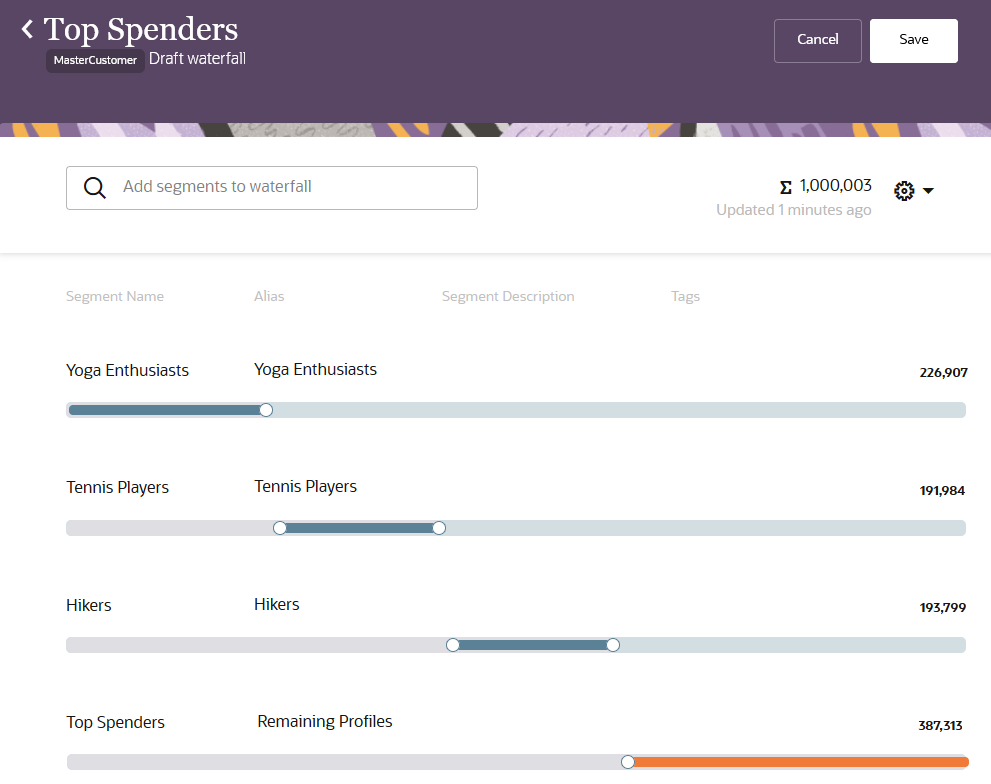
Example segment waterfall
This feature lets you send a single segment to an activation platform, and use the waterfall attribute to personalize content for customers in each of your sub-segments.
Steps to Enable
To enable this feature you need to log a Service Request (SR).
Role And Privileges
You must have the Business user or Instance admin role to use this feature.
This feature lets you customize the concurrency of a job sequence as appropriate for your business strategy. The job sequence can be configured to run multiple instances concurrently or one instance at a time, depending on what is appropriate for your use case.
Concurrency at the job sequence level helps you achieve higher levels of reliability and success.
Steps to Enable
You don't need to do anything to enable this feature.
Role And Privileges
You must have the Instance admin role to use this feature.
Organization-Based Access Control
This feature lets you assign your Oracle Unity users to organizations that govern which data records and business resources (e.g., campaigns) they can access. The organizations you create might correspond to different departments or different brands or different countries--whatever makes sense for your business.
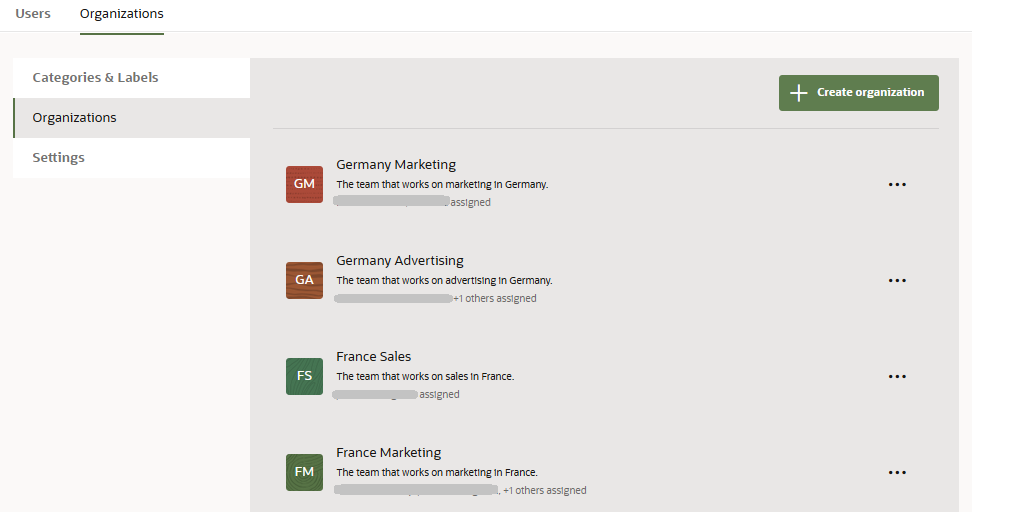
Example organizations
You can now ensure that Oracle Unity users have access to only the data records and business resources that are appropriate for them. It supports multi-brand and multi-geo use cases.
Steps to Enable
You don't need to do anything to enable this feature.
Role And Privileges
You must have the Instance admin role to use this feature.