
This document will continue to evolve as existing sections change and new information is added. All updates appear in the following table:
| Date | Module | Feature | Notes |
|---|---|---|---|
| 10 JAN 2024 | Industries Framework Common | CXIF Landing Page | Updated document. Revised feature information. |
| 15 SEP 2023 | Created initial document. |
 HAVE AN IDEA?
We’re here and we’re listening. If you have a suggestion on how to make our cloud services even better then go ahead and tell us by submitting a service request. Wherever you see this icon after the feature name it means we delivered one of your ideas.
DISCLAIMER
The information contained in this document may include statements about Oracle’s product development plans. Many factors can materially affect Oracle’s product development plans and the nature and timing of future product releases. Accordingly, this Information is provided to you solely for information only, is not a commitment to deliver any material, code, or functionality, and should not be relied upon in making purchasing decisions. The development, release, and timing of any features or functionality described remains at the sole discretion of Oracle.
This information may not be incorporated into any contractual agreement with Oracle or its subsidiaries or affiliates. Oracle specifically disclaims any liability with respect to this information. Refer to the Legal Notices and Terms of Use for further information.
Column Definitions:
Report = New or modified, Oracle-delivered, ready to run reports.
UI or Process-Based: Small Scale = These UI or process-based features are typically comprised of minor field, validation, or program changes. Therefore, the potential impact to users is minimal.
UI or Process-Based: Larger Scale* = These UI or process-based features have more complex designs. Therefore, the potential impact to users is higher.
Features Delivered Disabled = Action is needed BEFORE these features can be used by END USERS. These features are delivered disabled and you choose if and when to enable them. For example, a) new or expanded BI subject areas need to first be incorporated into reports, b) Integration is required to utilize new web services, or c) features must be assigned to user roles before they can be accessed.
| Ready for Use by End Users Reports plus Small Scale UI or Process-Based new features will have minimal user impact after an update. Therefore, customer acceptance testing should focus on the Larger Scale UI or Process-Based* new features. |
Customer Must Take Action before Use by End Users Not disruptive as action is required to make these features ready to use. As you selectively choose to leverage, you set your test and roll out timing. |
|||||
|---|---|---|---|---|---|---|
| Feature |
Report |
UI or |
UI or |
|
||
CX Industries Framework serves as a platform for seamless integration of applications. You can use this platform to integrate your application with other Oracle applications and third-party applications, which includes cloud services and on-premise systems. In addition, you can leverage data from various sources, use TM Forum Open APIs and REST APIs to configure and extend tailored experiences.
CX Industries Framework supports both synchronous and asynchronous interactions between the integrated applications. It hosts all the TM Forum Open APIs on Oracle Cloud Infrastructure API Gateway to secure and optimize the API interactions. It also ensures high availability and resiliency by using the Oracle Cloud Infrastructure Load Balancing service.
Circuit Breaker for CXIF Microservices
Circuit breaking is a software design pattern used in microservice architecture to prevent cascading failures and improve system resilience. The idea behind circuit breaking is to detect and stop requests to a service that is failing or is likely to fail.
Benefits of implementing circuit breaking:
- Improved resilience: By detecting and preventing requests to failing services, circuit breaking helps to prevent cascading failures and improve the overall resilience of the system.
- Faster failure detection: Circuit breaking allows for the rapid detection of service failures, reducing the time it takes to detect and respond to issues.
- Increased stability: By blocking requests to failing services, circuit breaking helps to reduce the load on other services and improve the stability of the overall system.
- Better resource utilization: By reducing the load on failing services, circuit breaking helps to improve resource utilization and reduce the costs associated with running a large-scale microservice architecture.
Overall, circuit breaking is an important technique for improving the reliability and resilience of microservice architecture, and is an important aspect of a robust, scalable microservices system.
Steps to Enable
You don't need to do anything to enable this feature.
Generic Adapter for Documents Management
CX Industry Solutions now delivers a generic adapter to store artifacts in a content management system.
By default, the new Document Management Adapter is configured to store artifacts (document, attachments, images, etc.) in Oracle Content Management System. This adapter is configurable & extendible to work with any after-market content management system of the Tenant's choosing.
Steps to Enable
You don't need to do anything to enable this feature.
CX Industry Framework provides a Home Page for DX4C and CX4U Tenant administrators to login and access the application that they are entitled to manage.
The Landing Application URL is a single access URL, https://<CXIF_API_GW_URL>/apps/landingpage
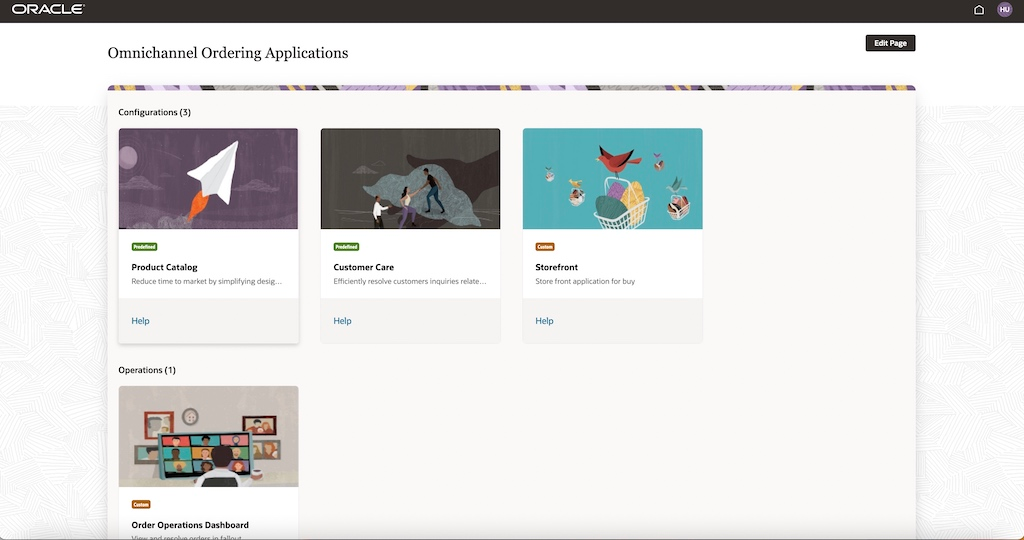
Landing Page Screen
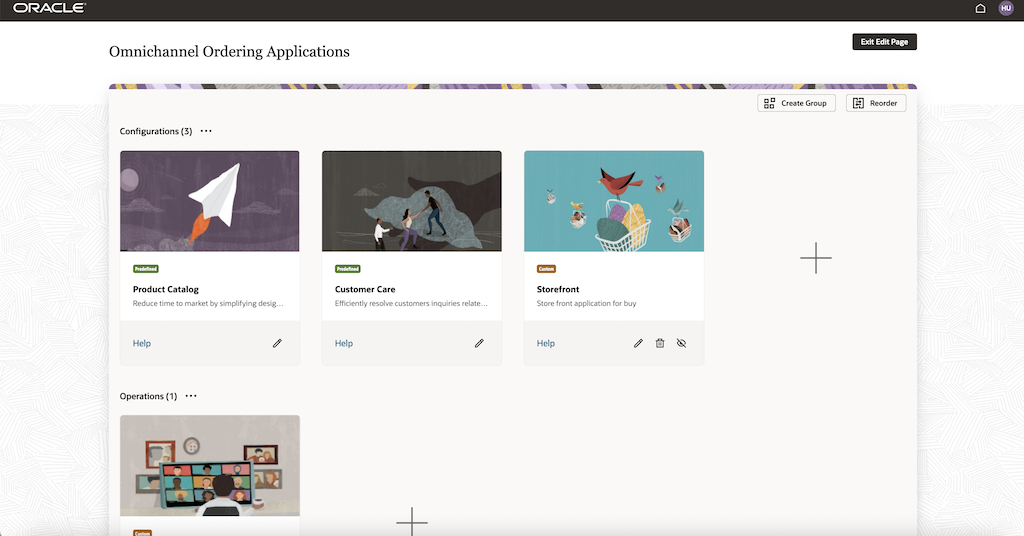
Admin Managing the Groups and App Cards
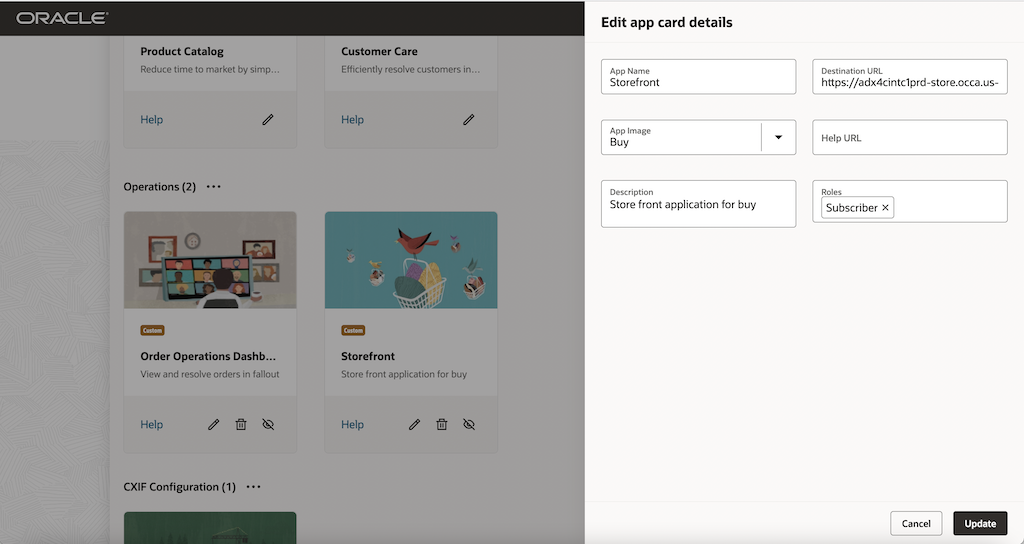
Editing App Card
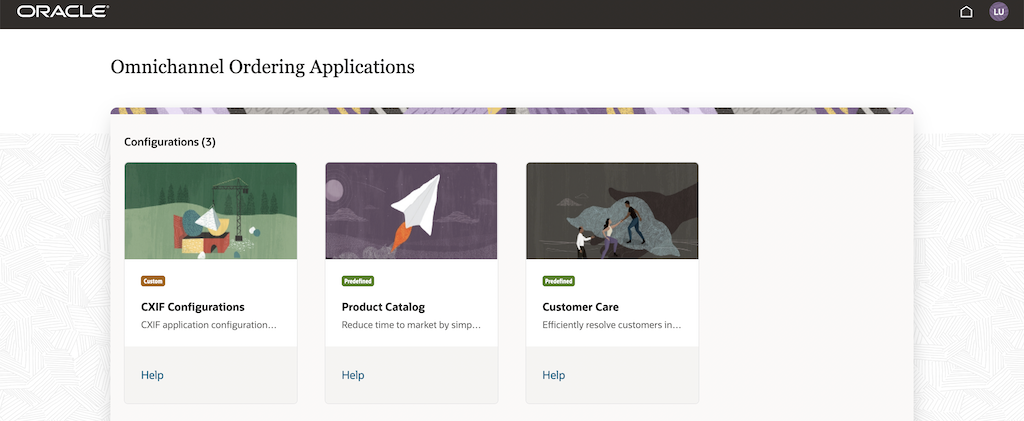
Landing Page for User
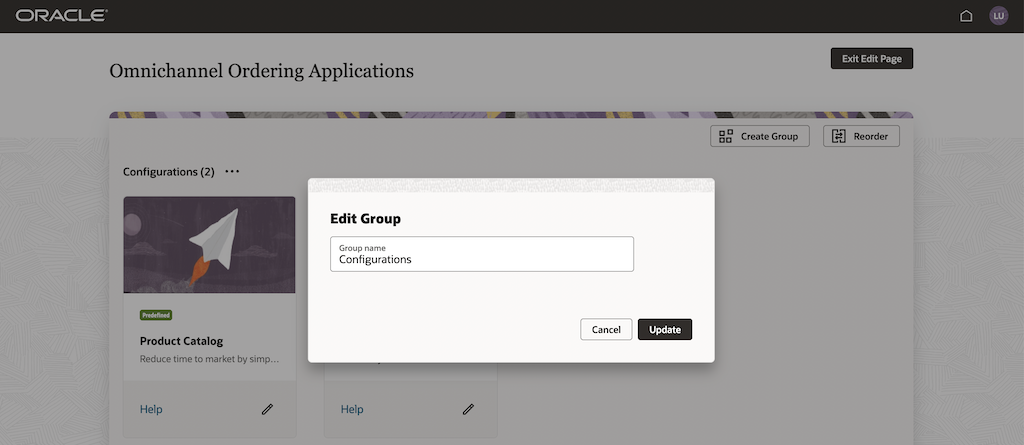
Edit Group
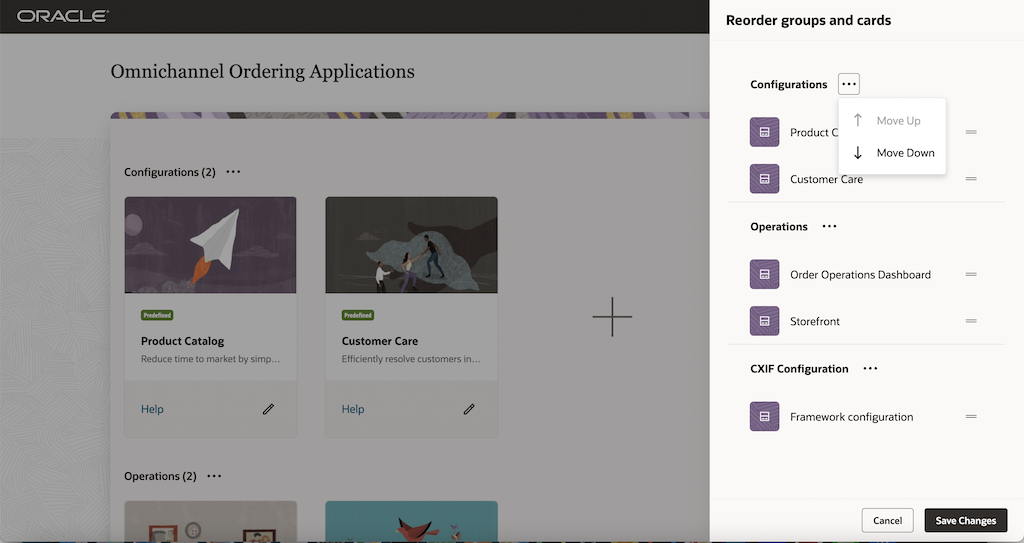
Arrange Cards
The CX Industry Framework Landing Page is a single access URL, shared with tenants once the provisioning is complete. Tenant administrators can create, manage, and group new application cards in the landing page and manage the provisioned application cards. This feature enables the customer to group the activities based on the business needs in the environment. We can make use of the cards to provide access to applications, key tasks, tutorials, and related information. Set the availability of cards on a page depending on the role.
Steps to Enable
You don't need to do anything to enable this feature.
Tips And Considerations
Supported Browsers
The following are the Supported Browsers for the Landing Page:
- Google Chrome
- Mozilla Firefox
Access Requirements
Fabric IDCS role for Tenant Administrator :
The tenant administrator requires IDCS role CXIF_LANDINGPAGE_TENANT_ADMIN which is preseeded. This role enables the Tenant administrator to manage the landing page cards and groups.
Landing Page requires default user to be created as a Prerequisites:
- Configure Single Sign-On
Configure Fabric IDCS as Oracle Identity Cloud Service (idP) and FA IDM as Fusion Applications (sp)
Refer Oracle Fusion Applications Release 13 documentation section Configure Single Sign-On for configuring SSO.
- Configure Provisioning and Synchronization
Refer Configure Provisioning and Synchronization section in the Oracle Fusion Applications Release 13 documentation
- Configure an FA User
A new FA user with username LANDINGPAGE_FA_USER is required for landing page .
To create a new user with username LANDINGPAGE_FA_USER > Navigate to FA Home page , for ex https://fusovmsmc36-fa-ext.us.oracle.com/ Then navigate to Tools > Security Console > Create New user account with the details in screenshot below.
User Name : LANDINGPAGE_FA_USER
Role Code : ORA_FND_IT_SECURITY_MANAGER_JOB
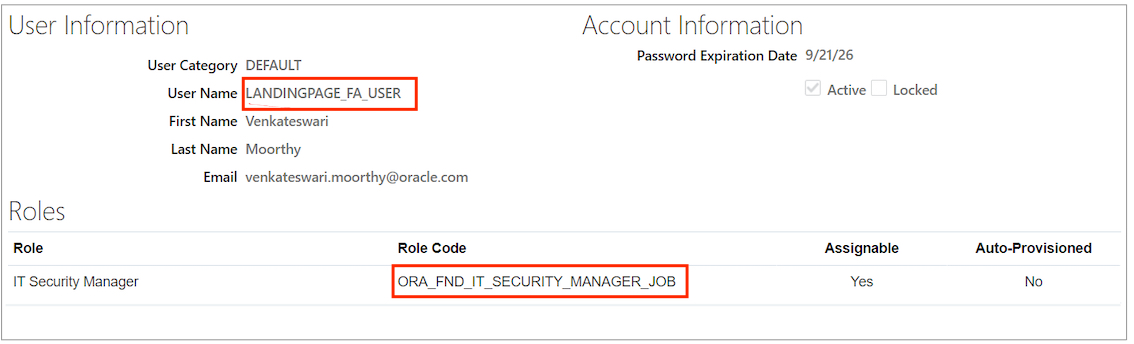
Known Limitation:
While initial provisioning of DX4C with Customer Care and Product Catalog, the predefined cards for 'Customer Care' ( CareX) and 'Product Catalog' (LaunchX) applications gets preseeded in to landing page. In case if these 2 applications are provisioned after the initial provisioning of DX4C , those cards won't get preseeded and are not available in Landing page. The Tenant Administrator will have to create those application cards manually.
Tenant Administrator can create a new group and add new card for 'Customer Care' and 'Product Catalog' by using the below details.
Customer Care:
| Information |
Details |
|---|---|
| Name of the Application |
Customer Care |
| Description of the Application |
Efficiently resolve customers inquiries related to billing, payments, and account receivables. |
| Image to represent the Application |
Care |
| URL |
<FA_BASE_URL>/fscmUI/redwood/atcagentcare sample url : https://fuscdrmsmc168-fa-ext.us.oracle.com/fscmUI/redwood/atcagentcare |
| Application Roles needed by the application |
|
| Help Link |
https://docs.oracle.com/en/cloud/saas/industries/care.html |
Product Catalog :
| Information |
Details |
|---|---|
| Name of the UX Application |
Product Catalog |
| Description of the Application |
Reduce time to market by simplifying design, launch, and lifecycle management of offers. |
| Image to represent the Application |
Launch |
| URL |
<FA_BASE_URL>/fscmUI/redwood/atcproductcatalog/atcproductcatalog sample url : https://fuscdrmsmc168-fa-ext.us.oracle.com/fscmUI/redwood/atcproductcatalog/atcproductcatalog |
| Application Roles needed by the application |
· ORA_ATC_COMMUNICATIONS_TECHNICAL_SPECIALIST_JOB · ORA_ATC_COMMUNICATIONS_CATALOG_ADMINISTRATOR_JOB · ORA_ATC_COMMUNICATIONS_MARKETING_MANAGER_JOB · ORA_ATC_COMMUNICATIONS_CATALOG_PRODUCT_MANAGER_JOB · ORA_ATC_COMMUNICATIONS_CATALOG_VIEWER_JOB |
| Help Link |
https://docs.oracle.com/en/cloud/saas/industries/launch.html |
Oracle Fusion Utilities Agent Experience Cloud Service simplifies the agent experience, and provides customer service representatives and managers with a variety of agent tools that reduce the cost-to-serve and provide elevated customer service. This solution integrates Oracle Utilities customer information with the Oracle Sales and Oracle B2B Service applications.
Use the Person and Premise Search, previously known as the Customer List, to search for contacts, customers, prospects, and premises in one location. When searching for premise locations, you will see locations that do not have any active service contracts. This search can help you determine whether a premise location is within the service territory of your utility. You can access your customer information system directly from the Person and Premise list to view additional premise details.
The Person and Premise Search enables you to search for person and premise records in one location, and allows you to quickly and easily access your customer information system for more detailed premise data.
Steps to Enable
You don't need to do anything to enable this feature.
Key Resources
- Refer to the Use the Person and Premise Search chapter of the Oracle Utilities Agent Experience User Guide.
Using profile options available under the Profile Option Code ORA-UER, your system administrators can configure the page that users land on when they log into the Customer Experience for Utilities solutions. Default landing pages are configured by role, and you are not required to change them. However, you can specify different landing pages by role, or by user, to suit your business needs.
Using configurable landing pages enables you to make your agents and key account managers more efficient, by automatically launching the landing page that makes the most sense for their roles or individual jobs.
Steps to Enable
To enable this feature, set up individual roles and users with their preferred landing page using profile options available under the Profile Option Code ORA-UER.
Key Resources
- Refer to the Configure Utility Details chapter in the Oracle Customer Experience for Utilities Implementation Guide.
IMPORTANT Actions and Considerations
If you are upgrading your Agent Experience from an earlier release to the Oracle Fusion 23D release, be sure to review the "Upgrade Considerations" topic in the Implementing Customer Experience for Utilities Guide.