Oracle Fusion Cloud Enterprise Performance Management
Oracle Fusion Cloud Enterprise Performance Management (EPM) helps move finance toward autonomous operations with AI agents embedded across connected planning, financial close, reporting, and master data management. Purpose-built agentic experiences use trusted, high-quality data from ERP and operational systems to improve forecasting, automate routine analysis, surface contextual insights, generate narratives, and support decisions that require human judgment. Operating within defined policies, these agents help finance teams move from managing systems of record to delivering better business outcomes, with measurable gains in efficiency and agility.

Customers who plan, predict, and outperform using Oracle Enterprise Performance Management
- GM Financial improves planning and reporting with Fusion Cloud Applications
Explore Oracle Enterprise Performance Management
Transform financial planning and analysis with the Planning Agent
- Uncover real-time insights as they happen with root cause analysis already done.
- Analyze trends and variances through natural language interactions grounded in financial and operational data.
- Enable continuous planning with agentic flows and event-driven predictions to address issues and act on opportunities.
- Connect decisions across functions using what-if scenarios and simulations to improve outcomes.
Accelerate your financial close to a continuous agent assisted process
- Use AI automation to support continuous, accurate financial close processing and reduce period-end disruption.
- Monitor financial data in real time for proactive insights into exceptions and anomalies.
- Enable business users to generate consolidation rules and calculations using natural language and AI.
- Remove bottlenecks in the close process to improve agility and resilience in finance operations.
Automate allocations with the Profitability and Cost Management Agent
- Easily generate and manage complex allocation models using the Profitability and Cost Management Agent informed by business context and rules.
- Systematically allocate shared costs to analyze profitability by product, region, or customer segment.
- Trace cost flows with natural language queries to understand key profitability drivers.
- Identify variances and root causes continuously to support cost optimization across the enterprise.
Reimagine reconciliations with the Reconciliation Agent
- Automate account reconciliations with the Reconciliation Agent to improve accuracy and efficiency.
- Run reconciliations continuously and use near real time insights and anomaly detection to resolve issues, and avoid period-end fire-drills.
- Assign reconciliation tasks intelligently based on risk profiles, policy thresholds, and team capacity.
- Use agentic workflows for complex, high-risk reconciliations to reduce manual intervention.
Streamline the accounting for income tax
- Automate and align the tax close with the broader financial close.
- Improve efficiency in tax provision, country-by-country reporting, and Pillar II reporting.
- Use AI to analyze trends and variances, and potential exceptions through automated data analysis.
- Monitor tasks, automate tax data collection, and track key deadlines in one governed, auditable workflow.
Align enterprise data with intelligent, governed master data management
- Align and manage enterprise hierarchies and dimensions consistently across ERP, EPM, and other business applications.
- Streamline data governance workflows to maintain consistency during routine changes and business transformations.
- Improve AI effectiveness by establishing a trusted master data foundation that supports AI adoption.
Benefits of Oracle Enterprise Performance Management
1
AI that automates finance work—and elevates decision-making
AI isn’t an add-on; it’s embedded where work happens. Built-in AI and agents reduce manual effort from day one, automating routine activities, surfacing anomalies, predicting likely outcomes, generating explanations, and recommending next steps so teams can move faster with greater confidence.
2
One unified EPM suite, not disconnected tools
Unlike point solutions, all EPM processes—planning, financial close, account reconciliation, tax, and reporting—work together in one connected suite. This reduces handoffs and complexity while aligning finance, operations, and the business around a shared view of enterprise performance.
3
Connected planning to help you move from hindsight to foresight
Plan, forecast, and model with AI-powered predictions that surface drivers, trends, and correlations and translate insights into action. Planning agents curate real-time transactional data from ERP and operational systems in finance context, enabling agile analysis, informed decisions and connected actions.
4
Touchless, end-to-end near financial close
Embedded AI in the entire close process—across reconciliations, close, tax and reporting—removes bottlenecks and automates key financial close activities, enabling finance to move toward a touchless close process with greater efficiencies and continuous, error-free operations.
5
A trusted system of record for enterprise data
Establish a governed “single source of truth” for the critical enterprise data that powers finance, operations, and analytics. With consistent aligned master data across systems, enterprise AI gains a reliable, auditable foundation to accelerate adoption and enable trust.
6
Faster time to value with AI-powered best practices
Prebuilt EPM processes and agentic flows help teams adopt best practices with little customization. Continuous innovation allows finance teams to make full use of embedded AI and agents, with no disruption, and reimagine finance for efficient operations and agile decisions.
AI highlights in Oracle Enterprise Performance Management
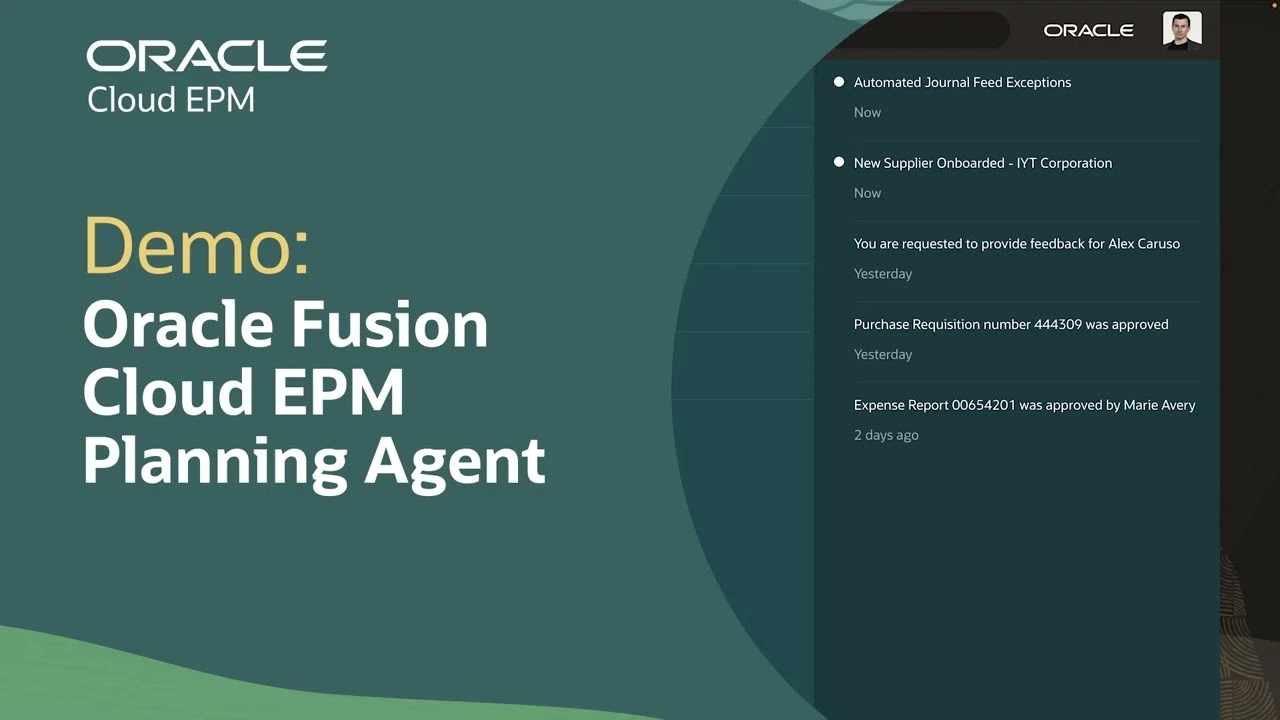 Watch the Planning Agent video (6:00)
Planning Agent
Planning Agent keeps FP&A continuously current with real-time insights, predictions and what-if modeling to improve forecasts and decisions.
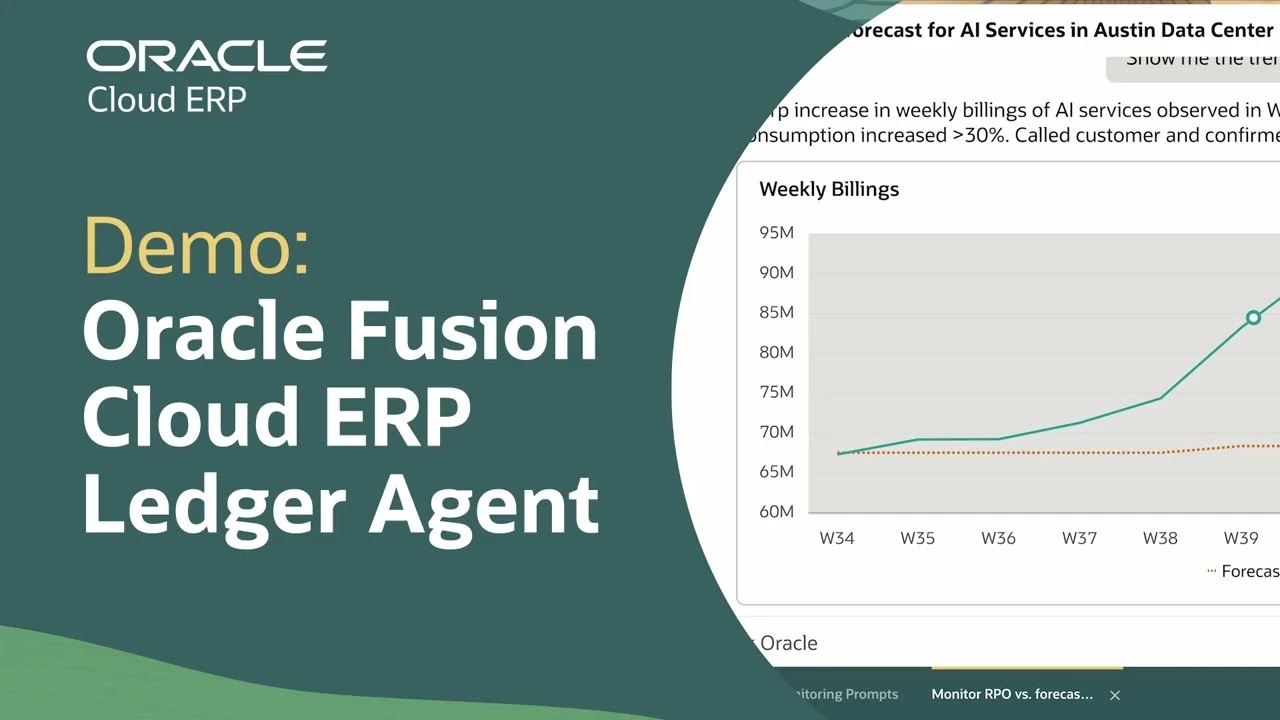 Watch the Ledger Agent video (7:34)
Ledger Agent
Ledger Agent turns monitoring into action with always-on insights and automated adjustments to improve speed and accuracy.
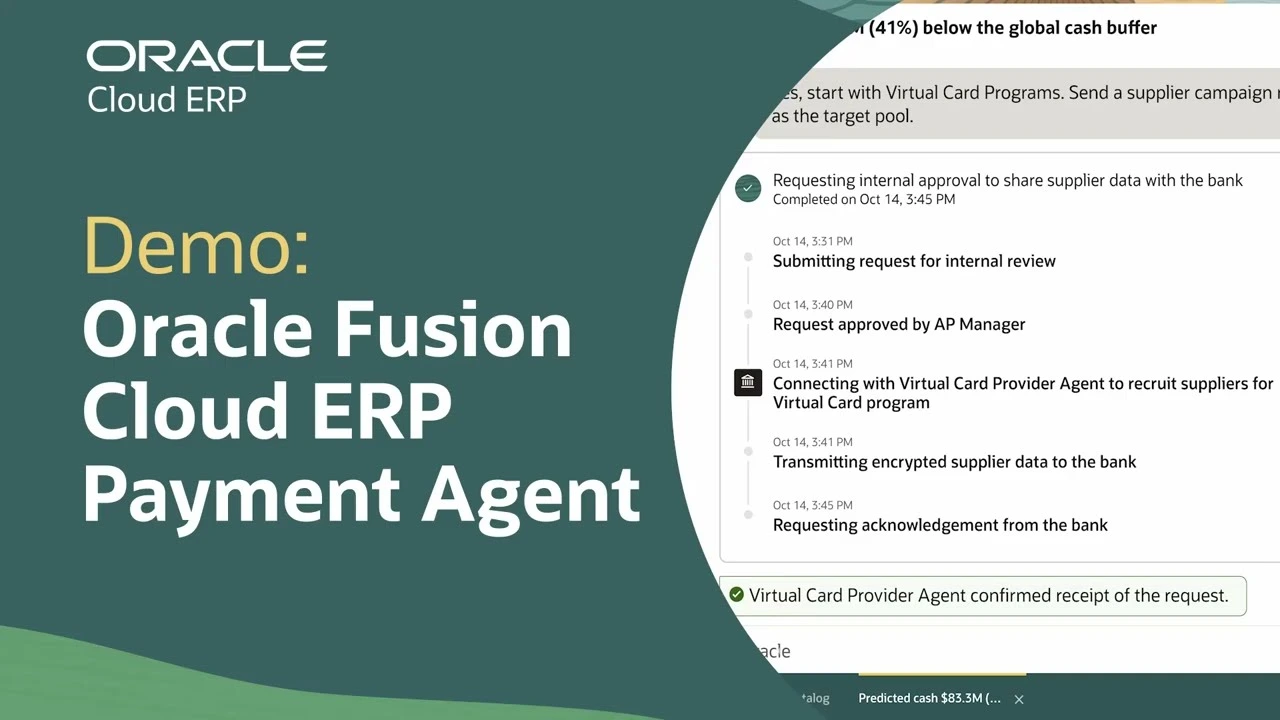 Watch the Payments Agent video (4:07)
Payments Agent
Payments Agent modernizes payouts with smarter payment options and faster execution to improve working capital and outcomes.
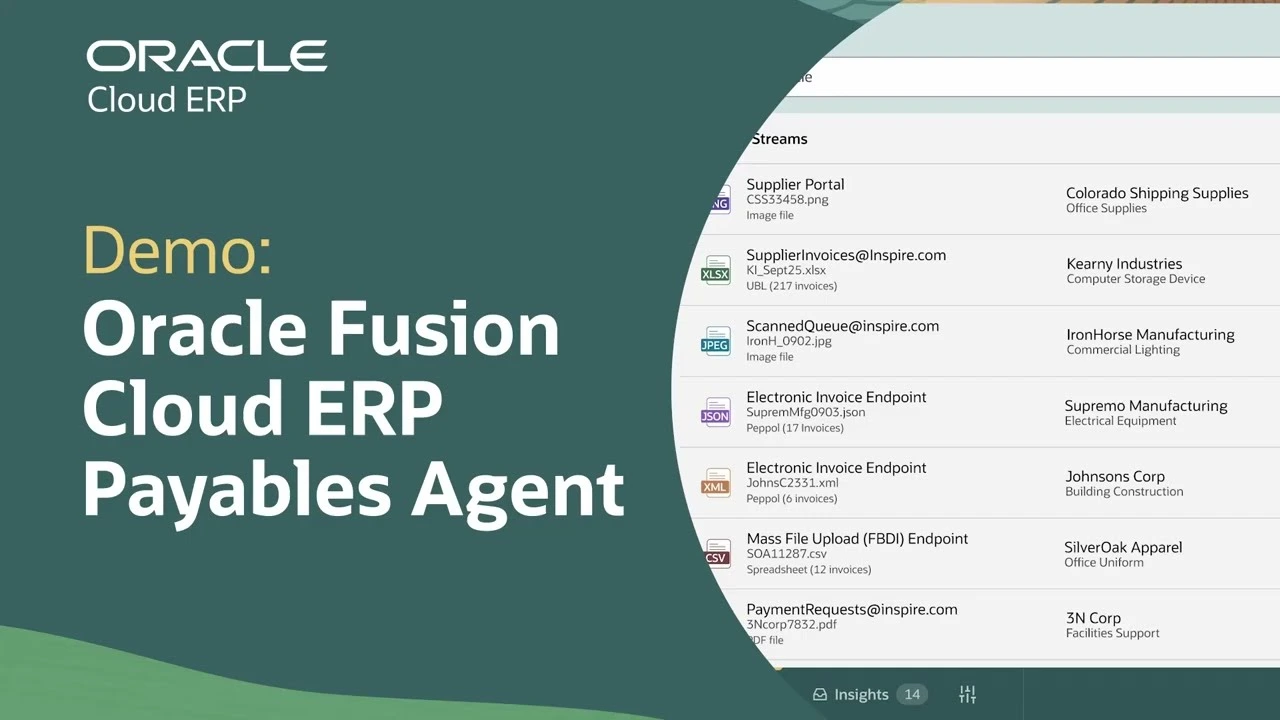 Watch the Payables Agent video (3:18)
Payables Agent
Payables Agent automates invoices end to end across every channel to boost straight through processing and compliance.
What analysts say about Oracle Enterprise Performance Management
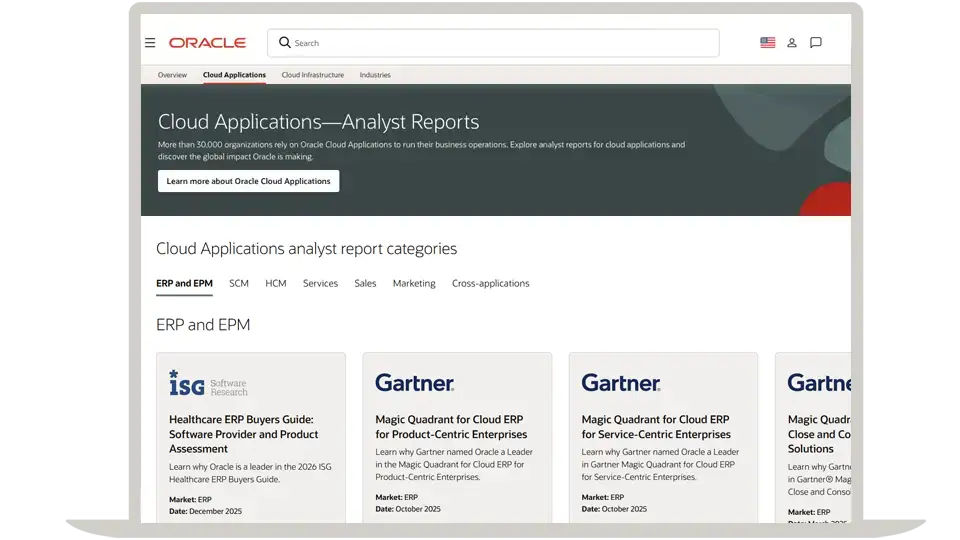
Oracle Enterprise Performance Management is positioned as a Leader in a IDC Marketscape report for Planning and Budgeting and two Gartner® Magic Quadrant™ reports covering Financial Close and Consolidation, and Financial Planning.
Customers using Oracle Enterprise Performance Management


Oracle Enterprise Performance Management resources
- Learn and explore
Get started with Oracle Enterprise Performance Management
Oracle Fusion Cloud Enterprise Performance Management FAQ
Open allClose allOracle Fusion Cloud EPM
- Do finance users require deep AI and data science skills to effectively use AI in Oracle Fusion Cloud EPM?
- Is my EPM data shared with other model providers or used to train AI models?
- When using embedded AI in Oracle Fusion Cloud EPM, can users access data beyond their existing permissions?
*Gartner®, Magic Quadrant for Financial Planning Software, December 1, 2025. Regina Crowder, Sid Sahoo, and Mike Lashinsky.
**Gartner®, Magic Quadrant for Financial Close and Consolidation Solutions, March 9, 2026. Jeffrin Francis, Renata Viana.
GARTNER is a registered trademark and service mark, and MAGIC QUADRANT is a registered trademark of Gartner, Inc. and/or its affiliates in the U.S. and internationally and are used herein with permission. All rights reserved.
Gartner does not endorse any vendor, product or service depicted in its research publications, and does not advise technology users to select only those vendors with the highest ratings or other designation. Gartner research publications consist of the opinions of Gartner’s research organization and should not be construed as statements of fact. Gartner disclaims all warranties, expressed or implied, with respect to this research, including any warranties of merchantability or fitness for a particular purpose.
This graphic was published by Gartner, Inc. as part of a larger research document and should be evaluated in the context of the entire document.