Harnessing the AI advantage in finance
Insights from Miranda Nash's conversation with PwC Global Chief AI Engineer, Scott Likens

In a recent episode of our AI Now with Oracle video series, Miranda sat down with PwC Chief AI Engineer Scott Likens to explore how AI is transforming finance and positioning it as a proving ground for broader enterprise AI adoption. Here are some of the key takeaways.
Finance—The unexpected leader in AI adoption
Likens explains why finance, often considered risk-averse, is a front-runner in adopting AI. This in-depth conversation covers practical use cases, how PwC leverages its operations to test AI applications, and why governance doesn't need to be a barrier—it can be a launchpad for innovation.
Finance is core to the success and growth of any enterprise. Likens shared that its data-rich environment and need for compliance make the finance function ideal for AI adoption. Rather than being a hurdle, regulation has motivated faster adoption due to compliance demands and the need for efficiencies. Finance can be a strategic AI entry point, with business functions that can be optimized.
PwC became its own "client zero," deploying tech innovations internally, using that experience to refine them before offering new products or services to clients. With generative AI, the company uses a “human-in-the-loop” model, which emphasizes the importance of human oversight and expertise in artificial intelligence systems. At PwC, AI is deployed across audit and tax workflows to reduce manual tasks, such as anomaly detection, compliance checks, and data consolidation from disparate sources.
AI agents: The future of AI
Likens describes AI agents as digital coworkers capable of reasoning, planning, and automating workflows—functionality that goes far beyond traditional chatbots. These AI agents, powered by generative AI, can now read regulations, suggest controls, and continuously monitor compliance, helping manage risk.
While AI's energy demands are genuine, Likens remains optimistic. He notes progress in chip efficiency, greener data centers, and AI's carbon impact tracking. The goal is to use AI sustainably and drive further innovation in green energy.
Speed of innovation and the case against waiting
Likens mentions that “waiting is not a great strategy” when it comes to AI. Enterprises that embraced AI early are reaping tangible benefits, including faster product development and market entry. He underscores the need for a portfolio approach: balancing quick wins (efficiencies) with bold moonshots (complete process reimagination).
Contrary to fears, governance can fuel innovation if designed into systems from the outset. Likens and Miranda highlight the importance of "trust by design" and laud examples such as companies that have established AI innovation councils to oversee AI projects—reframing the governance narrative as proactive, not restrictive.
AI, especially in finance, is no longer optional. Companies should act, infuse AI across functions, and rethink their data governance and data strategy to stay competitive. To learn more, check out the Al Now with Oracle video series, where we dive into the latest use cases, trends, and breakthroughs in AI.
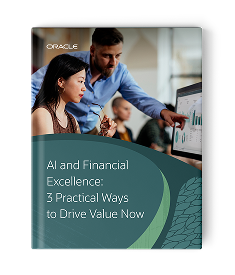
AI and Financial Excellence: 3 Practical Ways to Drive Value Now
AI is no longer just a concept. It’s a tool for delivering real results in finance. Discover three high-impact areas where AI can help finance teams today
*Gartner, Magic Quadrant for HCM Suites for 1,000+ Employee Enterprises, Published 31 August, 2026. Analysts: Josie Xing, Ranadip Chandra, Ron Hanscome, Sam Grinter, Kate Jensen, Anand Chouksey
Gartner and Magic Quadrant are trademarks of Gartner, Inc. and/or its affiliates.
Gartner does not endorse any company, vendor, product or service depicted in its publications, and does not advise technology users to select only those vendors with the highest ratings or other designation. Gartner publications consist of the opinions of Gartner’s business and technology insights organization and should not be construed as statements of fact. Gartner disclaims all warranties, expressed or implied, with respect to this publication, including any warranties of merchantability or fitness for a particular purpose.
This graphic was published by Gartner, Inc. as part of a larger research document and should be evaluated in the context of the entire document. The Gartner document is available upon request from Oracle at https://www.oracle.com/human-capital-management/gartner-magic-quadrant.