

Leading Through Change
in the Age of New Technologies
How HR Can Be a Strategic Business Leader in Digital Transformation


Table of Contents
Chapter 1:
Our Digital Era Is Unleashing Unprecedented Capabilities—and Uncertainty
page 3
Chapter 2:
Disruptive Technologies Drive New Possibilities for HR and the Workplace
page 6
Chapter 3:
Three Strategic Levers to Help HR Lead the Business Through Change
page 8
Chapter 4:
It’s Time to Become a Positive Disrupter—and Empower People to Drive Change
page 12
Chapter 1: Our Digital Era Is Unleashing Unprecedented Capabilities—and Uncertainty
New digital technologies and big data are shaking up all the rules and redefining business opportunities across industries. Not only are these technologies transforming the way we work and live, they are setting the stage for business growth and innovation that can provide a competitive edge. Let’s take a closer look.
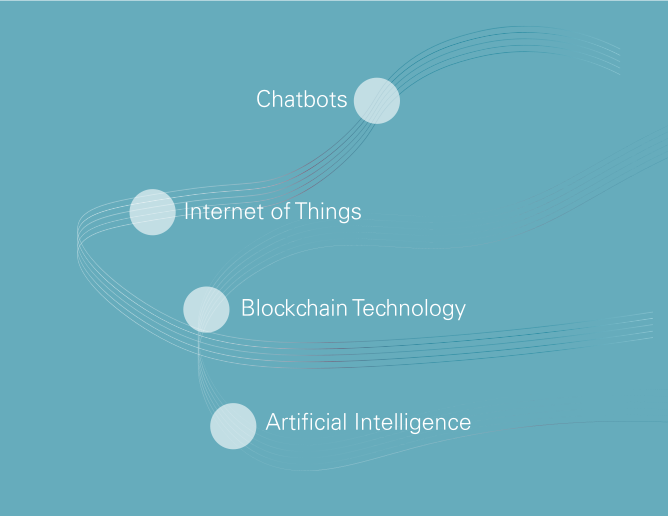
Chatbots are helping people manage bank accounts, return merchandise, and rebook missed flights without downloading an app or interacting with a human being. Sensors connected to the Internet of Things (IoT) are enabling automated, driverless cars and allowing factory machines to perform their own maintenance.
At the same time, blockchain technology is poised to make resumes and job networking sites obsolete, while artificial intelligence (AI) and machine learning are powering just about everything to allow machines to solve problems on their own. If you think things are moving quickly, you’re right. And they’re not slowing down anytime soon.
85 percent of executives surveyed in an Accenture report state that they will be investing extensively in AI-related technologies over the next three years.1
Although all of these innovations offer huge possibilities for business and society, like any seismic change, they introduce new questions and concerns about just how disruptive these technologies will be. It’s natural for people to worry that they’ll lose their jobs or that the workplace will become empty of meaning and personal interaction. It’s also understandable that business leaders worry that they won’t have the right talent, foresight, or technical abilities to benefit from these technical advancements.
In this time of uncertainty, it’s essential that chief human resource officers (CHROs) and other HR leaders have the knowledge and tools to lead their people and the business into the future with confidence and even excitement. In this ebook, we illuminate both the uncertainties about emerging technologies and how HR can turn them into new opportunities for its people and organization.
1Accenture, “Technology Vision 2017.”
Chatbots
Internet of Things
Blockchain Technology
Artificial Intelligence
Chapter 2: Disruptive Technologies Drive New Possibilities for HR and the Workplace
The term “disruptive technologies” can be worrisome, perhaps conjuring up images of operational chaos. With so much talk about disruption in the news, it’s easy to envision workflows being abruptly halted and daily routines shattered, leaving workers confused and disgruntled. But rather than upsetting the workplace, these technologies have the potential to improve human functions and create a lasting, positive transformation—if HR manages the process strategically from the get-go.
Technology Is Changing the Nature of Work
Even though disruptive technologies offer a wealth of thrilling possibilities, the worry that they will render people or their skills obsolete is pervasive. However, studies indicate that AI and cognitive technologies are unlikely to significantly displace most human workers. In a survey conducted for Deloitte’s 2017 Global Human Capital Trends report, more than 10,000 HR and business leaders worldwide were asked about the impact of automation on the future of work. Only 20 percent said they would reduce the number of jobs at their companies. 1
1Jeff Schwartz et al., “The future of work: The augmented workforce” (Deloitte University Press, 2017).
Another Deloitte Insights report1 states that new technologies can actually augment human workers as they perform higher-level tasks. In this type of culture, human workers get recognized for their uniquely human qualities such as creativity, ethical thinking, leadership, and social contributions. A culture of augmentation allows managers to evaluate employees on their holistic contributions instead of mere throughput, since most throughput tasks will be automated. In this way, work culture is likely to become more human rather than less.
Professional services leader Accenture claims that AI and other technologies are benefiting its workforce by reducing or eliminating menial work, enabling the company to refocus its workforce on higher-end strategic work2. In Forbes magazine, author Jacob Morgan predicts, “The organizations that are going to win are the organizations that are going to use AI to explore new opportunities, to augment humans, to help humans, not replace them.”3
1Bill Briggs and Craig Hodgetts, “Tech Trends 2018: The symphonic enterprise, Introduction,” Deloitte Insights (December 5, 2017), https://www2.deloitte.com
2Accenture, “Technology Vision 2017.”
3Rob Preston, “4 Insights on Artificial Intelligence and the Future of Work,” Forbes (March 28, 2018), https://www.forbes.com
Only 20 percent of more than 10,000 business leaders said they would reduce the number of jobs at their companies because of the impact of automation.
Machines Will Help Workers Make Smarter Decisions
Over the past few decades, technology has been great at minimizing tiresome, unpleasant work. But what happens when technologies such as AI and machine learning move beyond repetitive tasks? Though the technology continues to break new ground, AI isn’t a replacement for human leadership or decision-making. The best business decisions are not merely based on information extrapolated from numbers, they also align with a company’s vision and core values. This is work for humans; machines can’t do it. It’s essential for HR to ensure that strong values, ethics, and empathy thrive in the company culture, even when new technologies share the stage.
For organizations that are strategically planning how machines and people will work together, Deloitte Insights1 suggests that a good initial step is to categorize skills and tasks. Companies should define the difference between skills that only humans have and nonessential tasks that machines can perform. This can help HR redesign jobs, identify opportunities for augmentation, and develop better automation strategies. A sign that companies are finding value in this approach is that, according to Deloitte, 77 percent of survey respondents said they will either retrain people to use new technology or will redesign jobs to better take advantage of human skills.2
1Briggs and Hodgetts.
2Schwartz.
Big Data Will Create New Opportunities
Technologies such as mobility, AI, and machine learning are generating a flood of data and extracting meaning and benefit from it at an ever-increasing pace. As AI makes interaction between humans and technology frictionless, organizations are gaining access to more information than ever about people, their behavior, and their preferences.
However, too much information can quickly overwhelm people as they try to organize, assimilate, and make sense of it. For example, AI and digital technologies have made the job application process easier, making recruiters victims of their own success. Now inundated with new applications, they often lack the time or resources to evaluate all of them.
As these evolving technologies redefine roles and responsibilities, HR must make the transition from being a producer of data to a consumer of data. Instead of simply generating numbers, HR must now set its sights on how to thoughtfully analyze all this new data not only to understand what’s happening in the business but to predict what will happen in the future.
Oracle HCM in Action

Chapter 3: Three Strategic Levers to Help HR Lead the Business Through Change
With all these thrilling new technologies and the disruption they are causing in the workplace, how can an HR organization assuage uncertainty and transform technologies into new opportunities? One powerful way is to think of emerging technologies as strategic levers that can make jobs easier and more satisfying for employees.
Lever One: The Future Lies in the Cloud
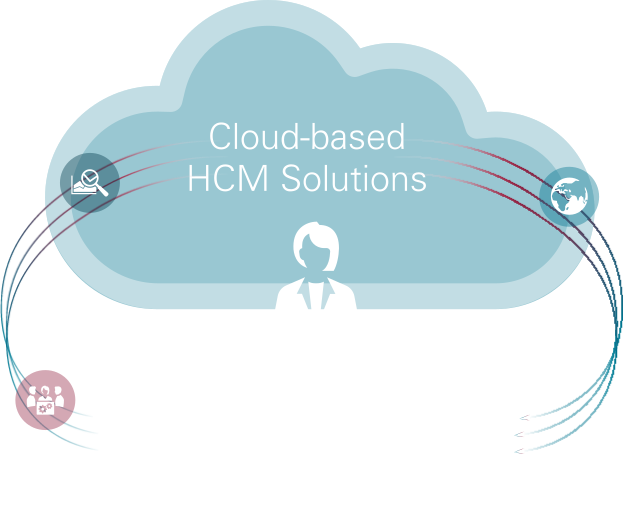
For all of this talk about disruptive technologies, few have been as disruptive as the cloud. The cloud is a springboard for change because it leads the way toward total digital transformation in the business. By moving human capital management (HCM) systems to the cloud, HR leaders have access to timely innovation, seamless integration with other solutions, and a flexible, scalable environment. Cloud implementations can continuously deliver improvements and upgrades to AI and other leading-edge technologies that would be difficult to achieve on premises. And it makes the massive scale of data manageable while at the same time offering support for proactive security and identity management.

Transitioning to cloud-based HCM solutions also provides HR teams the opportunity to re-evaluate and streamline processes and workflows. Since teams no longer have to navigate disparate HR systems, the experience is more intuitive, and teams spend less time on administrative tasks and more time creating value. Cloud-based HCM solutions enable HR teams to simplify, automate, and accelerate their activities, making work easier for everyone.
Organizations can deploy a single global HR solution that supports local needs—no matter where they operate—and engage the workforce from recruitment to retirement. They can also benefit from the cost savings that come from offloading and automating maintenance tasks. With cloud-based HCM, organizations can develop a workforce that is more flexible and future-ready.
Lever Two: Technology Is for People
People are a company’s most important asset. That’s why the second strategic lever focuses on letting emerging (and existing) technologies serve people—instead of the other way around. In a world where technology adoption and innovation are quickly accelerating, the value people bring to the business is increasing. According to Deloitte, 30 percent of high-paying new jobs will be social and “essentially human” in nature.1

HR plays the key role in determining which employees will take advantage of these new technologies, by analyzing data and making data-driven decisions. Technology can empower employees to see and predict business changes well in advance, but they require freedom to make choices, act quickly, and exercise judgement.
However, employees are often hemmed in by broken processes or disparate technologies that don’t let them to do their best work. There’s no reason for technology to limit employees by forcing them into bad processes. Instead, HR can help their organizations recommit themselves to shaping their processes around enabling people—and providing emerging technologies that can help them do their jobs better and faster.
1Deloitte, “Talent for survival: Essential skills for humans working in the machine age” (2016).
To get the most out of human capital management (HCM) in the cloud, HR should start with cloud-ready thinking. Migration is the best time to optimize processes that are more people-centered and make everyone’s work easier and more efficient. Cloud technology offers tremendous potential to:

Break down data silos
Ease communication and collaboration
Create opportunities to integrate new systems and capabilities
As organizations move forward with an initiative, a key to ensuring change management and minimizing disruption to workers is to let people participate in the change and see the value of disruptive technologies. One example of applying this lever is using the humanlike capabilities of AI to support better recruiting and performance reviews.
“We’ve talked for years about the value of having all this content together in one place,” said Gretchen Alarcon, group vice president for Oracle’s HCM strategy. “If natural language processing programs could write the performance review, and give me suggestions about the employee as well, I could save a lot of time and go into the conversation much more prepared.”1
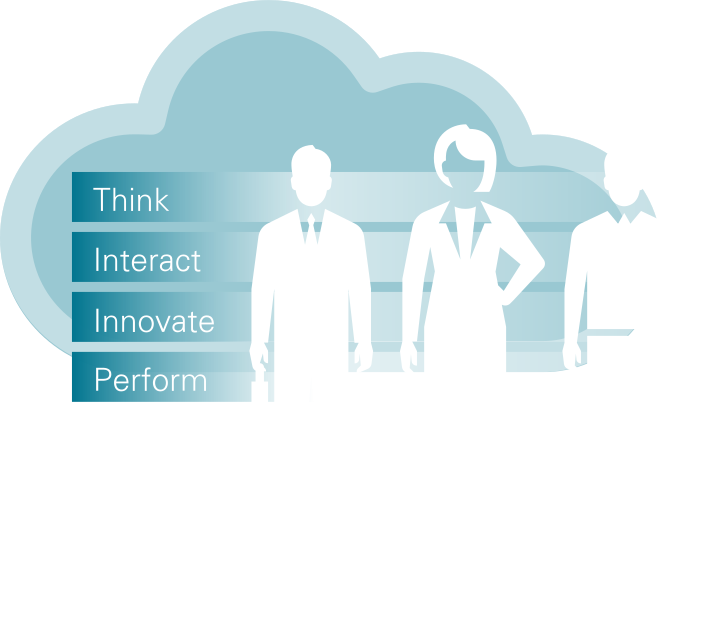
HCM in the cloud provides a single, supercharged solution for all HR activities, providing an opportunity to create a workplace where people deliver inspired results. It fosters an environment where artificial intelligence and machine learning amplify what teams can accomplish, and a culture that supports the technology people rely on in their everyday lives, so they can think, interact, innovate, and perform in powerful new ways.
1Monica Mehta, “How Artificial Intelligence Can Make HR More Human,” Forbes (November 9, 2017), https://www.forbes.com
Lever Three: Let the Right People, Insights, and Results Chart the Way Forward
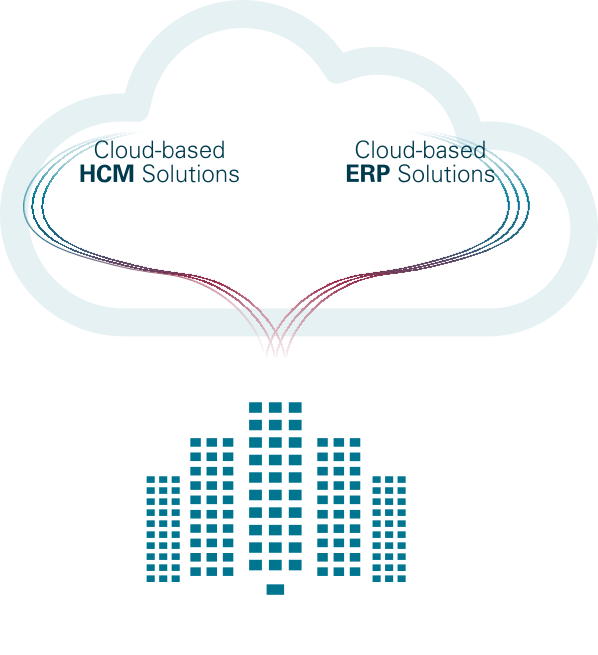
The third lever for change focuses on setting the stage for better decisions, driven by actionable insights and analytics. With the right approach to augmenting people with technology, HR can bring the cornerstones of business—HCM and enterprise resource planning (ERP)—together to build on their strengths and drive real transformation.

The approach starts with a better alignment of business strategies and imperatives. Deloitte Insights1 recommends that before organizations commit to a major digital initiative, they consider the hardest part of the equation: where do their people, organizational structure, processes, and technology fit? Be sure that any technology modernization is well understood before provisioning budget and establishing milestones. And remember that many established assets can serve as building blocks for the new core.
1Briggs and Hodgett
Innovation doesn’t come just from giving people incentives; it comes from creating environments where their ideas can connect.
Bringing HCM and ERP systems more closely together as part of an integrated solution is key to providing the readiness organizations need as changes keeping coming. According to business author Steven Johnson, innovation doesn’t come just from giving people incentives; it comes from creating environments where their ideas can connect.1
Creating a connected enterprise brings together people and financial data in one place, so the CFO and CHRO can work together better—from the same set of trusted data. Together, cloud-based HCM and ERP solutions help connect the enterprise so that business leaders can find the right information at the right moment to make the right choices—quickly and confidently.
Ultimately, unified cloud solutions imbued with emerging technologies in the hands of an empowered workforce create an environment that adapts more readily to new operating models, market imperatives, and competitive threats. The result is a workplace where digitally savvy leaders thrive, individual performance peaks, and innovations come to life.
1Steven Johnson, Where Good Ideas Come From: A Natural History of Innovation (New York: Riverhead, 2010).
Chapter 4: It’s Time to Become a Positive Disrupter—and Empower People to Drive Change
Every era of transformation has its challenges, but every challenge can be a tool to improve the culture and embrace positive change to drive the business forward. In an environment that’s evolving rapidly, HR finds itself in the strategic driver’s seat and is poised to lead through change.
By redesigning processes and strategies to help people make the most of emerging technologies, HR organizations can help ensure that all employees have the tools and opportunities they need to do work that is both personally and professionally satisfying. It also positions HR as a true partner to the CEO and CFO, contributing to both stability and growth.
Bill Allen, who has been chief HR officer for three different companies over his career, spoke at Oracle HCM World about key technology challenges faced by HR leaders and their companies.
“Technology is an absolutely incredible disrupter. If you move slowly, you die,” said Allen. “But there’s an even bigger wave coming—AI, machine learning, and everything else that’s coming with it.”1
As the latest wave of technology disruption crests, and the next wave approaches, the companies that are prepared will ride the change to greater success. There’s no better time for companies to embrace technology and explore the new ways to make it work effectively for their people. Here’s the opportunity to become a positive disrupter.
1Preston


