Simplify IT and Unleash Innovation
Is your IT organization focused on making your business more competitive, or are you caught up in the complexities of maintaining the status quo?
A recent article in the McKinsey Quarterly related a concern shared by many CEOs that the competition is heating up while their own organization is "preoccupied with 'keep the lights on' IT projects."1 Without a doubt, IT must stay up and running, but it shouldn't stop there.
Too often, businesses are tied to complex IT systems that have become more difficult and expensive to manage and maintain—and that can't adequately support new ideas and changing business models.
1 "How Strategic Is Our Technology Agenda?" McKinsey Quarterly, October, 2011.
Years of a highly fragmented IT industry have given rise to highly fragmented and increasingly complex IT environments that are making it difficult for organizations to keep costs down, grow their business, and respond quickly to rapidly changing markets.
The less complex your IT environment becomes, the more room there is for the innovation that can change the future of your organization. According to a recent paper from the Economist Intelligence Unit, 59 percent of companies value innovation generated from within—so it's important for businesses to create an environment in which innovation can thrive.2
Businesses that use IT as more than just a provider of services see more innovation in their organization. By eliminating complexity and simplifying IT, you have more time and resources to create added value for your customers and for your business.
2 "Cultivating Business-Led Innovation," Economist Intelligence Unit, 2012.
Using IT to create value-added services and consistent user experiences simply makes sense. Leading companies use IT to test new ideas, adopt successful changes, and disseminate innovations quickly and cheaply.3
3 "Using IT to Drive Innovation," Erik Brynjolfsson, MIT Technology Review, 2011.
There's good news for business leaders struggling with too much complexity in their organization. Oracle is engineering out the complexity that stifles business innovation, and engineering in speed, reliability, security, and manageability.
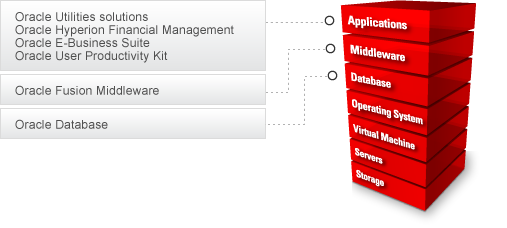
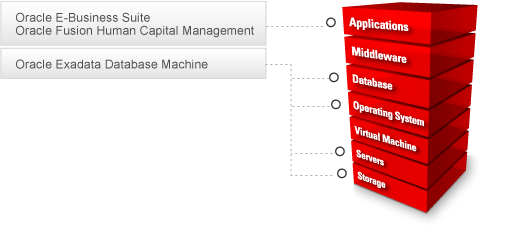
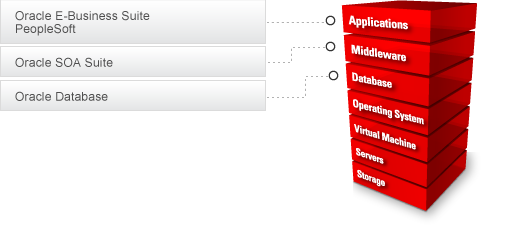
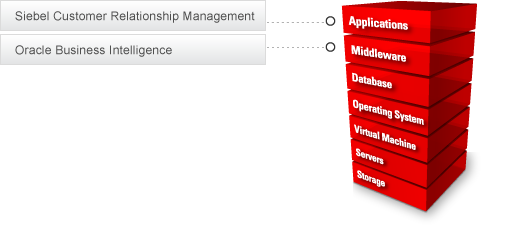
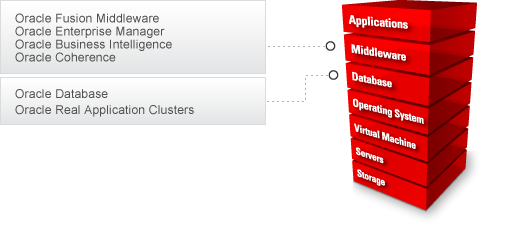
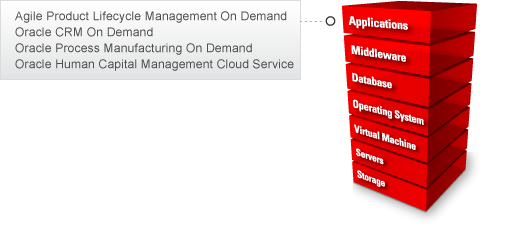
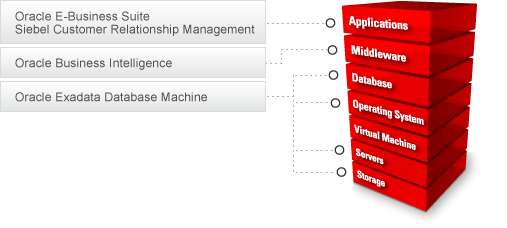
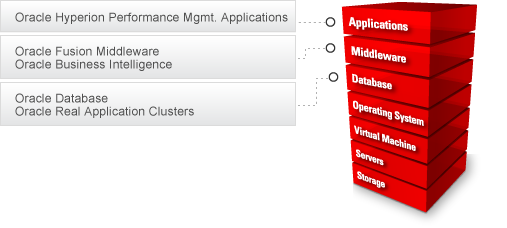
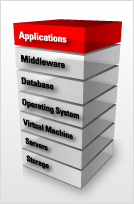
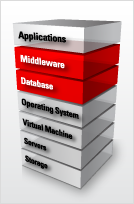
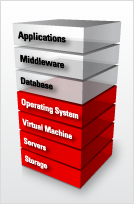
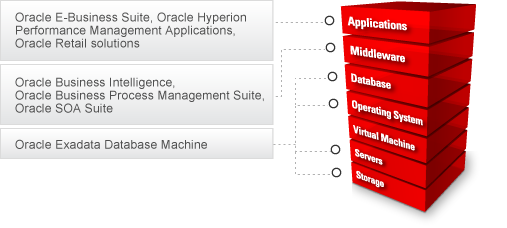
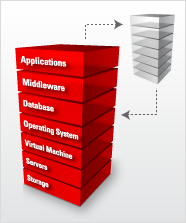
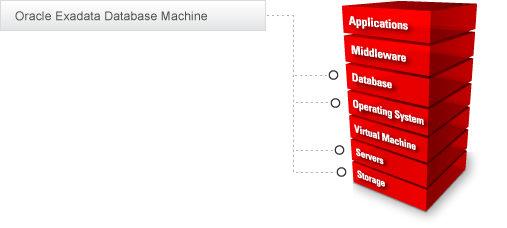
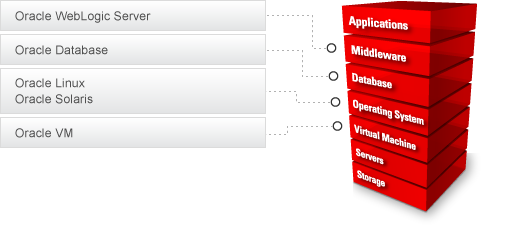
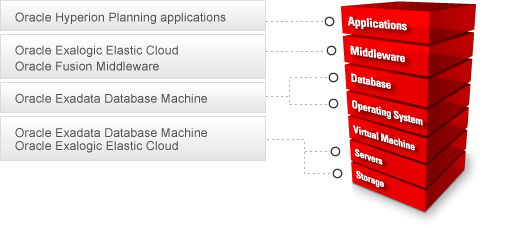
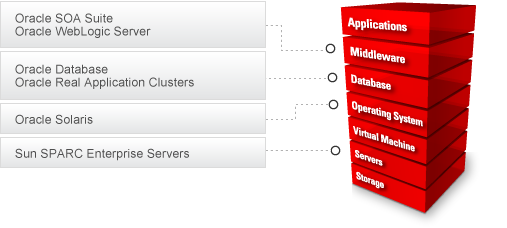
The result is best-in-class products throughout an integrated stack of hardware and software, with every product and every layer designed and engineered to work together according to open industry standards. Oracle's complete, open, and integrated solutions offer extreme performance at the lowest cost, with support for the entire stack—all from a single vendor.
Oracle is changing the game and making room for innovation by simplifying IT.
Gartner estimates that, in 2012, organizations spent 63 percent of their IT resources to run the business, 21 percent to grow the business, and 16 percent to transform the business.1
What if you could change that mix for your business?
Businesses spent almost four times as much on IT resources in 2012 to maintain the status quo as they do to enable new business models.
1"IT Metrics: IT Spending and Staffing Report, 2012," Gartner, January 2012.
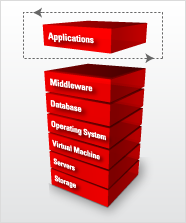
For decades, businesses have built massively customized IT infrastructures from a mixture of components and makeshift integrations. Simply being able to share data, business processes, and computing resources among systems requires a major effort—and is often unsuccessful. In the middle of this complex web of systems and processes, IT organizations must make any modifications slowly and cautiously, because even the smallest change could break everything.
Saddled with making all the pieces and parts work together, IT has to concentrate almost exclusively on maintaining business as usual, with little opportunity for innovation.
If you could spend less of your IT budget on maintaining day-to-day operations by eliminating complexity—for example, by managing the performance, configuration, provisioning, and patching of your IT systems from a single application—then you could invest more in growing your organization's top line. That's where you want to spend your resources.


 First, determine which vendors have the best engine, brakes, wheels, transmission, steering assemblies, seats, and so on. Next, hire a mechanic to assemble your car—with no guarantee that the parts will actually work together, or that you'll ever get where you want to go.
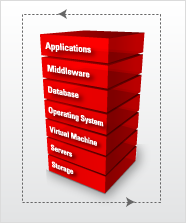
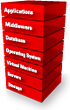
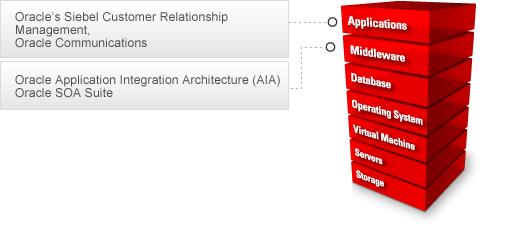
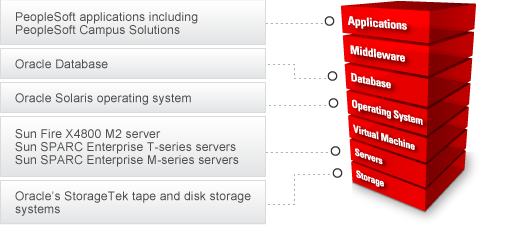
 From software to hardware and applications to disk, there's a synergy that starts in the engineering process. It's the understanding that the whole is greater than the sum of the parts, and it's the idea behind Oracle's integrated technology stack—hardware and software engineered to work together in a way that's never been done before.
Throughout the Oracle technology stack, products have been engineered to work together—not as an afterthought or a workaround, but incorporated into the design and built into the code to provide a new kind of extreme integration that has
With this extreme integration, Oracle can deliver performance, scalability, security, business intelligence, and manageability for the entire stack.
To protect against data loss, regulatory noncompliance, and damage to your brand, Oracle provides multiple layers of security to ensure that only authorized users have appropriate access to your systems. Oracle's inside-out approach to security starts with protecting the core—where your data resides—and adds more security layers out to the perimeter.
Data Encryption
Data encryption prevents direct access to sensitive information—whether it's on the network, at rest in the database, in transit from the database, or in a back-up file. Oracle helps you safeguard personal and confidential information stored in Oracle Database, even when a user has bypassed other controls. The built-in cryptographic acceleration in Oracle's SPARC servers allow these encryption and decryption operations to be processed quickly, without sacrificing application performance.
Access Control
With access controls, you can allow the right people in (with a manageable process) while keeping the wrong people out. Oracle Identity Management lets you set access controls based on roles, entitlements, rules, and other factors to secure applications and data. For added protection, Oracle Database prevents privileged users from accessing application data within the database. Risk-based authentication and strong authentication methods provide assurance of a user's identity for both on-premises and public cloud environments. And Oracle prevents co-mingling of data in virtualized operating system environments by providing separate security domains for each application.
Auditing and Monitoring
Oracle adds another layer of security to your database and applications with the ability to detect and prevent configuration changes. You can continuously monitor different activities—including business transactions, database traffic, and database audit trails—to identify suspicious behavior and block threats before they reach your data.
By using clustering and virtualization technologies to add storage, network, and computing capacity at all levels of the stack, Oracle can deliver the highest levels of performance and scalability for your virtualized or cloud environment.
Instead of managing applications that are tied to specific server, storage, or network components, you can pool hardware and software into shared resources, and make a single physical resource look like many resources (virtualization) or many physical resources look like a single resource (clustering). As your data center workloads fluctuate, having a centralized pool of IT resources lets you automatically match supply with demand and provide predictable system performance—in spite of unpredictable demand.
You can take advantage of clustering capabilities at the database, middle tier, Web cache, and storage layers. Oracle's database and middle tier server clusters provide automatic server failover so that your business-critical applications keep running.
IT organizations tasked with delivering services on demand can take advantage of Oracle's unique, application-driven virtualization that lets them rapidly and automatically provision and manage the entire application stack.
Based on a common enterprise information model, Oracle Business Intelligence foundation delivers a unified view of all your enterprise data—including relational databases, multidimensional OLAP databases, and operational transaction systems—no matter whether the data is from Oracle or non-Oracle sources. The same tools and technology used in Oracle's BI platform are also used in Oracle's analytic, enterprise performance management, industry, and transactional business applications.
Whether you have a traditional data center, a virtual environment, or a cloud computing environment, your IT administrators can use a single integrated console to monitor, manage, provision, and patch the entire Oracle stack. This makes it possible for IT to monitor the performance and availability of business services—not simply the technical components. It also makes it easier for IT to fulfill its agreed-upon service-level agreements (SLAs).
With the insight you get about the actual user experience, you can quickly detect performance issues and immediately trace the source of the problem—starting with the network and going through the applications, middleware, and database layers, all the way to the virtual machines and hardware layers.
Oracle also offers a complete solution for managing the entire cloud lifecycle, including consolidation and capacity planning, metering and chargeback, self-service, testing, and monitoring.
Oracle is in a unique position to offer customers a complete solution, because only Oracle owns all the layers in the technology stack. With access to the entire stack, Oracle can fine-tune products and optimize performance—for each product and at every layer.
Over the last 10 years, Oracle has worked toward its goal of enabling innovation by reducing complexity and simplifying IT through a complete, open, and integrated technology stack solution. During that time, Oracle
Oracle also designed a standards-based architecture and a set of Web services to drive consistency across the Oracle software stack. By reusing services across the stack, Oracle can offer higher-quality products and more innovation.
You've always been able to differentiate your business with enterprise software—as long as you were willing to write custom applications or heavily modify your best-of-breed software. And hire people to manage and maintain those custom systems.
But is this the best way to invest your resources?
In the past, your IT organization has had little choice about how to meet the strategic and unique needs of your business—for example, how to interact with customers, fulfill their demands, and provide innovative products and services. You generally had two options.
Either way, these projects were expensive and complicated. In the end, you were left with custom, legacy systems that would prove impossible to adapt in a way that would let you sustain any process or performance advantage.
Now consider a more efficient model—one that lets your IT group provide a complete, integrated solution designed to address the challenges unique to your industry. It's a simpler way to deliver IT, and it lets you concentrate on business growth and innovation.
Oracle simplifies IT by designing and investing in best-in-class vertical and horizontal applications, and then engineering them to work together for your industry. With Oracle's industry solutions, you can

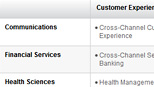
Oracle delivers targeted, end-to-end solutions for more than 20 industries in which Oracle has expertise and a deep understanding of industry requirements. You can use individual solutions to address specific pain points, or leverage the full suite of industry-specific solutions to help achieve a large-scale transformation of your business.
1 "Does Oracle Go Top of the Class in Telecom Transformation?" IDC, 2011.
Oracle uses industry-specific business process models and examines common pain points to develop comprehensive, industry-specific solutions. Even though the specifics vary from industry to industry, all of Oracle's industry solutions focus on powering three core areas.
In all three areas, Oracle has the most complete portfolio of software and related intellectual property of any provider.
Oracle's commitment to customer success extends to dedicated development, consulting, strategy, support, and sales teams that can work with you to optimize your business results.
Oracle's expertise is the result of more than 30 years of customer experience, and is delivered through a variety of consultants, support engineers, and industry experts who help you assess your business (and your business data), and recommend how best to use your industry-specific IT portfolio to achieve your business goals. Oracle's expertise is available through a variety of programs, including Oracle Insight, Oracle Consulting, Oracle Support, Oracle Managed Cloud Services, Oracle University and Oracle PartnerNetwork.  Learn More
A survey shows that more than 50 percent of businesses will need a new data center within two years.1
Are you ready?
Transforming IT by optimizing your data center should be at the center of your IT strategy. At a minimum, the optimal data center must be able to help your organization
1 "Oracle Next-Generation Data Center Index" report based on independent market research conducted by Quocirca, 2011.
It is estimated that by 2014, 85 percent of the data warehouses currently in use will be unable to meet new information volume and complexity demands.2
Will the choices you make today prepare your business to turn this information explosion into a competitive advantage, or are you at risk of falling behind?
According to IDC estimates, digital content grew to 2.7 zettabytes in 2012, up almost 50 percent from 2011. And 90 percent of this data was unstructured.3
In the past, when a data center needed to handle more data, the answer was simply to add more disk storage. Unfortunately, this approach no longer reflects today's reality.
2 "Oracle Exadata Database Machine Deployments Meet Expectations and Drive Interest," Gartner, 2011.
3 "IDC Predictions 2012: Competing for 2020," IDC, 2011.
No matter how much data your organization handles today, that amount is growing—and will continue to grow—at unprecedented rates. Solutions that offer more storage as the only way to handle bigger data volumes don't adequately address the problems of processing bottlenecks and limited real-time accessibility.
If adding more storage doesn't solve the problem, how do you handle this massive inflow of data? Organizations that are successfully handling explosive data growth focus on
The biggest challenge associated with massive amounts of data is getting the data to a point where it can be used for real-time reporting and analysis. With Oracle's engineered systems, you can create highly efficient, large-scale data warehouses to manage all your enterprise information.
Data Warehousing
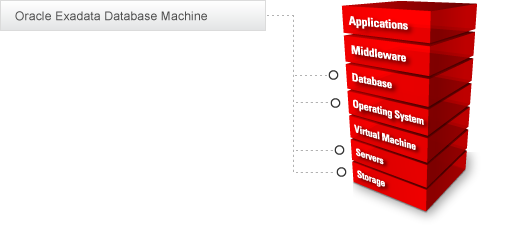
With its capacity to move large volumes of data efficiently, Oracle Exadata Database Machine is an ideal platform for large data warehouses. Innovative technologies such as Exadata Smart Scan, Exadata Smart Flash Cache, and Oracle Hybrid Columnar Compression work together to deliver extreme performance for data warehousing and OLTP workloads.
For example, by using compression to reduce the size of data warehousing tables, Oracle Exadata can scan data faster. Compared to traditional storage infrastructures, Oracle Exadata offers a 10-fold improvement in query performance, and with a compression ratio that's 10 to 50 times better than conventional data warehousing and storage solutions, Oracle Exadata lets you store more data for a lower cost.
Big Data
Big data refers to unstructured data—such as the data in blogs, social media content, e-mail, sensors, and photographs—that can be mined for useful information. By combining and analyzing this potentially valuable information alongside transactional data, you can gain new insights into your business.
Oracle offers a complete big data solution that lets you evolve your existing data architecture to incorporate big data.
If global data grows 40 percent per year as projected,4 businesses will need more storage, more computing resources, more electricity, and more space for more servers. That's good for the IT industry.
But is it good for your bottom line?
Traditional data centers often house isolated systems that allow applications to run on dedicated technology stacks. The silos are different, so each system is
Developing a strategy for delivering IT services more efficiently is key to reducing what your business spends on IT infrastructure, facilities, and utilities. To be more efficient, you have to be more effective about managing the capacity of your data center and about using your data center resources. While global businesses must operate 24/7 with no unplanned downtime, they also need to control skyrocketing operational costs.
4 "Big Data: The Next Frontier for Innovation, Competition, and Productivity," McKinsey Global Institute, May 2011.
By optimizing your existing data center, you can significantly increase IT efficiency along with system performance, availability, and security. When you standardize and consolidate the components in your data center and use virtualization technology to increase the usage capacity of those components, you're able to deploy new services quickly and dynamically allocate resources on demand.
Standardize
By limiting the number of hardware platforms, software configurations, and IT services your business supports, you can reduce the amount of time and money required to procure, provision, and install different IT resources. And you can eliminate the complexity of maintaining heterogeneous systems. Standardizing on a common set of building blocks lets your IT organization rapidly deploy predefined configurations. Instead of hiring people with knowledge of a specific computing or storage platform, you can build a workforce with common, interchangeable skills—a workforce that can deliver effective and cost-efficient IT services.
5 Oracle IT operations.
And because Oracle's best-in-class components are built according to industry open standards, you can still leverage third-party and legacy systems when you need them to create the best IT strategy for your business.
Consolidate
For many organizations, consolidation is the first step on the path to a private cloud. New hardware technologies offer more computing power in less space, making it possible to reduce your server and storage footprint without adversely affecting performance.
You can consolidate operating systems, databases, and applications to simplify overall manageability. With Oracle Enterprise Manager, you can even streamline and automate consolidation tasks for any type of workload. The improved operational efficiency you get from consolidating components in your data center helps you eliminate duplication and streamline resource management—resulting in significant cost savings.
Virtualize
Any time you have a server dedicated to a single operating system and application, you inevitably end up with an underutilized asset. With virtualization and clustering technologies, IT organizations can pool hardware and software into shared resources that can be allocated—as needed—to balance supply and demand and to maximize the utilization of resources.
Replacing the physical silos in your data center with shared virtual resources means you can easily add computing, storage, and networking capacity—instead of extra hardware—when workloads change. Less hardware means less data center space and less energy used.
Many organizations rely on just one type of virtualization and therefore lack the ability to support different workloads. With Oracle's comprehensive set of virtualization technologies—including support for x86 and SPARC servers as well as virtualization and clustering built into the database and middleware—you can run all your production workloads in a shared-resource environment.
By automating IT management tasks, you can dramatically cut unplanned downtime due to manual errors, configuration drift, and untested changes as well as enable faster delivery of IT services. Oracle offers a unique approach to IT automation by providing applications-to-disk management capabilities—from infrastructure to development platforms, to databases and business applications. Oracle's management solutions can help you monitor non-Oracle technologies as well as manage the entire cloud lifecycle across your private and hybrid clouds.
With Oracle's complete technology stack, you can choose the path to data center optimization that's right for your business.
By using these approaches to optimize your data center, you set the stage for efficiency at every level of the technology stack and throughout your data center.
| Consolidation | Standardization | Virtualization |
|---|---|---|
|
|
|
Top technology trends for 2013 include big data, cloud services, enterprise mobility, gamification, Internet of Things, and social business. To take advantage of new technologies that can differentiate your business, you need to have the right infrastructure in place.
Is your IT organization agile enough to respond effectively to the rapidly changing needs of your business?
IT innovation starts with the data center. To change the way your organization delivers IT services to your business, you need an infrastructure that provides high availability and scalability and can help you meet business demands faster.

Around the world, organizations are rethinking how to deliver IT services so they can
As IT organizations make the transition from tactical providers of services to strategic partners in the business, data centers must evolve to reflect this updated role. Traditional models for delivering IT services are simply too slow to be practical in an environment where changes can happen—literally—overnight.
6 "2011 State of Cloud Survey," Symantec Corporation, 2011.
Once you've taken the steps to standardize, consolidate, virtualize, and automate your data center, implementing the self-service and elastic scalability capabilities that you need to move to cloud computing is a relatively small effort. A private cloud environment offers
To help you build, deploy, manage, integrate, and secure your private cloud environment, Oracle offers comprehensive products including

Oracle Cloud Applications
Oracle's cloud applications provide complete business processes spanning a wide range of functions. You can choose to deploy them any way you want—in a private, public, or hybrid cloud environment. These enterprise-grade applications also will meet even the most-stringent performance and security requirements.
Oracle Cloud Platform
By using a shared platform for database and middleware technologies, you can increase your asset utilization and provide elastic capacity on demand. The Oracle Cloud platform lets you quickly develop and deploy new applications to support the rapid pace of change in your business and includes SOA-based business process management, data integration, identity management, as well as user interaction and cloud management services.
Oracle Exadata Database Machine and Oracle Exalogic Elastic Cloud are the ideal building blocks for delivering platform-as-a-service (PaaS) solutions because of their unmatched speed and consolidation efficiency. And if you want to run both Oracle Exadata and Oracle Exalogic on the same systems, you can use Oracle SPARC SuperCluster. Learn More
Oracle Cloud Infrastructure
With Oracle's flexible cloud infrastructure, you can support dynamic resource pooling, elastic scalability, and rapid application deployment through system consolidation. Oracle's infrastructure-as-a-service (IaaS) technologies include Linux and UNIX operating systems, server virtualization and clustering, SPARC and x86 servers, Flash, disk and tape storage, and networking fabric. Learn More
Unified Platform for Managing the Cloud
With Oracle Enterprise Manager 12c, you can plan, build, and manage your private cloud. This unified management platform provides self-service capabilities for consuming all your cloud services, including IaaS, PaaS, and applications. It includes complete cloud lifecycle management capabilities, from capacity planning and self-service provisioning to policy-based resource management and chargeback. Oracle Enterprise Manager 12c provides a single point of control to manage your entire technology stack and cloud services—whether it's monitoring health and availability, managing configurations and performance, or automating provisioning and patching. Learn More
Research shows that the productivity of innovation workers can increase by 50 percent when companies apply technology more precisely—with solutions tailored to specific jobs or roles.1
Are you empowering your innovation workers with the tools to do more?
In today's business environment, it's not just knowledge that has become the underlying commodity—the value lies in knowing how to use that knowledge to innovate.
Intellectual property, brand value, process know-how, and other manifestations of brain power were responsible for generating an estimated 70 percent of all U.S. market value created over the past three decades.2 They likely had similar effects in other advanced economies as well.
The knowledge worker of the 1960s is giving way to what Oracle refers to as the innovation worker—someone who uses creativity and innovation to do a different type of work in the current business environment.
1 "Rethinking Knowledge Work: A Strategic Approach," McKinsey Quarterly, February 2011.
2 The Productivity Imperative," McKinsey Quarterly, June 2010.
For example, at any time, anywhere in the world, an innovation worker must be able to
To empower people to drive innovation and change, organizations must first identify the skills and the types of information that innovation workers need in order to be effective. In other words, they must learn how innovation workers work.
Oracle pioneered this approach in developing its next-generation applications. For example, Oracle Fusion Applications don't force users to integrate different work activities themselves. The applications do it for them—through analytics and social computing that are embedded in the business activity.
Once businesses can identify the skills and information needed by innovation workers, they can help them be more productive by providing the right kinds of technology solutions, including
When Oracle's User Experience team conducted onsite visits to observe how people used technology to do their job, they saw users toggling among transactions, e-mail, chat, search, and group workspaces, as well as between analytical dashboards and reports.
As a result of this customer input, Oracle engineers completely redesigned the next generation of Oracle Applications—Oracle Fusion Applications—to work the way most people work today.
Oracle Fusion Applications is a complete suite of modular applications that can coexist with existing Oracle Applications and is based 100 percent on industry open standards.
Because Oracle Fusion Applications were designed from the ground up using the latest technology advances in Oracle Fusion Middleware, Oracle engineers were able to structure and assign information, analytical data, and tasks to particular jobs or roles, incorporating best practices gathered from Oracle's thousands of customers. Oracle engineers then built the business processes for Oracle Fusion Applications using a service-oriented architecture (SOA) approach—the same approach that lets you quickly create the unique, custom-fit processes and extensions that can differentiate your business.
Whether a job requires interacting with teams of people, making information-based decisions, or ensuring that operations are running smoothly, Oracle has systemically thought through what is needed for each task, and then brought together all the tasks for a particular role.
With Oracle Fusion Applications, Oracle engineers built a complete user experience, with applications that empower innovation workers by providing them with the right information, the right processes, and the best technology.
Specifically, these intuitive applications include

With Oracle Fusion Applications, Oracle streamlined many of the activities that employees do and set a new standard for empowering innovation workers. The redesigned user experience in Oracle Fusion Applications supports specific business roles and delivers all the information necessary for users to take action.
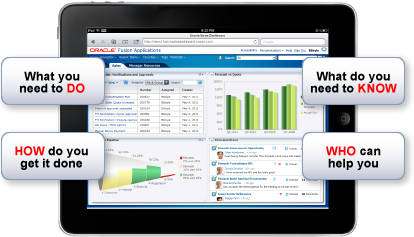
Using embedded analytics, Oracle Fusion Applications tell innovation workers
Oracle's investment in a complete user experience for Oracle Fusion Applications also benefits its other application product lines, including Oracle E-Business Suite, and Oracle's PeopleSoft, JD Edwards EnterpriseOne, JD Edwards World, Siebel Customer Relationship Management, and Hyperion. With every new release, Oracle continues to deliver user experience innovations that make getting from point A to point B simple—no matter which Oracle Applications you use.
Cloud computing is changing the way technology enables business innovation. Businesses like the ease and speed of deployment that the cloud offers. Unfortunately, most niche cloud providers use a decade-old, one-size-fits-all model that simply can't meet the specific—and changing—business and service-level requirements of modern organizations.
In contrast, Oracle designed its enterprise-grade cloud applications from the ground up to have the simplicity and flexibility that customers want, and the performance and horsepower they need.
Because Oracle Fusion Applications are built on a common, standards-based platform and a single code line, you can switch between software-as-a-service (SaaS) and on-premises deployments. You can choose to deploy Oracle Fusion Applications in any cloud environment, including
Oracle delivers all applications as managed services through Oracle Cloud Services, including Oracle E-Business Suite, PeopleSoft, JD Edwards EnterpriseOne, JD Edwards World, Siebel Customer Relationship Management, and Hyperion, as well as all of Oracle's industry applications.

Innovation is key to competitiveness, but if your business can't keep up with constant change, you're losing a winnable fight. Once upon a time, modifying an enterprise application meant rewriting and retesting code every time you made a change. But that was before open, standards-based, best-of-breed middleware technologies provided a common applications platform—and before Oracle Fusion Middleware.
With Oracle Fusion Middleware, you can take advantage of the same technologies and the same development platform used in Oracle Fusion Applications. You can keep pace with new business demands by extending and maximizing your existing technology investment with embedded analytics and social collaboration, and mobile and cloud computing.
Oracle Fusion Middleware provides a foundation for innovation that gives you
3 "SOA with Smarts: University of Virginia Makes a New-School Change to a Venerable Application," Alan Joch, Profit, August 2011.
Oracle Business Intelligence foundation brings together all your enterprise data sources in a single, easy-to-use solution, delivering consistent insights whether it's through ad hoc queries and analysis, interactive dashboards, scorecards, OLAP, or reporting.
Innovation workers rely on a broad set of tools in today's workplace. Oracle Fusion Middleware helps IT organizations give existing enterprise applications the rich social networking capabilities and content sharing that users have come to expect in consumer software.
Oracle WebCenter is a component of Oracle Fusion Middleware that provides a user engagement platform for social business that connects people—both inside and outside the organization—and information. It delivers intuitive, personalized, and contextual user experiences for enterprise applications, both by enhancing existing enterprise applications and by creating new composite applications. It also enables users to build collaborative communities across disparate applications and business processes.
For many, the cloud's promise of improved business agility and faster innovation has fallen short of expectations. The proprietary platforms and cloud silos of niche providers make it difficult to integrate and extend business processes and applications with other cloud or on-premises systems—systems that are often required to execute a business process.

Oracle Fusion Middleware—the same platform used in Oracle's enterprise-grade cloud applications—offers a different approach based on portability between clouds and durable integration. This next-generation applications platform is based on 100 percent open standards, so you aren't locked into one deployment model when your business requirements change. Oracle Fusion Middleware allows you to create rich applications—no matter whether the applications are deployed on premises or in the cloud.
In addition, Oracle Fusion Middleware has tools and a common development framework that can help you
With Oracle's complete SOA platform, your IT organization can rapidly design, assemble, deploy, and manage these adaptable business applications and—with Oracle's business process management tools—even bring the task of modeling business processes directly to the business analysts. Your organization will benefit as business and IT collaborate on process improvements.
It's not that you want to have it all, but you do want the combination of capabilities, deployment options, and hardware and software solutions that works best for your business today—and tomorrow.
You don't need everything. What you need is choice.
Choice has always been part of enterprise IT solutions, but in too many cases, choice meant limits.
In the past, IT organizations could choose to automate tasks for a group (such as the Accounting department), but they couldn't link those tasks to other departments (such as Finance) because the proprietary software they used was too costly and too difficult to integrate.
Then you could choose how to automate business processes across the entire enterprise. However, even if you hadn't selected proprietary software, you had to implement the whole system—even the pieces you didn't need. What's more, when it was time for a new release, everything had to be upgraded at once, including integrations with other systems.
And today, you can choose a cloud deployment to avoid the problem of monolithic upgrades, but unless your entire business is running in the cloud, you're back where you started—with silos of information that you can't share across the enterprise.
You've always had choices, just difficult ones.
Now you can choose a better way.
Many vendors claim to have the right IT solution for your business, but too often, their offerings force you to commit to one choice over another. Only Oracle can offer a complete, open, and integrated technology stack that provides real choice, so you can make the right decision about the products and services you need for your business.
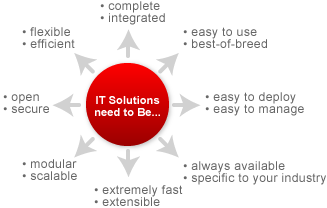
Oracle's complete, open, and integrated product strategy means having best-in-class products at every layer of the technology stack—and within each layer—and engineering them to work together.
You can start with individual products that address specific business challenges and then add more later. Or you can take advantage of Oracle's integrated solutions to transform entire areas of your business. With high-performance products that stand alone or work together, you get both best-in-class capabilities and simplified integration.
Industry analysts recognize Oracle's leadership in key product segments, including database, middleware, hardware, applications, and industry-specific solutions.
Oracle also has best-in-class solutions within each layer of the technology stack. For example, industry analysts recognize Oracle's leadership in several middleware categories, including
Whether Oracle builds or acquires its best-in-class products, all are engineered, tested, certified, and managed to work with all other products in the Oracle stack, and—through industry open standards—with third-party and legacy products as well.
To meet the diverse needs of its customers, Oracle offers a choice of deployment models in addition to its on-premise deployments, including private cloud, public cloud, and hybrid options.
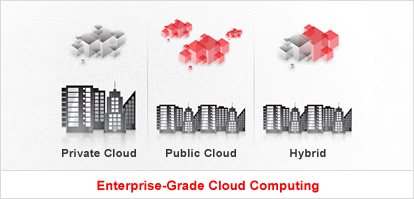
Many organizations are moving to the cloud, but most enterprises will need a mix of deployment models for the foreseeable future. Organizations need greater control for specific areas of their business (highly regulated processes, for example) and prefer private cloud or on-premises deployments. In other areas of the business—especially where moving quickly is a priority—a software-as-a service public cloud solution may be the right choice.
No matter which type of deployment or combination of deployments you choose, they all need to work together. For some organizations that's a problem, but for Oracle customers, it's just one more way of "having it all."
Oracle has the broadest and most comprehensive portfolio of public, private, and hybrid cloud offerings in the industry. Whether you've decided to build a private cloud, have Oracle design and manage your private cloud, or take advantage of public cloud services, Oracle has solutions at every layer.
| Public Cloud | Private Cloud Products | Managed Cloud Services |
|---|---|---|
| Application Services | Cloud Applications | Applications On Demand |
| Social Services Platform Services |
Cloud Platform | Technology On Demand |
| Common Infrastructure Services | Cloud Infrastructure | Technology On Demand |
With the most comprehensive cloud portfolio in the industry, Oracle allows you to adopt cloud computing for as much (or as little) of your IT services as your business needs—and do it at the pace that makes sense for your business. You have the option of building your own private cloud or having Oracle host and manage your applications and technology. You can also choose from Oracle's broad suite of subscription-based application services, platform services, social services, and common infrastructure services.
Just because Oracle's cloud solutions are comprehensive, it doesn't mean one size fits all. Oracle gives you the choice of public, private, and hybrid cloud deployment models, as well as the opportunity to have your cloud in your data center, one of Oracle's global data centers, or any combination thereof. Oracle also gives you the flexibility of choosing an upgrade window that best fits your business. By optimizing the entire stack of hardware and software, Oracle has the unique ability to protect your data at every layer and federate identity management across on-premise and cloud environments.
Oracle has engineered each layer of the Oracle stack according to open industry standards so customers have all the benefits of preintegrated components that are designed, tested, and certified to work together, but they aren't forced to purchase unnecessary hardware or software. The result is that Oracle makes IT simpler—without the compromises associated with proprietary systems.
When enterprise software is built with standard interfaces, customers can easily extend their systems and respond quickly to changes in the marketplace or in their business. Open standards protect your technology investments by reducing vendor lock-in and lowering the cost of integrating heterogeneous environments.
Because Oracle has engineered each layer in the Oracle stack according to open industry standards, you don't have to use Oracle products in every layer of your technology stack to get the benefits of Oracle's integrated technology.
In fact, you can benefit from using Oracle products anywhere in your existing IT landscape: many Oracle customers have specialized components that they continue to use. Oracle tests the interoperability of the Oracle stack with third-party components so customers will know which ones will work together and can choose the right combination of products for their business.
With Oracle's high-performance products that stand alone or work together, you can get the best fit for your business by choosing fully integrated solutions with best-in-class capabilities.

Oracle also gives you the flexibility to make real choices. For example, you can start with an individual module to address a specific business challenge, and deploy additional modules later for preintegrated, purpose-built solutions that can transform entire areas of your business.
Oracle offers a range of products, solutions, and deployment models to give you choices for your business.
Learn More Learn MoreIf you'd like to speak with an Oracle specialist, please call 1.800.633.0738.

2 "Does Oracle Go Top of the Class in Telecom Transformation?", IDC, 2011.
| Oracle Insight | Based on your business objectives, the Oracle Insight group can help you decide which vertical solutions to adopt and in what order. They can also provide fact-based assessments of how to achieve the maximum return on investment using your company's data. You can then incorporate only those solutions that are appropriate for your business. |
| Oracle Consulting | Oracle Consulting provides faster adoption and return on investment across Oracle hardware and software. With our deep expertise, Oracle Consulting helps you succeed with architecture, planning, implementation, upgrade, migration and expert services across the Oracle stack. |
| Oracle Managed Cloud Services | Oracle Managed Cloud Services enable organizations to leverage their Oracle investments to extend into the cloud with greater value, choice, and confidence. Oracle delivers enterprise-grade, end-to-end managed cloud services across its broad portfolio of business applications, middleware, database, and hardware technologies. |
| Oracle Support | Oracle Premier Support provides essential support services including 24/7 technical assistance, powerful proactive support resources, and product updates. Oracle also offers Oracle Advanced Customer Support Services which provides mission critical support services for complex IT environments. |
| Oracle University | Oracle University delivers superior education and certification services to successfully enable organizations adopting Oracle technologies. Ensure your staff has the required skills to meet your business goals with flexible and globally available training solutions developed and delivered by the experts at Oracle. |
| Oracle Partners | Together, Oracle and more than 25,000 partners provide customers around the world with industry-leading solutions and services that address business needs. Oracle partners help customers deploy world-class Oracle products, but also offer extended capabilities that can address any specific functional, market, or industry needs you may have. Find an Oracle partner to help with your IT solutions. |