Soundex |
The Soundex processor generates a soundex code for each value in a specified attribute. Soundex is an abstract key which represents similar sounding names as the same code. Soundex is specifically applicable to family / surnames (although is sometimes used – with care - in other domains).
Soundex codes are used where spelling or transcription differences occur in names that sound the same. Having created a soundex code, you would often use the soundex instead of the raw data value in a duplicate check.
Any String or String Array attributes from which you want to create a soundex code.
Note that if you input an Array attribute, the transformation will apply to all array elements, and an Array attribute will be output.
None.
|
Data attribute |
Type |
Purpose |
Value |
|
[Attribute Name].Soundex |
Derived |
A new attribute with the soundex code derived from each input attribute |
The original attribute value, converted to its soundex code. |
None
|
Execution Mode |
Supported |
|
Batch |
Yes |
|
Real time Monitoring |
Yes |
|
Real time Response |
Yes |
The Soundex transformer presents no summary statistics on its processing.
In the Data view, each input attribute is shown with its new derived soundex attribute to the right.
None. All records input are output.
This example uses the Soundex transformation on a Surname attribute. The Surname attribute was created from the NAME attribute in the Customers table of the example Service Management data, by splitting the attribute using a Make Array from String processor, using a space separator, and outputting the Surname by selecting the second element in the array using Select Array Element processor:
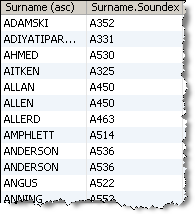
Note that where values should possibly be the same and may be the subject of typos, such as ALLAN/ALLEN, the same soundex code is generated.
Oracle ® Enterprise Data Quality Help version 9.0
Copyright ©
2006,2011 Oracle and/or its affiliates. All rights reserved.
