
This document will continue to evolve as existing sections change and new information is added. All updates appear in the following table:
| Date | Product | Feature | Notes |
|---|---|---|---|
| 18 JUL 2022 | IMPORTANT Actions and Considerations | Updated document. Added section. | |
| 17 JUN 2022 | Created initial document. |
 HAVE AN IDEA?
We’re here and we’re listening. If you have a suggestion on how to make our cloud services even better then go ahead and tell us. There are several ways to submit your ideas, for example, through the Ideas Lab on Oracle Customer Connect. Wherever you see this icon after the feature name it means we delivered one of your ideas.
GIVE US FEEDBACK
We welcome your comments and suggestions to improve the content. Please send us your feedback at oracle_fusion_applications_help_ww_grp@oracle.com.
DISCLAIMER
The information contained in this document may include statements about Oracle’s product development plans. Many factors can materially affect Oracle’s product development plans and the nature and timing of future product releases. Accordingly, this Information is provided to you solely for information only, is not a commitment to deliver any material, code, or functionality, and should not be relied upon in making purchasing decisions. The development, release, and timing of any features or functionality described remains at the sole discretion of Oracle.
This information may not be incorporated into any contractual agreement with Oracle or its subsidiaries or affiliates. Oracle specifically disclaims any liability with respect to this information. Refer to the Legal Notices and Terms of Use for further information.
Pre-Update and Post-Update Tasks
Depending on the features you're using in your Cloud applications, you may be required to perform certain steps immediately before or after your quarterly update. For details of these pre-update and post-update steps and the product areas that are affected, refer to Oracle SCM Cloud: Performing Your Quarterly Update (doc ID 2337485.1) on My Oracle Support.
Optional Uptake of New Features (Opt In)
Oracle Cloud Applications delivers new updates every quarter. This means every three months you'll receive new functionality to help you efficiently and effectively manage your business. Some features are delivered Enabled meaning they are immediately available to end users. Other features are delivered Disabled meaning you have to take action to make available. Features delivered Disabled can be activated for end users by stepping through the following instructions using the following privileges:
- Review Applications Offering (ASM_REVIEW_APPLICATIONS_OFFERINGS_PRIV)
- Configure Oracle Fusion Applications Offering (ASM_CONFIGURE_OFFERING_PRIV)
Here’s how you opt in to new features:
- Click Navigator > My Enterprise > New Features.
- On the Features Overview page, select your offering to review new features specific to it. Or, you can leave the default selection All Enabled Offerings to review new features for all offerings.
- On the New Features tab, review the new features and check the opt-in status of the feature in the Enabled column. If a feature has already been enabled, you will see a check mark. Otherwise, you will see an icon to enable the feature.
- Click the icon in the Enabled column and complete the steps to enable the feature.
In some cases, you might want to opt in to a feature that's not listed in the New Features work area. Here's how to opt in:
- Click Navigator > My Enterprise > Offerings.
- On the Offerings page, select your offering, and then click Opt In Features.
- On the Opt In page, click the Edit Features (pencil) icon for the offering, or for the functional area that includes your feature.
- On the Edit Features page, complete the steps to enable the feature.
For more information and detailed instructions on opting in to new features for your offering, see Offering Configuration.
Opt In Expiration
Occasionally, features delivered Disabled via Opt In may be enabled automatically in a future update. This is known as an Opt In Expiration. If your cloud service has any Opt In Expirations you will see a related tab in this document. Click on that tab to see when the feature was originally delivered Disabled, and when the Opt In will expire, potentially automatically enabling the feature. You can also click here to see features with Opt In Expirations across all Oracle Cloud Applications.
Column Definitions:
Report = New or modified, Oracle-delivered, ready to run reports.
UI or Process-Based: Small Scale = These UI or process-based features are typically comprised of minor field, validation, or program changes. Therefore, the potential impact to users is minimal.
UI or Process-Based: Larger Scale* = These UI or process-based features have more complex designs. Therefore, the potential impact to users is higher.
Features Delivered Disabled = Action is needed BEFORE these features can be used by END USERS. These features are delivered disabled and you choose if and when to enable them. For example, a) new or expanded BI subject areas need to first be incorporated into reports, b) Integration is required to utilize new web services, or c) features must be assigned to user roles before they can be accessed.
| Ready for Use by End Users Reports plus Small Scale UI or Process-Based new features will have minimal user impact after an update. Therefore, customer acceptance testing should focus on the Larger Scale UI or Process-Based* new features. |
Customer Must Take Action before Use by End Users Not disruptive as action is required to make these features ready to use. As you selectively choose to leverage, you set your test and roll out timing. |
|||||
|---|---|---|---|---|---|---|
| Feature |
Report |
UI or |
UI or |
|
||
Reference History End Date and Forecast Start Date in Measure Expressions |
||||||
Link Planning Cycle Tasks to Demand and Supply Plans
Drill into demand and supply plans directly from a task in a sales and operations planning cycle. View tables, layouts, graphs, and metrics in Oracle Demand Management and Oracle Supply Planning during demand and supply reviews.
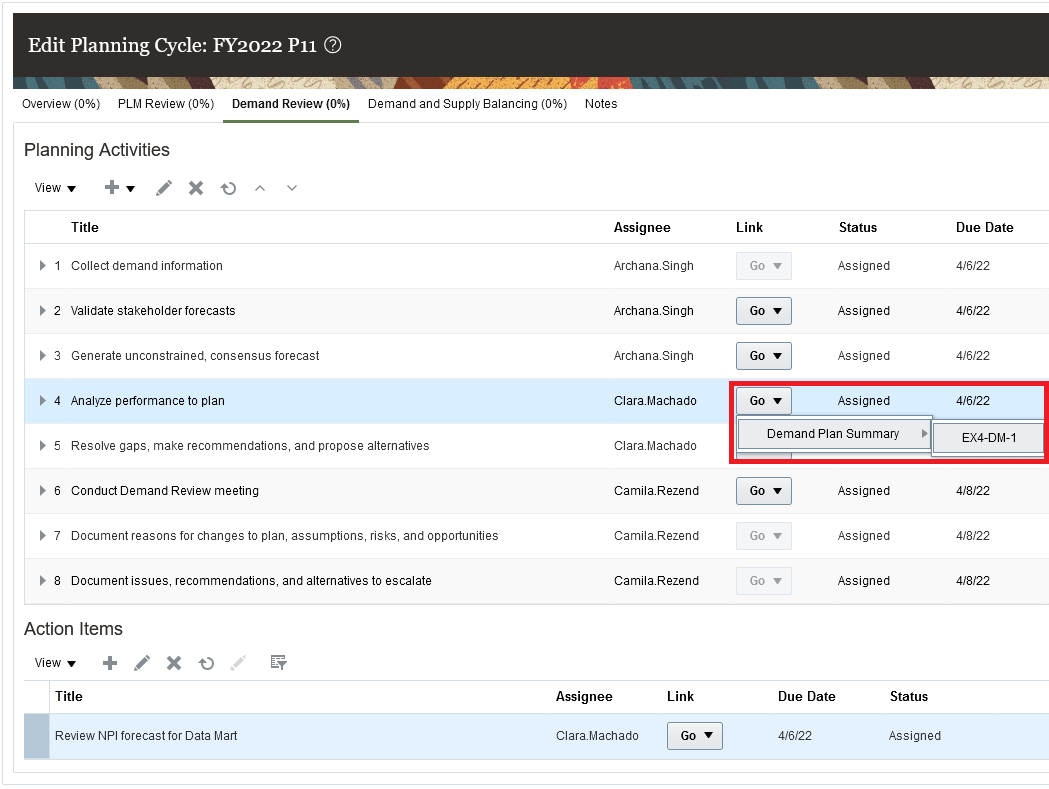
Navigation: Tasks > Planning Cycle > Manage Planning Cycles
Provide holistic and contextual information to support decision making for sales and operations planning.
Steps to Enable
You don't need to do anything to enable this feature.
Tips And Considerations
On the Manage Planning Cycles page, in the Actions menu, select Edit to associate plans with a planning cycle.
Key Resources
- The Link Planning Cycle Tasks to Demand and Supply Plans readiness training available on Oracle Cloud Readiness for Sales and Operations Planning.
Role Information
You have a couple options for giving people access to this feature, depending on whether you're assigning them predefined job roles or your own configured job roles.
- Users who are assigned this predefined job role are automatically able to access this feature:
- Sales and Operations Planner (ORA_MSC_SALES_AND_OPERATIONS_PLANNER_JOB)
- Users who are assigned configured job roles that contain these privileges are able to access this feature:
- Monitor Sales and Operations Planning Work Area (MSC_MONITOR_SALES_AND_OPERATIONS_PLANNING_WORK_AREA_PRIV)
- Administer Planning Cycles (MSC_MANAGE_PLANNING_CYCLES_PRIV)
- Review Planning Cycles (MSC_REVIEW_PLANNING_CYCLES_PRIV)
Specify a Time Range When Loading Measures from Other Plans
Copy and store measure data from a source plan to a target plan for a specified time range instead of importing the entire time-phased measure data. Creating stored versions of copied measure data, especially for measures with complex underlying calculations, improves the analytical performance of tables, graphs, and metrics in the target plan. By specifying an appropriate time range, you can also address measure data spanning both historical and forecast time ranges.
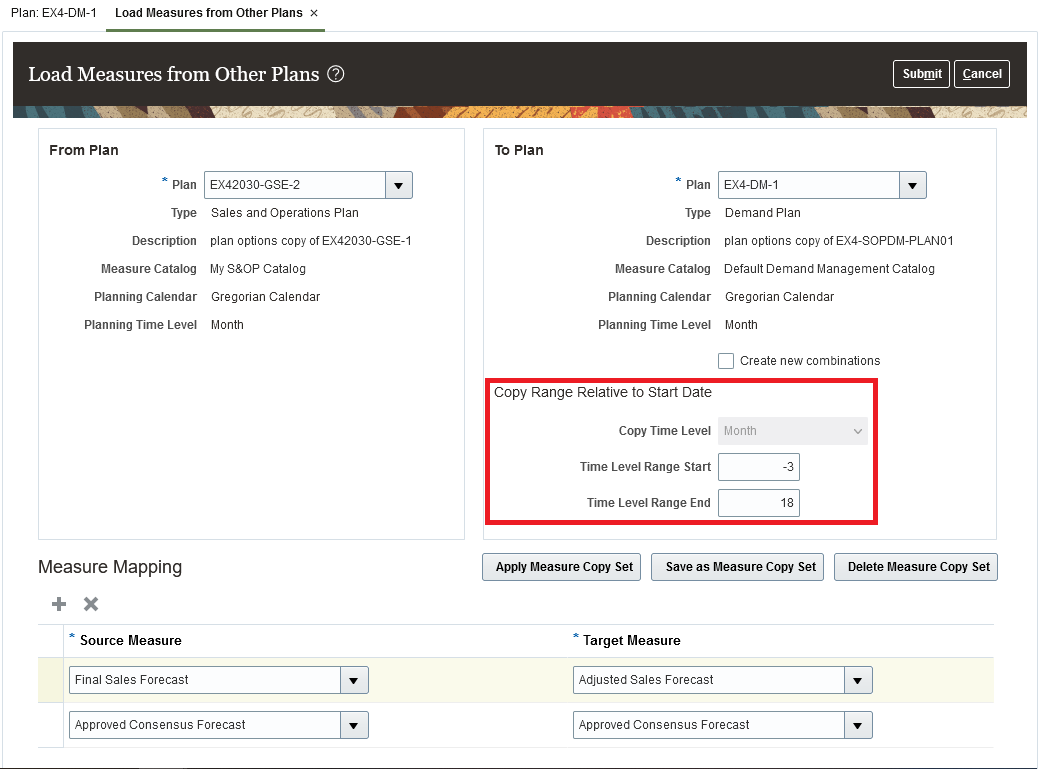
The new Copy Range Relative to Start Date section on the Load Measures from Other from Other Plans page (Navigation: Tasks > Plans > Load Measures from Other Plans)
Improve planning efficiency through better processing of data from other plans and faster visualization of key metrics that support sales and operations decision making.
Steps to Enable
You don't need to do anything to enable this feature.
Tips And Considerations
- Specify the time level range start and end that you want to pertain to the target plan.
- Specify a time range to copy measure data for both forecast and history. Use negative values for historical time periods.
- You can still search for and select the Orchestrate Load Measures Processes in the Scheduled Processes work area to schedule this process.
Key Resources
- The Specify a Time Range When Loading Measures from Other Plans readiness training available on Oracle Cloud Readiness for Sales and Operations Planning.
Role Information
You have a couple options for giving people access to this feature, depending on whether you're assigning them predefined job roles or your own configured job roles.
- Users who are assigned any of these predefined job roles are automatically able to access this feature:
- Demand Planner (ORA_MSC_DEMAND_PLANNER_JOB)
- Sales and Operations Planner (ORA_MSC_SALES_AND_OPERATIONS_PLANNER_JOB)
- Users who are assigned configured job roles that contain these privileges are able to access this feature:
- Load Measure Data from Other Plans (MSC_LOAD_MEASURES_FROM_OTHER_PLANS_PRIV)
- Run Plan with Snapshot (MSC_RUN_PLAN_WITH_SNAPSHOT_PRIV)
As part of your planning process, you may need to analyze data using multiple dimensional segments. You can classify your business into different segments where each segment is comprised of various combinations of items, organizations, customer sites, and demand classes. These segments can be based on attributes, such as planner code, or on metrics, such as demand volume. Examples of how you might define segments:
- Segment item organization combinations by planner code
- Segment item customer site combinations by demand volume into various tiers
The ability to define segments was previously available in Oracle Demand Management and for defining attribute netting rules. With this update, you can analyze by attributes in Oracle Sales and Operations Planning and Oracle Supply Planning.
You can use these segments for analysis in tables and graphs. You can also use these segments in analysis sets. Segments that were previously created for use in Demand Management can be used in Oracle Sales and Operations Planning and Oracle Supply Planning.
Segment your supply chain and drive your planning analysis using segments
Steps to Enable
You don't need to do anything to enable this feature.
Tips And Considerations
- Configure segment groups using the Manage Segment Groups and Criteria task. You define the granularity of the segment group. The granularity can be a combination of item, organization, customer site, and demand class. Then you define each of the segments within the segment group and the criteria for each segment. Segment criteria can be based on attributes of products or organizations or based on measure values from a specified plan.
- After configuring a segment group, you invoke the Execute Segmentation action to generate the individual segments and identify the combinations within each segment. You can view the results using the View Segmentation Summary option. Additionally, you can manually override the results using the Manage Segment Members action.
- After a segment group is created and successfully executed, you can use it for analysis and filtering in tables, graphs, and analysis sets. When configuring a table or graph, segment groups are listed on the Hierarchies tab. Select a segment group to include it as a level in the table or graph. Segment groups behave like any other hierarchy level, such as product family or month, except they are multidimensional. For example, if the granularity of a segment group is item and organization, then the segments within this segment group will be made up of item and organization combinations. Segment groups are also listed on the Members tab enabling you to filter on selected segments within a segment group.
Key Resources
- The Analyze a Plan by Segment readiness training available on Oracle Cloud Readiness for Supply Planning.
Role Information
You have a couple options for giving people access to this feature, depending on whether you're assigning them predefined job roles or your own configured job roles.
- Users who are assigned any of these predefined job roles are automatically able to access this feature:
- Supply Chain Planner (ORA_MSC_SUPPLY_CHAIN_PLANNER_JOB)
- Materials Planner (ORA_MSC_MATERIALS_PLANNER_JOB)
- Sales and Operations Planner (ORA_MSC_SALES_AND_OPERATIONS_PLANNER_JOB)
- Users who are assigned configured job roles that contain this privilege can access this feature:
- Manage Segments (MSC_MANAGE_SEGMENTS_PRIV)
- Save Plan Extract (MSC_SAVE_PLAN_EXTRACT_PRIV)
- Edit Planning Analytics Configuration (MSC_EDIT_PLANNING_ANALYTICS_CONFIGURATION_PRIV)
Reference History End Date and Forecast Start Date in Measure Expressions
When you configure measures in Oracle Fusion Cloud Supply Chain Planning using measure expressions, sometimes you need to reference a relative point in time, such as the history end date. A relative point in time is one that changes as a plan proceeds forward in time. With this update, you can use new measure functions that enable you to query the forecast start date and history end date and configure the measure expression to your business needs. For example, if you want to lock a measure from edits for a certain number of days using a lock measure expression, then you can reference the demand forecast start date in the measure expression.
Use the Manage Planning Measures task to configure measure expressions with the new date type measure functions DemandHistoryEndDate() and DemandForecastStartDate().
- For plans defined with forecasting profiles:
- DemandHistoryEndDate: Provides the demand history end date calculated by the demand forecasting process at the forecasting time level
- DemandForecastStartDate: Provides the demand forecast start date calculated by the demand forecasting process at the forecasting time level
NOTE: The calculations for the demand history end date and demand forecast start date functions take the setting for the history offset parameter into account
-
DemandHistoryEndDate and DemandForecastStartDate: Provide the maximum of the history end date and maximum of the forecast start date calculated between the forecasting profiles
- For plans defined without forecasting profiles:
- DemandHistoryEndDate: Provides the date before the plan horizon start date
- DemandForecastStartDate: Provides the plan horizon start date
Configure measure expressions that reference relative points in time, such as forecast start date, and create measures that align even better to your business needs.
Steps to Enable
You don't need to do anything to enable this feature.
Key Resources
- Watch Reference History End Date and Forecast Start Date in Measure Expressions Readiness Training
Role Information
- Users who are assigned any of these predefined job roles are automatically able to access this feature:
- Demand Planner (ORA_MSC_DEMAND_PLANNER_JOB)
- Replenishment Planner (ORA_MSC_REPLENISHMENT_PLANNER_JOB)
- Sales and Operations Planner (ORA_MSC_SALES_AND_OPERATIONS_PLANNER_JOB)
- Supply Chain Planner (ORA_MSC_SUPPLY_CHAIN_PLANNER_JOB)
- Supply Chain Planning Application Administrator (ORA_MSC_SUPPLY_CHAIN_PLANNING_APPLICATION_ADMINISTRATOR_JOB)
- Supply Chain Application Administrator (ORA_RCS_SUPPLY_CHAIN_APPLICATION_ADMINISTRATOR_JOB)
- Users who are assigned configured job roles that contain either this privilege or duty, or both, are able to access this feature:
- Maintain Measure Definition (MSC_MAINTAIN_MEASURE_DEFINITION_PRIV)
IMPORTANT Actions and Considerations
Bug Fix Delivered in Update 22B: Enforce Work Center and Supplier Capacity Constraints
In update 22B, we delivered a bug fix that changes the default behavior of capacity constraints. If you haven't reviewed the details of this bug fix, refer to Enforce Work Center and Supplier Capacity Constraints in the Selected Sales and Operations Planning Bug Fixes in This Update in the 22B What's New.