| Inside Java January 2026 |
|
| |
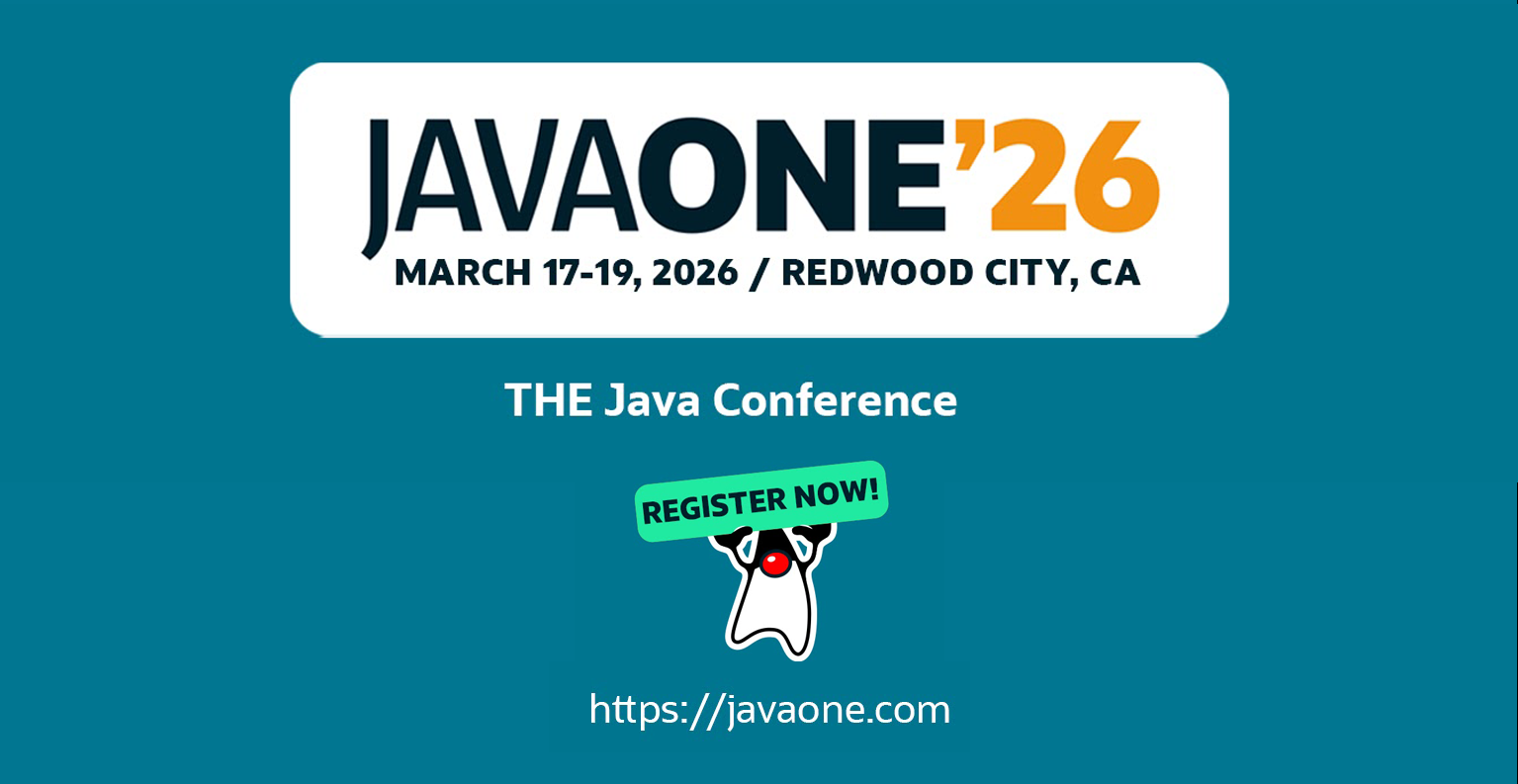
| JavaOne 2026 Registration is Open! And for a limited time, we're offering a special discount code for $100 off! Details below. |
|
|
|
|
|
|
| Save $100 for JavaOne 2026 |
| March 17-19, Redwood Shores, California |
|
Early registration for JavaOne 2026 is open until February 9. But register now and receive an additional $100 off your individual registration.
This offer is available for a limited time and is valid for new individual registrations only and cannot be combined with any other offers or promotions. *Not valid on group passes or for public sector attendees.
Use this code at checkout: J12026IJN100 |
|
|
|
|
|
JavaOne: Keynotes & Sessions Published
The keynotes and sessions for JavaOne have been published. We’ll have hands-on labs, deep dives into the latest in JVM development, Java in AI, enterprise Java, machine learning, tooling, application development, and community.
If you’ve never been to JavaOne, check out JavaOne 2025 (videos, photos) and JavaOne 2022 (videos, photos). And this year will be even better. JavaOne is the only Java conference in the world that draws the highest percentage of engineers from the Java Platform Group — the team that builds Java at Oracle. You just can’t beat that concentration of core technical talent in one space. But we have fun too, so don't miss this event!
If you are attending, speaking, or sponsoring please subscribe here to get the latest JavaOne 2026 news. And we’ll see you in California! |
|
|
|
| JavaOne: Welcome to our Sponsors |
|
JavaOne 2026 will have some great sponsors participating at the conference. Stop by and meet their teams and have some great technical discussions.
Below are messages from the sponsors themselves. |
|
|
| This year, JetBrains is celebrating 25 years of IntelliJ IDEA, the leading IDE for professional development in Java. Join the team to celebrate together at the JavaOne booth or online. |
|
|
|
Microsoft at JavaOne 2026: Leading the Next Era of Java and AI
Microsoft is proud to be back at JavaOne 2026, reaffirming our deep commitment to the Java community. Microsoft continues to be a major contributor to the ecosystem and an active partner, working closely with organizations such as Red Hat, Oracle, Broadcom, and many other companies and communities.
These collaborations help ensure Java remains open, portable, and ready for what is next. |
|
|
|
|
|
As a recognized leader in AI innovation, Microsoft empowers Java developers with advanced tools and platforms. GitHub Copilot is transforming how developers write, review, and maintain Java code across IDEs such as IntelliJ IDEA, Visual Studio Code, and Eclipse, while Microsoft Foundry provides a robust AI platform to build, optimize, and govern AI apps and agents using a variety of foundational models from OpenAI, Anthropic, and other providers. Together, these technologies help teams accelerate development, automate routine tasks, and unlock new forms of innovation.
Java powers critical systems and applications across industries worldwide, including those used within Microsoft itself. On Azure, teams can deploy and run workloads across Spring, Jakarta EE, Quarkus, Apache Tomcat, Oracle WebLogic, and many other platforms, with first-class support, enterprise-grade security, and cloud-native services designed for production at scale. Microsoft is deeply invested in the future of Java.
At JavaOne 2026, Microsoft will showcase how AI is redefining application modernization with GitHub Copilot. With Microsoft Foundry and Azure Copilot Agents, teams can move beyond simple application development and automation to intelligent, agentic systems that can reason, act, and adapt. These capabilities help teams accelerate refactoring, improve test coverage, modernize legacy systems, migrate to Azure, optimize workloads, and introduce AI-driven features.
Join Microsoft at the JavaOne 2026 keynote on March 17, where Patrick Chanezon, VP of Developer Relations, and Brian Benz, Principal Developer Advocate, will share how Microsoft is shaping the future of Java with AI, open source, and agentic systems. |
|
|
| Azul is the only company 100% dedicated to advancing Java for the modern enterprise, and the trusted leader in commercially supported Java. |
|
|
|
|
|
Its open-source–based Java platform delivers industry-leading security, efficiency, performance, and affordability, backed by the most comprehensive end-to-end Java portfolio—from high-performance runtimes and application servers to Java intelligence—helping organizations build, run, and modernize Java applications with confidence.
Azul powers mission-critical systems for 36% of the Fortune 100, 50% of the Forbes Top Ten World’s Most Valuable Brands, all 10 of the world’s top 10 financial trading companies and many of the world’s most valuable brands, including Mastercard, BMW, Deutsche Telekom and Workday. Learn more at azul.com and follow us @azulsystems. |
|
|
Stop chasing vulnerabilities. Start fixing them.
Waratek offers the only compiler-based, runtime application tools that find vulnerabilities in the pre-production development pipeline then later block attacks in production against known and unknown vulns. |
|
|
|
|
|
Shift Left with Waratek IAST
Waratek IAST doesn't just scan code; it watches the code execute. By analyzing data flow within the application runtime, we identify security flaws with absolute certainty, eliminating the "guesswork" and alert fatigue associated with traditional scanners. For example, an AI-driven attack might launch a million different SQL Injection payloads, but IAST doesn’t care about the payload. During testing, IAST focuses on the root cause: the vulnerable code that fails to sanitize user input. It identifies the fundamental weakness in the application’s logic so it can be fixed before the app moves into production.
Shield Right with Waratek RASP
There will always be flaws that make their way into production. That’s why Waratek RASP acts as the runtime guardian watching application behavior as it operates, in real-time. When there’s an attempt to change an app’s operation, RASP intercepts and terminates the unsafe operation at the JVM level. Standard and custom rules block attacks against Zero Day and known vulnerabilities.Because of the unique nature of Waratek RASP, vulnerabilities can be instantly patched in the runtime while the app operates. No downtime required, negligible performance impact, and no changes to the source code. |
|
|
Take Your Java Applications to the Web – with BASIS International and webforJ
BASIS International has been delivering stable, flexible, and future-proof business software for over 40 years. Our platforms are used worldwide, from mid-sized companies to global enterprises. Everything we build is based on Java and designed to support the real-world demands of business-critical applications.
We give organizations the tools to truly control their software and ensure their processes run reliably. |
|
|
|
|
|
With our webforJ framework, developers can take existing Java applications to the web quickly and securely. webforJ leverages your existing Java expertise, enabling teams to modernize business applications efficiently and maintainably – without the need for costly or risky rewrites.
Why webforJ matters for developers:
- Leverage your existing Java skills – no new languages, frameworks, or tools required.
- Optimize processes – reduce cost, effort, and risk when modernizing applications.
- Web-enable business-critical applications – keep proven systems stable while unlocking modern web capabilities.
- Flexible and scalable – from mid-sized companies to international enterprises.
webforJ simplifies the transition from traditional Java development to modern, web-based business processes. Developers can take advantage of modern UIs, improved accessibility, and seamless web integration without compromising the stability and security of core applications.
Visit BASIS International at JavaOne to see firsthand how webforJ empowers developers to modernize Java applications for the web safely and efficiently, and how your team can deliver more value without introducing risk.
BASIS International & webforJ – the platform for developers who want their Java applications web-ready, future-proof, and business-critical ready. |
|
|
| The Inside.java website aggregates technical content from engineers in the Java Platform Group and developer advocates from Java Developer Relations. We publish articles, videos, podcasts, and more. Here's a sample of the latest content on the site. |
|
|
|
The Inside Java Podcast is a program for Java developers brought to you directly by the people that make Java at Oracle, hosted by engineers on the Java Developer Relations team.
We discuss the language, the JVM, OpenJDK, platform security, innovation projects like Loom and Panama, and everything in between! |
|
|
|
|
|
Episode 43 “Predictability or Innovation? Both!” with Georges Saab
Nicolai Parlog, Java Developer Relations
Georges Saab, SVP, Java Platform Group, Chair, OpenJDK Governing Board
This program takes a meta approach. Instead of focusing on specific features, it explores the bigger picture: What are the right problems for Java to tackle? What are the current and future challenges for the Java platform? Why is predictability so important for Java, and what’s driving the recent focus on learners and students? |
|
|
Duke's Corner explores the Java community and the technology with interesting developer profiles every month.
Jim Grisanzio from Java Developer Relations hosts the show and below are some recent episodes: |
|
|
|
|
|
Jeanne Boyarsky: Get Ready for Java 25 Certification
Jeanne Boyarsky is an author and a Java Champion in New York.
In this conversation Jeanne previews her upcoming JavaOne session, which will be a Hands on Lab for Java 25 certification covering features added to the language from Java 17 to Java 25. "You can be one of the first people in the world to be certified if you come to my talk and learn about it and are ready when the test comes out." |
|
|
The time off over the holidays gave way to lots of reflection about Learn.java and the direction we will take in 2026.
At the core of what we produce is the question: What has been most helpful to teachers and students? |
|
|
|
|
|
The following list represents the goals and priorities for 2026 that help to answer this question.
- Complete the tutorials and practice for the CS 1 curriculum.
- Create at least 3 tutorial videos each week to add to the tutorial pages to address the different learning styles of teachers and students.
- Create at least 1 FRQ per month to help prepare students for the AP CSA exam.
- Add labs to support learning CS 1 materials and lesson plans for teachers to implement in Fall 2026.
- Interview more professionals to help students understand what it means to pursue a career in computer science.
- Interview and recognize more rock star teachers who are inspiring the next generation.
|
|
|
|
| Conferences & Java User Groups |
| |
|
Aside from JavaOne coming up in March 2026 in California, the Java Developer Relations team will have speakers at these major Java conferences to start the year:
Jfokus in Stockholm: February 2-4
Devnexus in Atlanta: March 4-6
JChateau in Paris: March 4-8
JCon in Germany: April 20-23
GIDS in Bangalore: April 21-24
Devoxx France in Paris: April 22-24
To follow all our conferences, check out the Events page on Dev.java. |
|
|
|
|
|
Pre JavaOne JUG Tour
The Java Developer Relations team is engaging some Java User Groups as we gear up for JavaOne in the spring.
Billy Korando from the team has been visiting JUGs across the USA in January. His JUG tour is covering the upcoming Java 26 release and promoting JavaOne in March.
So far, he’s visited the Boulder and Denver JUGs in Colorado, Chicago JUG in Illinois, and the Seattle JUG in Washington. |
|
|
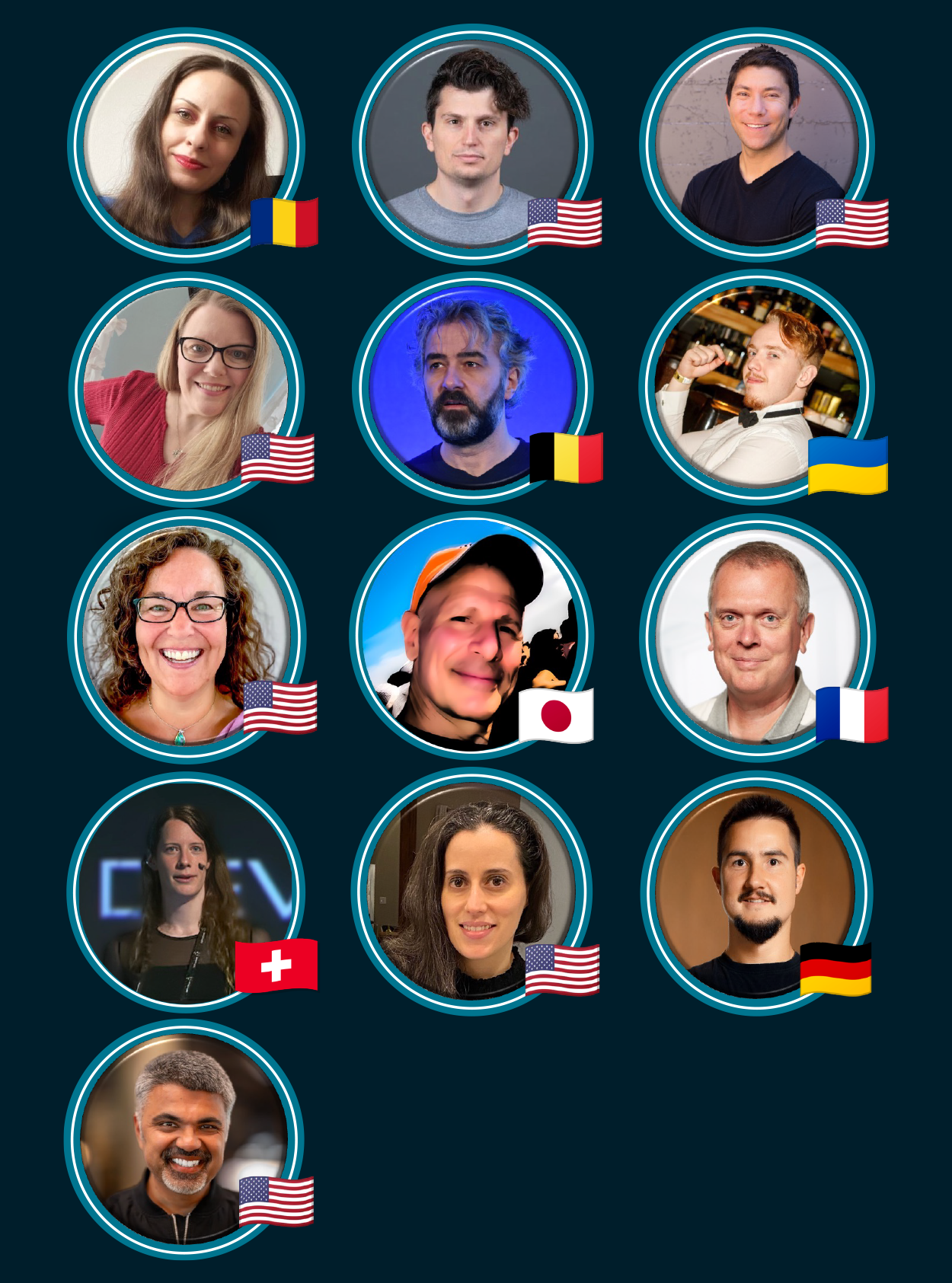
| Java DevRel Team |
|
Ana-Maria Mihalceanu
Billy Korando
Chad Arimura
Crystal Sheldon
David Delabassée
Denis Makogon
Heather Stephens
Jim Grisanzio
José Paumard
Lize Raes
Melissa Jacobus
Nicolai Parlog
Sharat Chander |
|
|
|
|
|