
Oracle/HCM ebook
Leadership capability has emerged as a constraint to growth in many organizations. In the “State of Succession” study, 84 percent of organizations reported that they lack ready leaders.(Brandon Hall, 2015)
For the first time since 1950, the workforce is contracting. Quite simply, companies are running out of workers. (Wall Street Journal, November 2015)
Introduction
They say that sometimes a picture is worth a thousand words. So let me start by sharing this picture:
Labor Shortage
Job openings are poised to surpass unemployed works for the first time on record.
US job openings on 3/31/18
US unemployed workers
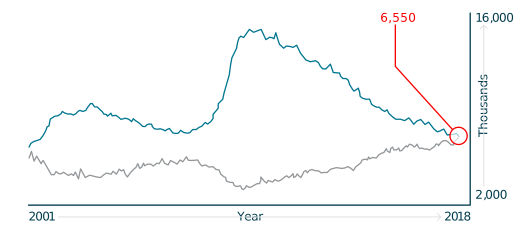
Source: US Department of Labor Statistics
In May 2018, Bloomberg reported on the latest state of the job economy. For the first time on record, job openings surpassed the number of unemployed workers. If you fast-forward to July 12, one day before June job numbers were reported, Ali Velshi, MSNBC, reported that we had 6.8 million open jobs but only 6.4 million people to fill them—and what existed was a mismatch of jobs to the available skills in the market, meaning that those available in the job market aren’t a fit for the job openings that exist.

This scenario does not improve in subsequent quarters or years. While we have somewhere between 6.8 and 7.2 million open jobs, by 2035 we will have an additional 8 million job openings (NBC news, July 2018). By the way, for those of you who track these predictions and trends, in 2009, Lee Branham predicted that we will be short by 15 million workers within 15 years. While the timing might have been off a bit, the reality of the shortage is the same—it was a warning and a prediction of the world to come. The patterns operationalize themselves on a monthly basis.


In April of 2018, 3.4 million people left their jobs and took a new role in a new company. This monthly number has been growing over the last two years, and now nearly 41 million people change jobs in a year. At the height of the recession, there were seven workers for every job. Fast-forward to July of 2014, there were two workers for every available job.


The Bureau of Labor statistics reported that we now have a 1:1 relationship—one worker for every open job. If the job market continues to grow, by the time we get to the end of 2018, there will be less than one available worker for every open job. The math problem of available people to open jobs is simply that: a numbers game. It has nothing to do with qualifications, fit, culture, or career. When you factor in any one of those areas or all of them, the available talent pool shrinks considerably.
The 2018 Deloitte Millennial Survey, reported that 44 percent of millennials will leave their current job within two years. This reinforces other workforce predictions that people now stay in a job for less than 18 months; researchers have stated that people stay in roles anywhere from 6 to 18 months.
In 2017, Gallup reported that 51 percent of workers were looking to leave their jobs. Because people can increase their salaries 30 percent just by switching companies, job hopping is gathering steam. It is important in this job economy to understand how often people are switching and why, because the financial impact of attrition is costly. Depending on job level, technical specialization, level, and availability of “hard to replace” talent, it can cost anywhere from 30 percent to a whopping 400 percent of a worker’s annual salary to replace an employee!
Another reason employees cite leaving their jobs is a lack of career development. Deloitte reported in 2010 that 86 percent of people leave a job for lack of development—and that number hasn’t changed. If it is easier to build a career at another company, people will favor the organization where career growth and personal development are possible.