Oracle Government Cloud DigiBook

How to Tackle the Federal IT Workforce Challenge


A range of data points have recently emerged that highlight the current shortfall among IT workers in general, as well as a significant demographic threat to the federal IT workforce in particular.
Across all industry sectors, there exists a profound shortage of capable technology workers. This is especially visible in the realm of security, where the high incidence of cyber attacks and the need for aggressive remediation have combined to put pressure on an already thin labor supply. In one recent report, US government agencies estimate a shortfall of 299,000 US cybersecurity professionals.1
Within the federal government, demographics compound the scarcity of talent. The federal workforce is aging: Analysis of OPM data shows that the number of government employees age 55 and over is more than quadruple the number of those under 30.2



The pending retirement of older workers will widen the existing talent shortage. These workers take away with them a deep understanding of complex, often idiosyncratic legacy systems, knowledge not easily replaced. Retirements will likely come in a big wave, the “tsunami” effect, rather than playing out over time, thus creating an urgent need to backfill.
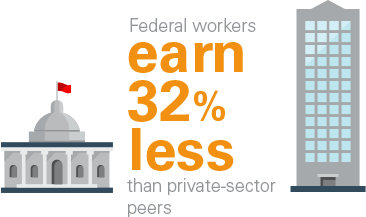
At the same time, competitive factors make it difficult for federal IT managers to attract and keep rising talent. Federal workers earn 32 percent less than private-sector peers on average, thus compounding the personnel challenge for government IT managers striving to entice top performers.3 Bureaucratic and time-consuming hiring processes also put federal managers behind the curve, as promising candidates get snapped up by industry’s more nimble HR systems.
The impact of this current and rising shortage of federal IT capabilities is widespread. In a key report, “Top Management and Performance Challenges Facing Multiple Federal Agencies,” a wide range of agencies including the Department of Defense (DOD), the Securities and Exchange Commission (SEC), and the Department of State all report difficulties in attracting and retaining top talent.4 On the technology side, areas potentially impacted by a skills gap may include the following:

Safeguarding sensitive data and information systems
Securing networks against cyberattacks and insider threats
Modernizing and managing federal IT systems
Ensuring continuity of operations