
to Modern EPM
Contents
|
0
|
Introduction page 3
Finance organizations have been tapped to lead the way to business transformation in a digital economy. Will outdated technology keep you from a successful journey?
|
|
1
|
Modern EPM: The Key to Your Business Transformation page 5
Transforming your business—growing a company to do more than react—requires flexibility in your systems. A modern, cloud-based EPM solution can help you move from strategic plans to exceptional results.
|
|
2
|
Top Signs It’s Time for Modern EPM page 7
Spreadsheet overload? Frustrated analysts? Reports that offer too little, too late? Successful organizations are transforming their business and embracing the benefits of a flexible, modern EPM solution.
|
|
3
|
Next Generation EPM: The Capabilities of the Right Solution page 9
As priorities evolve from day-to-day operations to forward-looking strategies, savvy leaders find results in modern EPM: accurate and agile plans, optimized financial close, and a focus on the innovation that distinguishes your business.
|
|
4
|
Putting the Enterprise in EPM page 11
Modern EPM transcends the finance department to include every area of your business. Whether in finance, sales, marketing, IT, HR, or operations, fact-based planning and informed decision-making are key to succeeding.
|
|
5
|
Why Oracle Is Your Best Choice for EPM page 14
Oracle offers a complete cloud platform with a full suite of EPM solutions along with proven products and an expertise not found from other vendors.
|
What Successful CFOs
Know That You Should Know Too

What is agile finance? It means that to survive and thrive, businesses must become increasingly agile—starting with the functions of their finance organizations. Corporate leaders—specifically, corporate finance leaders—have a critical role in transforming the business so that it can succeed in a digital economy.
 A 2017 study by the American Institute of Certified Public Accountants (commissioned by Oracle) found that finance leaders who practiced agile finance displayed certain attributes—attributes not shared by other financial leaders.
For example, the study showed that agile finance leaders were far more likely to have:

Introduction
There’s too much data, too many reports, too many systems, and too much complexity. At the end of the day, it adds up to a vote of no confidence—in the systems, in the reports, in the data, and ultimately, in the decisions.
In survey after survey, CFOs and other business leaders agree: the finance organization is key to better decision-making and to the future success of the business. But they also agree that current capabilities of most finance groups fall short of what’s needed to take on the challenges of a digital economy.
Savvy business leaders understand the wealth of benefits that a modern enterprise performance management (EPM) system represents, but may need help starting or navigating the journey.
To facilitate your transformation to a modern EPM solution, this guide shares some of the best practices and lessons learned from working with thousands of customers who have already made the journey—and are already reaping the benefits.
Agile finance leaders are:
89%
More likely to report positive revenue growth
95%
More likely to report increasing profitability
“Having an integrated system between ERP and EPM, and having it in the cloud, means that the gap between what’s facts—what’s here and
now—and how we project that, is almost down to zero.”
Modern EPM:
The Key to
Your Business
Transformation
As the demand for better insight and more-accurate information explodes, finance groups are facing the uncomfortable reality that legacy,
on-premises systems simply can’t keep up.
What’s needed is a cloud-based enterprise performance management (EPM) system that gives finance groups the flexibility, advanced analytics, and robust reporting that can help lead the business forward.
What Does EPM Bring to the Party?
The key to surviving disruption is flexibility.
Whether from external forces (such as new regulations or global weather events) or because of internal realities (one product skyrockets to success while another flops), an organization that responds quickly can stay ahead of the curve and the competition.
Helping business understand when, how, and where to adjust to disruptions is what a modern EPM solution does best.
and revenue.1
 Read the digibook
1 “Pushing the Frontiers—CFO Insights from the Global C-Suite Study,” IBM Institute for Business Value, 2014.
A Complementary Pair
When paired with enterprise resource planning (ERP) systems, modern EPM helps your organization manage around planned—and unplanned—changes in you business environment.
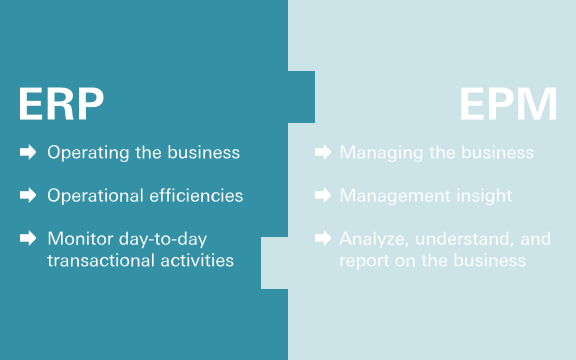
A modern EPM system links strategies to plans and execution. It monitors financial and operational results against goals, and applies analytics to help decision-makers understand key trends and drive higher performance across the enterprise.
and Oracle Enterprise Performance Management Cloud, we gained live data for approximately 100,000 fleet contracts, closed month-end reporting 50 percent faster, and cut our planning-cycle time.”
Top Signs It’s Time for Modern EPM
Research confirms that when finance organizations leverage the capabilities of a robust EPM system, they outperform businesses that are stuck with inflexible, highly customized, on-premises legacy systems. But how do you know if it’s time for your business to modernize?
force planning and budgeting organization. I would describe it mostly as spreadsheet gymnastics. We used tools like Outlook and Excel and Access, and we would do everything manually.”

A Perfect Storm of Corporate Reporting
Increases in the number of compliance standards means a growing demand for more reports. Companies are scrambling to find ways to satisfy the various reporting requirements—sometimes using more than 20 different reporting systems.
In “Are You Prepared for Corporate Reporting’s Perfect Storm?” global consultant EY surveyed 1,000 CFOs and heads of reporting to understand what challenges they face in today’s corporate environment.
The study identified challenges in three broad categories—backed up by rather startling statistics that will get the attention of anyone involved in the increasingly complex task of producing corporate reports:
More reports. The demand for reports has increased throughout the enterprise. Some 71 percent of those surveyed have seen an increase in the total number of reports required by their business, and 63 percent report an overall increase in the number of reporting standards.
Growing compliance requirements. Increased complexity in reports and reporting systems goes hand-in-hand with a growing number of reporting standards. Of the companies surveyed, 48 percent must comply with more than 10 reporting standards, and 33 percent have more than 16 standards with which they must comply.
Multiple reporting systems. Along with the increases in the complexity and number of reports comes an increase in the number of reporting systems used to create the reports. Of those companies surveyed, 32 percent used 16 or more systems for reporting—half of those (16 percent) actually used 20 or more reporting systems.
You Too?
Is your organization dealing with these same challenges? See how many of these sound familiar, and then check below to see what your score is telling you.
|
1
|
Spreadsheet overload Too many versions of too many templates mean too many spreadsheets. Which also means that you don’t have a “real” system—no checks and balances, no audit trails, and no workflow processes. What do you have? Broken links, bad formulas, and a lack of consistency among stakeholders and between versions. |
|
2
|
Patchwork reporting processes Too often reporting “solutions” are actually a piecemeal collection of legacy applications from a variety of vendors. Reports created by these solutions are usually difficult to produce and only partly integrated, and data from different departments doesn’t always align. Worse case? Inaccurate data and reports that don’t tell you what you need to know. |
|
3
|
Too little, too late reporting You need complete, timely reports for business insight and better decisions, and you need more of them to satisfy various compliance standards. But that kind of report takes a long time to generate, and when you finally finish all the acrobatics needed to consolidate information and produce the report, the data is …dated. |
|
4
|
Analysts without insight The good news is that you’ve hired the right people who can add value by bringing insight to the finance process. The bad news? Getting them the data and the tools they need to do their magic is—at best—difficult and time consuming. |
|
5
|
Rigid systems in changing environments Your organization could benefit from adopting cross-industry best practices and involving more stakeholders in finance and budgeting processes, but updating the current system is painful (is it even possible?) and expensive. And even then, you don’t have the new data you need. |
How does your organization score?
0-1 |
You understand the value of flexibility when it comes to EPM.A modern, cloud-based system could take your finance function to the next level and give you an edge over your competition. |
2-3 |
You’re probably not making the best use of your resources or getting everything you need from your reports. A modern, cloud-based EPM system would help your finance group be more productive and would provide better insight for decision-makers. |
4-5 |
Chances are your organization is spending too much time fighting fires and playing catch-up. A modern cloud-based EPM system could be your first step in getting the systems and flexibility you need to manage disruptions and keep your teams focused on the road ahead. |
Next Generation EPM: The Capabilities of the Right Solution
As your finance organization moves toward more forward-looking strategies for the business, the right EPM solution gives you the ability to drive accurate and agile plans, optimize the financial close, and focus on the innovation that distinguishes your business.
And, because EPM applications—such as budgeting, planning, and forecasting—are not part of the day-to-day operations, they make an ideal “first step” in your transformation to cloud.

Exorcising the Specter of Inconsistent Data

Choose your cliché.
A chain is only as strong as its weakest link. One bad apple spoils the whole bunch. Garbage in, garbage out.
As businesses grow and evolve (through mergers and acquisitions, departmental initiatives, or simply from legacy system proliferation), the number of data systems they have increases—as do the resulting information silos.
When the number of data sources grows, the organization’s manual change processes and integrations become brittle. Data consistency, data integrity, data quality, and data accuracy become suspect, and—ultimately—no one trusts the information and insight that ensues.
Managing the hierarchical master data for a business is essential to maintaining data integrity and critical to decision-making processes. With the right cloud-based enterprise data management system, you can gain:
Data Quality
Policy compliance
Repeatable business processes
Cross-functional collaboration
Change awareness
As you transform and modernize your business, be sure that your choice of a data management platform can flexibly maintain data integrity and build application alignment throughout the enterprise.
Watch the videoFrom Analysis to Action: The New Face of EPM
Now that you’ve sunsetted the spreadsheets, what’s next? What has EPM done for you lately?
Historically, EPM systems have focused on transitioning finance from spreadsheets to more robust solutions that let your team spend less time on low-value tasks (like data manipulation and reconciliations) and more time on high-value tasks (like analysis). But, even after you’ve made the move from spreadsheets, there’s still too much time between analysis and action, and most finance organizations feel that they don’t have enough time to engage with other departments.
Enter the new face of EPM—that incorporates innovations in technologies such as AI and machine learning.
Emerging technologies are closing this gap between analysis and action. These new capabilities help automate steps that can be done faster by a machine as compared to a human (such as pattern recognition) as well as find correlations in the data to provide insight that a human would have difficulty accomplishing within a reasonable amount of time.
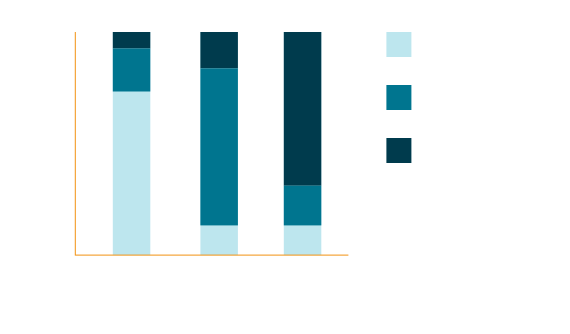
This next generation of EPM moves from analysis to action much faster and with better insight than analysts could easily find on their own. As a result, finance organizations can spend more time in the high-value activities of engaging with operations.
Do What You Do…But Better
For finance organizations to excel, they need world-class planning as well as financial close and reporting capabilities—all guided by proven best practices, and all accessible through the innovation and simplicity of a unified cloud experience.
Modern, cloud-based EPM helps you do everything you need to do—with a new confidence that the resulting data and insight are accurate, up-to-date, complete, and accessible.
Optimize the financial close
In today’s changing regulatory environment, you need to adapt quickly to new requirements and deliver faster, more-accurate insights to all stakeholders. Streamline the financial close, and report with confidence and insight.
Drive accurate and agile integrated plans
Say goodbye to disconnected spreadsheets, manual processes, and fragmented reports. Align planning across the enterprise, so that you can develop agile forecasts for all lines of business and respond faster and more effectively to change.
Satisfy all your reporting requirements
There’s no need for multiple reporting systems with the right EPM solution. No matter how many reporting standards you have to comply with, you can be sure that the data you provide in your reports is accurate, complete, and up-to-date.
Manage change with enterprise data management
Whether you’re migrating applications to the cloud, managing applications in a hybrid environment, or spearheading major business and financial transformation, an enterprise data management platform in the cloud helps ensure data accuracy and integrity with the alignment of your data and master data.
Read more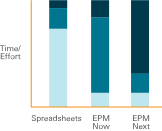 The first generation of EPM worked to replace spreadsheets and enable analysis. The next generation of EPM minimizes the analysis phase to enable faster decision-making with intelligent performance management.
Putting the Enterprise
in EPM
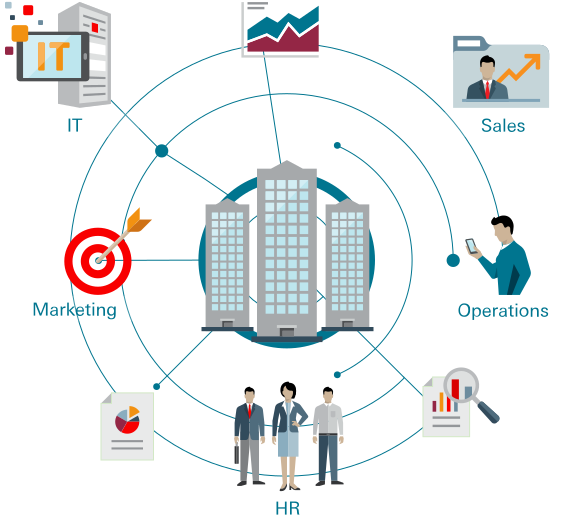
EPM transcends the finance department and brings fact-based planning and informed decision-making to every area of your business—from sales and marketing to IT, HR, operations and beyond.
When competing at today’s speed of business, you want collaborative processes that connect the dots between operational and financial data—there’s no time for disconnected spreadsheets and manual processes.
You need a solution that easily brings together diverse data sources from across the organization, letting your team analyze and predict alternative scenarios without missing a beat. And—with the right vendor—you can even continue to use your existing legacy system in combination with your modern cloud solution.
Zero-Based Budgeting: Investing for Profitable Growth

Zero-based budgeting (ZBB) applications are becoming increasingly popular—not just for companies in industries focused on cost-cutting, but for any company, in any industry, that wants to understand what they are spending, and why.
ZBB helps answer questions about why the organization is spending—on a certain area, program, project, or any aspect of the business—so that the business can deploy resources and financial assets more strategically. ZBB relies heavily on what drives costs as well as the assumptions behind those drivers. It is a collaborative effort that uses bottom-up planning along with top-down targeting to achieve the desired results.
Instead of relying on historic spending data to forecast budgets, ZBB has all stakeholders start at zero and build budgets based solely on costs while justifying the need.
Unfortunately, for many organizations, the sheer volume of information involved in creating a budget starting at zero is simply too overwhelming to justify this approach.
Until now.
With the availability of modern, cloud-based EPM solutions, new technologies can now easily integrate and manage the huge amounts of data needed for ZBB and speed up processes. And, by providing centralized and standardized access to up-to-date operational data and collaborative workflows, these modern EPM solutions enable participation from stakeholders at all levels of the organization—enabling smarter investment decisions leading to profitable growth.
Read MoreSee how Kraft Heinz used zero-based budgeting in a cloud-based EPM system to improve their planning accuracy and significantly reduce IT management costs.
EPM Meets IT
Today’s CIOs are under pressure to perform an extreme balancing act between business innovation and operational excellence. On the one hand, IT leaders want to leverage innovation and technology to create new revenue streams and build better customer relationships. On the other hand, they are still responsible for “keeping the lights on” and maintaining day-to-day operations.
Oracle IT Financial Management Cloud lets you provide transparency for shared services, optimize IT investment decisions, and promote partnerships within the business so that IT can run and grow the business.
Learn more: Read the Oracle IT Financial Management Cloud solution brief.
Download the briefEPM for Sales Planning
In today’s fast-paced sales environments, territories and scenarios are constantly changing. You must be able to respond quickly or risk losing revenue—which is why optimizing your sales planning processes is so important.
There’s a significant need to innovate and drive performance improvement within sales operations, but in many companies, corporate sales planning and forecasting is still being managed with disconnected spreadsheets.
Combining Oracle Planning Cloud for Sales Performance with your sales force automation applications can help remove risk by providing predictive forecasts with more accurate results. Extensive modeling capabilities ensure higher achievement of targets to make planning more accurate; rich analytics provide deeper insight for more informed decision-making.
Learn more: Download the Sales Planning Improves Sales Performance Management white paper.
Download the white paperRead the Report: Modern Sales Operational Planning Delivers Better Results.
Read the report81%
of companies identify sales-forecast inaccuracy as the primary cause of poor financial performance.
EPM for Strategic Workforce Planning
Corporate strategy is only as good as the organization’s ability to execute, so modern HR has taken on the responsibility of working with finance and lines of business (LOB) to make sure that the company has the workforce to deliver.
By aligning your HR strategy with corporate and LOB priorities, you can plan for having the right people with the right skills ready at the right time—and for the right price.

Looking for the sweet spot in your workforce planning? Download A New Era of Workforce Planning.
Download the white paperRead more about finding the right workforce for the future. Download the Oracle whitepaper.
Download the white paperDownload Finance and HR: The Cloud’s New Power Partnership, An MIT Technology Review.
Download the white paperWhy Oracle Is Your Best Choice for EPM
Oracle’s modern EPM solutions meet the requirements that today’s finance groups require. Flexibility, lower costs, and better access for more contributors with collaboration and social features along with advanced, built-in analytics—it’s the whole package…and it’s all from Oracle.

Oracle Planning Cloud
Take a look at some of the ways Oracle customers have transformed their businesses with Oracle Planning in the cloud.
St John Ambulance Western Australia Halves Reporting Time with Oracle EPM Cloud
View the customer success storyAustralian Finance Group Triples Innovation Capacity with Oracle Cloud
View the customer success storyNorwegian Nurses Organization Streamlines Budgeting Process with EPM Cloud
View the customer success storyGet Ahead of the Curve with Oracle
Learn More about Oracle Planning CloudReady, Let’s go!
Start your journey to cloud with global EPM from Oracle.


Talk to an Oracle sales representative
USA: +1 800 633 0738
Canada: +1 800 363 3059
UK: +44 207 5626 822
Australia: +61 1300 366 386
New Zealand: +64 0508 555 215
India: +91 80 6786 2950
South Africa: +27 11 319 4550
Elsewhere: oracle.com/corporate/contact

