
AI Data Platform agents
Oracle AI Data Platform gives teams one place to build, deploy, and govern enterprise AI agents alongside the data they need. Using AI Data Platform’s workbench, developers and domain experts can create agentic workflows visually or in code; connect agents to enterprise data, knowledge, models, and tools; test every step; and deploy to production on managed AI compute with built-in identity, controls, and observability.
Why Oracle AI Data Platform agents?
-
One platform, two ways to build
Use a drag-and-drop visual canvas or build with Python, the AI Data Platform SDK, utilities, and notebooks. Both paths share the same tools, MCP connectivity, testing environment, compute, and route to production.
-
Connect agents without bespoke integration
Give agents governed access to SQL, RAG knowledge bases, prompt templates, custom code, HTTP APIs, and remote MCP servers instead of rebuilding every connection for each project.
-
Move from prototype to governed production
Test agent behavior in the integrated playground, deploy on managed AI compute, protect invocation with role-based access control or OAuth, and monitor sessions, traces, activity, and usage.
Explore agents and agentic development in AI Data Platform
Building enterprise AI agents often stalls at three points: specialist skills, bespoke tool integration, and the infrastructure required for production. AI Data Platform addresses those barriers in one governed environment, so teams can build the agent and its supporting workflow beside the data, knowledge, models, and controls it needs.
Design and compose agents
Visual agent canvas
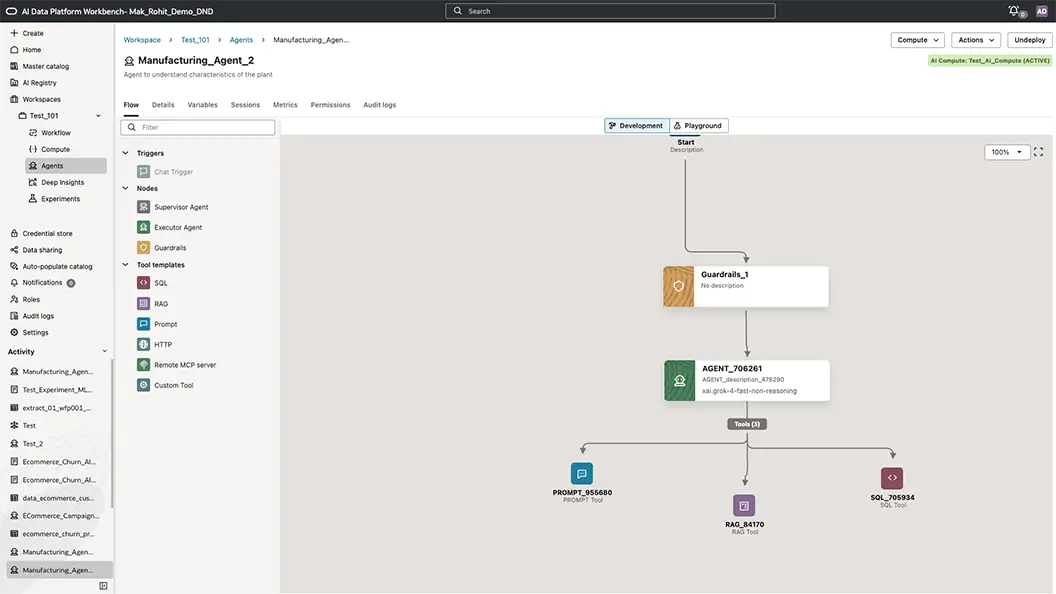
Build flows by dragging chat triggers, supervisor agents, executor agents, guardrails, and tool nodes onto the canvas and connecting the path a request should take.
Single- and multi-agent design
Start with the smallest design that meets the need, or use a supervisor to plan, route, and delegate work to focused specialist agents when separation improves reliability, security, or maintainability.
Guardrails and bounded behavior
Apply personally identifiable information (PII), content-moderation, and prompt-injection controls, and restrict each agent to the instructions, memory policy, data, and tools appropriate to its role.
Build with code
Python SDK and utilities
Develop agents in the AI Data Platform workbench using Python, platform utilities, notebooks, and the same model and tool capabilities available to visual flows.
Bring your LangGraph code
Upload an existing LangGraph codebase or create a new LangGraph agent directly in AI Data Platform, with entry files and dependencies managed as part of the agent project.
Open development choices
Use supported Oracle Cloud Infrastructure (OCI) Generative AI models and third-party Python libraries while keeping the agent connected to AI Data Platform data, tools, testing, and deployment services.
Connect agents to enterprise knowledge and action
Built-in tool templates
Use SQL, RAG, prompt, custom code, and HTTP tools for structured queries, document retrieval, reusable generation tasks, bespoke Python logic, and calls to enterprise APIs.
Knowledge bases and RAG
Register document sources, chunk and embed supported files with Oracle AI Vector Search, and retrieve semantically relevant content through agent RAG tools.
Remote MCP connectivity
Connect visual or code-built agents to supported remote MCP servers, expose only the required tools and parameters, and reuse existing services and governed workflows, including human approval steps where the connected system provides them.
Test, deploy, and operate
Integrated playground and testing
Run test conversations, test individual tools, and inspect how agents route requests, call tools, and produce results before deployment.
Managed AI compute and deployment
Use AI compute for the playground and production hosting, then expose deployed agents through stable, authenticated endpoints for applications and supported agent-to-agent communication.
Observability and lifecycle control
Review session history, traces, spans, status, duration, token usage, metrics, errors, and deployment activity across development and production, with permissions and session-retention controls defined by you.
See AI Data Platform agents in action
A unified platform for building, managing, and deploying enterprise AI.
Design and compose multiagent systems in a visual drag-and-drop canvas. Connect prompts, SQL tools, RAG knowledge bases, and multiple specialist agents, and then deploy on managed AI compute.
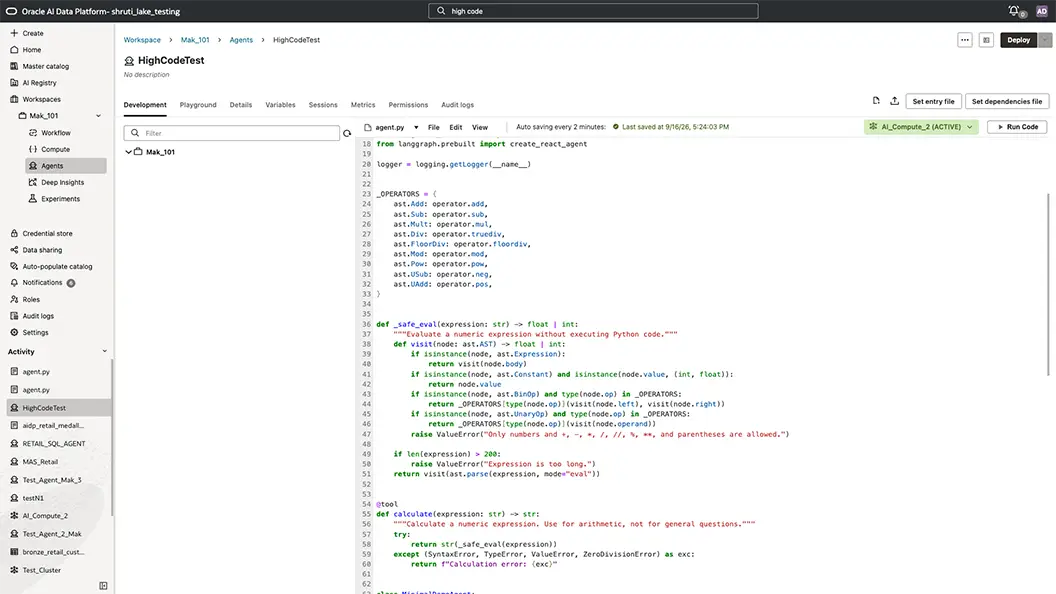
High-code agent development with full platform power.
Build agents in Python with AI Data Platform SDK and the open source frameworks your team already uses. Develop, version, and deploy agents alongside shared data, tools, and enterprise controls.
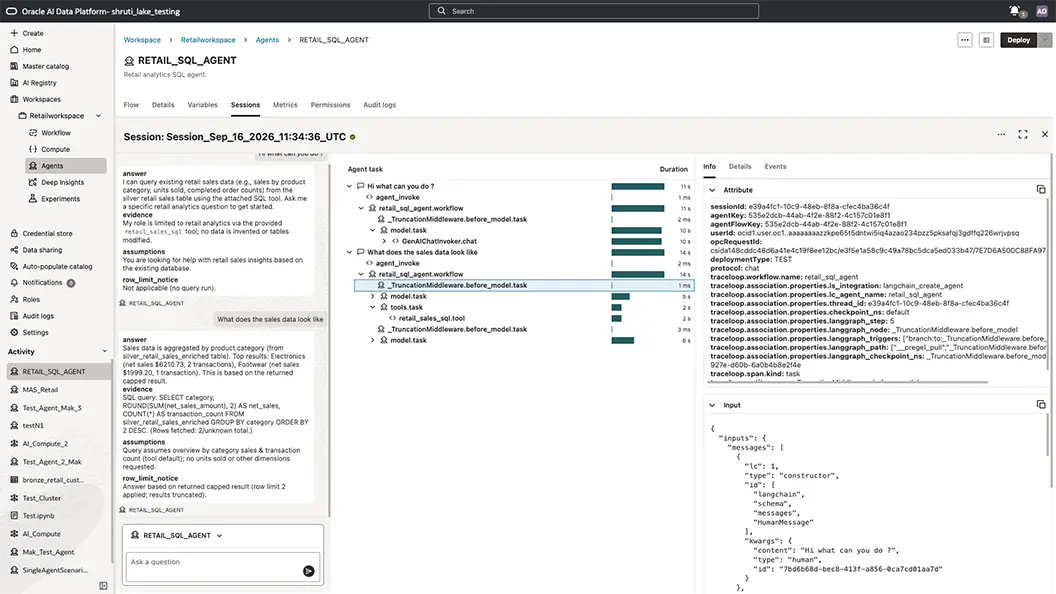
End-to-end observability built into the platform.
Monitor each agent session with detailed visibility into tool calls, reasoning, inputs, outputs, status, duration, and step-level events. Track latency, token usage, error rates, and business KPIs from development through production.
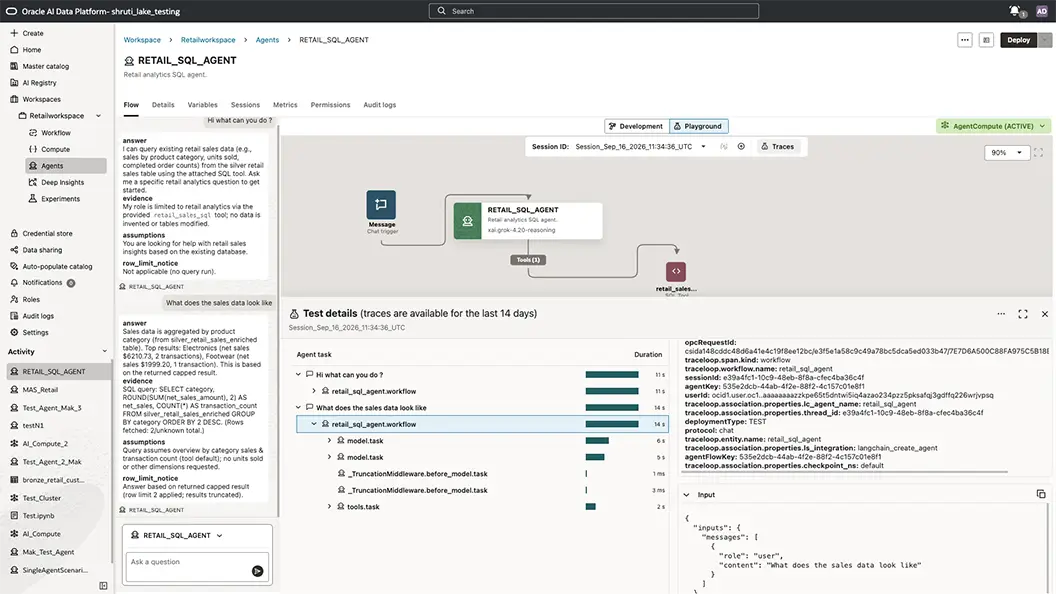
Flexible agent building, testing, and debugging with traceability and an integrated playground.
Test agents interactively before deployment and inspect each step of their execution in the integrated playground. Use session traces to debug behavior, validate outputs, and maintain a complete audit trail across environments.
추천 AI Data Platform 블로그
에이전트 vs. 워크플로: ROI는 실제로 어디에서 발생할까요?
대부분의 기업이 AI 에이전트 도입에 실패하는 이유는 기술 때문이 아니라, 단순한 워크플로로 더 잘 처리할 수 있는 업무에 에이전트를 사용하고 있기 때문입니다. 이 블로그에서는 워크플로와 자율형 에이전트의 주요 차이점과, 올바른 접근 방식을 선택하는 것이 ROI, 확장성, 거버넌스 및 비용에 어떤 영향을 미치는지 설명합니다. 또한 에이전틱 AI가 실제로 투자할 가치가 있는지 판단할 수 있는 실용적인 프레임워크를 제공합니다.

-
2026년 5월 12일
인프라 엔지니어로 계약하신 건 아니잖아요
-
2026년 2월 13일
Enterprise AI의 3가지 구성 요소
-
2025년 12월 8일
Oracle AI Data Platform 여정 시작하기