Oracle Cloud Migrations for VMs
Oracle Cloud Migrations enables migrations from both on-premises VMware estates and AWS EC2 VMs to OCI Compute virtual machines, helping reduce costs while maintaining performance.
Choose your VMware migration path
Your VMware strategy can include different migration paths. Choose the one that fits your priorities today and where you want to go next.
Path 1: Keep VMware operations with Oracle Cloud VMware Solution
Move VMware workloads as they are to Oracle Cloud VMware Solution with minimal operational change while maintaining familiar VMware tools, skills, and processes.
Path 2: Replatform to native OCI Compute
Move eligible workloads off VMware and onto the OCI services that best fit them—from OCI Compute for virtual machines to containers and Kubernetes with OCI Kubernetes Engine. Reduce VMware dependency while modernizing at your own pace.
Not sure which path is right for you? Talk with an Oracle expert to assess your VMware environment and determine the right approach.
Why Oracle Cloud Migrations?
-
Migrate VMs from AWS and VMware environments
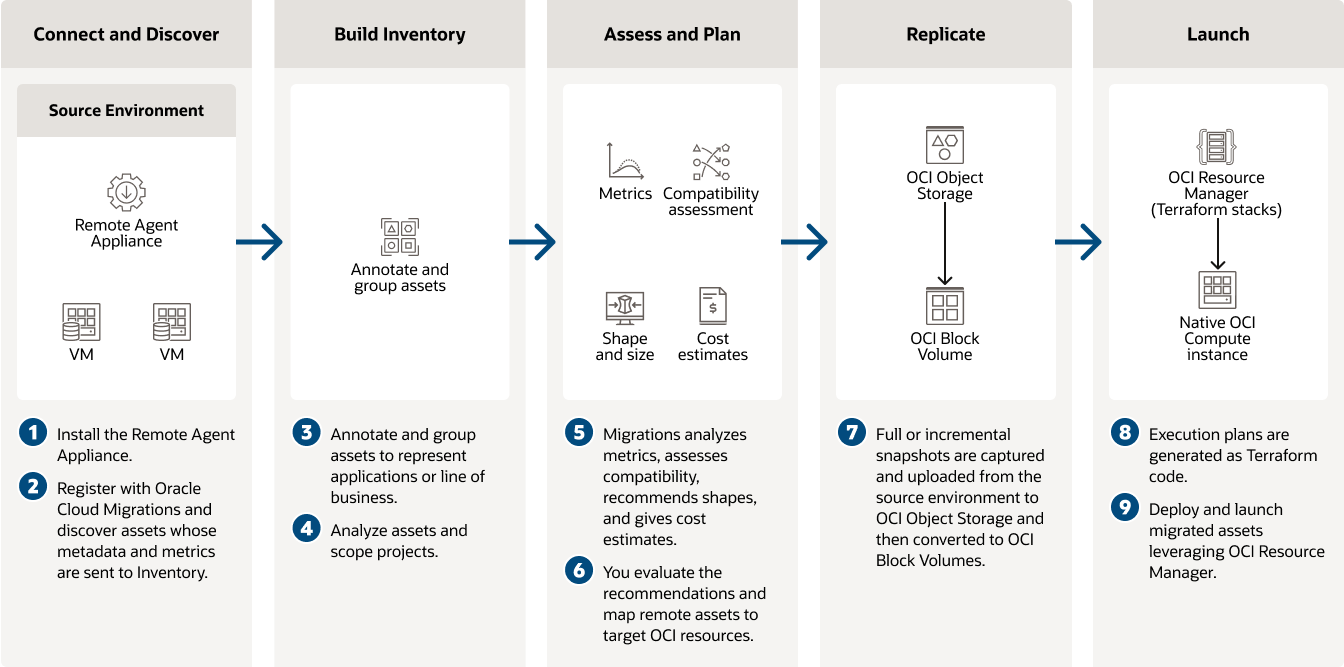
Oracle Cloud Migrations supports migrations from both on-premises VMware estates and AWS EC2 VMs in the cloud to OCI Compute virtual machines.
-
Fully managed with automated assets discovery
Automatically discover virtual machines external to OCI. Organize the virtual machines for migration and replicate their data to OCI Compute.
-
Assess compatibility and plan cost scenarios
Assess compatibility with OCI Compute shapes and sizes, estimate cost, and explore price and performance for different deployment scenarios.
-
Migrate with end-to-end visibility and control
Migrate workloads with supported guest operating systems to OCI. Autogenerate execution plans. Deploy and launch OCI resources leveraging Oracle Cloud Infrastructure Resource Manager.
How Oracle Cloud Migrations works
More flexibility for your VMware strategy
-
01Keep what works
Move VMware workloads to Oracle Cloud VMware Solution with minimal operational change while maintaining familiar VMware tools, skills, and processes. Keep control of your environment today while creating room to evolve your cloud strategy over time.
-
02Reduce VMware dependency
Replatform eligible VMware workloads to native OCI Compute when you’re ready to move away from VMware licensing. Run workloads on OCI while reducing the licensing requirements associated with maintaining a VMware environment.
-
03Modernize on your timeline
Your migration strategy can vary by workload. Choose the approach that fits each workload and your priorities today, with the flexibility to adopt native OCI services over time as your application and business requirements evolve.
Find the right path for your VMware estate
Every VMware environment is different. Talk with an Oracle expert about your workloads, operational priorities, and modernization goals to determine the migration approach that fits your business.
Oracle Cloud Migrations resources
-
Plan your next step
Get started with Oracle Cloud Migrations
Try 20+ Always Free cloud services, and start a 30-day trial for even more
Oracle offers a Free Tier with no time limits on more than 20 services, including Oracle Autonomous AI Database Arm Compute, and storage, as well as US$300 in free credits to try additional cloud services. Get the details and sign up for your free account today.
-
What’s included with Oracle Cloud Free Tier?
- Two Autonomous AI Database instances, 20 GB each
- AMD and Arm Compute VMs
- 200 GB total block storage
- 10 GB object storage
- 10 TB outbound data transfer per month
- 10+ more Always Free services
- US$300 in free credits for 30 days for even more
Contact sales
Interested in learning more about Oracle Cloud Infrastructure? Let one of our experts help.
-
They can answer questions such as
- What workloads run best on OCI?
- How do I get the most out of my overall Oracle investments?
- How does OCI compare to other cloud computing providers?
- How can OCI support my IaaS and PaaS goals?