Datenbank mit PostgreSQL
Der innovative verwaltete PostgreSQL-Service von Oracle, OCI Database with PostgreSQL, kombiniert modernste Open-Source-Technologie mit der Robustheit und Geschwindigkeit von Oracle Cloud Infrastructure (OCI). Oracle nutzt das Potenzial beider, um mit OCI Database Optimized Storage eine höhere Leistungsfähigkeit zu bieten.
Gründe für OCI Database with PostgreSQL
Oracle ist der einzige Cloud-Provider, der vollständig in seiner eigenen Cloud ausgeführt wird (Infrastruktur, Datenbank und Anwendungs-Cloud).
60 %
Weniger kostspielig
3X
schneller als ein selbstverwaltetes Cluster1
99,99 %
SLA für Verfügbarkeit
Preis-Leistungs-Verhältnis
60 % kostengünstiger und bis zu dreimal so leistungsstark wie eine Standard-PostgreSQL-Bereitstellung – dank des einzigartigen Database Optimized Storage.
Vielseitig und erweiterbar
Verfügt über eine einzigartige Kombination aus RDBMS und nicht-relationalen Operationen sowie Erweiterungen, die daraus eine Geodatendatenbank, eine Zeitreihendatenbank oder sogar eine Vektordatenbank für generative KI machen können.
Vollständig verwaltet
Optimiert die Datenbankskalierung und -wartung und bietet eine problemlose Einrichtung und automatisierte Verwaltung in einem vereinfachten, effizienten Service.
1. Leistungsvergleich zwischen denselben Konfigurationen für OCI Database with PostgreSQL und nicht verwaltetem Standard-PostgreSQL auf OCI. Die Architektur basiert auf gemischten Workloads auf einem Primärrechner mit 6 Knoten mit 16 OCPU, 256 GB RAM und VM.Standard.E4.Flex-Ausprägung und PostgreSQL-Version: 14.9.
Datenbank mit PostgreSQL – Kundenerfolge



How OCI Database with PostgreSQL works
OCI Database with PostgreSQL is a top-tier managed service that frees up your team from routine tasks, such as patching and backups. Its standout feature is OCI Database Optimized Storage, which boosts system resilience and performance. Additionally, this architecture allows for independent scalability of compute and storage. OCI Database with PostgreSQL also provides enhanced data security with end-to-end encryption.
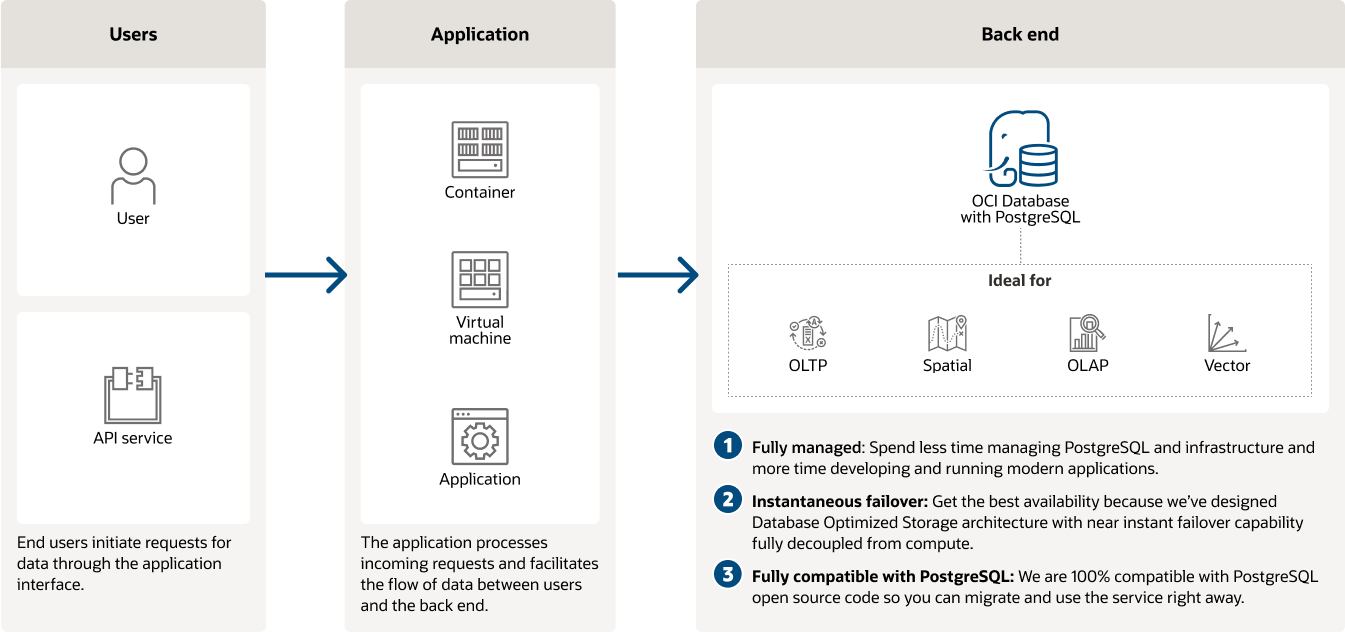
The image is an infographic showing a workflow from users to application to backend. Users interact with an API service, which connects to an application running on containers or virtual machines. The application then interfaces with the backend, specifically the OCI Database with PostgreSQL, which is suited for OLTP, Spatial, OLAP or Vector workloads. Key benefits highlighted include a fully managed service, instantaneous failover for high availability, and full compatibility with PostgreSQL for easy migration and immediate use.
- 1. Users Section:
- Contains two icons: One of a person labeled "User" and another that looks like interconnected blocks labeled "API service".
- Beneath it, a caption reads: "End users initiate requests for data through the application interface."
- 2. Application Section:
- Contains three icons: A box filled with smaller boxes labeled "Container", a simple box with features that make it resemble a computer screen labeled "Virtual machine", and a gear icon labeled "Application".
- Caption below mentions: "The application processes incoming requests and facilitates the flow of data between users and the back end."
- 3. Back end Section:
- Showcases a database icon with the label "OCI Database with PostgreSQL".
- Below it, there's a dotted box titled "Ideal for" with four icons inside: One that represents "OLTP", another for "Spatial", another for "OLAP" and a fourth for "Vector".
- 4. Three Key Points on the right side of the image:
- Fully managed: Text says, "Spend less time managing PostgreSQL and infrastructure and more time developing and running modern applications."
- Instantaneous failover: Describes an architecture with near instant failover capability decoupled from compute.
- Fully compatible with PostgreSQL: Emphasizes 100% compatibility allowing easy migration and immediate service usage.
The image provides an organized and visual representation of how users interact with an application and how the data flows to the back-end OCI Database with PostgreSQL.
OCI Database mit PostgreSQL-Cloud-Architektur kennenlernen
Sehen Sie sich an, wie Chief Technical Architect Pradeep Vincent die OCI Database mit der Cloud-Architektur PostgreSQL durchgeht und wie diese eine hohe Performance ohne RPO sowie Effizienz für Unternehmens-Workloads bietet.
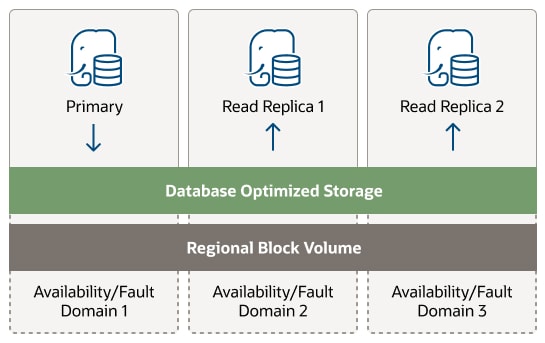
OCI’s unique disaggregated storage architecture with Database Optimized Storage
- Optimized workloads: Compute nodes focus on database tasks such as query processing and optimization. The storage nodes also have low-level optimizations that greatly improve transaction rate while reducing latency.
- Enhanced reliability: Independent failure of compute or storage nodes ensures data safety. Even if a compute machine fails, data remains secure in the storage cluster.
- Quick recovery: In a multi-node database system, if the primary node becomes unreachable, another node would be promoted as the primary node and connect to the existing storage without data loss.
- Scalability: Decoupling compute and storage paves the way for independent scaling, accommodating varied demands and growth.
OCI Database mit PostgreSQL stärkt Disaster Recovery und Erweiterbarkeit
Devneel Vaidya, Sr. Principal Product Manager, OCI Data and ServicesKaran Singh, Director Product Management, Data and AI
Julien Lehmann, Product Marketing Director, Oracle Modern Data Platform
Um Unternehmen dabei zu unterstützen, ihre geschäftskritischen Daten besser zu schützen und die Möglichkeiten von PostgreSQL zu erweitern, freuen wir uns, OCI Database mit PostgreSQL Backup Copy vorzustellen. Diese Funktion ermöglicht eine nahtlose Backup-Replikation über Regionen hinweg und verbessert damit das Disaster Recovery. Zusätzlich erweitern wir das Potenzial von PostgreSQL durch neue Erweiterungen – PostGIS und pglogical – für erweiterte Geodatenanalysen und eine effizientere Datenreplikation.
Vollständigen Beitrag lesenAusgewählte Blogs
- 14. November 2023First Principles: PostgreSQL für die Cloud optimieren
- 19. September 2023Erleben Sie mit OCI Database with PostgreSQL das Beste aus PostgreSQL
- 19. September 2023 Oracle erweitert seine Cloud-Services um neue Open-Source-Datenmanagementlösungen
Erste Schritte mit Database with PostgreSQL
Mit schrittweiser Anleitung lernen
Folgen Sie diesen Schritt-für-Schritt-Anleitungen, um das Beste aus den Oracle Cloud Infrastructure Services herauszuholen.
-
Bereitstellung einer von OCI verwalteten PostgreSQL-Datenbank mit dem PostgreSQL-Service über Terraform
Erfahren Sie, wie Sie mit einem Terraform-Skript drei Knoten eines von OCI verwalteten PostgreSQL-Datenbanksystems in einer OCI-Cloud-Umgebung bereitstellen und über eine Compute-Instanz privat darauf zugreifen.
Tutorial ansehen – Tutorial zur Bereitstellung einer von OCI verwalteten PostgreSQL-Datenbank mit Terraform -
Daten mit PostgreSQL aus einer On-Premise-PostgreSQL-Datenbank in eine OCI-Datenbank migrieren
Erfahren Sie, wie Sie Daten mithilfe von pg_dump aus einer On-Premises-PostgreSQL-Datenbank einer bestimmten Hauptversion exportieren und in eine andere PostgreSQL-Datenbank auf OCI importieren.
Tutorial ansehen – Tutorial zur Migration von Daten aus einer On-Premises-PostgreSQL-Datenbank zur OCI-Datenbank mit PostgreSQL -
Mit pgAdmin 4 über einen privaten Endpunkt eine Verbindung zur OCI Database with PostgreSQL herstellen
Erfahren Sie, warum pgAdmin 4 ein nützliches Tool für routinemäßige Verwaltungsaufgaben mit PostgreSQL ist.
Tutorial ansehen – Tutorial zur Verbindung von pgAdmin 4 mit der OCI Database with PostgreSQL über einen privaten Endpunkt -
OCI Database with PostgreSQL sichern und wiederherstellen
Erstellen, planen und stellen Sie Backups einer OCI Database with PostgreSQL wieder her.
Tutorial ansehen – Tutorial zum Sichern und Wiederherstellen einer OCI Database with PostgreSQL -
Verbindung zu Oracle Cloud Infrastructure Database mit PostgreSQL über Oracle Analytics Cloud herstellen
Verbinden Sie OCI Database with PostgreSQL mit Oracle Analytics Cloud.
Tutorial ansehen – Tutorial zur Verbindung mit Oracle Cloud Infrastructure Database mit PostgreSQL über Oracle Analytics Cloud -
Verbindung zu Oracle Cloud Infrastructure Database mit PostgreSQL über DBeaver herstellen
Erfahren Sie, wie Sie mit einem Datenbankverwaltungstool wie DBeaver eine Verbindung zur OCI Database with PostgreSQL herstellen.
Tutorial ansehen – Tutorial zur Verbindung mit Oracle Cloud Infrastructure Database mit PostgreSQL über DBeaver -
OCI Email Delivery Service mit OCI Functions, OCI Object Storage, OCI Vault und OCI Database with PostgreSQL integrieren
Erfahren Sie, wie der OCI Email Delivery Service eingesetzt wird, um den E-Mail-Versand zu optimieren und die Automatisierung sowie Zuverlässigkeit in E-Mail-Versandprozessen zu verbessern.
Tutorial ansehen – Tutorial zur Integration des OCI Email Delivery Service mit OCI Functions, OCI Object Storage, OCI Vault und der OCI Database with PostgreSQL
Mehr als 20 kostenlose Cloud-Services mit einer 30-tägigen Testversion für noch mehr
Oracle bietet ein Free Tier ohne zeitliche Begrenzung für eine Auswahl von mehr als 20 Services wie Autonomous AI Database , Arm Compute und Storage an. Darüber hinaus erhalten Sie 300 US-Dollar an kostenlosen Credits, um zusätzliche Cloud-Services zu testen. Informieren Sie sich über die Einzelheiten und melden Sie sich noch heute für Ihr kostenloses Konto an.
-
Was ist im kostenlosen Oracle Cloud-Kontingent enthalten?
- 2 Autonomous AI Database-Instanzen mit jeweils 20 GB
- AMD und Arm Compute-VMs
- Insgesamt 200 GB Blockspeicher
- 10 GB Objektspeicher
- 10 TB ausgehende Datenübertragung pro Monat
- Mehr als 10 permanent kostenlose Services
- Kostenlose Credits im Wert von 300 US-Dollar, 30 Tage lang noch mehr
Vertrieb kontaktieren
Möchten Sie mehr über die Oracle Cloud Infrastructure erfahren? Einer unserer Experten wird Ihnen gerne helfen.
-
Sie können Fragen beantworten wie:
- Welche Workloads werden am besten auf OCI ausgeführt?
- Wie kann ich meine gesamten Oracle Investitionen optimal nutzen?
- Wie schlägt sich OCI verglichen mit anderen Cloud-Computing-Anbietern?
- Wie kann OCI Ihre IaaS- und PaaS-Ziele unterstützen?