What Is Composite AI?
Jeffrey Erickson | Senior Writer | November 6, 2025

Think of composite AI like a great sports team—each player has unique strengths, and together they create something truly impressive. Similarly, AI models are specialists: Some are experts at understanding language, others excel at finding patterns, and a few are brilliant at applying logic. When these different models collaborate, you get a solution that’s far more powerful than any individual player. Let’s break down what makes composite AI special.
What Is Composite AI?
Composite AI is a methodology that brings together multiple artificial intelligence techniques—such as machine learning, natural language processing (NLP), knowledge graphs, and rule-based reasoning—to tackle tough, real-world business problems. By blending the strengths of techniques, such as statistical, symbolic, and knowledge-based, into a single solution, businesses can take on challenges that are too complicated or nuanced for a lone AI model to manage alone.
Key Takeaways
- Composite AI combines multiple AI techniques, including machine learning, NLP, knowledge graphs, and rule-based reasoning, into a single system to achieve a specific outcome.
- The goal of a composite AI solution is simple: Deliver results that are nuanced, reliable, and easy to explain.
- Building composite AI solutions requires a platform that supports different types of AI models and helps unify your data.
Composite AI Explained
Most AI systems stick to one main technique, and that comes with both strengths and weaknesses. For example, machine learning models might be great at recognizing patterns in images but aren’t always transparent. Rule-based systems are clear and easy to audit but inflexible when things change. Composite AI bridges these gaps by letting each technique do what it does best. One example: Combine rules for compliance, machine learning for adaptability, and a knowledge graph for understanding context. The end result is a solution that’s both strong and trustworthy.
Imagine a conversational AI agent helping users at a service desk. It could use a neural language model to understand what people want, rules to automate tasks, and a searchable knowledge base with company information. This creates an AI assistant that not only “gets” what a user means but also learns, reasons, and finds quality answers by drawing on real company resources.
This approach isn’t limited to service desks—it’s also valuable for fraud detection, compliance automation, and predictive maintenance.
Why Is Composite AI Important to Businesses?
Businesses are discovering the limits of using just one AI model and a limited roster of techniques. Composite AI expands teams’ horizons, helping them make decisions faster, use resources better, and stay flexible. When data changes or new requirements pop up, it’s easier to add or tweak components rather than starting from scratch.
Composite AI is of special interest to businesses that demand trustworthy, explainable automation because it can offer built-in defensibility. For regulated businesses, composite AI supports the need for results that are accurate, reliable, and auditable. It’s not just about boosting performance—it’s about being able to show your work. Composite AI opens possibilities for automation, agentic technologies, and more.
How Does Composite AI Work?
What makes composite AI tick? It all comes down to mixing various AI techniques together. These can include machine learning, symbolic reasoning, knowledge representation, and more. The composite AI architectures layer these different techniques, allowing each one to contribute its strengths. This collaboration happens through thoughtful system design. Data flows through multiple components, each performing specific tasks: Natural language processing modules might extract meaning from unstructured text, knowledge graphs provide rich contextual links, and reasoning engines apply business logic or regulatory rules.
Composite AI orchestrates elements so that their combined efforts produce better results than any individual AI technique could achieve alone. Composite systems can also take on more complex tasks than a single AI model could.
8 Key Components of Composite AI
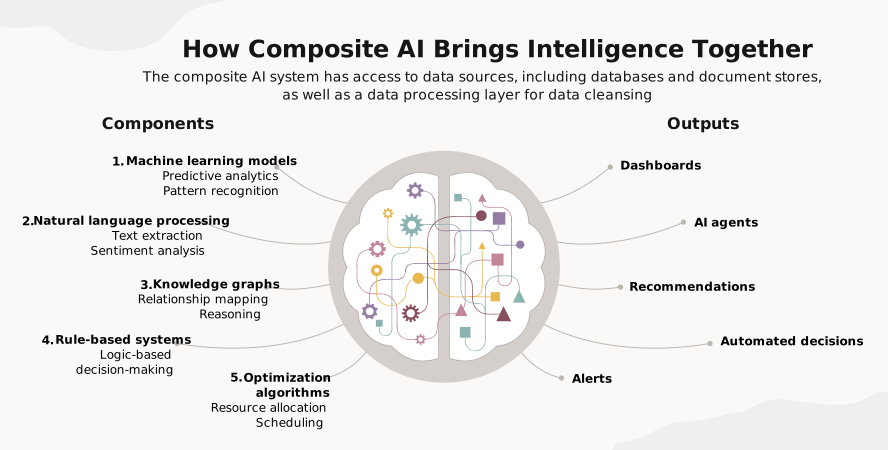
Composite AI systems are adaptive and modular. This lets organizations incorporate new data sources or update components, including new generative AI models, without redesigning the entire application. Components that are often part of composite AI systems include
1. Machine learning: Machine learning allows composite AI systems to learn from historical data, uncover nonobvious patterns, and make predictions or recommendations. It also allows a computing system to continuously adapt to new information.
2. Natural language processing: NLP is what allows AI to understand, interpret, and generate human language. This is essential for conversational assistants and agents, document analysis, and extracting meaning from both structured and unstructured text.
3. Knowledge graphs: Knowledge graphs organize data into interconnected entities and relationships, providing context and supporting reasoning. They help composite AI systems map concepts, recognize connections, and support more informed decision-making.
4. Rule-based systems: Rule-based systems apply predefined, transparent logic to help maintain compliance, handle exceptions, or enforce organizational policies. They offer auditability and clarity, which is especially important in regulated or structured environments.
5. Optimization algorithms: When you need to identify the best solutions from a set of possibilities, optimization algorithms help by balancing constraints and goals. This helps with resource allocation, scheduling, and process improvements.
6. Symbolic AI: Symbolic AI deals with logic, symbols, and relationships to simulate reasoning and problem-solving. It uses a set of explicit, human-defined rules and symbols to reason through a problem and offers a way to integrate rules, ontologies, and expert knowledge.
7. Computer vision/object detection: Computer vision empowers AI to interpret and analyze image-based content, such as photographs, video, or scanned documents. This capability supports automatic object detection, defect detection, and visual search.
8. Robotic process automation (RPA): While not AI, RPA automates repetitive, rule-based tasks in business workflows. By integrating it with AI components, RPA helps increase efficiency and reduce human error.
What Are the Key Aspects of Composite AI?
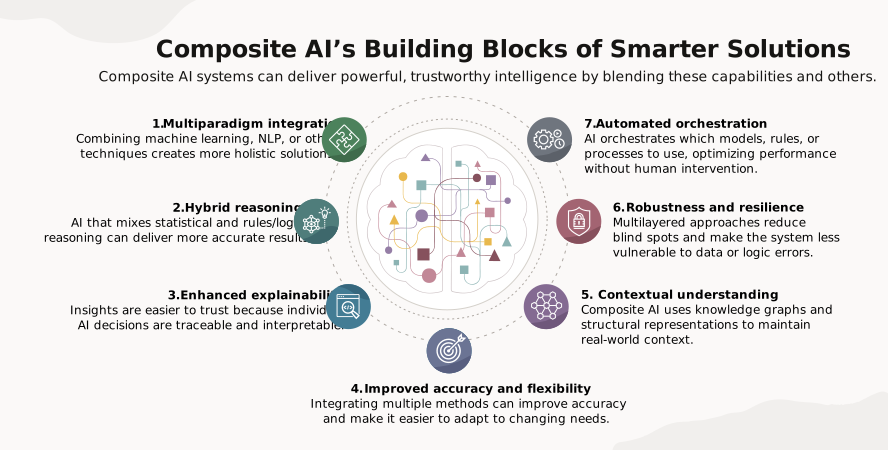
Each component in a composite AI system helps create a more flexible, context-aware, and intelligent AI that can adapt to a wider range of business needs. Here are some of those aspects in detail:
- Context-awareness: By using domain-specific knowledge, often captured through knowledge graphs and expert rules, composite AI systems can help make more relevant and informed decisions.
- Flexibility and scalability: The modular design of composite AI lets it easily adapt as needs evolve while a scalable architecture can manage growth in both data volume and analytic complexity.
- Human-AI collaboration: By providing explanations for its conclusions, composite AI helps people trust the results and further refine them.
- Improved accuracy and efficiency: Different strengths of multiple AI techniques working together often result in fewer errors and faster problem-solving.
- Integration: By mixing symbolic, statistical, and machine learning methods in one system, composite AI can address many different challenges as they arise.
Industry Use Cases for Composite AI
Government: Municipalities can use composite AI to improve citizen services, help prevent fraud, and manage programs via explainable models, NLP, and AI-driven decision-making frameworks.
Healthcare: Composite AI can help support diagnostics and patient care by, for example, integrating machine learning for analyzing images, NLP for summarizing medical records, and knowledge-driven reasoning for suggesting treatment protocols.
Finance: In finance, composite AI combines statistical models, fraud detection logic, and compliance rules to strengthen risk assessment and automate reports.
Manufacturing: Manufacturing teams use composite AI for predictive maintenance, quality checks, and process optimization using sensors, image recognition, and expert rules for better, faster production lines.
Retail: Composite AI blends predictive analytics, personalization, and inventory optimization to improve targeted marketing and stock management.
Transportation and logistics: Composite AI can improve route planning, supply chain management, and predictive maintenance with real-time data, optimization algorithms, and rule-based systems.
Build, Deploy, and Manage AI Agents at Scale
For a composite AI solution or AI agent to make an impact, it must connect easily with your workflows and grow along with your business. Oracle Cloud Infrastructure AI Agent Platform gives you the tools to build, deploy, and manage advanced AI agents using your choice of machine learning and language models. It’s designed to help you create virtual agents that deliver personalized, context-aware service—and engaging customer experiences—at enterprise scale.
Composite AI represents the next step for businesses seeking trustworthy automation and smarter decision-making. Look for these systems to feature deeper integration with an organization’s domain-specific knowledge and use their inherent modularity and flexibility to provide highly available, and accurate and explainable, outputs.

Composite systems can give businesses a big boost, but AI was already an efficiency multiplier. See nine areas where AI can make a significant operational impact, helping improve processes, reduce costs, and increase productivity.
Composite AI FAQs
What are the main types of AI?
AI can be grouped in several ways, but when we talk about the models often used together in a composite AI system, they often include machine learning models, natural language processing, knowledge graphs, and rule-based reasoning models.
What is composite AI and how does it differ from traditional AI approaches?
Composite AI combines multiple artificial intelligence techniques—such as machine learning, natural language processing, and knowledge graphs—to solve complex business problems more effectively than using a single AI method alone. Meanwhile, traditional AI often relies on a single technique or model. This flexibility makes composite AI well suited to solving complex problems.
What are the benefits of using composite AI?
Composite AI enables organizations to tackle a wider range of use cases by mixing and matching a range of AI approaches, improving accuracy, adaptability, and interpretability over traditional single-method solutions. Combining symbolic reasoning with machine learning in composite AI systems may also enhance transparency and explainability, making it easier to understand and validate decisions made by the AI.