What Is Business Continuity and Disaster Recovery (BCDR)?
Aaron Ricadela | Content Strategist | August 6, 2026

Businesses need to keep running during times of crisis. A central part of the challenge is operating through and recovering after computer system crashes that can put a halt to sales, operations, finance, production, and logistics. Whether IT outages are caused by human actions, software bugs, cybersecurity incidents, heat waves, or natural disasters, organizations need well-planned operational and technical strategies for getting through a crisis with key processes intact, then quickly recovering and resuming normal work.
Unplanned events that disrupt operations can harm brand reputation and lead to financial losses and regulatory penalties. That’s why organizations have long maintained comprehensive business continuity plans and backup systems. Those strategies may need to be revisited as the proliferation of cloud computing, rapid adoption of generative AI, and cloud native application architectures change the way organizations plan for operating through outages, design disaster recovery systems for retrieving critical data, and budget for improved resilience.
While plans that use geographically distanced physical data centers as the basis for disaster recovery are common, this article focuses on newer strategies that take advantage of cloud services.
Running some applications in both a data center and the cloud can be a simple, affordable way to improve resilience by geographically distributing application systems. Costs can be further reduced by running smaller or standby instances in the cloud and scaling them up only when needed.
As we’ll cover, one of the toughest decisions involves deciding how to keep constantly updated copies of critical data stores, such as customer account portals, customer management systems, and e-commerce engines, so that losing one copy only momentarily interrupts operations. Database replication strategies are often the basis of a resilient strategy.
What Is Business Continuity?
Business continuity is an organization’s overall strategic plan to keep operations running during and after a crisis. It goes beyond IT considerations to include factors such as alternative workspaces, customer service plans, supply chain redundancies, and emergency communications with employees, partners, and customers.
The most common reasons for interruptions to normal operations are human technical errors and software bugs that cause crashes. But natural disasters and extreme weather can also lead to business interruptions, as can terrorism, cyberattacks, and geopolitical conflict. Business continuity plans need to answer the question, How will we keep our people safe and productive and our customers informed?
What Is Disaster Recovery?
Disaster recovery refers to the detailed technical plans businesses create for restoring critical systems, applications, and data in their order of importance, the budgets they allocate for doing so, and the requirements for testing that strategy regularly. Its primary objective is to minimize downtime and data loss by executing predefined technical protocols, such as server failovers or backup restorations. While business continuity aims to ensure the organization as a whole survives a crisis, disaster recovery is dedicated to bringing its technology infrastructure back online.
A solid DR plan minimizes downtime and data loss while balancing the cost of protecting each workload with its importance to the business. And cloud technologies can help.
When computing was primarily done on client-server systems in company-owned or rented data centers, IT budgets could double or triple for each application that needed its own set of licenses, duplicate servers, storage, networking, and cooling, all running in facilities an appropriate distance from the company’s production data center. Cloud computing has changed the math, letting businesses deploy mission-critical applications to multiple cloud regions or data centers. Cloud technologies also let IT departments quickly add more capacity as needed using remote management tools.
Businesses need to make critical choices on two key disaster recovery metrics: How quickly do we need to recover from an outage, and what is an acceptable amount of data loss?
The recovery time objective (RTO) measures how long a business is willing to wait until service is restored, while the recovery point objective (RPO) determines the maximum amount of data a business is willing to lose in a disaster. The lower the thresholds the better, but the more a disaster recovery plan will cost to implement. Each system IT runs will have its own RTO and RPO. A sales transaction system will have short recovery times and points, while an employee expense system could reasonably be recovered a few days after a disaster.
What Is BCDR (Business Continuity and Disaster Recovery)?
Business continuity and disaster recovery refers to the technologies, policies, and procedures an organization puts in place to ensure it can continue operating in the event of a disaster or other unplanned interruption. It involves identifying potential risks and developing strategies to recover and resume normal operations as quickly as possible.
Business continuity and disaster recovery, or BCDR, strategies have become more important for a broader range of companies as more transactions with customers, suppliers, and other partners happen online and data volumes grow. Further, more systems have become interdependent. A portal that lets customers see past orders and make new ones may require connections with inventory management, fulfillment, and production management systems. Since they’re all required, each will inherit the shortest RTO and RPO requirements of the group.
While business continuity is important for companies in every sector, effective BCDR plans can be particularly critical for organizations in certain industries. For example, companies in highly regulated sectors, including banking, energy, and healthcare, have rigorous business continuity requirements and may have limited tolerance for recovery delays from backups. And certain subsectors, such as capital markets trading, may require recovery approaches that limit data loss to seconds or less.
Businesses should start their BCDR planning with an impact analysis that details what disasters may take place and the types of losses that could result. The plan should include technical configuration errors, natural disasters, acts of terrorism, and cybersecurity incidents such as ransomware attacks. Since data volumes today are much higher than in decades past, business leaders need to prioritize processes and their associated software applications, determining which are mission-critical and placing others in ranked groups of importance, called tiers, where more lenient RTO and RPO standards can apply.
Disaster Recovery Trade-Offs
Businesses need to make decisions about recovery time, data loss, and costs when planning a DR strategy.
| DR method | RPO | RTO | Cost |
|---|---|---|---|
| Backup and restore | Hours | Hours | $ |
| Pilot light | Minutes | Minutes | $$ |
| Warm standby | Seconds | Minutes | $$$ |
| Active/active | Nearly zero | Potentially zero | $$$$ |
What Is the Difference Between Business Continuity and Disaster Recovery?
Business continuity plans help a company make sure it can continue operating and delivering its products or services during a crisis. BC involves putting the people, processes, and technology in place to get through a disaster scenario.
Disaster recovery is the facet of business continuity concerned with getting IT operations back up and running quickly and with minimal data loss. It encompasses technical plans for restarting computing workloads and a tiered approach to recovery based on applications’ importance and dependencies.
Key Takeaways
- Business continuity plans can benefit from clearly defined roles and sponsorship by a visible executive.
- Disaster recovery strategies should include provisions for restoring data at a site or cloud data center that’s safe from the disruption, and document critical systems whose work needs to be distributed among multiple sites.
- Organizations must weigh how quickly they need to recover from an unplanned IT outage, the amount of data they’re willing to lose, and the cost and complexity of maintaining backup systems.
- Use of cloud computing technologies such as containers and virtual machines lets businesses restore workloads from smaller, less costly IT environments.
- Businesses planning DR strategies need to look closely at application dependencies that could prevent a key software program from starting if another that it relies on is offline.
BCDR Explained
BCDR planning starts with a risk assessment—what could go wrong? Organizations then measure the expected impacts of identified risks on processes and select the team members who’ll take on defined roles to mitigate them. Plans should also capture how the company will maintain employee communications, account for customer service and sales contingencies, and adjust supply chains. And they shouldn’t depend on any one individual to bring systems back online.
Companies should also create an inventory of their hardware, cloud, and software assets that documents the dependencies among them. Components of systems that will run only during disasters need especially careful testing, since they aren’t ordinarily used and are prone to failure.
The most successful BCDR programs continually update dependencies and application tiers, assess risk, perform regular testing, and feature skilled teams and a visible executive sponsor. It’s also important for businesses to differentiate between high availability and disaster recovery when planning their cloud computing approaches. Public clouds that include so-called availability zones can help ensure that if there’s a failure in one data center, customers’ workloads will continue running in the others in the zone. While this approach provides higher availability, it doesn’t cover disasters with a wider radius, such as major weather events, regional blackouts, and heat waves.
Why Is Business Continuity & Disaster Recovery Important for Businesses?
Disruptive events, natural disasters, and unforeseen IT failures can impede sales and operations, render offices unusable, knock data centers offline, and destroy plants and equipment. Financial losses often follow. A business continuity and disaster recovery plan can help organizations respond swiftly during a crisis, allowing them to limit losses, meet compliance requirements, and continue to serve customers.
Severe computer outages that wreak havoc on operations can cause financial damage to the tune of US$100,000 per hour, according to estimates. Southwest Airlines, for example, temporarily halted domestic departures in April 2023 after data connection issues resulted from a firewall failure, causing more than 2,000 flight delays. And unplanned outages remain expensive: IT advisory group Uptime Institute’s 2026 outage analysis report, based in part on a 2025 survey of 1,025 companies, found that a fifth of unplanned outages cost affected businesses more than US$1 million. AI workloads, which use many densely packed, power-hungry chips “may increase the likelihood of cascading failures,” according to the report.
How Does BCDR Work?
Business continuity and disaster recovery works by establishing processes to help organizations prepare for and respond to disruptions. It combines identifying critical operational functions and IT systems, assessing the risks to them, setting recovery time and recovery point objectives, and developing continuity and recovery plans, complete with testing, validation, and continuous improvement. BCDR plans aim to keep employees productive and customers informed, bring critical systems back online as quickly as possible after an incident, and then restore other systems in order of importance.
Businesses need to prioritize their workloads and define the required availability and RTOs and RPOs when planning a disaster recovery approach that fits their budgets. Restoring systems from backup copies may be the least expensive path—though large data sets can take a very long time to recover, and offline backups will have a long RPO. Still, offline backups are important, especially for critical data, and may be the only viable option to recover from a ransomware incident.
A pilot light deployment is a cloud disaster recovery strategy that keeps critical databases actively running and synced in a secondary region while leaving compute servers powered down until an outage requires them to be spun up. Pilot light deployments can restore systems to running status in minutes instead of hours but are costly to maintain.
Warm standby methods, which combine live, up-to-date data with cloud-based application replicas that can handle requests while running at lower capacity, have RPOs measured in seconds and RTOs in minutes. A so-called active/active approach using multiple live sites running at full capacity can deliver recovery times and points of nearly zero but is the most expensive.
Cloud computing technologies can help companies implement business continuity and disaster recovery plans without breaking their budgets.
Hybrid IT setups, in which some computing resources run in the public cloud and some run in on-premises data centers, have lowered the cost of disaster recovery. Cloud workloads based on microservices architectures let companies create pilot light IT deployments that combine up-to-date data with idle services that can be used to restart a system in a cloud data center.
Hybrid cloud environments do require businesses to identify, catalog, and manage application dependencies that would prevent a system from restarting if services it relies on are offline.
Some businesses are working to move all their applications to the cloud, with the goal of eventually shutting down their data centers. Several drivers are typically at work here, including a desire to integrate in-house applications more easily with other cloud-based systems; simpler system and application management; better application scalability, availability, and upgradability; and superior BCDR. The business continuity benefits include the ability to keep pilot light systems in cloud data centers in geographically disparate cloud regions, fewer concerns for employee and customer accessibility in a disaster, and a fundamentally more resilient application design with few or no single points of failure.
Getting all these benefits requires more than simply moving an existing application to run in a cloud data center, however. It requires re-architecting and recoding in-house applications. The process is known as refactoring, and it can be time-consuming and expensive, but the resulting applications are more resilient, versatile, and scalable—all outcomes that benefit your BCDR strategy. The application will also be easier to modify to provide new functionality. For instance, adding analytics and AI functionality becomes a more manageable process, as these are just new web services to use within the app.
What Components Are Included in a BCDR Plan?
Business continuity plans include comprehensive assessments of potential risks and the interruptions to operations they would cause, how internal staff and suppliers could be affected, and the financial losses and regulatory fines that could result. They also detail the personnel, processes, and technical steps needed to get back online and operational and recover any missing data. Training and testing are also essential.
A strong BCDR plan includes the following:
- Identification of scenarios that would interrupt normal business processes, noting the essential people, resources, and facilities that would likely be affected and that would require attention during recovery.
- A business impact analysis with a discussion of recovery time objectives and recovery point objectives. The analysis should include estimates of lost sales and profits following a disaster, factoring in how much risk those losses would pose to the company’s survival.
- A strategy for selecting and provisioning backup sites and distributing workloads in a public cloud in a way that lets operations restart promptly.
- A ranking of critical and important business applications that need to be restarted first and a map of IT dependencies that could impede getting those apps online.
- Changes to operations, the risks involved, and a program for educating staff about contingency planning.
- Provisions for continuous improvement of the plan and approval from line-of-business executives whose groups would potentially be involved. Individual lines of business should also identify scenarios that would interrupt their work, determine the people, resources, sites, and technology involved, and develop plans for responding to those scenarios.
Hyperscalers are working to make BCDR easier for their customers. For example, OCI offers the Full Stack Disaster Recovery service, which helps manage disaster recovery workflows across primary and standby environments, while Oracle Database Zero Data Loss Autonomous Recovery Service enables fast restoration to recovery point objectives for Oracle databases running on OCI, Amazon Web Services, Microsoft Azure, and Google Cloud; the system can support RPOs of less than one second of lost data.
How to Build a BCDR Plan in 7 Steps
Building a BCDR plan involves several steps, beginning with assembling a team of key stakeholders. By following this process, you can build a comprehensive BCDR plan that will help protect your business and minimize disruptions in the event of an emergency.
- Identify and build a team of people, including an executive sponsor, that’s responsible for creating and implementing the plan and ensuring that it’s kept up to date and periodically tested.
- Catalog the physical and IT assets that could be affected by a disaster.
- Conduct a business impact analysis of operations and locations that could be disrupted by a disaster or an unforeseen outage, including the impact on suppliers, distributors, retailers, and other outside parties.
- Establish an alternate site where staff can work during the disruption and create a plan for communicating with employees during that time. Alternatively, determine how employees can work from wherever they may be during a disaster.
- Create a disaster recovery plan that ensures recovery times are commensurate with an application’s importance, keeping in mind that large data sets can take a very long time to recover from a backup system.
- IT teams should determine which workloads can be restored from backup, which require live data combined with services running at reduced capacity, and which always need full-service capacity, even when running on backup servers. Decide on their RPOs and RTOs and develop recovery processes to meet them.
- Test the business continuity and disaster recovery plans, either through tabletop testing, consisting of a verbal run-through of the steps key stakeholders would take, or through an actual walk-through of those measures. Temporary cloud deployments can help significantly in testing recovery procedures.
On the IT side, pay special attention to testing components of systems that will be used only during disasters.
Download a free business continuity and disaster recovery plan (DOC)
AI’s Role in the Future of BCDR
Introducing AI tools into business continuity and disaster recovery makes the practice less reactive and more predictive and automated. Generative AI can lessen the time engineers spend searching for step-by-step runbooks that detail the right recovery plans for specific applications, instead retrieving them based on operational data and historical similarities.
The tools can comb through standards and documents about best practices to create a starting point for a BCDR plan and draw connections between business processes and the resources behind them, helping create a business impact analysis. During an outage, AI agents can also produce incident summaries and generate reports.
In IT development and operations, AI tools can analyze usage spikes and abnormal changes in access to data that staff could miss and that could indicate a pending outage. They can also help identify software dependencies and re-architect systems to have fewer single points of failure. The goal is to help businesses identify risks earlier, classify them by the amount of disruption they could cause, and recover faster from disruptions.
Organizations need to be aware that AI agents working on business processes can propagate errors across systems rapidly, meaning autonomous agents need monitoring and restrictions on their behavior. BCDR plans would do well to account for the possibility that an agent incorrectly analyzes a computing environment’s behavior and unnecessarily triggers a failover or other remediation action, for example.
Simplify Your Business Continuity Strategy with Oracle Cloud Infrastructure
Oracle provides several safeguards against computing downtime as the result of a disaster. Oracle Cloud Infrastructure (OCI) employs a unique and especially resilient approach that separates each of its global cloud regions, which provide services across geographic areas, into availability domains, which are isolated from one another. Availability domains in the same region each have their own power and cooling systems, so a failure at one domain in the region is unlikely to bring down computing work in another. Availability domains are connected by low-latency, high-bandwidth networks that help customers build systems that can be replicated for high availability and disaster recovery. Each OCI availability domain in turn includes three fault domains, so computing instances don’t reside on the same hardware within the domain.
In addition, Oracle Database includes Real Application Clusters (RAC) technology for built-in redundancy, whether workloads are running on OCI or Microsoft Azure. A separate product, Oracle Active Data Guard, maintains a real-time, remote standby copy of data for higher availability and faster disaster recovery of Oracle Database. For customers with the most demanding and sophisticated DR needs, Oracle Cloud Infrastructure GoldenGate can replicate across diverse database environments in real-time.
A comprehensive business continuity and disaster recovery plan can help minimize downtime, financial losses, and reputation damage. It also provides a sense of security to employees, customers, and stakeholders, knowing that the organization is prepared to handle unexpected situations, comply with regulatory requirements, and protect critical data and assets. The peace of mind and resilience that a BCDR plan offers make it worth the effort for businesses of all sizes.
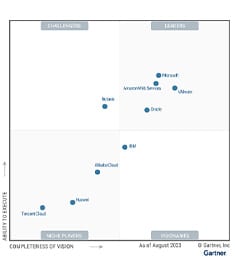
2025 Gartner® Magic Quadrant™ for Distributed Hybrid Infrastructure
A distributed cloud provides the flexibility to choose where and how services are delivered to meet your needs—including BCDR. See why Oracle has been named a Leader in the 2025 Gartner® Magic Quadrant™ for Distributed Hybrid Infrastructure.
BCDR FAQs
What do you include in a BCDR plan?
A business continuity and disaster recovery plan should include a risk assessment of the potential errors and events that could interrupt normal operations, an impact analysis of what assets and computer systems would be affected, an estimate of potential financial losses, and provisions for keeping people and processes running during a crisis. BCDR plans also include detailed technical descriptions of how a business will bring key applications back online and make sure employees have access to data while minimizing its loss. Training for staff is also an important component.
What does BCP stand for?
BCP stands for business continuity plan, which includes a detailed strategy and a catalog of the processes and systems that let a company maintain its operations through an unforeseen disruption. A BCP includes provisions for managing people, processes, and technology during a crisis, with the goal of returning to normal work as quickly as possible.