Oracle Fusion Cloud Supply Chain Execution
Oracle Fusion Cloud Supply Chain Execution unifies production, costing, inventory, quality, and maintenance to improve manufacturing operations. With built-in AI and agentic applications, it delivers real-time visibility, process automation, quality control and connected equipment to reduce costs, minimize downtime, and support a lean, responsive supply chain.

Customers who run mission-critical business functions using Oracle Supply Chain Execution
Explore Oracle Supply Chain Execution
End-to-end inventory visibility and control
- Get visibility and control by tracking and optimizing inventory across multiple locations.
- Support mobile transactions—including receipts, shipping, transfers, and inventory counts—to improve decision-making.
- Integrate with other supply chain functions to improve service levels and reduce inventory-related costs.
- Manage inventory tasks and full stockroom operations with AI-driven warehouse capabilities and automation.
- Use digital technologies for real-time inventory tracking, automated replenishment, and shortage and stockout prevention.
Cost tracking, allocation, and analysis across the supply chain
- Centralize and automate product costing, manufacturing accounting, and inventory accounting.
- Support detailed cost structures with multiple elements and full absorption costing models.
- Simulate cost changes, run what-if analyses, and compare profitability across products or sourcing options.
- Integrate with financial consolidation and inventory accounting processes to support end-to-end reporting.
- Use built-in AI and intelligent agents to automate cost analysis, improve accuracy, and deliver real-time insights to improve decision-making.
Smart operations for manufacturing
- Support discrete, process, project, contract, and mixed-mode production, with work orders, scheduling, and resource management for make-to-stock and make-to-order models.
- Support lean manufacturing with flow manufacturing and Kanban to reduce waste and lead time, improving throughput and efficiency. Improve rate-based production and daily scheduling and minimize changeovers using just-in-time principles.
- Support factory-floor operators with built-in AI recommendations to produce safely and efficiently with fewer interruptions.
- Adjust production, reduce changeover time, and increase yield by controlling automation equipment.
Smart operations for asset maintenance
- Integrate asset management with the broader supply chain to improve visibility into materials, parts, and work orders.
- Support preventive maintenance with automated forecasts, work order creation, and transaction capture to improve cost control and analytics.
- Connect field service, supply chain, and customer service operations to support timely parts delivery, accurate billing, and efficient service execution.
- Use real-time data and analytics to guide technicians, monitor asset performance, reduce downtime, and extend asset utilization.
- Automate production exception handling and maintenance work orders using operational rules and connected equipment.
Connected quality monitoring across design and manufacturing
- Oversee quality events across the full product lifecycle, from design through supply chain execution.
- Integrate with Oracle Fusion Cloud Product Lifecycle Management and other systems to improve quality visibility, control, and collaboration.
- Collect real-time data with barcode scanning and attribute capture to support accurate inspections.
- Automate inspection results and workflows to streamline dock-to-stock and improve inventory accuracy.
- Use built-in AI and predictive analytics to detect issues, automate inspections, reduce defects, and maintain compliance.
See Oracle Supply Chain Execution in action
Explore how organizations can optimize production operations, improve asset reliability, and maintain inventory accuracy. Discover tools that help businesses reduce complexity and stay ahead in a rapidly changing market.
Benefits of Oracle Supply Chain Execution
1
Standardize costing and unify material and inventory data
Centralized, automated costing captures real-time expenses across material, labor/resources, and production. A cloud inventory solution provides real-time visibility across warehouses, production, and in-transit inventory.
2
Automate and optimize manufacturing
By connecting and digitizing factory floor workflows with guided steps, automated data capture, and built-in AI insights, companies can boost productivity, optimize schedules, improve quality, and reduce bottlenecks.
3
Adopt predictive asset maintenance for assets
With AI, the Internet of Things, and analytics, companies can shift from reactive fixes to predictive maintenance. Automated work orders, optimized schedules, and real-time asset data can boost uptime, cut costs, and extend equipment life.
4
Embed quality controls across workflows
A quality solution embeds inspections, nonconformance tracking, and corrective and predictive actions (CAPA) across inventory, manufacturing, and maintenance. Real-time analytics help teams identify issues early, enforce standards, and improve processes over time.
AI highlights in Oracle Supply Chain Execution
 Watch the Production Shift Operations Workspace demo (1:42)
Production Shift Operations Workspace Agentic App
Boost shift performance with real-time recommendations to resolve issues and prevent downtime.
 Watch the Maintenance Operations Workspace demo (1:59)
Maintenance Operations Workspace Agentic App
Improve maintenance execution by prioritizing actions, reducing execution risks, and keeping maintenance plans on track.
 Watch the Warehouse Operations Workspace demo (1:47)
Warehouse Operations Workspace Agentic App
Identify inventory shortages, prioritize warehouse actions, and maintain operational continuity across warehouse networks.
 Watch the Cost Accounting Workspace demo (1:28)
Cost Accounting Workspace Agentic App
Monitor close readiness, identify issues early, and streamline period close with financial summaries and variance insights.
What analysts say about Oracle Supply Chain Execution
Oracle Supply Chain Execution helps organizations improve operational agility, productivity, and resilience by connecting inventory, manufacturing, maintenance, and quality processes with built-in AI, automation, and real-time insights. Learn why industry analyst firms named Oracle a leader in cloud SCM applications.
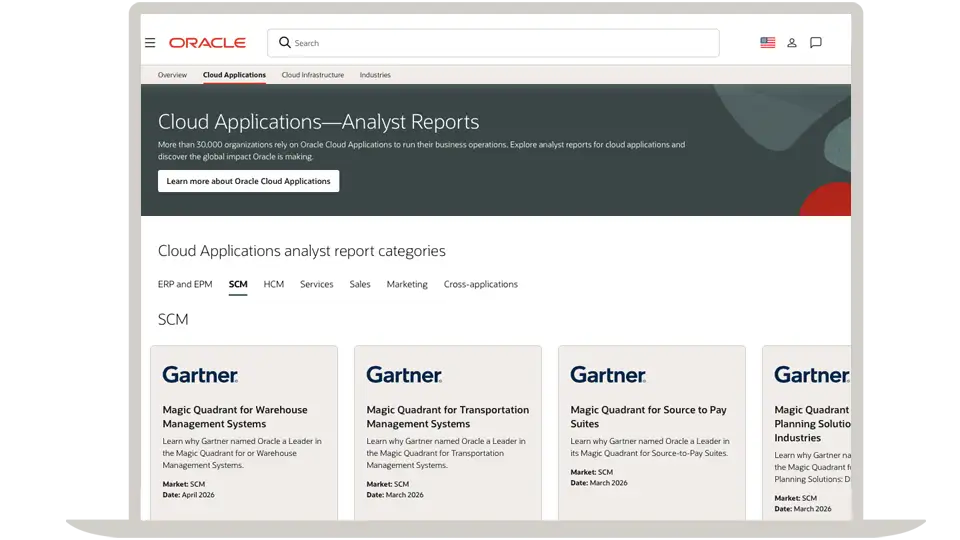
Customers using Oracle Supply Chain Execution


Oracle Supply Chain Execution resources
- Communities and support
- Additional resources
Get started with Oracle Supply Chain Execution
Oracle Fusion Cloud Supply Chain Execution FAQs
Open allClose allProduct overview
- What is Oracle Fusion Cloud Supply Chain Execution?
- What is Oracle Fusion Cloud Supply Chain Execution used for?
- Who is Oracle Fusion Cloud Supply Chain Execution for?
- Who is Oracle Fusion Cloud Supply Chain Execution for?
- What problems does Oracle Fusion Cloud Supply Chain Execution help solve?
Modules and capabilities
- What capabilities are part of Oracle Fusion Cloud Supply Chain Execution?
- Does Oracle Fusion Cloud Supply Chain Execution include inventory management?
- Does Oracle Fusion Cloud Supply Chain Execution support lower-complexity warehouse operations without a full WMS?
- Does Oracle Fusion Cloud Supply Chain Execution support mixed-mode manufacturing?
- Does Oracle Fusion Cloud Supply Chain Execution support maintenance work?
- Does Oracle Fusion Cloud Supply Chain Execution include quality control?
Data and integrations
- What data does Oracle Fusion Cloud Supply Chain Execution use?
- How does Oracle Fusion Cloud Supply Chain Execution connect with other Oracle Fusion Cloud SCM product areas?
- Does Oracle Fusion Cloud Supply Chain Execution replace ERP, CRM, web, advertising, or email systems?
AI and automation
- Does Oracle Fusion Cloud Supply Chain Execution use AI?
- What does AI automate or assist with in Oracle Fusion Cloud Supply Chain Execution?
- What decisions still require human review in Oracle Fusion Cloud Supply Chain Execution?
Implementation and readiness
- What should customers have ready before implementing Oracle Fusion Cloud Supply Chain Execution?
Common buyer questions
- How does Oracle Fusion Cloud Supply Chain Execution work with adjacent Oracle product families?
* Gartner® Magic Quadrant™ for Cloud ERP for Product-Centric Enterprises, 13 October 2025. Greg Leiter, Tomas Kienast, Johan Jartelius, Denis Torii, Dennis Gaughan.
This graphic was published by Gartner, Inc. as part of a larger research document and should be evaluated in the context of the entire document. The Gartner document is available upon request from Oracle. Gartner does not endorse any vendor, product or service depicted in its research publications, and does not advise technology users to select only those vendors with the highest ratings or other designation. Gartner research publications consist of the opinions of Gartner's research organization and should not be construed as statements of fact. Gartner disclaims all warranties, expressed or implied, with respect to this research, including any warranties of merchantability or fitness for a particular purpose.
GARTNER is a registered trademarks and service mark, and MAGIC QUADRANT is a registered trademark of Gartner, Inc. and/or its affiliates in the U.S. and internationally and are used herein with permission. All rights reserved.