Move, Optimize, and Extend Custom and Third-Party Applications
Migrate custom and third-party applications to Oracle Cloud Infrastructure (OCI) with minimal rearchitecture or reintegration and implement infrastructure that delivers higher performance at lower cost than alternatives. OCI includes all the core infrastructure and platform-as-a-service options to meet secure development lifecycle needs through its industry-leading data management products and support for open source technologies like Java, Kubernetes, and MySQL. Customers can use Oracle Cloud Lift Services for rapid workload migration at no cost, Oracle Cloud Coach Clinics to jumpstart development, and Oracle Support Rewards to effectively reduce technology software license costs.

 Migrate Enterprise Workloads to Oracle Cloud
Migrate to the cloud with confidence and no complexity. See how Oracle can help support your journey from start to finish.
IDC business value study finds that organizations using OCI realize benefits worth US$11.6M per year.
Why choose OCI to run custom and third-party apps?
Improve price-performance
Oracle helps organizations get workloads to the cloud rapidly and economically. In fact, OCI can provide up to 3x superior price performance compared to AWS. Customers get the same low cloud pricing across all regions and services, committed use discounts, software license portability, and further rewards.
Consistently low and predictable global pricingCompare OCI versus AWS, Microsoft Azure, and Google Cloud
Increase reliability and resilience
OCI provides guidance and reassurance, for both custom and third-party applications, via OCI Architecture Center, financially backed SLAs for availability, performance, and manageability, and free migration assistance via Oracle Cloud Lift Services. The Oracle partner ecosystem can assist customers migrate more complex applications to OCI.
Best practices for designing reliable and resilient cloud topologiesLearn about architecting a highly available cloud topology
Extend and modernize apps
Oracle Integration provides connectivity for custom and third-party applications. With OCI’s open and application development platform, developers can use products such as Oracle APEX and Oracle Visual Builder to code less and build web, mobile, and cloud native applications quickly.
Build modern intelligent applications using Oracle CloudExplore the benefits of OCI for custom and third-party applications
-
Price/Performance

Achieved superior price-performance by moving third-party applications from AWS -
Reliability

Upgrades to OCI for better security, disaster recovery, and support for Ellucian Banner -
Modernization

Built custom, cloud native application using Kubernetes and Terraform to serve 75,000 users -

Triples performance and cuts costs by moving all its workloads to OCI -

Processes 60,000 vehicle status updates in just 10 seconds using custom application on OCI -

Used Oracle APEX and Oracle Autonomous Database to reduce administrative overhead
Defining custom and third-party applications
Custom apps
Homegrown IT or departmental applications that support an organization’s unique business processes.
Third-party apps
Non-Oracle software products, which may use Oracle application servers or databases for use cases such as business intelligence, integration, and ERP.
ISV apps
Applications created and distributed by software vendors for use cases such as video conferencing and cybersecurity.
Learn more about why ISVs are choosing OCI.
Migrating and extending custom applications on OCI
Products, tools, and resources relevant to migrating and deploying custom and third-party applications. These apps may be designed using traditional or cloud native architectures.
Connect custom/third-party apps and data sources
Oracle Integration offers a combination of prebuilt connectivity to Oracle as well as third-party, cloud-based and on-premises apps, prebuilt process automation templates, and an intuitive visual builder for web and mobile app development. Customers can migrate and integrate data faster and more easily; and deliver real-time, enriched, and trusted data from disparate cloud and on-premises sources to enable business insights. Additionally, Oracle Cloud Marketplace provides a catalog of integration solutions.
Solution and product pages
Blogs, technical papers, and other resources:
- E-book: Integrate and Automate Business Processes (PDF)
- Oracle Integration Update webcast
- Oracle SOA Suite Modernization Series
Solution playbooks:
Innovate with autonomous and open source databases
Oracle Autonomous AI Database delivers a multimodel converged database that is self-driving, self-securing, and self-repairing, allowing customers to focus energies on developing and delivering applications that directly add value to their business. Autonomous AI Database runs natively on Oracle Cloud Infrastructure while providing workload-optimized cloud services for transaction processing and data warehousing.
Oracle MySQL Database Service lets developers quickly develop and deploy secure, cloud native applications using the world’s most popular open source database. MySQL Database Service is the only MySQL cloud service with an integrated, high-performance, in-memory query accelerator–HeatWave.
Solution and product pages
Blogs, technical papers, and other resources:
- Oracle Database Insider: product news, customer stories, developer tools, and more
- Oracle MySQL blog on Oracle MySQL Database Service and HeatWave
- Oracle Open Source
Reference architectures:
Support for major application platforms
Oracle WebLogic Server is a unified, extensible platform for developing, deploying, and running custom enterprise applications, both on-premises and in the cloud. WebLogic Server offers a robust, mature, and scalable implementation of Java Enterprise Edition (EE) and Jakarta EE. With rapid deployment and flexible pricing options, Oracle WebLogic Server for OCI is Oracle’s recommended way to run enterprise Java applications in the cloud. Oracle also offers WebLogic Server for Kubernetes in the OCI Marketplace, with the option to bring your own license (BYOL).
When customers migrate their third-party application servers (IBM Web Sphere Apache Tomcat, and others) to OCI, they can take advantage of Oracle and third-party reference architectures that provide guided implementation. Additionally, Oracle Cloud Marketplace is available with preconfigured images that help automate deployment.
Product page
Blogs, technical papers, and other resources:
- Application Modernization on OCI Demo Series
- Hands-on lab: Moving Oracle WebLogic Server to Oracle Cloud
- Oracle WebLogic Server for Oracle Cloud Infrastructure – Get Started
Reference architectures and solution playbooks:
Observability and management
Using Oracle Cloud Observability and Management Platform, customers can harness visibility and machine learning-driven actionable insights to ease management across all layers of the stack deployed on any technology, anywhere. Oracle’s integrated functionality and automation for DevOps monitoring and IT operations management makes it 50% easier to prevent and solve IT problems.
Oracle realizes that customers need service level objectives and agreements from their cloud vendor. In order for customers to ensure 24/7 uptime, Oracle Cloud Infrastructure provides guidance and reassurance that customers can use to plan for high availability (HA) and disaster recovery (DR) for their applications.
Solution and product pages
Reference architectures and solution playbooks:
- Best practices for designing reliable and resilient cloud topologies
- Learn about architecting a highly available cloud topology
- Learn about protecting your cloud topology against disasters
- Learn about protecting your VMware SDDC in the cloud against disasters
- Reference Architecture: design a pilot-light disaster recovery (DR) topology
- Reference Architecture: highly available web application
- Active/Passive Data Recovery workshop
- Disaster Recovery Rapid Start on OCI
Protect your enterprise data and applications
Oracle Cloud Infrastructure Security is designed to protect customer workloads with a security-first approach across compute, network, and storage—down to the hardware. OCI’s security services strengthen your security posture and protect your most valuable data and applications in the cloud.
With OCI, customers can meet global compliance and regulatory requirements. They can also address the need for data sovereignty and privacy through Oracle Cloud@Customer products, including Oracle Dedicated Region.
Solution and product pages
Blogs, technical papers, and other resources:
Reference architectures and solution playbooks:
Value-added services to migrate and consolidate custom workloads
Oracle Cloud Lift Services provide guidance from cloud engineers on planning, architecting, prototyping, and managing cloud migrations. Customers can move critical Oracle and non-Oracle workloads in weeks, or even days, instead of months by leveraging these included services for customer tenancies.
Oracle Cloud VMware Solution provides a customer managed, native VMware-based cloud environment, installed within a customer’s tenancy. Move or extend VMware-based workloads to the cloud without rearchitecting applications or retooling operations, and later use Oracle Cloud services to modernize your applications.
Oracle Database Migration Service provides a high-performing, self-service experience for migrating databases to OCI. It provides logical online and offline migration for enterprise-level database migration with minimal downtime.
Solution and product pages
Blogs, technical papers, and other resources:
- OCI Move and Improve - Third Party Applications workshop
- Oracle Cloud: The Ideal Enterprise Platform for VMware webinar
- Best Practices for Database Consolidation (PDF)
- Get Out of the Data Center Game with Oracle Cloud webinar
Reference architectures and solution playbooks:
Marketplace and Kubernetes for custom apps
When customers migrate their applications to OCI, they can use Oracle and third-party reference architectures that provide guided implementation. Additionally, Oracle Cloud Marketplace is available with preconfigured images and templates that help automate deployment.
Oracle Container Engine for Kubernetes (OKE) makes it easy to containerize applications and orchestrate them, reducing time and cost required to manage cloud native applications. Unlike other cloud vendors, OCI provides Container Engine for Kubernetes as a free service that runs on lower-cost, higher-performance compute shapes.
Solution and product pages
Blogs, technical papers, and other resources:
- Custom and Bespoke Applications: Key Considerations for Moving to Oracle Cloud
- Key Considerations Regarding the Migration of Custom Applications to the Cloud (PDF)
- Improve your skills through Oracle Developer Live
- Workshop: Deploying Microservices in Kubernetes and OCI Supporting Features
Reference architectures and solution playbooks:
Build low code apps faster with APEX and Visual Builder
Oracle APEX is a low-code development platform that enables engineers to build scalable, secure enterprise apps with world-class features that can be deployed anywhere. Using Oracle APEX Service, developers can quickly develop and deploy compelling apps that solve real problems and provide immediate value. APEX is a fully supported, no-cost feature of Oracle AI Database—the most complete, integrated, and secure data platform for any scale deployment.
Oracle Visual Builder lets developers create and deploy web, mobile, and progressive web interfaces quickly. Developers can extend their applications using the same development platform that Oracle Cloud Applications are built on.
Solution and product pages
Blogs, technical papers, and other resources:
Automate and simplify application management
Developer tools and services automate the software development lifecycle (SDLC), infrastructure operations, observability, and messaging for developers. Customers can use popular open source tools such as Jenkins, Terraform, and Grafana to integrate with OCI.
With Oracle Cloud Infrastructure DevOps service, engineers can automate the delivery and deployment of software to OCI compute platforms such as Oracle Container Engine for Kubernetes (OKE), OCI Compute hosts (Instance Groups), and Oracle Functions. DevOps service provides an end-to-end continuous integration/continuous delivery (CI/CD) experience for developers.
Solution and product pages
Blogs, technical papers, and other resources
- Simplify your software deployments with the Oracle Cloud Infrastructure DevOps service
- Infrastructure-as-Code is the building block for scalable technology
- Terraforming the Cloud with Oracle Cloud Infrastructure Resource Manager (54:38)
Reference architectures and solution playbooks:
- Reference Architecture: Set up a CI/CD pipeline for cloud deployments
- Reference Architecture: Build a Continuous Deployment Pipeline using Oracle Cloud Infrastructure DevOps service
- Best practices for operating cloud deployments efficiently
- Best practices for optimizing the performance and cost of cloud resources
Enable diverse application deployment models
While many custom applications, tools, and resources can be migrated to the cloud, some simply require the resources of an on-premises environment. Oracle’s offerings address customer requirements for specialized deployment, disconnected and intermittently connected operation, low latency, and high performance, as well as data locality and security. Oracle Dedicated Region offers all the capabilities of a public cloud within customer datacenters, thereby allowing applications to be deployed on-premises and migrated over time to the public cloud.
Oracle also provides an open platform ecosystem and diverse options to connect to different cloud providers or on-premises data centers. Inexpensive data egress charges allow enterprises to save significant costs while extending their IT environment to the cloud. The Oracle Cloud and Microsoft Azure Interconnect helps customers choose the best of Oracle’s and Microsoft's technology stack, and maximize their return on investment.
Solution and product pages
- Hybrid cloud, multicloud, and intercloud products
- Oracle Cloud and Microsoft Azure Interconnect
- Oracle Cloud@Customer
- Oracle Dedicated Region
Blogs, technical papers, and other resources
- Learn more about hybrid cloud
- Embracing hybrid cloud with Oracle Cloud Infrastructure
- Set Up a Hybrid Cloud with Oracle Cloud VMware Solution
- Multicloud solution using Oracle Exadata Cloud service for data management with applications running on Azure
Solutions playbook
OCI technical case studies for custom applications
Technical case studies highlight the customer’s goals and the breadth and depth of their technical solution on OCI. Each technical case study features all applicable OCI products used, the customer’s cloud migration path, OCI solution architecture, and the results of their cloud transformation.
Archaeological Park of Pompeii taps OCI to reopen after COVID-19 lockdown
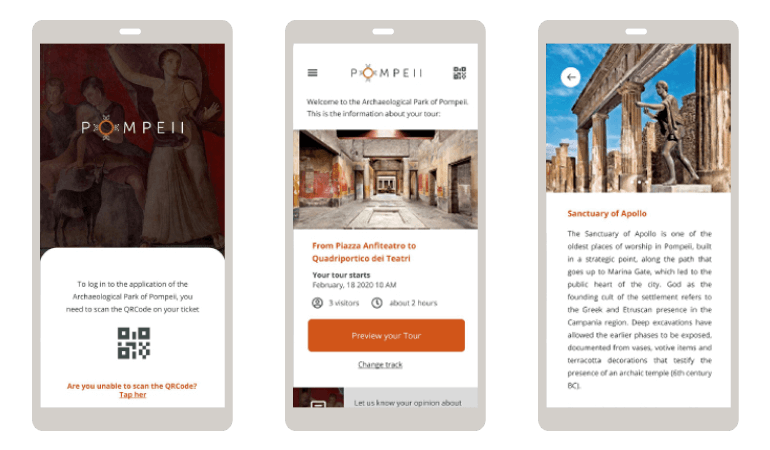
Following the pandemic, historical site Pompeii reopened using the MyPompeii mobile app, a solution built entirely on OCI with cloud native and API-first principles in mind. Pompeii used these OCI services, SDKs, and frameworks:
- Oracle Cloud Infrastructure
- Oracle Blockchain
- Oracle Container Engine for Kubernetes
- Oracle Autonomous AI Transaction Processing
- Oracle Autonomous AI Database
- Oracle Functions
- Container Registry (OCIR)
- Oracle Spatial Analytics
- A real-time heat map that enables information for points of interest, facilities, and social distancing
- Complete integration with online ticket sales application TicketOne, so visitors can scan a QR code on their tickets and access all the application’s content
- Visitor feedback through the application, certified through blockchain
The application has been downloaded by 20,000+ visitors in 2021.
Oracle Cloud helps accelerate COVID-19 testing in the US

In the early days of the pandemic, Oracle Consulting built a suite of public health management applications to help collect and analyze the data necessary for government health organizations and the medical community to understand the virus and its spread. Counties using the platform include Tarrant County, the third most populous county in the state of Texas. The platform not only helps Tarrant County’s testing facilities operate more effectively, but also provides valuable information to keep communities safe. These are the services used:
- Oracle Cloud Infrastructure
- Autonomous AI Transaction Processing
- Oracle APEX
- Oracle Functions
- Oracle API Gateway
- Provide an online form and categorize each respondent’s risk as high, medium, or low
- Schedule appointments for people most likely to contract the coronavirus
- Allow patients to check in using a mobile app and QR code
- Allow patients to check out and provide the necessary data to testing partners
- Make the results from the testing partners available to patients
- Build customized dashboards with augmented and predictive analytics, data visualization, and intelligent insights
The platform provides Tarrant County with valuable information to keep its communities safe and COVID-19 cases down.
AgroScout improves development and DevOps with Oracle Cloud Native Services

AgroScout, a startup in the agritech sector, leveraged Oracle Cloud Native Services to migrate its application to Kubernetes and deliver an automated deployment pipeline. The AgroScout development team can easily manage its application, streamline its CI/CD platform, and achieve better performance on OCI. Facilities operate more effectively, but also provide valuable information to keep communities safe. These are the services used:
- Oracle Cloud Infrastructure
- Oracle Container Engine for Kubernetes (OKE)
- Oracle Cloud Infrastructure Registry
- Oracle Cloud Native Services
- Transition from a static application to a dynamic microservice-based app
- Cluster deployment time decreased from 23 hours to 2 minutes
- New version deployment reduced from 24 hours to minutes
- Enhanced ability to query thousands of images in seconds
AgroScout’s machine learning technology relies on OCI’s GPU instances proving the speed and performance that machine-learning workloads demand.
Cloud native and DevSecOps at scale with Capgemini and Oracle Cloud

Capgemini has been an Oracle Platinum Partner for over two decades, helping customers with projects such as critical migrations and implementations. When a customer approached Capgemini with aging legacy systems, business change requirements, and strict deadlines enforced by a government directive (PSD2), Capgemini turned to Oracle Cloud. Capgemini delivered a rapidly developed, cloud native platform using these products:
- Oracle Cloud Infrastructure
- Oracle Identity
- Oracle Cloud Infrastructure Object Storage
- Oracle API Manager
- Oracle Container Engine for Kubernetes
- Oracle Cloud Infrastructure Registry
- Achieved design to launch in 6 months
- Scaled its testing to 200% of expected maximum user concurrency
- Measured a response time averaging 77ms
- Delivered the PSD2 portal and PSD2 APIs on time and launched the debt register API a week ahead of schedule
The platform serves 300,000 API requests per day.
MESTEC launches robust multicloud strategy with Oracle Cloud and Microsoft Azure Interconnect

MESTEC is the world's first cloud-based SaaS manufacturing solution provider. It offers manufacturing execution system (MES) and advanced planning and scheduling (APS) software to manufacturers looking to improve efficiencies in the critical aspects of the manufacturing lifecycle. The company deployed a multicloud strategy leveraging solutions from Oracle and Microsoft. It relies on Oracle Autonomous AI Transaction Processing database connected to an Azure front end through the Oracle-Azure Interconnect to deliver solutions that boost overall manufacturing processes without customization and typical upfront costs. The company utilized the following cloud services from Oracle:
- Oracle Autonomous AI Transaction Processing
- Oracle Data Guard
- Oracle Cloud and Microsoft Azure Interconnect
- OCI Object Storage
- Oracle Cloud Infrastructure FastConnect
- Site-to-Site VPN
- OCI Dynamic Routing Gateway (DRG)
- Reduced labor and infrastructure costs by half compared to its on-premises environment
- Ran manufacturing workloads up to 600% faster with half as many CPUs
- Achieved a more secure and 100% compliant environment
- Implemented a diverse set of manufacturing environments quickly and reliably
- Committed higher-availability SLAs to its customers
With OCI, MESTEC optimized their manufacturing lifecycle and scaled to new infrastructure resources rapidly.
Mynet delivers exceptional mobile gaming experience with OCI, cuts costs by 80%

Mynet offers mobile game services by acquiring an existing game title, then redesigning and repackaging it to reach a broader audience. This business model enhances the overall profitability and revenue for Mynet. The company migrated to OCI for superior performance at a lower price and reduced overall costs by about 80%. Mynet uses services from other cloud providers depending on game characteristics, in support of its multicloud strategy. The company delivers an exceptional mobile gaming experience utilizing a portfolio of OCI services listed below:
- OCI Compute
- OCI Block Volumes
- OCI Object Storage
- OCI File Storage
- OCI Flexible Load Balancer
- Outbound OCI Data Transfer
- Oracle Cloud Infrastructure Health Checks
- Oracle Cloud Infrastructure Email Delivery
- Oracle Cloud Functions
- OCI Internet Gateway
- About 80% reduced infrastructure cost
- Cost savings of over $1M in twelve months
- 6X improved processing time for a title—from about an hour to just 10 minutes
- Specific game titles running automatically and at scale without human intervention
- A unified view of cloud security posture across OCI tenancy
By deploying its mobile gaming experience on OCI, Mynet achieved notable improvements in overall game performance.
Custom applications technology center
Design and implement your departmental and IT applications using our catalog of reference architectures, solution playbooks, and best practices.
-
![]() Build and extend applications with cloud native services
Build and extend applications with cloud native servicesAdopt Cloud Native services to run highly scalable and resilient applications
-
![]() Migrate and consolidate your data and workloads to OCI
Migrate and consolidate your data and workloads to OCIMigrate on-premises databases and workloads to the cloud
-
![]() Architect your solution for high availability (HA)
Architect your solution for high availability (HA)Learn about architecting for a highly available cloud topology
-
![]() Prepare your solution for business continuity
Prepare your solution for business continuityProtect against regional failures or disasters
-
![]() Secure your applications and data in OCI
Secure your applications and data in OCICreate the most secure cloud topology to meet all your security, data protection, and compliance requirements
-
![]() Explore best practices
Explore best practicesReview best practices for security and compliance, reliability and resilience, performance and cost optimization, and operational efficiency.






Built & Deployed on OCI
Custom application built on serverless architecture helps minimize biases in the recruiting process
Get hands-on with custom application development on OCI
-
![]() Get hands on experience with cloud development
Get hands on experience with cloud development -
![]() Low Code development workshops
Low Code development workshops -
![]() Application development workshops
Application development workshops -
![]() Enable your technology transformation to Oracle Cloud
Enable your technology transformation to Oracle Cloud



Work with Oracle Consulting, your current partner, or one of ours.
Related topics
-
Oracle Developers Portal
Get started on OCI with developer resources
-
Application Development with Oracle Cloud
Explore Oracle’s products for app dev
-
Arm on Oracle Cloud Infrastructure
See why Arm-based computing is ideal for development
-
Migrate ISV Applications to Oracle Cloud
Why ISVs are Choosing Oracle Cloud
Save on software license support by using OCI.
 The Oracle AI Playbook series
We've compiled the secrets to our people, process, data, and systems strategy. And we want to share them with you.
Migrate enterprise workloads to Oracle Cloud
Oracle Cloud Infrastructure is the best place to run your Oracle Applications, custom, or third-party applications on Oracle AI Database.
-
Explore the OCI Cloud Adoption Framework
-
Why Oracle Gen 2 Cloud is best suited for enterprise workloads