Oracle Agent Memory
Enterprise context management, built on Oracle AI Database
Oracle Agent Memory gives AI agents accurate, governed access to business context and is designed for low-latency retrieval on Oracle AI Database.
Your enterprise already depends on Oracle AI Database to manage the transactions, relationships, policies, and operational history that define how your business works. Oracle Agent Memory extends that trusted data foundation to AI agents, without creating another disconnected context silo.

Your agents need context. Your database already has it.
Every enterprise has spent decades accumulating context: which suppliers serve which factories, which customers hold which contracts, which employees have which permissions, and which policies govern which decisions.
Many agent architectures recreate that context inside a separate memory service. The organization must then secure, govern, and synchronize another version of the business.
Oracle AI Agent Memory takes a different approach. It brings persistent agent memory to Oracle AI Database - the platform already managing the data, relationships, and operational history behind the enterprise.
Your agents should not require a second, less-governed version of your business.
New in Oracle Agent Memory 26.8
Graph Memory, Image support, and End-user memory isolation with Deep Data Security.
94.4% Accuracy
472 of 500 LongMemEval questions correct
Graph Memory
Memories can now be linked to related memories.
Full lifecycle
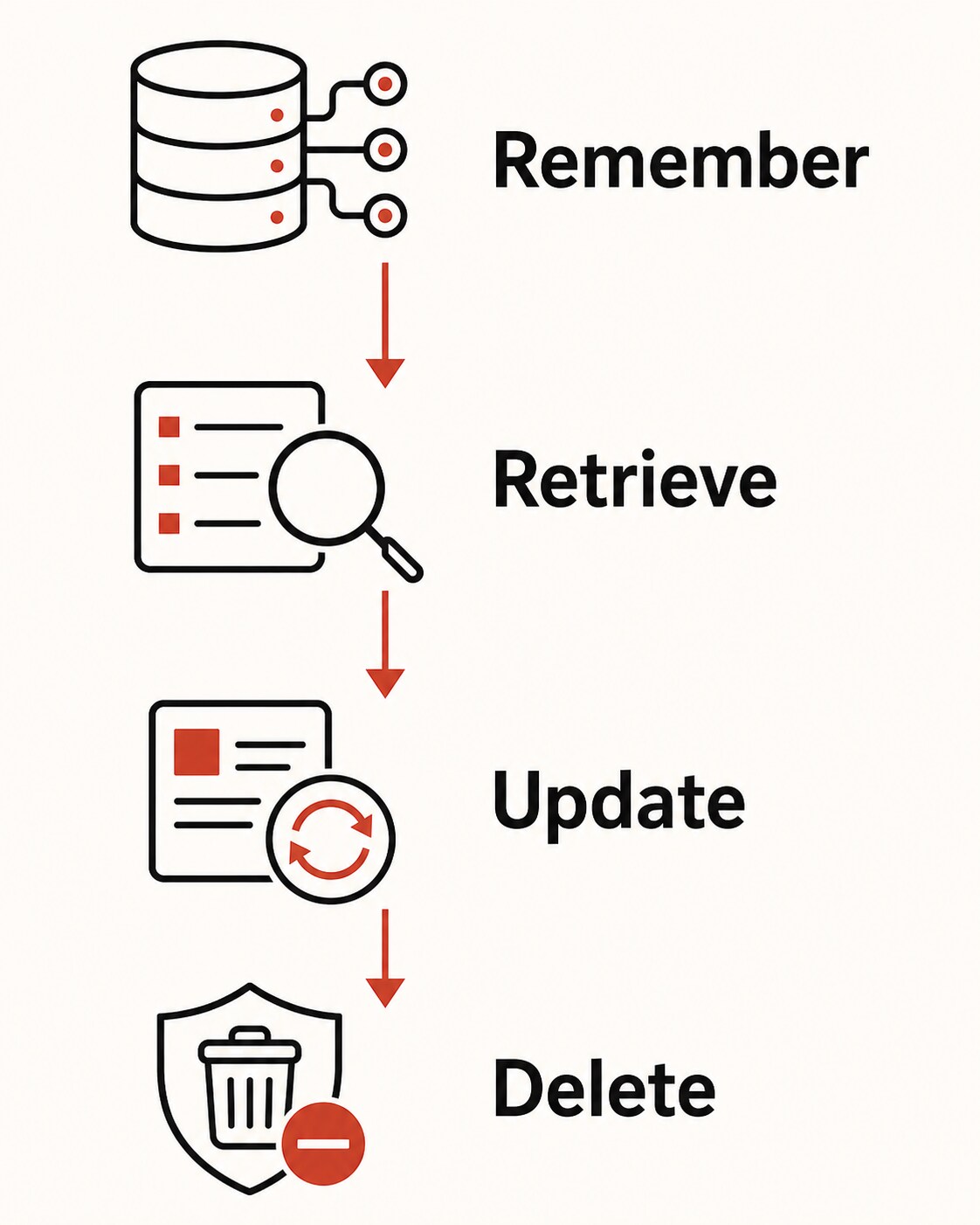
CRUD, expiration, and cascading deletion
Security
End-user memory isolation with Deep Data Security
Full 500-question LongMemEval evaluation. Results reflect the documented model and evaluation configuration.
A new standard for enterprise agent memory
Retrieve the right context
Combine semantic similarity, keyword precision, metadata filters, record types, and explicit memory scope. Oracle Agent Memory helps agents retrieve context that is not merely similar, but appropriate for the business task.
Reduce latency and complexity
Keep memory and retrieval close to enterprise data in Oracle AI Database. Reduce unnecessary movement between application databases, external memory services, and separate search systems—with fewer copies and fewer synchronization pipelines to operate.
Govern the complete lifecycle
Create, inspect, update, expire, and delete memories as business conditions change. Apply explicit scope and cascading deletion at the user, agent, or thread level rather than leaving stale fragments behind.
When the business changes, the agent’s memory changes with it
A logistics agent learns that Factory A requires three large chemical shipments every Thursday. Drivers must hold the required hazardous-material certification, and delivery must be completed before midnight.
Oracle Agent Memory preserves those requirements across planning sessions. Hybrid retrieval helps the agent find the exact facility, shipment, and certification context when it prepares the next schedule.
When a supply-chain disruption moves the deadline to 6:00 p.m., the existing memory can be updated. The agent does not have to choose between two contradictory instructions.
When the route or supplier relationship ends, the associated context can be deleted, including related memories that should not remain behind.
The agent gains continuity. The enterprise retains control.
.png)