Model Context Protocol (MCP) Explained
Art Wittmann | Oracle Technology Content Director | February 17, 2026

What Is Model Context Protocol?
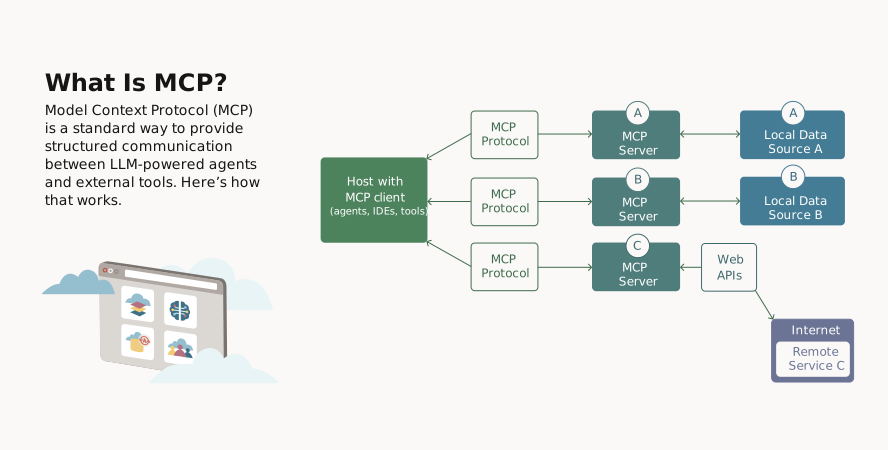
MCP is a standard that lets AI systems, such as LLMs and AI agents, use external tools, data sources, and services. By providing a standards-based way for AI applications to access data, execute functions, and receive feedback, MCP enables an LLM or agent to perform multistep tasks. By standing up MCP servers, organizations no longer need to build custom connectors to their data sources, simplifying development and improving interoperability.
What Is the Difference Between MCP and RAG?
While both MCP and retrieval-augmented generation, or RAG, help LLMs access and use information that wasn’t part of their training, they vary in their approaches and applications.
Let’s look at some differences and similarities.
MCP vs. RAG
| Feature | Model Context Protocol (MCP) | Retrieval-augmented generation (RAG) |
|---|---|---|
| Primary goal | Standardize two-way communication for LLMs to access and interact with external tools, data sources, and services. | Enhance LLM responses by retrieving relevant information from authoritative knowledge bases before generating a response. |
| Mechanism | Defines a standardized protocol for LLM-based applications to invoke external functions or request structured data from specialized servers. | Retrieves information based on a user’s query that requires outside data and uses it to improve the LLM’s response. |
| Output type | MCP lets LLMs generate structured calls, receive results, and complete actions based on those results. It can also involve real-time data and functions, which are particularly helpful to AI agents. MCP heavily relies on JSON documents to structure exchanges. | LLMs generate responses based on their training data, supplemented by text from external documents relevant to the query. RAG often enhances factual accuracy or provides unique data otherwise unknown to the LLM. |
| Interaction | Designed for active interaction and execution of tasks in external systems, providing a “grammar” for LLMs to use external capabilities. | Used primarily for passive retrieval of information to inform text generation, not typically for executing actions by external systems. |
| Standardization | An open standard for LLMs to integrate with other systems, reducing the need for custom APIs; MCP relies on JSON–remote procedure call schemas. | A technique or framework for improving LLMs but not a universal protocol for tool interaction across vendors or systems. |
| Use cases | AI agents that perform tasks—such as booking flights, updating a CRM, or running code—by fetching real-time data and using advanced integrations. | Question-answering systems, chatbots providing up-to-date information, document summarization, or hallucination reductions in text generation by providing relevant data. |
You can get a more detailed exploration of RAG in Oracle’s comprehensive guide to the AI technique.
Key Takeaways
- MCP is a standard protocol for connecting AI systems with external tools, data sources, and services.
- By freeing companies from wrangling custom connectors, MCP can democratize access to data and services. Programmers familiar with JSON will likely be comfortable using MCP.
- Its ability to enhance the functionality of AI applications while reducing the need for custom connectors is a key reason for the excitement around MCP.
Model Context Protocol Explained
MCP is an open source framework developed by Anthropic that standardizes the way AI systems share data with external tools, services, and data sources.
In the absence of a standard like MCP, developers have had to build custom connectors for each data source or tool, resulting in dozens of unique integrations per application. Because it provides a standardized protocol, MCP can help eliminate the need for custom connectors to achieve interoperability across platforms.
How Does Model Context Protocol Work?
MCP creates an efficient client-server architecture, where AI systems—clients—request information from data repositories or tools—servers. This standardizes real-time access to files, databases, and APIs by using JSON objects and schemas to define interactions. With MCP, AI assistants can not only fetch information but complete useful tasks, such as updating records in a CRM or responding to a customer request. In a nutshell, GenAI goes from useful, if siloed, intelligence source to real-world functionality.
Model Context Protocol Features
MCP offers features designed to enhance the integration and usefulness of AI systems and will likely gain new functionality as the standard matures. Core capabilities include
- Persistent memory: MCP stores long-term contextual data across sessions, letting AI applications retain relevant information over time.
- Scoped contexts: MCP supports user-, session-, and organization-specific context layers for tailored interactions.
- Structured data input: MCP accepts JSON-like structured requests and replies, facilitating accurate, predictable data exchange.
- Real-time updates: MCP allows for dynamic modification of context during interactions, which provides up-to-date information.
- Multiagent support: MCP shares data across multiple AI agents or models, promoting coordinated actions.
- Access control: MCP manages permissions for context visibility and offers a mechanism for controlled data handling.
- Event logging: MCP tracks exchanges for auditing, providing transparency and accountability.
- Interoperability: MCP is interoperable with external systems and APIs to enhance AI capabilities.
3 Model Context Protocol Use Cases
MCP’s versatility is powering a wide range of creative use cases, and many organizations are seeing benefits. Here are three real-world examples to spark ideas and help you get started with MCP:
1. Executive assistant’s assistant: AI-powered personal assistants can use MCP to access calendars and coordinate scheduling across different platforms. Say you need to set up a lunch for your sales team to discuss a new product launch. With MCP, an AI assistant could retrieve relevant documents from R&D and marketing, find the soonest open time for participants in the company’s calendar app, reach out to OpenTable for a reservation at a local restaurant, and send invitations through the mail client. Before the luncheon, the AI assistant could compile the latest product documents and sales statistics into a presentation.
2. Healthcare superagent: Chatbots can use MCP to combine personal device data and sentiment analysis tools. With patient consent, a physician practice might monitor heart patients by using a health app to synchronize data from wearable devices; medical records; connected home devices, including scales and blood pressure monitors; and diary entries. An AI model could analyze this data to provide personalized health updates, help schedule appointments, and send alerts, all based on triggers set by the practice.
3. Employee tutor and coach: HR might use MCP to connect AI tutor agents with employee performance data and recommend third-party courses from external databases to create adaptive learning paths tailored to an individual’s strengths, weaknesses, growth path, and role.
As more companies develop MCP servers to open access to their data and services, the list of use cases will expand. Keys to success include the way MCP lets models remember information across user sessions, adjust behavior in real time based on changing context, and tailor responses based on roles or access levels.
How to Implement Model Context Protocol
Think of MCP as the next evolution of APIs in that companies will use it to provide a standardized interface framework for AI systems to interact with their tools and data sources—a clear improvement over direct, service-specific interfaces that require programming.
Implementing MCP involves five general steps:
- Understand MCP specifications: Familiarize yourself with the MCP framework and its components and confirm that the MCP aligns with your company’s AI and data security policies.
- Select appropriate SDKs: Choose the MCP SDKs that align with your programming environment or develop access routines, if needed.
- Develop MCP servers: Create MCP servers to expose your data and tools to AI applications. Data management providers, including Oracle, offer MCP servers that facilitate access to their systems and include authentication and role-based access management.
- Build MCP clients: Develop applications that connect to MCP servers, enabling AI systems to access and interact with external data.
- Test and deploy: Conduct thorough testing to help ensure you’re providing the intended integration and functionality before deploying the MCP-enabled system.
Get Started with MCP with Oracle AI Database
Integrating MCP with Oracle AI Database can significantly enhance AI applications with robust data management and retrieval capabilities. Oracle AI Database offers comprehensive support for MCP, providing efficient integration of AI systems with your enterprise data.
MCP represents a significant advancement in integrating AI systems with external tools, services, and data sources. By providing a standardized framework, MCP improves the functionality, contextual awareness, and interoperability of AI applications, paving the way for more efficient and effective AI solutions.
Is your AI failing to reach its potential because of a lack of data? MCP can be part of the answer, but it’s not the only smart move to make now.
Model Context Protocol FAQs
Why is MCP important for companies?
MCP is a win for most organizations because it helps companies use solutions from a wide range of providers and integrate AI models with their existing workflows, databases, and application ecosystems. By leveraging MCP, businesses can increase flexibility, gain access to innovative technologies, address specific compliance or geographic requirements, and more.
How does MCP help improve monitoring and visibility?
MCP provides unified management, monitoring, and policy enforcement across different providers. This helps companies apply security protocols, access controls, and internal policies consistently. MCP can help companies simplify audits, address regulatory standards, and gain better visibility into their cloud environments, thus reducing the risk of misconfigurations or company policy violations. And MCP includes features to help IT monitor performance and keep models updated.
What are some key considerations before adopting MCP?
Implementing MCP can involve managing sensitive data flows and model access, so businesses should follow their guidelines for authentication, authorization, data encryption, and other internal security and compliance protocols. It’s also important to evaluate cost implications and the scalability of your current infrastructure when considering workload placement.