The Rise of the Autonomous Enterprise for Healthcare
Chris Leone, EVP, Applications Development, Oracle

How agentic applications can automate core healthcare operations
Healthcare doesn’t just have a data problem. It has a coordination problem. But the opportunity isn’t just for better insight. It’s to automate how work moves across ERP, supply chain, HCM, workforce operations, and procurement.
What are agentic applications, and why are they now possible?
Agentic applications represent a new architecture for enterprise systems. This is the promise of Oracle Fusion Agentic Applications: enterprise systems that can understand context, reason across constraints, and execute work safely within policy.
Traditional systems were built around interfaces and workflows. They define what can be done and in what sequence, but deciding what should happen next has always required people.
Agentic applications change that. They introduce software that can:
- Understand context across the enterprise
- Apply domain knowledge and policy
- Reason across constraints such as cost, staffing, and risk
- Take action inside transactional systems
This is not AI layered on top. It’s a shift to systems that actively drive work toward outcomes. Put simply, enterprise applications are evolving from systems of record into systems of outcomes. They no longer just capture what happened; they help determine what should happen next, coordinate the work required, and execute actions within policy.
The architectural shift
Instead of static workflows, systems operate through coordinated teams of agents. Each agent has:
- A defined role (staffing, sourcing, billing, and so on)
- Access to real-time enterprise data
- Clear policies and guardrails
- The ability to execute transactions
Agents collaborate, continuously evaluate new signals, and adjust actions in real time. This allows the system to function as an operator, not just a recordkeeper.
Why automation is now possible
Three things make this level of automation achievable:
- Unified enterprise data structures across ERP, HCM, and supply chain as well as clinical systems
- Embedded execution inside the system of record (not external tools)
- Policy-aware governance with roles, approvals, and auditability
In healthcare, autonomy must remain governed. Agentic applications should operate within role-based permissions, policy guardrails, approval thresholds, audit trails, and exception handling. This combination allows systems to not only recommend actions but also execute them.
How it looks in action
Levels of automation: From human in the loop to autonomous execution
- Human in the loop: Agents recommend actions such as staffing changes or sourcing decisions. Humans approve.
- Human in the lead: Agents execute routine adjustments such as reorders, schedules, and RFQs, escalating key trade-offs.
- Autonomous execution: Well-defined processes such as replenishment, claims matching, and sourcing events run automatically within policy constraints.
Why this matters
Organizations scale automation safely while maintaining control and accountability.
Why foundation models alone fall short
Foundation models can generate insights, but they aren’t built to run enterprise processes. They lack transactional authority, policy awareness, and auditability. They can suggest what to do but can't reliably execute it inside real systems.
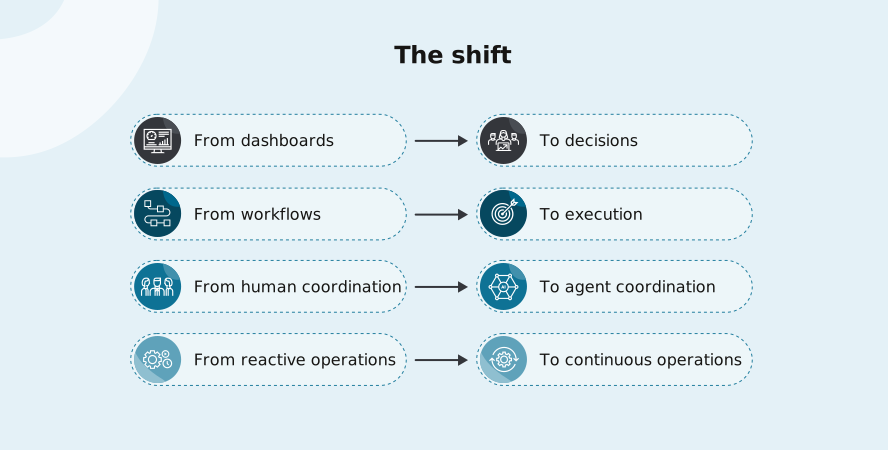
Agentic applications don’t just recommend work. They carry it forward. This is how healthcare moves from systems of record to systems of outcomes.
Learn more about Oracle’s AI-powered ERP and HCM solutions for healthcare organizations.
Learn why ISG Software Research named Oracle a Leader for both Healthcare ERP and Workforce Management for Healthcare systems.