The Rise of the Autonomous Enterprise
Chris Leone, EVP, Applications Development, Oracle | March 23, 2026

How systems of record become systems of outcomes
Enterprise applications have always been designed to capture what happened. They record transactions, enforce policy, and store the operational history of the business.
This architecture created what we now call the system of record. For decades, it has been the backbone of enterprise computing.
But the system of record has always had a limitation: It does not move work forward on its own. People interpret the data. People decide what action to take. People execute the next step. The application records the result.
That model is now changing.
Across industries, organizations are entering a new phase of enterprise software: the rise of the autonomous enterprise, where systems do not simply store information but reason, decide, and act to continuously advance work.
This shift is being enabled by agentic enterprise applications.
From systems of record to systems of outcomes
Traditional enterprise software was built around data and workflows: APIs first define what the system can do, and then workflows define the sequence of tasks. Deciding what should be done next has always required human interpretation.
Agentic applications introduce a fundamentally different model.
APIs still define what can be done. But now, agents then determine what should be done and carry it forward.
In this model, agents bring in the following:
- Context from across the enterprise
- Domain expertise about processes and policies
- Reasoning across multiple signals and constraints
- The ability to safely execute work within system guardrails
This allows enterprise systems to move beyond recording transactions and toward driving outcomes.
In this new architecture, the application does not wait for instructions. It continuously evaluates the state of the business and advances work toward predefined goals.
This is the foundation of the autonomous enterprise.
The architectural break
Agentic applications are not simply automation layered on top of existing software. They represent an architectural break in how enterprise systems operate. The chart below illustrates the difference between a traditional model where humans drive work, versus an agentic model where humans review work and the system evaluates, recommends, and executes work with oversight.
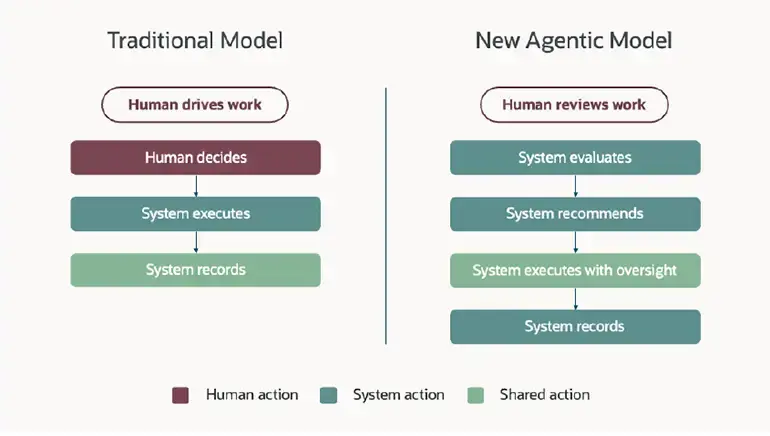
The application becomes an active participant in operations, not a passive database. Instead of static workflows, systems operate through teams of specialized agents, each responsible for a domain of expertise such as forecasting, scheduling, policy compliance, or financial reconciliation.
These agents collaborate toward shared outcomes, continuously evaluating new data and adjusting actions as conditions change. The result is software that carries work forward, rather than waiting for users to manually orchestrate it.
Human in the loop, human in the lead, autonomous execution
The autonomous enterprise does not eliminate the role of people. Instead, it changes how authority is distributed between humans and systems.
Agentic applications allow organizations to operate across three levels of autonomy.
- Human in the loop: The system prepares analysis, identifies risks or opportunities, and recommends the next action. In this level of autonomy, a human reviews and approves before execution. For example, a collections agent may analyze payment patterns and recommend intervention strategies for at-risk accounts.
- Human in the lead: The system continuously advances work while escalating key decisions to humans. For example, a supply chain planning agent may rebalance inventory across distribution centers while escalating capacity trade-offs to planners.
- Autonomous execution: In this level of autonomy, well-defined processes are governed by clear policy and the system automatically executes actions. For example, a financial close agent reconciles transactions and resolves matching exceptions without human intervention.
These models allow organizations to gradually increase autonomy as trust and confidence grow.
Agentic applications across the enterprise
Agentic applications are not confined to a single function. They operate across the enterprise, embedding expertise directly into core business processes for supply chain, HR, finance, and customer experience. The following are some examples:
- Design-to-source (supply chain): Agents monitor supplier performance, pricing signals, and contract obligations, recommending sourcing decisions and supplier adjustments.
- Workforce operations (HCM): Scheduling agents balance staffing needs and employee availability to maintain optimal workforce coverage.
- Collections and revenue operations (ERP): Agents evaluate customer payment behavior, identify delinquency risk, and initiate collection strategies while preserving customer relationships.
- Cross-sell and customer expansion (CX): Customer intelligence agents identify expansion opportunities based on usage signals, purchase history, and contract lifecycle events.
In each case, the application becomes an active operational partner, not simply a reporting system.
Why the system of record matters
Agentic applications are most powerful when they are built directly into the system of record. The reason why is simple: context matters.
The system of record already holds the authoritative business data, such as financial transactions, workforce records, supply chain operations, and customer interactions.
When agents operate inside this environment, they inherit the context, authority, and guardrails required to act safely. This enables agents to understand the full business state, consistently apply policies, execute real transactions, and maintain auditability and governance.
Without this foundation, agents remain disconnected tools. But built into the system of record, they become the engine of the autonomous enterprise.
The rise of the autonomous enterprise
The shift toward agentic applications represents more than a new technology capability—it changes how organizations operate.
In this new model, expertise can be embedded directly into systems, work progresses continuously instead of waiting in queues, and teams can scale their impact far beyond their size.
With agentic applications, organizations can move from managing workflows to managing outcomes. This results in enterprise systems that can do the following:
- Reason across operational data
- Decide on the next best action
- Safely execute work within policy
- Continuously advance the business forward
This is the emergence of the autonomous enterprise.
Fusion Applications: Built for the autonomous enterprise
Oracle Fusion Applications are designed to support this transformation. Because Fusion Applications integrate ERP, HCM, SCM, and CX on a unified data model, agents operate within the full operational context of the enterprise.
This allows Oracle’s agentic applications to do the following:
- Reason across financial, workforce, supply chain, and customer signals
- Apply policies consistently across functions
- Coordinate decisions across departments
- Securely execute real business transactions
In this model, the system of record evolves into a system of outcomes, and Oracle Fusion Applications becomes the platform built for the autonomous enterprise. Learn more about Agentic AI in Fusion Applications.
 Introducing Oracle Fusion Agentic Applications
Learn more about the system of outcomes that is redefining how work works. Oracle Fusion Agentic Applications is a new class of enterprise applications powered by coordinated teams of specialized AI agents that are outcome-driven, proactive and reasoning based, and engineered for enterprise execution.