JavaServer Pages[tm] Technology - White Paper
JAVASERVER PAGES TM
The JavaServer Pages TM (JSP) technology provides a simplified, fast way to create web pages that display dynamically-generated content. JSP technology was designed to make it easier and faster to build web-based applications that work with a wide variety of web servers, application servers, browsers and development tools.
This paper provides an overview of the JSP technology, describing the background in which it was developed and the overall goals for the technology. It also describes the key components of a Java TM technology-based page, in the context of a simple example.
Developing Web-based Applications: A Background .
In its short history, the Worldwide Web has evolved from a network of basically static information displays to a mechanism for trading stocks and buying books. There seems to be almost no limit to the possible uses for web-based clients in diverse applications.
Applications that can make use of browser-based clients have several advantages over traditional client/server based applications. These include nearly unlimited client access and greatly simplified application deployment and management. (To update an application, a developer only needs to change one server-based program, not thousands of client-installed applications.) As a result, the software industry is moving quickly toward building multi-tiered applications using browser-based clients.
These increasingly sophisticated web-based applications require changes in development technology. Static HTML is fine for displaying relatively static content; the challenge has been creating interactive web-based applications, in which the content of the page is based on a user request or system status, not pre-defined text.
An early solution to this problem was the CGI-BIN interface; developers wrote individual programs to this interface, and web-based applications called the programs through the web server. This solution has significant scalability problems -- each new CGI request launches a new process on the server. If multiple users access the program concurrently, these processes consume all of the web server's available resources and the performance slows to a grind.
Individual web server vendors have tried to simplify web application development providing "plug-ins" and APIs for their servers. These solutions are web-server specific, and don't address the problem across multiple vendor solutions. For example, Microsoft's Active Server Pages TM (ASP) technology makes it easier to create dynamic content on a web page, but only works with Microsoft IIS or Personal Web Server.
Other solutions exist, but they are not necessarily easy for the average page designer to deploy. Technologies such as Java Servlets, for example, make it easier to write server-based code using the Java programming language for interactive applications. A Java Servlet is a Java technology-based program that runs on the server (as opposed to an applet, which runs on the browser). Developers can write Servlets that take an HTTP request from the web browser, generate the response dynamically (possibly querying databases to fulfill the request) and then send a response containing an HTML or XML document to the browser.
Using this approach, the entire page must be composed in the Java Servlet. If a developer or web master wanted to tune the appearance of the page, they would have to edit and recompile the Java Servlet, even if the logic were already working. With this approach, generating pages with dynamic content still requires application development expertise.
What is needed, clearly, is an industry-wide solution for creating pages with dynamically-generated content. This solution should address the limitations of current alternatives by:
- Working on any web or application server
- Separating the application logic from the appearance of the page
- Allowing fast development and testing
- Simplifying the process of developing interactive web-based applications
The JavaServer Pages (JSP) technology was designed to fit this need. The JSP specification is the result of extensive industry cooperation between vendors of web servers, application servers, transactional systems, and development tools. Sun Microsystems developed the specification to integrate with and leverage existing expertise and tools support for the Java programming environment, such as Java Servlets and JavaBeans TM . The result is a new approach to developing web-based applications that extends powerful capabilities to page designers using component-based application logic.
The JavaServer Pages Technology Approach to Web Application Development
In developing the JSP specification, Sun Microsystems worked with a number of leading web server, application server and development tool vendors, as well as a diverse and experienced development community. The result is an approach that balances portability with ease-of-use for application and page developers.
JSP technology speeds the development of dynamic web pages in a number of ways:
- Separating content generation from presentation
Using JSP technology, web page developers use HTML or XML tags to design and format the results page. They use JSP tags or scriptlets to generate the dynamic content (the content that changes according to the request, such as requested account information or the price of a specific bottle of wine). The logic that generates the content is encapsulated in tags and JavaBeans components and tied together in scriptlets, all of which are executed on the server side. If the core logic is encapsulated in tags and beans, then other individuals, such as web masters and page designers, can edit the JSP page without affecting the generation of the content.
On the server, a JSP engine interprets JSP tags and scriptlets, generates content (for example, by accessing JavaBeans components, accessing a database with JDBC TM technology, or including files), and sends the results back in the form of an HTML (or XML) page to the browser. This helps authors protect proprietary code while ensuring complete portability for any HTML-based web browser.
- Emphasizing reusable components
Most JSP pages rely on reusable, cross-platform components (JavaBeans or Enterprise JavaBeans TM components) to perform the more complex processing required of the application. Developers can share and exchange components that perform common operations, or make them available to larger user or customer communities. The component-based approach speeds overall development and lets organizations leverage their existing expertise and development efforts for optimal results.
- Simplifying page development with tags
Web page developers are not always programmers familiar with scripting languages. The JavaServer Pages technology encapsulates much of the functionality required for dynamic content generation in easy-to-use, JSP-specific XML tags. Standard JSP tags can access and instantiate JavaBeans components, set or retrieve bean attributes, download applets, and perform other functions that are otherwise more difficult and time-consuming to code.
The JSP technology is extensible through the development of customized tag libraries. Over time, third-party developers and others will create their own tag libraries for common functions. This lets web page developers work with familiar tools and constructs, such as tags, to perform sophisticated functions.
The JSP technology integrates easily into a variety of application architectures, leveraging existing tools and skills, and scaling to support enterprise-wide distributed applications. As part of the Java technology-enabled family, and an integral part of the Java 2, Enterprise Edition architecture, the JSP technology can support highly complex web-based applications.
- Because the native scripting language for JSP pages is based on the Java programming language, and because all JSP pages are compiled into Java Servlets, JSP pages have all of the benefits of Java technology, including robust memory management and security.
- As part of the Java platform, JSP shares the Write Once, Run Anywhere TM characteristics of the Java programming language. As more vendors add JSP support to their products, you can use servers and tools of your choice, changing tools or servers without affecting current applications.
- When integrated with the Java 2 Platform, Enterprise Edition (J2EE) and Enterprise JavaBeans technology, JSP pages will provide enterprise-class scalability and performance necessary for deploying web-based applications across the virtual enterprise.
What Does a JSP Page Look Like?
A JSP page looks like a standard HTML or XML page, with additional elements that the JSP engine processes and strips out. Typically, the JSP elements create text that is inserted into the results page.
The JSP technology is best described using an example. The following JSP page is very simple; it prints the day of the month and the year, and welcomes you with either "Good Morning" or "Good Afternoon," depending on the time of day.
The page combines ordinary HTML with a number of JSP elements:
- Calls to a clock JavaBean component
- An inclusion of an external file (for copyright information)
- JSP expressions and scriptlets
<HTML>

<%@ page language=="java" imports=="com.wombat.JSP.*" %>

<H1>Welcome</H1>


<P>Today is </P>

<jsp:useBean id=="clock" class=="calendar.jspCalendar" />

<UL>

<LI>Day: <%==clock.getDayOfMonth() %>

<LI>Year: <%==clock.getYear() %>

</UL>

<% if (Calendar.getInstance().get(Calendar.AM_PM) ==== Calendar.AM) { %>

Good Morning

<% } else { %>

Good Afternoon

<% } %>

<%@ include file=="copyright.html" %>

</HTML>
The page includes the following components:
- A JSP directive passes information to the JSP engine. In this case, the first line indicates the location of some Java programming language extensions to be accessible from this page. Directives are enclosed in <%@ and %> markers.
- Fixed template data: Any tags that the JSP engine does not recognize it passes on with the results page. Typically, these will be HTML or XML tags. This includes the Unordered List and H1 tags in the example above.
- JSP actions, or tags: These are typically implemented as standard tags or customized tags, and have an XML tag syntax. In the example, the jsp:useBean tag instantiates the Clock JavaBean on the server.
- An expression: The JSP engine evaluates anything between <%== and %> markers. In the List Items above, the values of the Day and Year attributes of the Clock bean are returned as a string and inserted as output in the JSP file. In the example above, the first list item will be the day of the year, and the second item the year.
- A scriptlet is a small script that performs functions not supported by tags or ties everything together. The native scripting language for JSP 1.0 software is based on the Java programming language. The scriptlet in the above sample determines whether it is AM or PM and greets the user accordingly (for daytime users, at any rate).
The example may be trivial, but the technology is not. Businesses can encapsulate critical processing in server-side Beans, and web developers can easily access that information, using familiar syntax and tools. Java-based scriptlets provide a flexible way to perform other functions, without requiring extensive scripting. The page as a whole is legible and comprehensible, making it easier to spot or prevent problems and to share work.
A few of these components are described in more detail below.
JSP Directives
JSP pages use JSP directives to pass instructions to the JSP engine. These may include the following:
- JSP page directives communicate page-specific information, such as buffer and thread information or error handling.
- Language directives specify the scripting language, along with any extensions.
- The include directive (shown in the example above) can be used to include an external document in the page. A good example is a copyright file or company information, file -- it is easier to maintain this file in one central location and include it in several pages than to update it in each JSP page. However, the included file can also be another JSP file.
- A taglib directive indicates a library of custom tags that the page can invoke.
JSP Tags
Most JSP processing will be implemented through JSP-specific XML-based tags. JSP 1.0 includes a number of standard tags, referred to as the core tags. These include:
jsp:useBean This tag declares the usage of an instance of a JavaBeans component. If the Bean does not already exist, then the JavaBean component instantiates and registers the tag.
jsp:setProperty This sets the value of a property in a Bean.
jsp:getProperty This tag gets the value of a Bean instance property, converts it to a string, and puts It in the implicit object "out".
jsp:include
jsp:forward
The 1.1 release will include additional standard tags.
The advantage of tags is that they are easy to use and share between applications. The real power of a tag-based syntax comes with the development of custom tag libraries, in which tool vendors or others can create and distribute tags for specific purposes.
Scripting Elements
JSP pages can includes include small scripts, called scriptlets, in a page. A scriplet is a code fragment, executed at request time processing. Scriptlets may be combined with static elements on the page (as in the example above) to create a dynamically-generated page.
Scripts are delineated within <% and %> markers. Anything within those markers will be evaluated by the scripting language engine, in our example the Java virtual machine on the host.
The JSP specification supports all of the usual script elements, including expressions and declarations.
Application Models for JSP Pages
A JSP page is executed by a JSP engine, which is installed in a web server or a JSP-enabled application server. The JSP engine receives requests from a client to a JSP page, and generates responses from the JSP page to the client.
JSP pages are typically compiled into Java Servlets. Java Servlets are a standard Java extension, described in more detail at www.java.sun.com. The page developer has access to the complete Java application environment, with all of the scalability and portability of the Java technology-enabled family.
When a JSP page is first called, if it does not yet exist, it is compiled into a Java Servlet class and stored in the server memory. This enables very fast responses for subsequent calls to that page. (This avoids the CGI-bin problem of spawning a new processes for each HTTP request, or the runtime parsing required by server-side includes.)
JSP pages may be included in a number of different application architectures or models. JSP pages may be used in combination with different protocols, components and formats. The following sections describe a few of the possibilities.
A Simple Application
In a simple implementation, the browser directly invokes a JSP page, which itself generates the requested content (perhaps invoking JDBC to get information directly from a database). The JSP page can call JDBC or Java Blend TM components to generate results, and creates standard HTML that it sends back to the browser as a result.

This model basically replaces the CGI-BIN concept with a JSP page (compiled as a Java Servlet). This method has the following advantages:
- It is simple and fast to program
- The page author can easily generate dynamic content based on the request and state of the resources.
This architecture works well for many applications, but it does not scale for a large number of simultaneous Web-based clients accessing scarce enterprise resources, since each must establish or share a connection to the content resource in question. For example, if the JSP page accesses a database, it may generate many connections to the database, which can affect the database performance.
A Flexible Application with Java Servlets
In another possible configuration, the Web-based client may make a request directly to a Java Servlet, which actually generates the dynamic content, wraps the results into a result bean and invokes the JSP page. The JSP page accesses the dynamic content from the bean and sends the results (as HTML) to the browser.
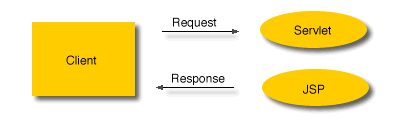
This approach creates more reusable components that can be shared between applications, and may be implemented as part of a larger application. It still has scalability issues in terms of handling connections to enterprise resources, such as databases.
Scalable Processing with Enterprise JavaBeans Technology
The JSP page can also act as a middle tier within an Enterprise JavaBeans (EJB) architecture. In this case, the JSP page interacts with back end resources via an Enterprise JavaBeans component.

The EJB component manages access to the back end resources, which provides scalable performance for high numbers of concurrent users. For e-commerce or other applications, the EJB manages transactions and underlying security. This simplifies the JSP page itself. This model will be supported by the Java 2 Enterprise Edition (J2EE) platform.
Integrating XML Technology in JSP Pages
JSP pages can be used to generate both XML and HTML pages.
For simple XML generation, developers can include XML tags and static template portions of the JSP page. For dynamic XML generation, use server-based Beans and customized tags that generate XML output.
JSP pages are not incompatible with XML tools. Although Sun designed the JSP specification so that JSP pages would be easy to author, even by hand, the JSP specification also provides a mechanism for creating an XML version of any JSP page. In this way, XML tools can author and manipulate JSP pages.
You can use JSP pages with XML-based tools by converting JSP tags and elements to their XML-compatible equivalents. For example, a scriptlet can be included within <% and %>, or within the XML-based tags <jsp:scriptlet> and </jsp:scriptlet>. In fact, it is possible to convert a JSP page into an XML page by following a few simple steps, including:
- adding a JSP root element
- converting elements and directives into XML-compatible equivalents
- creating CDATA elements for all other (typically non-JSP) elements on the page
With this XML-compatible alternative approach, page designers creating HTML pages still have an easy-to-use environment for quickly creating dynamic web pages, while XML-based tools and services can integrate JSP pages and work with JSP-compliant servers.
The Future for JSP Technology
JSP technology is designed to be an open, extensible standard for building dynamic web pages. Developers will use JSP pages to create portable web applications that can run with different web and application servers for different markets, using whatever authoring tools fit their market and their needs.
By working with a consortium of industry leaders, Sun has ensured that the JSP specification is open and portable. You should be able to author JSP pages anywhere and deploy them anywhere, using any client and server platforms. Over time, tool vendors and others will extend the functionality of the platform by providing customized tag libraries for specialized functions.