5 Types of EHRs and Their Most Important Features
Michael Hickins | Senior Writer | April 20, 2026

Modern electronic health record (EHR) systems provide healthcare organizations and patients with a wide range of features. In addition to containing data on patients’ medical histories and treatments, they can also help clinicians make more-informed diagnoses, and when integrated with enterprise application suites, they can help hospital administrators manage staff, financials, and supply chains.
This article discusses the different types of EHR systems and the features to consider when evaluating them.
What Is an Electronic Health Record (EHR) System?
Electronic health record systems typically include a wide range of patient health information, including past diagnoses, treatments, medications, lab results, and lifestyle factors. They also include physicians’ notes, patient appointments, and data that pertains to other related business processes, such as billing and staff scheduling.
Key Takeaways:
- Modern EHR systems use AI built into their code to reduce the number and types of repetitive tasks caregivers perform so that they can focus more time and attention on patient care.
- Data contained within EHR systems should be easily accessible to patients and caregivers, but protected securely so that only people entitled to see the data can access it.
- EHR systems should provide healthcare organizations with data reporting and analytics to help assess quality of care given to patients.
5 Types of EHR Systems
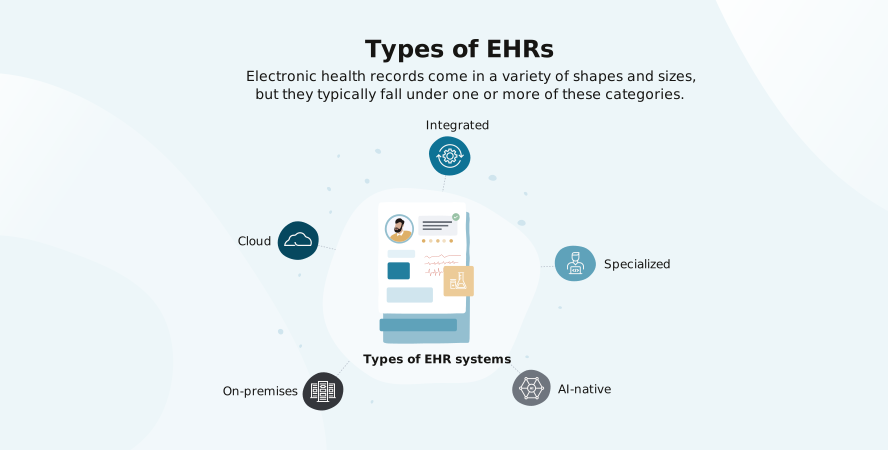
EHR systems differ in a number of important ways, most notably how they’re managed and the scope of support each offers. These are the five main types of EHRs:
- On-premises EHR systems. Also known as conventional or legacy systems, these EHRs are run and maintained in data centers owned or leased by the practice, clinic, or hospital. The software runs locally and is typically updated only sporadically. The onus of keeping these systems up and running, protecting the sensitive patient data they contain, and upgrading them to new versions falls to in-house IT staff, who often rely on expensive outside consultants for help. These EHRs come with large up-front license fees and annual maintenance fees.
- Cloud-based EHR systems. These EHR systems run entirely on servers managed by the cloud provider in its geographically dispersed data centers. The cloud vendor is responsible for keeping these EHRs up and running, securing their data, and delivering upgrades to customers (over the internet) on a regular basis. Because these systems are typically delivered as a subscription service, they don’t require customers to invest up front in their own supporting hardware, networking, or storage.
- Specialized EHR systems. These EHR systems are developed for specialized practices, such as oncology or pediatrics. They’re often included as part of a specific piece of healthcare equipment, such as an oncology radiation machine.
- Integrated EHR systems. These systems, also known as enterprise systems, include the core on-premises or cloud-based EHRs but are also integrated with back-office HR, supply chain, and/or finance applications. Such integration can enable a healthcare organization to schedule staffing from its human capital management application based on information contained in its patient portal or appointment scheduling software tied to its EHR system.
- AI-native EHR systems. Also known as agentic EHR systems, these platforms are designed with AI in mind, as opposed to having AI bolted on after the fact. They include AI agents that can help perform specific tasks within a workflow—such as sending follow-up instructions to patients, coordinating with insurance companies and other payers, and ordering lab tests—without requiring human intervention at each step. Agentic EHR systems can also pull data from separate data repositories, such as imaging, billing, and lab systems, thus helping coordinate not only care but also revenue collection and other back-office functions.
Features to Consider When Choosing an EHR
Most healthcare organizations already use some form of electronic health record. But many are now transitioning to more comprehensive systems that help connect patient records across individual hospitals within a network, connect to systems used by other organizations, give patients access to their own records, and connect to ERP, HCM, supply chain, and other back-office applications. Features to consider when evaluating HER systems include the following:
- Data security. The most secure EHRs encrypt data at rest and while in motion, identify weak passwords, build in strict access controls, detect and send alerts about anomalous activities, and provide logs for audit investigations. AI capabilities embedded in the latest cloud EHRs can even help organizations respond to attacks in progress.
- Interoperability. To facilitate the exchange of data, any new EHR system needs to be interoperable not only with other internal systems but also with third-party EHR, medical research, lab, government, population health, and pharmacy systems, as well as with other specialized systems.
- Patient data management. The system should be able to aggregate and store patient data from a variety of sources, including manual inputs, medical devices, and remote or mobile devices, and it should allow for analysis of this data in a secure environment that complies with HIPAA and other data privacy regulations. Data collected can include demographic information, medical histories and updates, and even information about a patient’s lifestyle.
- Scalability. Growing patient populations and increased adoption of AI, telehealth, remote patient observation, and other healthcare technologies make EHR scalability a top priority. Scalability refers to the ability of healthcare providers and their vendors to add or subtract EHR users/seats (including at multiple locations), adjust the underlying storage capacity and data processing power, and adopt new technologies in response to demand shifts.
- Workflow optimization. EHRs aren’t just for patient health records; they can help healthcare organizations improve business processes, such as staffing, and role-specific workflows, such as nursing and anesthesiology. AI in cloud-based EHRs has helped reduce manual work by performing tasks such as summarizing and inputting draft notes into the EHR for the clinician’s approval, responding to patient requests for prescription refills made through the patient portal, and automating appointment scheduling.
- E-prescribing. Most US states now require healthcare providers to submit prescriptions to pharmacies electronically rather than give patients slips of paper to pass along. This practice helps reduce fraud and abuse, and it helps ensure that patients receive the right medications.
- Reporting and analytics. Analytics capabilities built into EHRs can help healthcare organizations improve care directly by, for example, evaluating patients’ health status over time to determine if a given treatment regimen is effective. Analytics and reporting can also improve an organization’s performance by tracking quality-of-care metrics, patient safety events, readmission rates, inventory levels, patients with unpaid bills, and other factors.
- Clinical decision support (CDS). CDS tools provide physicians with best-practice treatment guidelines for patients presenting certain symptoms at the point of care. They can also remind clinicians of patients’ drug allergies or the need to perform certain tests, and they can automate the reordering of tests or medications. They can also produce summaries of patient medical histories and provide access to reference materials.
- AI and predictive analytics. EHRs can use AI in a variety of ways. For example, physicians can tap AI-based natural language processing capabilities to summarize their conversation with a patient and input those notes into the patient’s health record, freeing them from this time-consuming clerical work. AI can also be used to suggest the procedure codes most likely to be approved by the payer, or to extract data from various health systems to help inform diagnoses and treatments.
- Customization. Vendors of the latest cloud-based EHRs discourage customers from customizing their products, for good reason. Cloud EHRs already build in industry best practices, and customized EHRs are difficult to upgrade and can cause data security issues. However, healthcare providers can configure their cloud EHRs by adding new fields, setting up specific permissions or access rights, or adding features to support unique business activities, such as an onsite drug formulation.
- User-friendliness. While there’s a learning curve with the introduction of any new system, the more intuitive the user interface is, the flatter the curve will be. When evaluating EHRs, put a premium on ones with a UI that has a modern and familiar feel, similar to that of a consumer app.
- Telemedicine integration. Data in EHR systems should flow to and from video-based telemedicine systems, allowing practitioners to see patient records in real time on such calls while also ensuring data from the remote session is captured by the EHR. The EHR system should also automate billing and claims submissions for telemedicine visits and allow patients to schedule new appointments.
- Mobile access. Practitioners should be able to access the full range of the EHR system’s capabilities from their smartphones or tablets.
- Patient portal. Patient portals should reflect the patient data that’s contained in an EHR. They are, in many ways, the mirror image of what practitioners see, only with different access rules and permissions. Patients should be able to access their full healthcare histories through these portals, including diagnoses, treatments, prescriptions, and lab results, as well as book appointments and communicate with their individual caregivers.
- Task management. EHR systems should be able to automate clinical tasks such as note-taking, entering patients’ vitals, and practitioner recommendations, as well as automatically share anonymized health data with relevant authorities to help them identify health trends or the appearance of a new pathogen.
- Medical billing. EHR systems, especially ones with embedded AI, can help automate billing by suggesting billing codes, validating claims before submissions to reduce denials, and triggering electronic claims submissions.
- Vendor reputation. This isn’t so much an EHR feature as an important consideration when evaluating different types of EHRs. The #1 consideration is the vendor’s reputation for producing quality software, which entails interoperability with other systems as well as system reliability, security, and regulatory compliance. Also consider its reputation for providing support during the implementation process, meeting implementation deadlines, and training users at all levels of the organization after the implementation. Healthcare organizations should also consider the panoply of different applications a vendor can offer and its track record for innovating and keeping its customers on the cutting edge of technology.
New, cloud-based EHRs can increase efficiency and enhance care by helping clinicians gain a complete, accurate view of their patients.
Choose Oracle Health EHR for Your Unique Healthcare Needs
Oracle Health EHR offers a range of capabilities designed with both clinicians and patients in mind. For example, it can collate cleaned-up data from multiple providers, identify necessary tests to help cohorts of patients stay healthy, and determine which patients need follow-up appointments to help providers meet quality targets. The EHR runs on Oracle Cloud Infrastructure, enhancing the security of the sensitive health data it holds. Additionally, embedded AI capabilities enable physicians to navigate the EHR using plain language commands, filter information about specific illnesses, access patient histories to prepare for visits, and use ambient listening to capture relevant information from physician-patient conversations and generate draft visit summaries for physician review.
Types of EHRs FAQs
What are the different types of electronic records systems?
Broadly speaking, there are two main types of EHR platforms: ones where the application and its data are managed by healthcare providers in their own data centers and accessed locally, and ones where they’re managed by vendors in their data centers and accessible over the internet.
What training is required for EHR systems?
Users, with guidance and support materials provided by the vendor, need to learn how to navigate the system and how to perform the functions specific to their role, whether that’s intake, clinical work, or back-office administration.
What are examples of EHR data?
EHR data can include medical histories, demographic information, diagnoses, medications, allergies, lab results, and treatment plans.