
AI Data Platform
Oracle AI Data Platform unifies your enterprise data, creates and applies the business context AI needs to act accurately, and deploys agents that automate workflows, decisions, and processes—across every function, at enterprise scale. It’s one platform, end to end, with a governed data foundation and embedded intelligence.
What's new in Oracle AI Data Platform?
-
ISG Buyers Guide™ for AI and Data Platforms 2026
The Buyers Guide highlights leading providers in AI, data management, deployment capabilities, and more. Read it now to see why Oracle was named an Overall Leader.
-
Build AI That Works for Business
AI is only as good as its foundation. Discover how Oracle AI Data Platform provides a trusted, governed environment to help build accurate AI at scale.
-
3 Ways Enterprise AI Helps Pay Off for Financial Services Firms
Discover how Oracle AI Data Platform helps financial services firms unify trusted data, apply industry models, and embed AI into core workflows so teams can act on insights faster.
-
5 Ways Oracle AI Data Platform Can Benefit Your Business
Discover five key ways Oracle AI Data Platform can transform your enterprise data and AI initiatives.

See AI deliver business outcomes
Join us at Oracle AI World in Las Vegas from October 25 to 28 to see how Oracle’s AI and other technology innovations are helping organizations solve challenges across industries. Hear from Oracle leaders, explore demos and case studies, and connect with experts and peers.
Why Oracle AI Data Platform?
Enterprise AI succeeds when three things come together: data your organization trusts, context that reflects how your business actually operates, and intelligence embedded where decisions happen.
-
Trusted enterprise data
Enterprise AI is only as reliable as the data behind it. Oracle AI Data Platform unifies structured and unstructured data across your business systems, including Oracle Fusion Cloud ERP, SCM, HCM, customer experience (CX), and non-Oracle sources, into a single foundation. Data can stay secure and support your compliance requirements, accessed in place or moved through trusted, lineage-tracked pipelines, so AI operates on complete, accurate information rather than fragmented copies.
-
Deep business semantics
AI models understand language. They don't inherently understand your business. Oracle AI Data Platform encodes the metrics, relationships, domain logic, and process context that define how your organization operates across finance, supply chain, HR, and customer operations. Agents and analytics built on this semantic layer can reason in your business language and can produce outputs that are consistent, explainable, and trusted by the people making decisions.
-
AI in the flow of work
AI creates value only when it acts. Oracle AI Data Platform embeds agents and intelligence directly into business workflows where decisions are made—inside Oracle Applications and across third-party operational systems. Embedded AI surfaces recommendations, optimizes approvals, and drives action at the point where it changes outcomes.
AI Data Platform customer success stories
-
University College Dublin aims to improve chronic care with Oracle AI Data Platform
Using Oracle AI Data Platform, the UCD Clinical Research Centre is transforming respiratory care, turning unstructured clinical data into actionable insights. By combining synthetic and open data sets, they built a research analytics tool to support chronic disease research and data analysis.
-
Clopay drives manufacturing success with Oracle AI Data Platform
Clopay® Garage Doors is using Oracle AI Data Platform to transform how it understands and serves its customers. With millions of unique SKUs across its product line, Clopay replaced manual spreadsheet analysis with AI-powered insights that accurately predict dealer churn and reveal trends before they happen—driving stronger business performance, better decisions, and improved profitability.
Explore Oracle AI Data Platform
AI Data Platform agents
Build, deploy, and govern enterprise agents alongside the data they need. AI Data Platform's integrated workbench gives developers and domain experts visual and code-based ways to create agentic workflows and move them into production.
- Build visually or in code
Use a visual canvas, Python, notebooks, and open development frameworks in a common environment. - Connect enterprise context and tools
Give agents governed access to enterprise data, knowledge, models, APIs, MCP servers, and reusable tools. - Test and deploy with control
Evaluate each step in an integrated playground and deploy on managed AI compute with identity, access controls, tracing, and observability.
Lakehouse capabilities in AI Data Platform
Bring structured, semistructured, and unstructured data together in one complete lakehouse—accessed where it lives or moved to without unnecessary duplication. Transform raw data into trusted, AI-ready information for analytics, machine learning, and AI agents. One lakehouse. One environment.
- Bring all your data together
Connect to enterprise data across Oracle and non-Oracle sources while extending the existing data estate. - Create one path from raw data to AI-ready
Use managed Apache Spark to prepare data and Oracle Autonomous AI Database to deliver curated information for analytics, machine learning, and agents. - Build trust into every stage
Apply cataloging, lineage, and access controls so downstream users and AI workloads share the same governed foundation.
Security and governance in AI Data Platform
Bring security, access control, catalog governance, lineage, and auditability into the same environment used to build and run data, analytics, models, and agents.
- Keep authority with the customer
Customers define identities, roles, policies, permissions, approvals, and execution boundaries. - Govern data and AI together
Apply catalog, access, metadata, lineage, versioning, and lifecycle controls across AI Data Platform–managed and cataloged assets. - Collaborate without losing control
Use permission-aware discovery, separated workspace and data access, and explicitly authorized data sharing. - Maintain traceability
Use audit and operational records to understand data access, user activity, agent interaction, and administrative change.
See AI Data Platform in Action
Data Engineer
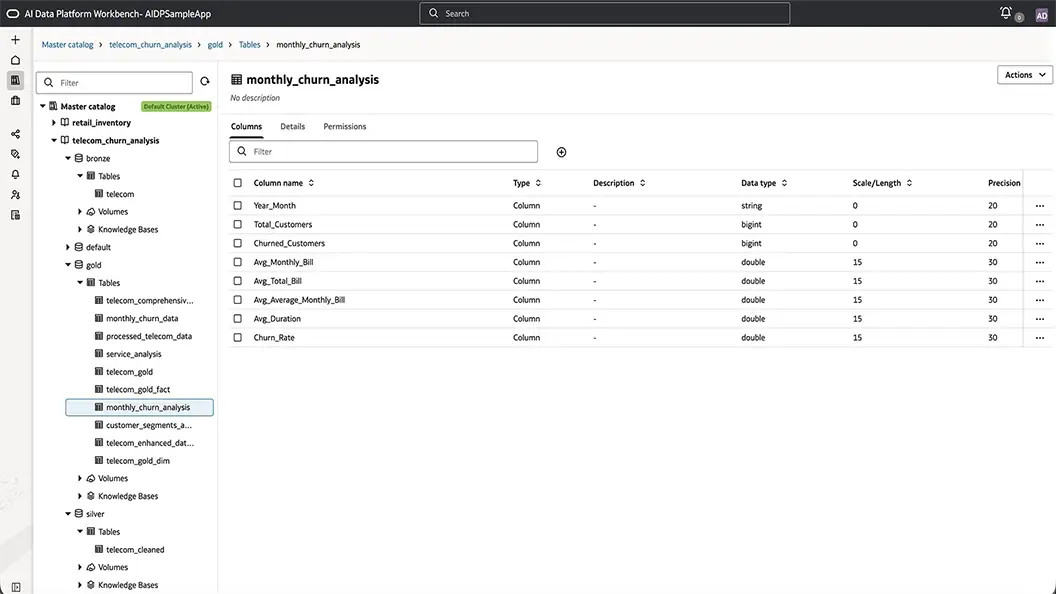
Build a complete lakehouse from raw data to AI-ready gold
Oracle AI Data Platform gives data engineers one path from ingestion to consumption across structured and unstructured data. Raw data lands in object storage, is refined with Spark into trusted silver data sets, and is delivered as curated gold data ready for analytics, AI agents, and downstream applications.
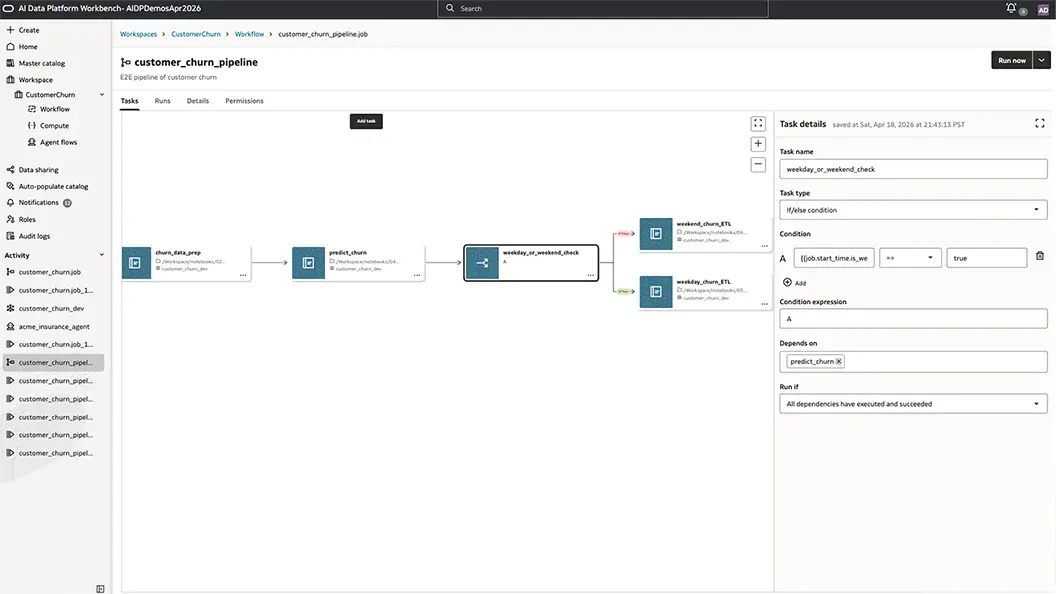
Design pipelines in one managed workspace
Data engineers can build ingestion, transformation, and enrichment pipelines via workflow jobs without switching platforms. This shortens development cycles while keeping every stage access-controlled, reusable, and easier to operate at enterprise scale.
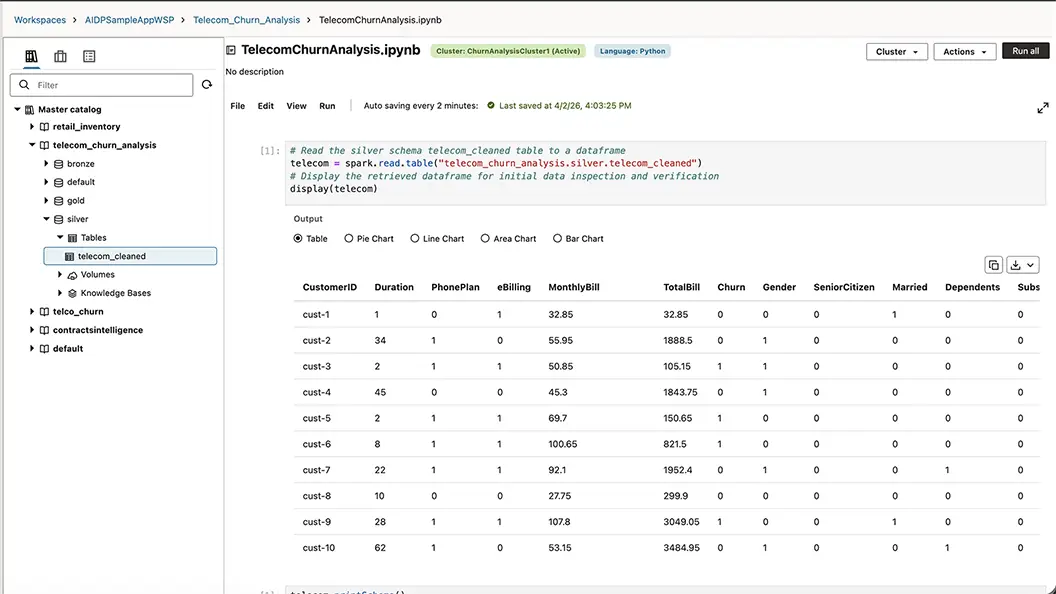
Run Spark and SQL where your data already lives
Teams can use Spark for large-scale processing and SQL for fast exploration and reporting, choosing the best engine for each workload. With in-place access across object storage and connected databases, engineers can analyze and prepare data without unnecessary movement or duplication.
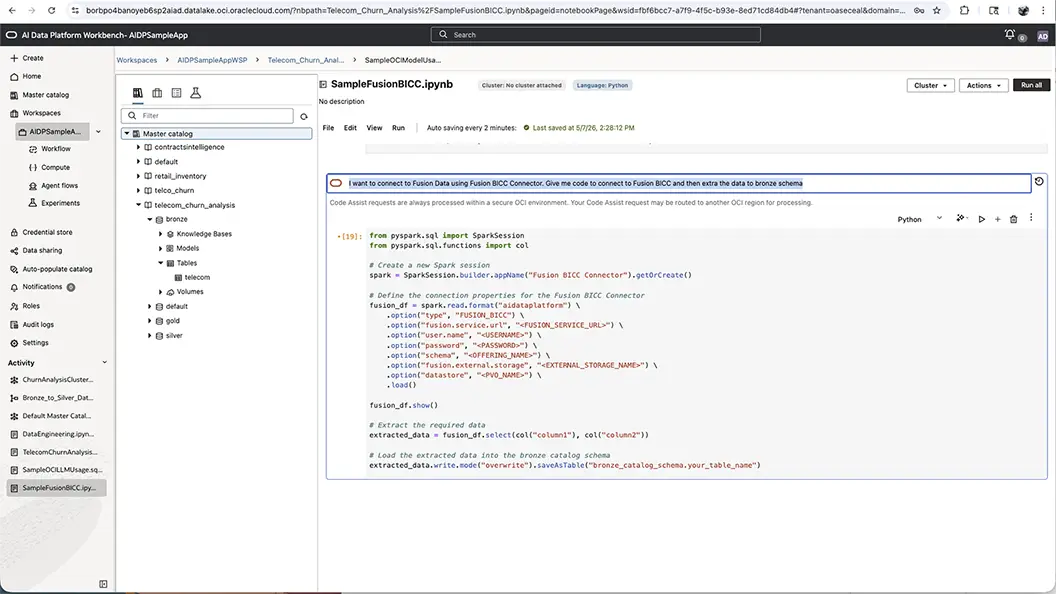
Accelerate pipeline delivery with AI-assisted engineering
AI-assisted development helps engineers move from source connection to production-ready pipeline faster with code generation, smart recommendations, and guided workflow creation. Combined with direct Oracle Fusion data integration, teams can quickly transform ERP, HCM, SCM, and CX data into managed AI-ready assets.
Data Steward
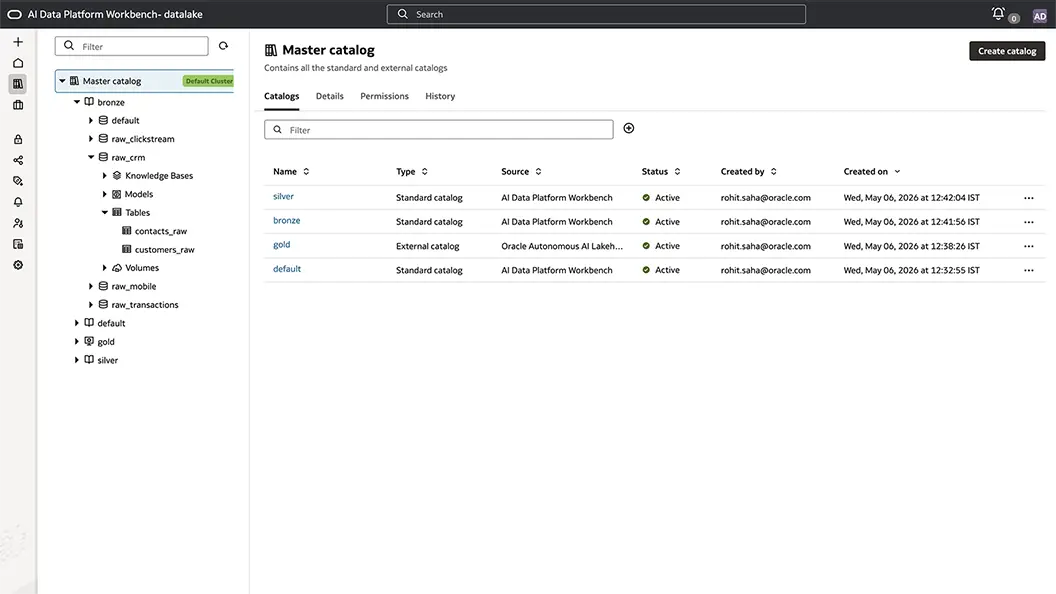
A unified metadata layer across your entire Oracle Cloud data estate
The master catalog serves as the central metadata layer, registering and organizing metadata without moving or copying underlying data. It connects to data where it resides across Autonomous AI Database, Oracle Database, and OCI Object Storage, covering both structured assets, such as tables, views, and schemas, and unstructured data.
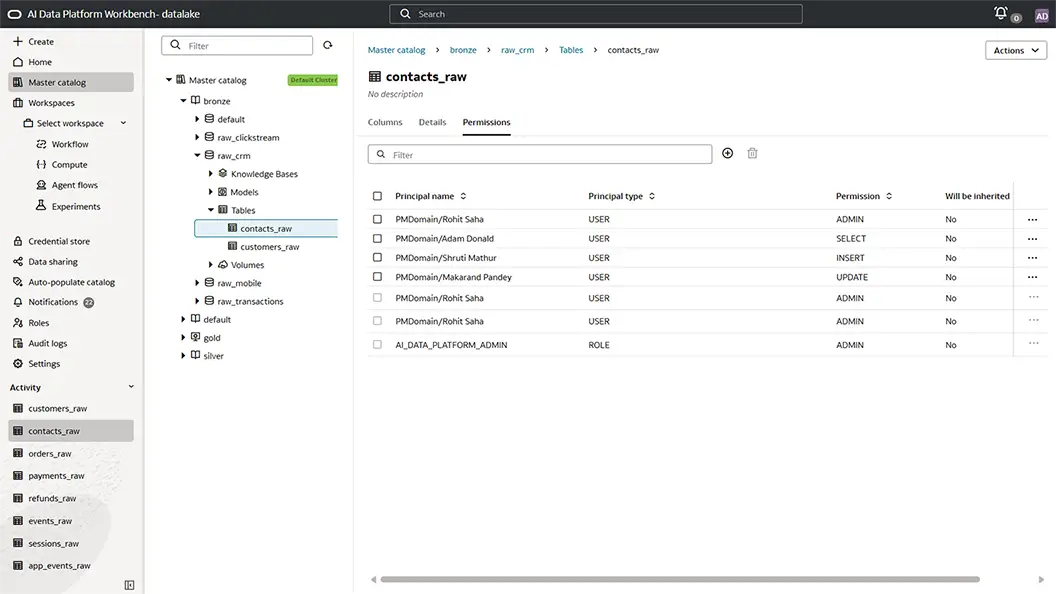
Consistent access control across all AI and data workloads
A centralized role-based access management framework designed to support secure data usage. Oracle AI Data Platform's workbench provides fine-grained access controls and policy management at the data layer, helping organizations manage how users and AI workloads access data while supporting scalable AI initiatives.
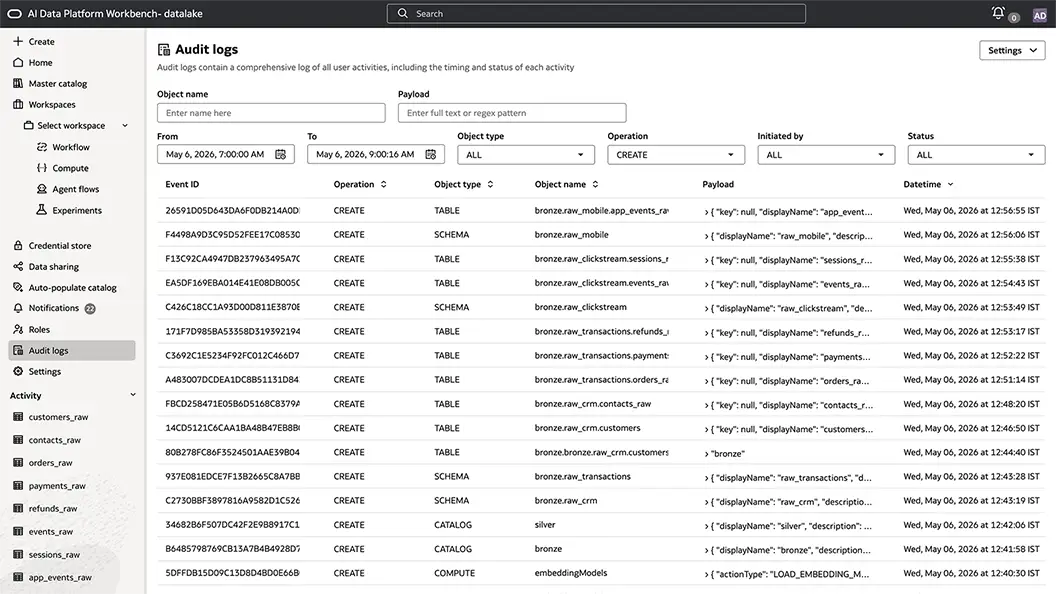
Complete visibility into data access across all AI and data workloads
Provide transparency and security with audit logs that track who accessed what data, when, and how. Gain end-to-end visibility with Oracle AI Data Platform's workbench for auditing and operational oversight.
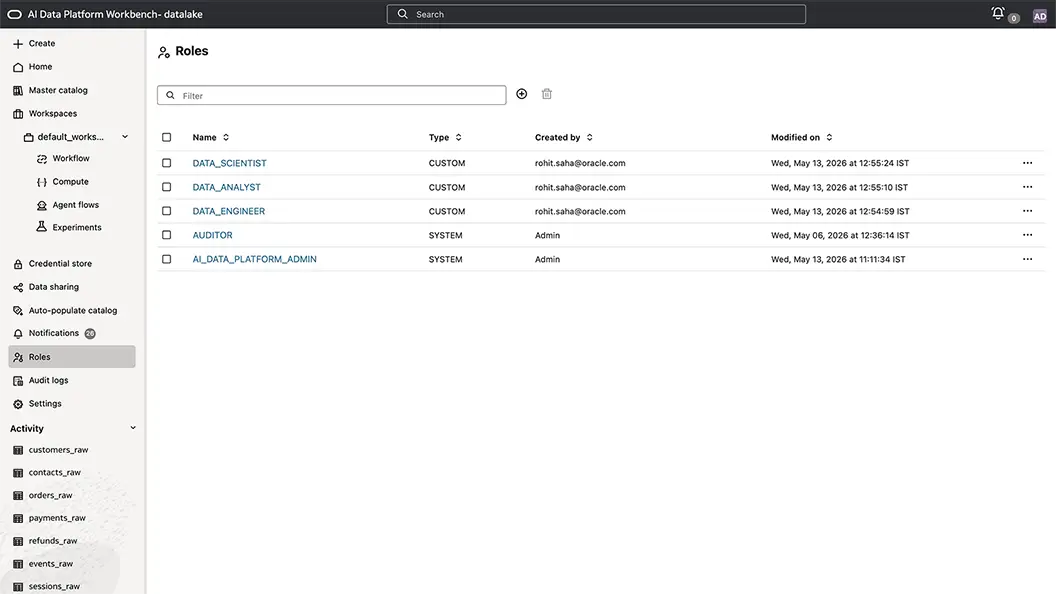
Role-based access management across AI and data workloads
Define and manage roles to ensure users and AI workloads have appropriate access to data, tools, and platform resources. Granular role-based controls simplify administration, strengthen security, and make it easier to apply access policies.
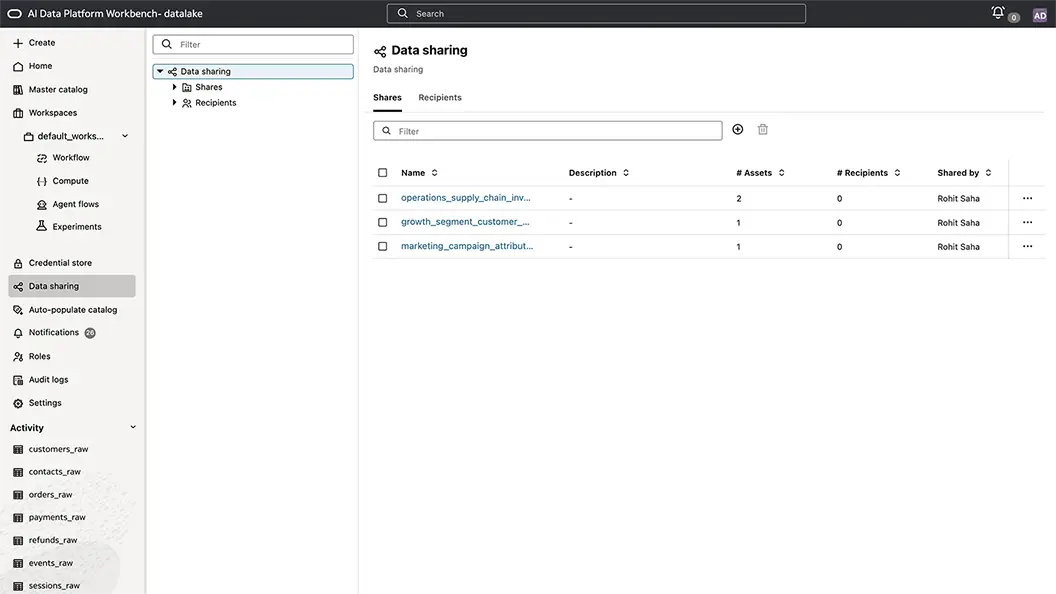
Seamless data sharing
Securely share data across teams and projects without unnecessary duplication or data movement. Oracle AI Data Platform enables controlled, policy-driven data sharing that improves collaboration, accelerates access to trusted data, and simplifies enterprise-scale data operations.
Data Scientist
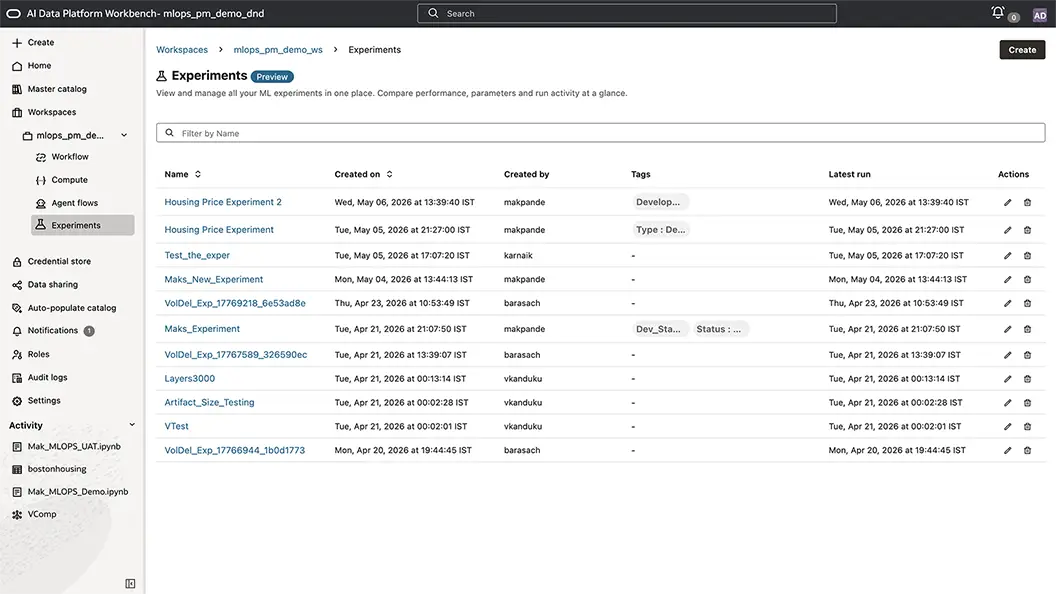
Experiment tracking for every team workspace
Experiments in Oracle AI Data Platform's workbench keep teams separated by workspace while autologging captures parameters, metrics, and artifacts, creating a reproducible history that reduces rework and makes it easy to rerun past experiments with controlled changes. AI Data Platform's workbench handles the administrative tasks so data scientists can focus on the science.
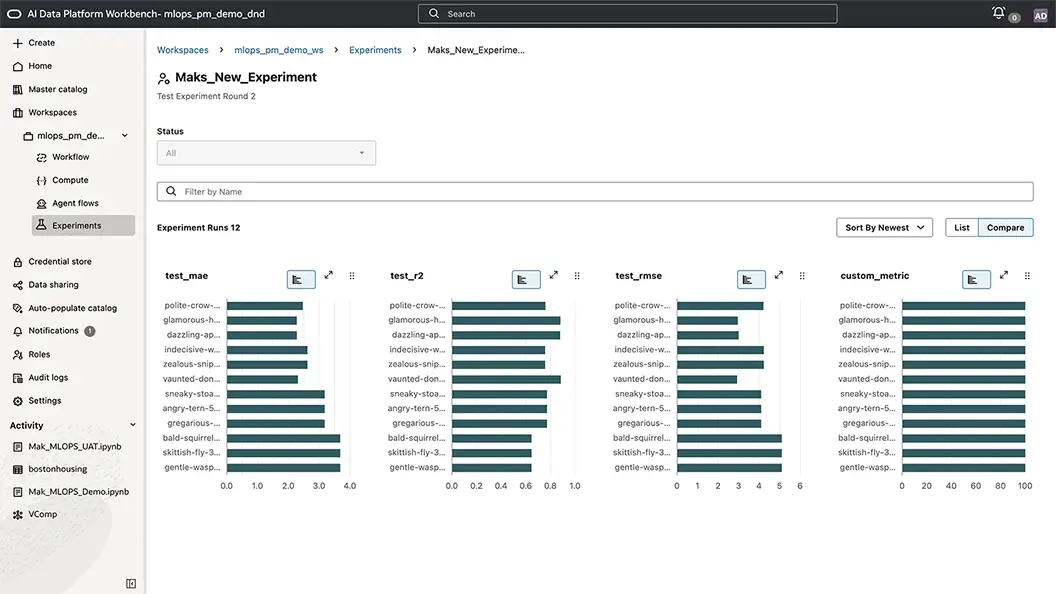
Promote the winning models to the registry with a one-click run comparison
Data scientists can filter and compare runs to identify the top performer, then register it from the experiment run into the master catalog–backed model registry with versions, tags, and custom fields, turning “best run” into a shared, discoverable champion asset. AI Data Platform automatically manages versions when improvements are made.
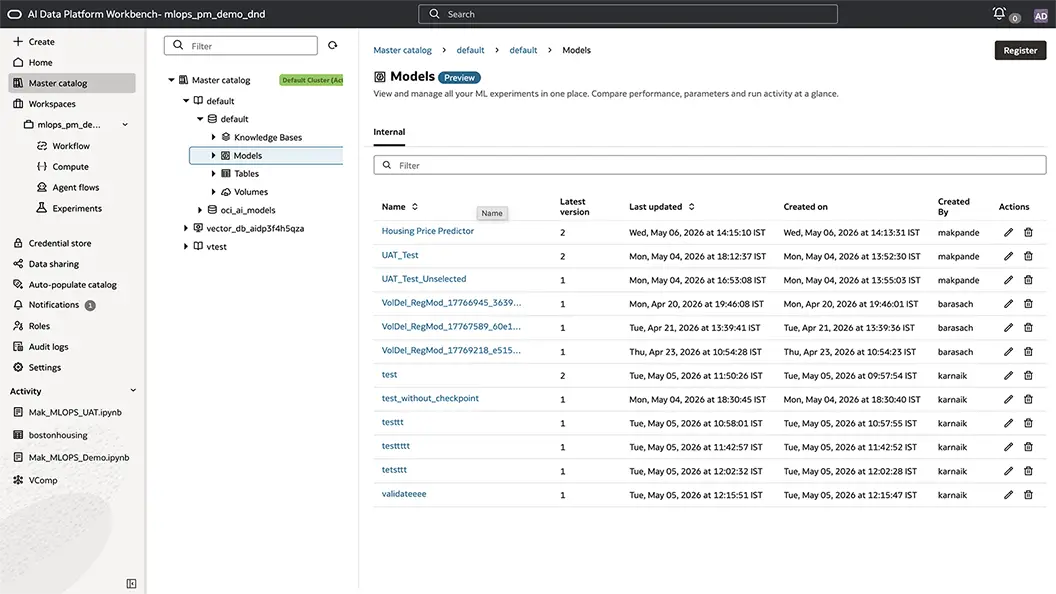
From best model to inference, no packaging overhead
Promote the best model into the registry with automatic versioning, tags, and custom metadata, making it easy to discover and reuse the right model without relying on institutional knowledge or side channels. Load the latest or a specific version directly into notebooks and run batch inference. AI Data Platform keeps everything from experimentation to inferencing simple, consistent, and repeatable.
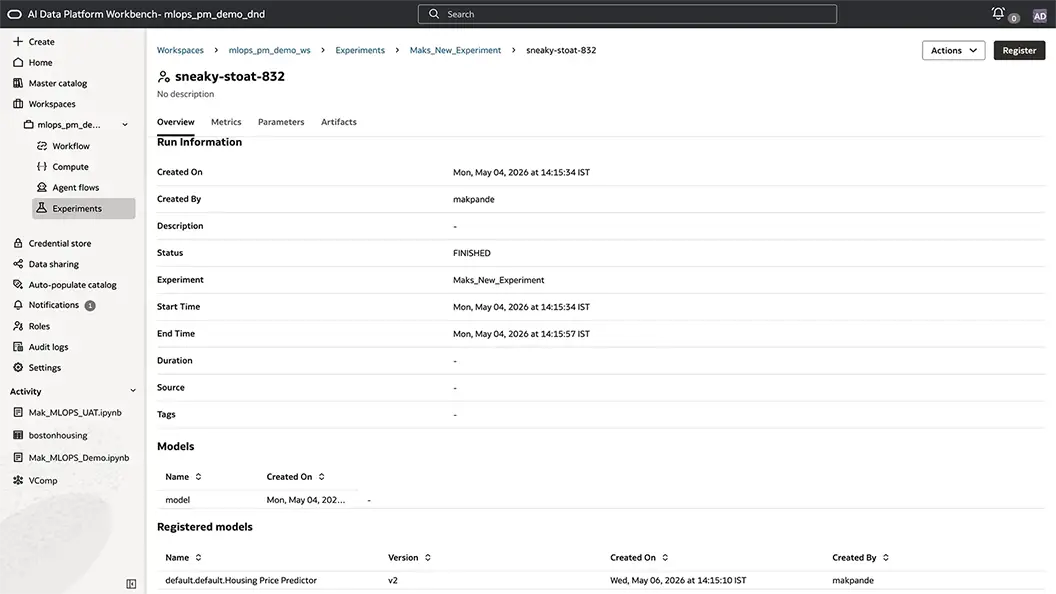
End-to-end lineage helps to make models generated explainable and auditable
Registered models in AI Data Platform trace back to the exact experiment run that produced them, surfacing lineage and run conditions, such as hyperparameters, environment variables, metrics, and artifacts. Teams can understand what was built, how it was built, and why it performs the way it does.
AI Developer
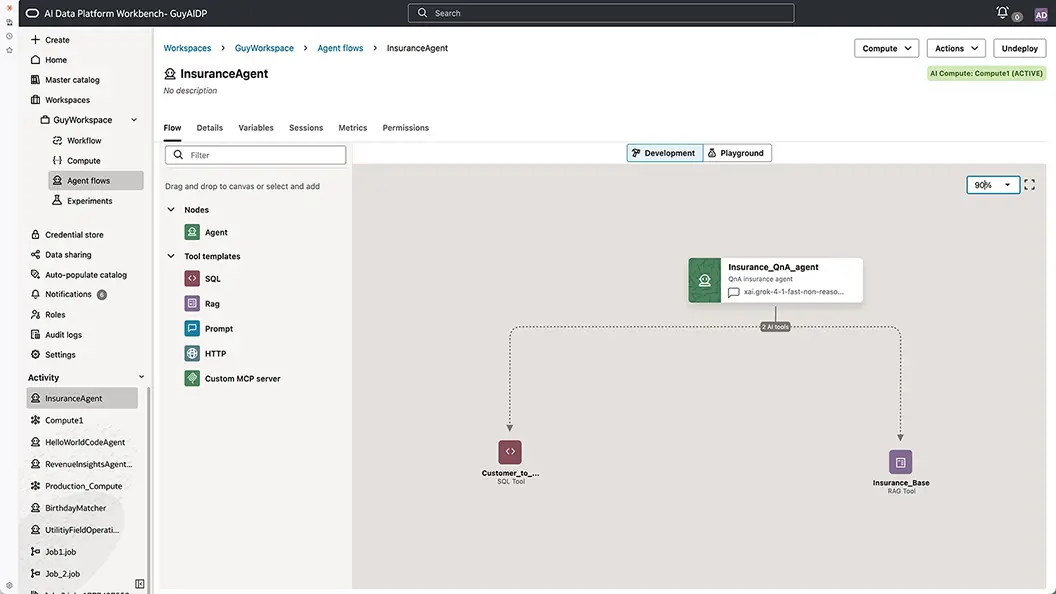
A unified platform for building, managing, and deploying enterprise AI
Oracle AI Data Platform brings together the tools, integrations, access management and audit capabilities teams need to take AI from development to production. Build agents and applications using visual low-code tools or code-first notebooks, grounded in enterprise knowledge through native vector store integration linked to the master catalog. Best-in-class LLMs are available via OCI Generative AI and Oracle AI Database 26ai, with full lifecycle management ensuring every AI asset is registered, versioned, and tested. Fusion AI Agent Studio integration lets custom agents embed directly into Oracle SaaS applications—closing the loop between AI development and real-world business workflows.
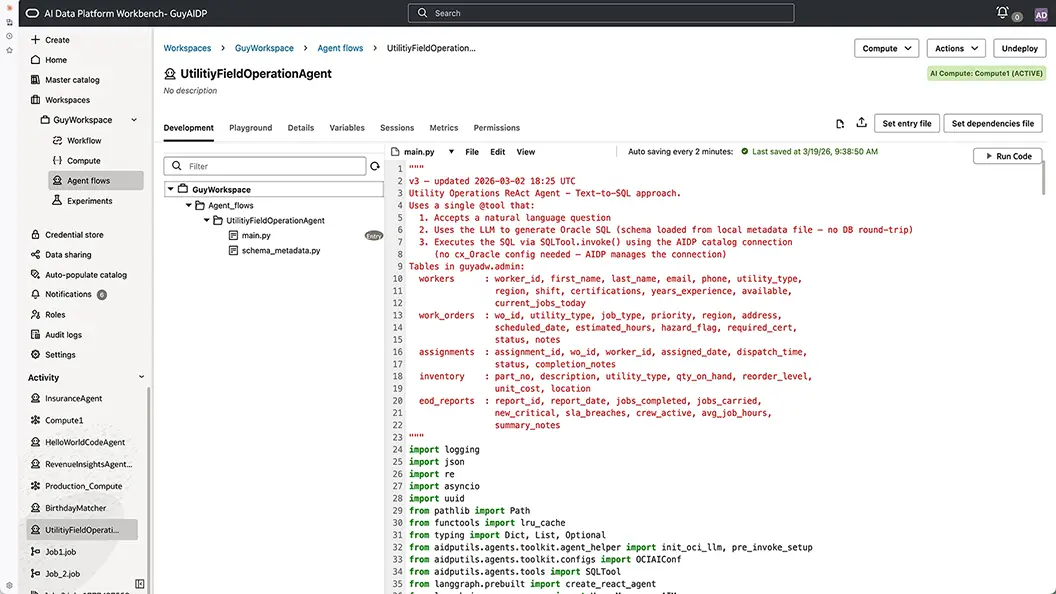
High-code agent development with full platform power
Define agent flows in code using LangGraph, open source frameworks, and third-party Python libraries within AI Data Platform. The built-in utilities library gives agents seamless access to model configuration, guardrails, and system tools, such as RAG, MCP, SQL, and prompt management. Code-built or canvas-built, all flows test through the same unified playground.
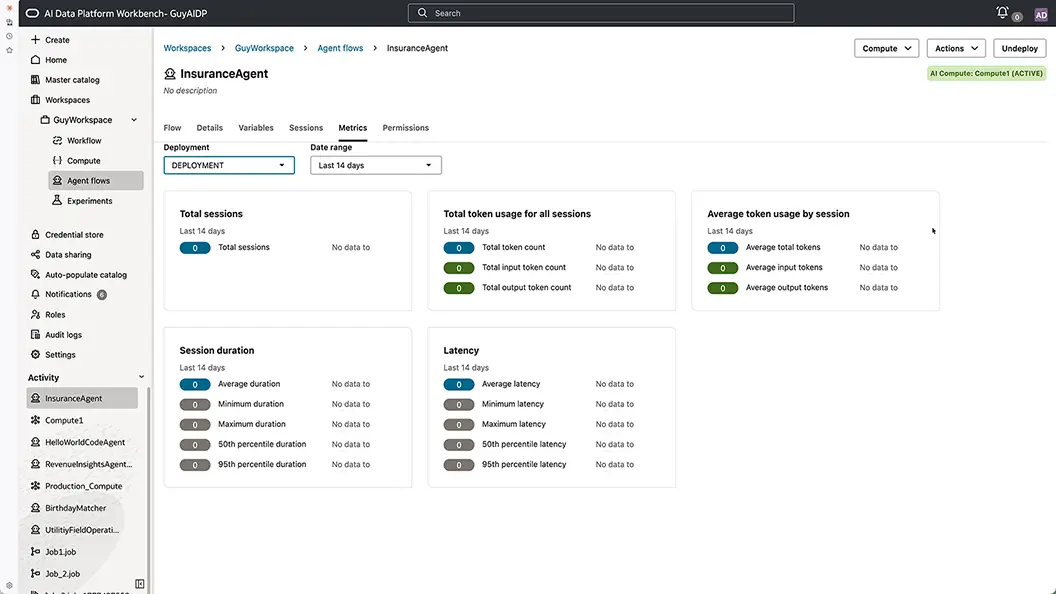
End-to-end observability built into the platform
Oracle AI Data Platform provides built-in observability tools that give teams full visibility into how their AI agents are performing in production. From tracing individual runs to monitoring outputs and surfacing issues in real time, teams can detect, diagnose, and resolve problems without leaving the platform.
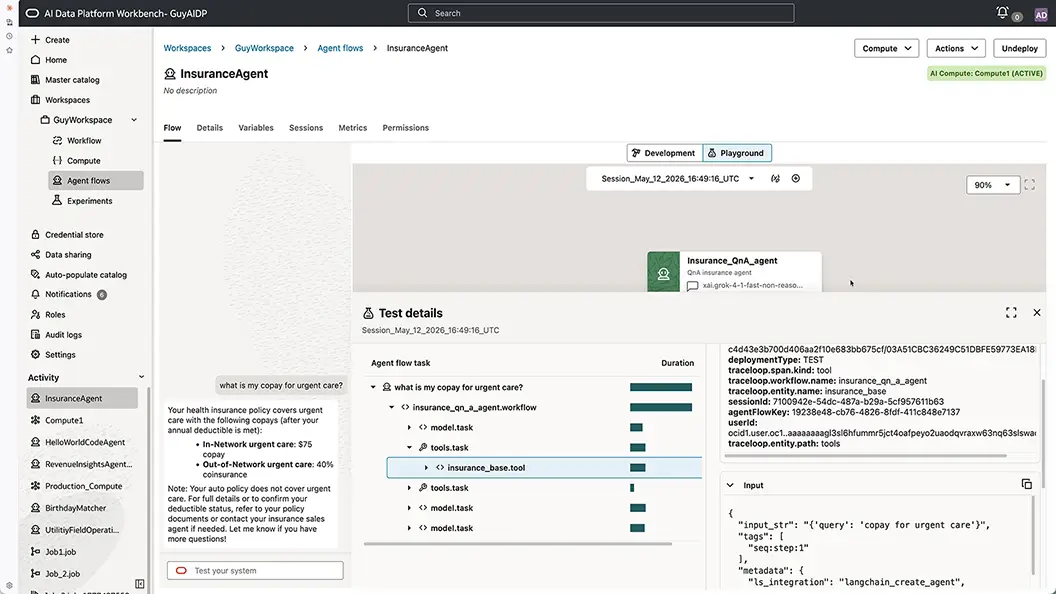
Flexible agent building, testing, and debugging with traceability and an integrated playground
Oracle AI Data Platform supports both no-code, canvas-style agent flow definition and code-based development through LangGraph, giving teams the freedom to build the way they work best. Dedicated build and test panels let developers iterate quickly, with changes made in the build phase immediately available in a comprehensive testing playground so teams can move from idea to working agent flow without unnecessary friction.
Business User
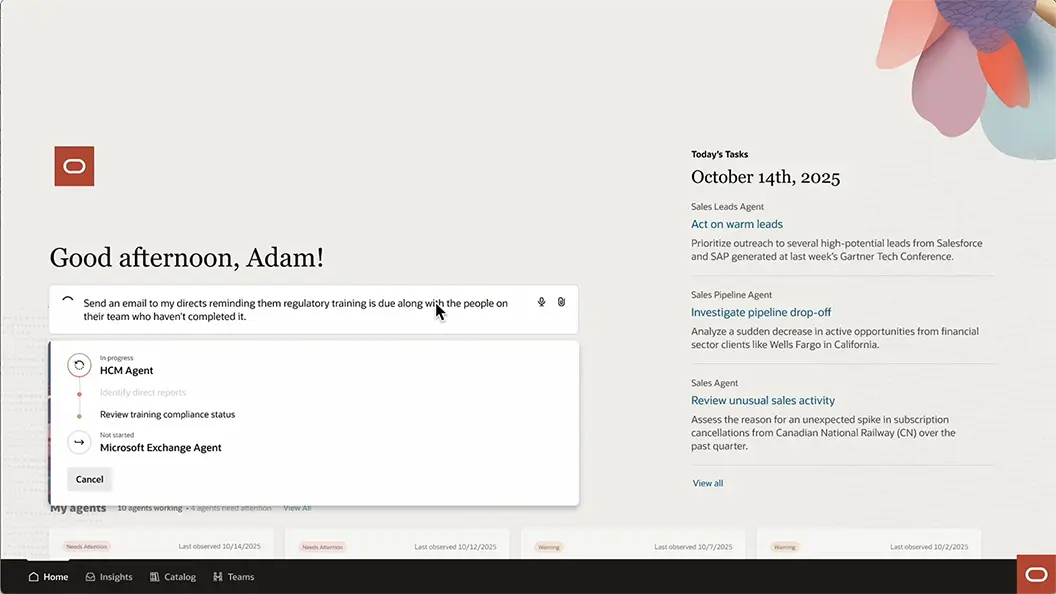
All your agents in one place
Every AI agent your organization uses, whether built in-house, embedded in Oracle Fusion, or connected from third-party systems, will be accessible from a single conversational interface. Ask a question, get automatically routed to the right agent, and pick up exactly where you left off with full session history preserved across every interaction.
Featured AI Data Platform blogs
Agents vs. Workflows: Where Does the ROI Actually Live?
Most enterprises aren’t failing with AI agents because of the technology—they’re failing because they’re using agents where simple workflows would do the job better. This blog explains the key differences between workflows and autonomous agents, and how choosing the right approach impacts ROI, scalability, governance, and cost. It also provides a practical framework for deciding when agentic AI is truly worth the investment.

-
September 18, 2026
Agents, Tools, and Skills: A More Efficient Approach to Enterprise AI
-
August 12, 2026
Your Data Already Knows the Answer. Now It Can Act on It.
-
June 30, 2026
Oracle Leads Across ISG Research AI and Data Platform Categories