 文章
身份和安全性
文章
身份和安全性
| |||
|


在涉及 Oracle WebLogic 和 Oracle Service Bus 的架构中使用 Oracle Security Token Service
作者:Ronaldo Fernandes
使用 Oracle Security Token Service 生成安全断言标记语言 (SAML) 令牌。
2014 年 1 月
下载
Oracle Security Token Service
Oracle WebLogic Server
Oracle Service Bus
最近,我对 Oracle Security Token Service (OSTS) 在涉及 Oracle 融合中间件(主要是 Oracle WebLogic Server (WLS)、Oracle Web Service Manager (OWSM) 和 Oracle Service Bus (OSB))的架构中的使用进行了概念验证。许多安全场景都可以使用 OSTS,但最初目标是使用 OSTS 生成安全断言标记语言 (SAML) 令牌,以在 WLS 和 OSB 之间提供一次性登录。本文介绍该解决方案的实施步骤。
情景
该解决方案是在 OWSM 上实现的,用到了 OSB 11g (11.1.1.6)、Oracle Access Manager (OAM) 11gR2 (11.1.2) 和 WLS 11g (10.3.6)。Security Token Service (STS) 创建并验证安全令牌,它使用 WS-Trust 等协议,在安全基础架构中充当集中点,并简化异质环境间的身份传播。
OSTS 是一个 Oracle 身份管理访问管理解决方案。有关 OSTS 的详细信息,请查阅 Oracle 融合中间件 A 团队解决方案架构师 Andre Correa 的以下文章:
概念验证要求 WLS 上的客户端使用 SAML 访问 OSB 提供的服务。SAML 断言应由 OSTS 生成。
WLS 可以使用 WS-Trust 策略并与 OSTS 通信,但 OSB 11g 仍然不支持 WS-Trust 策略。要解决此问题,请将 OSB 配置为信任 OSTS 证书签名的消息。以下是完整场景:
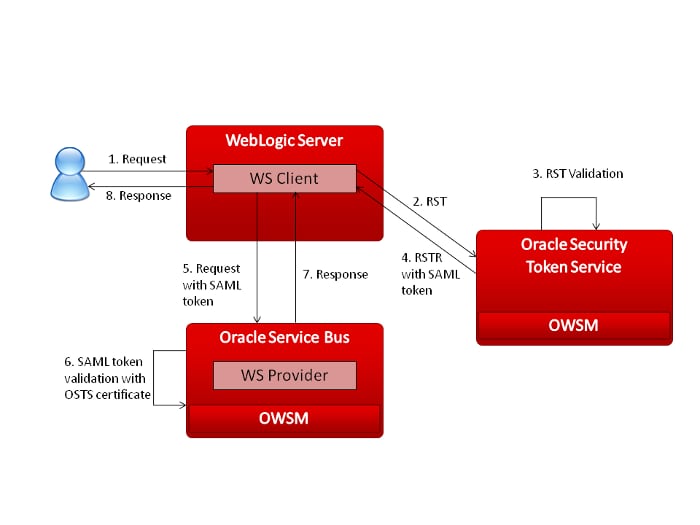
图 1:OSTS 场景
- 用户使用 BASIC 身份验证调用 WLS 上的 Web 服务
- WLS 对用户身份进行验证并使用请求安全令牌 (RST) 调用 OSTS
- OSTS 验证 RST
- OSTS 返回包含 SAML 令牌的请求安全令牌响应 (RSTR)
- WLS 从 RSTR 获取 SAML 断言调用 OSB 上的 Web 服务
- OSB 对照 OSTS 证书验证 SAML 断言
- OSB 向 WLS 返回响应
- WLS 向 OSB 返回响应
配置
Oracle Security Token Service
访问 OAM 控制台(例如 http://<host>:<port>/oamconsole>),确保已启用 STS:
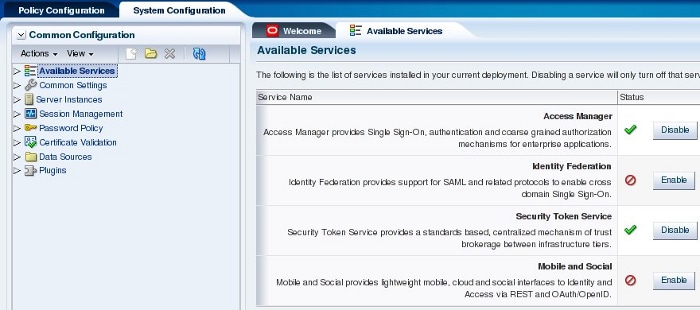
图 2:OSTS 已启用
请求方
请求方代表需要调用服务的客户端。可以为请求配置“签名和加密”,但在本场景中并无此必要。
在 Security Token Service 部分中,访问 Partners > Requesters,使用以下配置创建一个请求方:
- Partner Name:Test Client
- Partner Profile:request-profiler
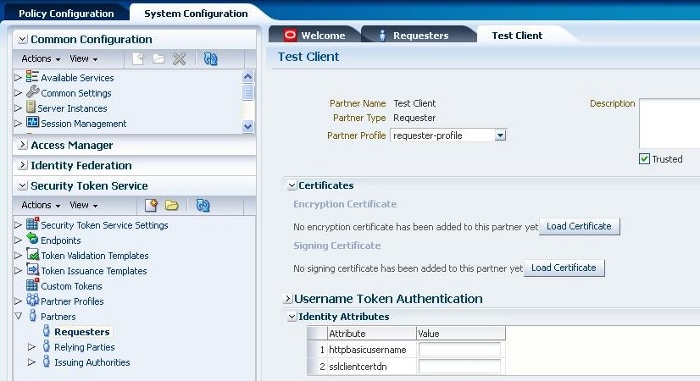
图 3:创建请求方
依赖方
依赖方代表要访问的资源。在此场景中,这代表 OSB 提供的服务端点。
使用以下配置创建一个依赖方:
- Partner Name:OSB_Test
- Partner Profile:Relying Party
- Resource Pattern:
https://osb.oracleads.com:8012/Testsec/Proxy_Service/Test - Description:OSB Test Service
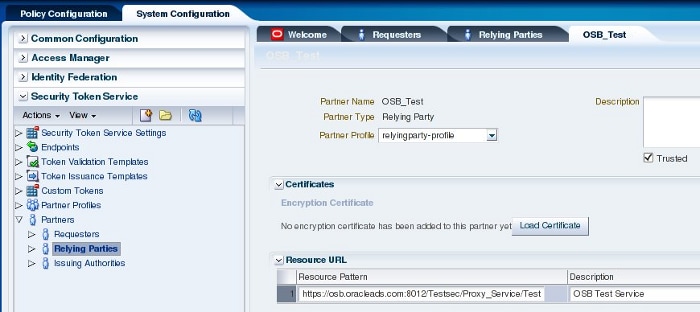
图 4:创建依赖方
颁发机构
颁发机构是负责颁发所需令牌的实体。
使用以下配置创建一个颁发机构:
- Partner Name:Test Issue Authority
- Issuer ID:TestIssuerID
- Partner Profile:issuingauthority-profile
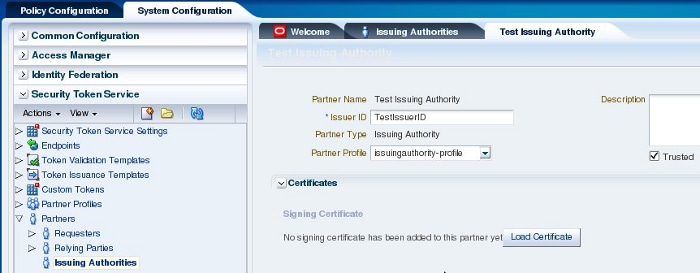
图 5:创建颁发机构
合作伙伴配置文件 (issuingauthority-profile) 颁发 SAML 令牌。
令牌颁发模板
令牌颁发模板定义如何构造令牌。在本例中,我们使用模板 saml20-issuance-template。
此模板定义断言颁发方。该值稍后将用于 OSB 代理服务安全。该模板还告知将如何验证代理用户。因为将对照 WebLogic 领域检查此用户,在本例中,将 Name Identifier Format 值更改为 Unspecified,将 Name Identifier User Attribute 值更改为 givenname。
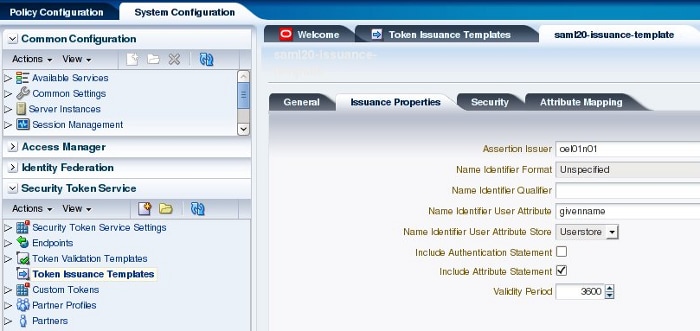
图 6:SAML 2.0 颁发模板
应用程序域
应用程序域定义资源的访问规则。
使用名称 Services 创建一个应用程序域:
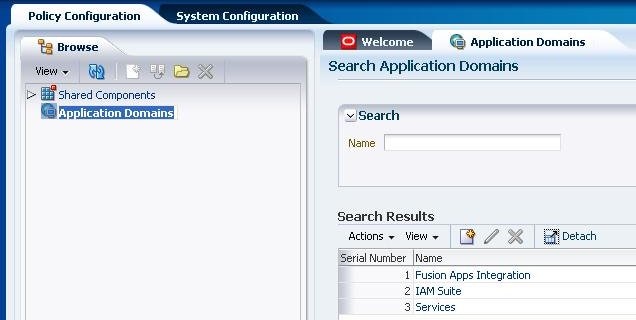
图 7:创建应用程序域
这是访问应用程序域 Services、映射要访问的资源 (OSB Web Service) 和访问规则所必需的。
资源
访问 Services 应用程序域。在 Resources 选项卡中,创建一个资源,它引用先前创建的资源:
- Type:TokenServiceRP
- Resource URL:OSB_Test
- Operations:All、ISSUE
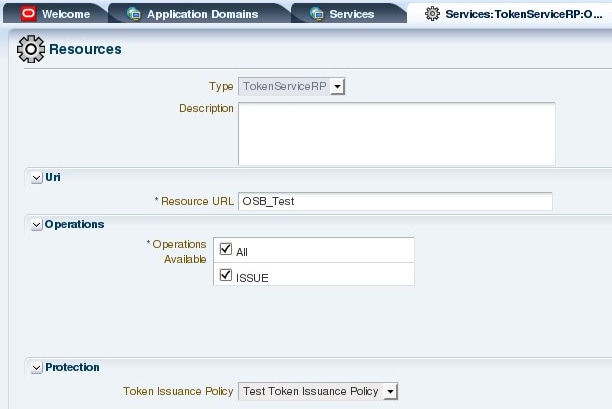
图 8:创建资源
令牌颁发策略
在 Token Issuance Policies 选项卡中,创建一个没有授权限制的策略:
- Name(图 9):Test Token Issuance Policy
- Resources(图 10):OSB_Test
- Conditions(图 11):
- Name:TRUE
- Type:true
- Allow Rule(图 12):TRUE (True)
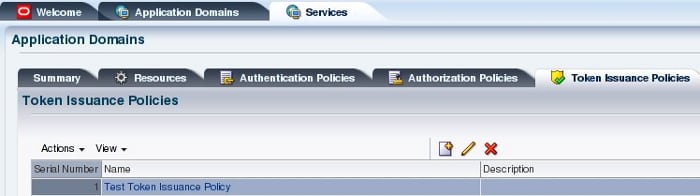
图 9:创建令牌颁发策略
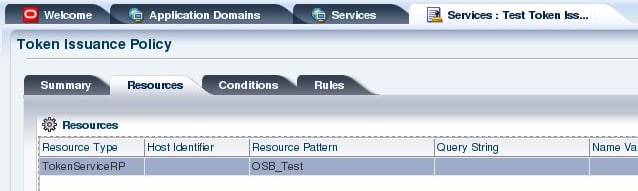
图 10:创建令牌颁发策略资源
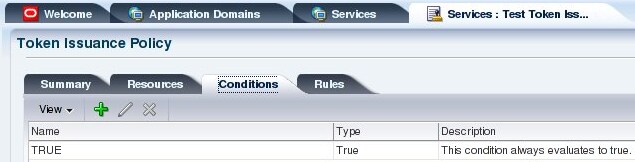
图 11:创建令牌颁发策略条件
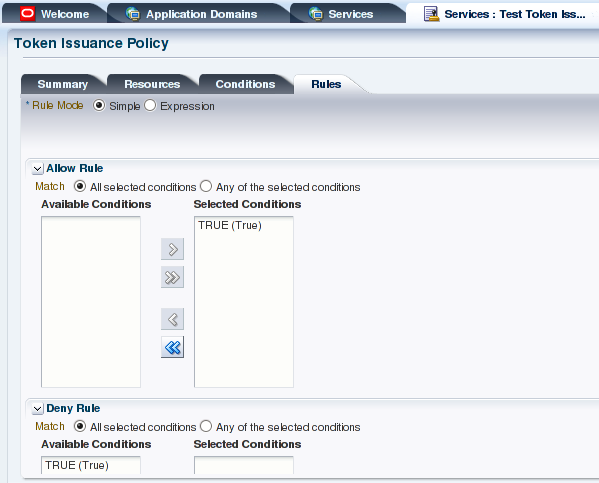
图 12:创建令牌颁发策略规则
WebLogic 控制台
访问 OSTS WebLogic 控制台,创建一个名为 pocsamlclient 的用户。
按照前面的定义,OSTS 将根据属性 givenname 验证用户名。因此将此属性的值更改为 pocsamlclient:
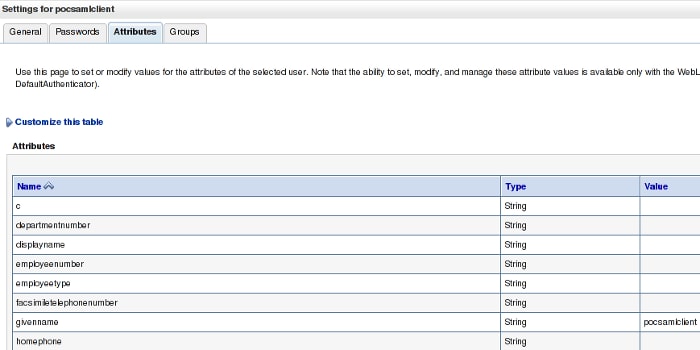
图 13:创建用户
Oracle Service Bus
创建一个名为 Test 的代理服务,路径为 Testsec/Proxy_Service:
Testsec/Proxy_Service/Test
代理服务接收并返回一个简单文本:
<xsd:schema targetNamespace="http://www.example.org/Test/">

      <xsd:element name="hello">

        <xsd:complexType>

          <xsd:sequence>

            <xsd:element name="in" type="xsd:string"/>

          </xsd:sequence>

        </xsd:complexType>

      </xsd:element>

      <xsd:element name="helloResponse">

        <xsd:complexType>

          <xsd:sequence>

            <xsd:element name="out" type="xsd:string"/>

          </xsd:sequence>

        </xsd:complexType>

      </xsd:element>

    </xsd:schema>
代理将接收一条包含安全头的消息。删除这些头,然后用替换节点将回答发送回客户端:
- XPath: .
- In Variable:header
- Expression:
<soap-env:Header/>
用一条消息替换响应,用户名串接在原始文本上。
示例:
<soap-env:Body>
<ns0:helloResponse>
          <out>{ concat('username = ', $inbound/ctx:security/ctx:messageLevelClient,
           ', text = ', $hello1/in) }</out>
</ns0:helloResponse>
</soap-env:Body>
将此策略与代理服务关联:
oracle/wss-saml20_token_bearer_over_ssl_service_policy
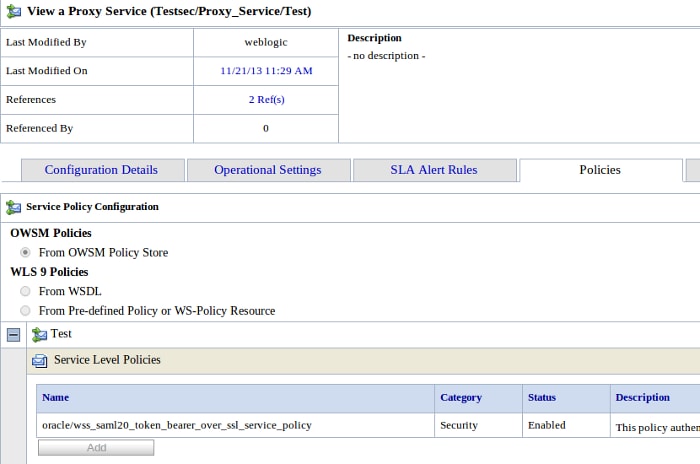
图 14:OSB 代理服务策略
此策略要求 SAML 2.0 作为持有者并使用 SSL。
在 Security 选项卡中,用 OSTS 颁发方覆盖 saml.trusted.issuers 属性:
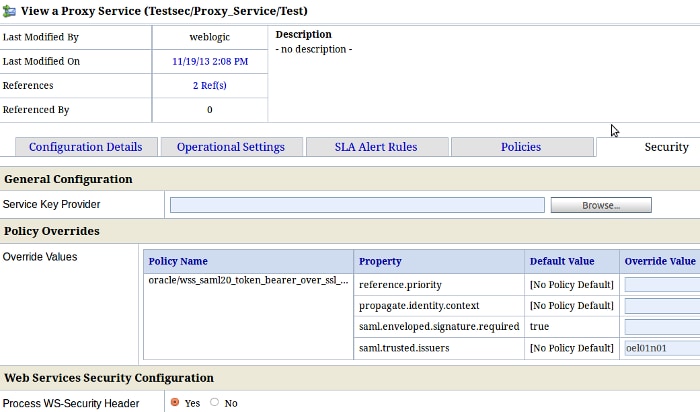
图 15:OSB 代理服务安全
OSB 收到的断言是用 OSTS 证书签名的。您必须从下面的 URL 获取此证书,并将其导入 Oracle Web Services Manager (OWSM) 密钥库:
http://<osts_host>:<osts_port>/sts/servlet/samlcert?id=osts_encryption&encoding=der
WebLogic Server
在本例中,客户端将使用策略 wss11user 从 OSTS 请求令牌,这要求按用户名进行身份验证,并使用 OSTS 证书对密码加密:
<?xml version="1.0"?>

<wsp:Policy xmlns:wsp="http://schemas.xmlsoap.org/ws/2004/09/policy"
xmlns:wsu="http://docs.oasis-open.org/wss/2004/01/oasis-200401-wss-wssecurity-utility-1.0.xsd"
    wsu:Id="wss11_username_token_with_message_protection_service_policy">
  <sp:SymmetricBinding
  xmlns:sp="http://schemas.xmlsoap.org/ws/2005/07/securitypolicy">
  <wsp:Policy>
    <sp:ProtectionToken>
    <wsp:Policy>
      <sp:X509Token
    sp:IncludeToken="http://schemas.xmlsoap.org/ws/2005/07/securitypolicy/IncludeToken/Never">
        <wsp:Policy>
          <sp:RequireThumbprintReference />
          <sp:WssX509V3Token11 />
        </wsp:Policy>
      </sp:X509Token>
    </wsp:Policy>
    </sp:ProtectionToken>
     <sp:AlgorithmSuite>
          <wsp:Policy>
               <sp:Basic128 />
          </wsp:Policy>
     </sp:AlgorithmSuite>
     <sp:Layout>
          <wsp:Policy>
               <sp:Lax />
          </wsp:Policy>
     </sp:Layout>
     <sp:IncludeTimestamp />
     <sp:OnlySignEntireHeadersAndBody />
  </wsp:Policy>
  </sp:SymmetricBinding>
    <sp:SignedSupportingTokens
    xmlns:sp="http://schemas.xmlsoap.org/ws/2005/07/securitypolicy">
    <wsp:Policy>
      <sp:UsernameToken
      sp:IncludeToken=
     "http://schemas.xmlsoap.org/ws/2005/07/securitypolicy/IncludeToken/AlwaysToRecipient">
        <wsp:Policy>
          <sp:WssUsernameToken10 />
        </wsp:Policy>
      </sp:UsernameToken>
    </wsp:Policy>
    </sp:SignedSupportingTokens>
     <sp:Wss11 xmlns:sp="http://schemas.xmlsoap.org/ws/2005/07/securitypolicy">
          <wsp:Policy>
               <sp:RequireSignatureConfirmation />
               <sp:MustSupportRefEncryptedKey />
          </wsp:Policy>
     </sp:Wss11>
     <sp:SignedParts xmlns:sp="http://schemas.xmlsoap.org/ws/2005/07/securitypolicy">
          <sp:Body />
          <sp:Header Namespace="http://www.w3.org/2005/08/addressing" />
          <sp:Header Namespace="http://schemas.xmlsoap.org/ws/2004/08/addressing" />
          <sp:Header Name=
          "fmw-context" Namespace="http://xmlns.oracle.com/fmw/context/1.0" />
     </sp:SignedParts>
     <sp:EncryptedParts
          xmlns:sp="http://schemas.xmlsoap.org/ws/2005/07/securitypolicy">
          <sp:Body />
          <sp:Header Name=
          "fmw-context" Namespace="http://xmlns.oracle.com/fmw/context/1.0" />
     </sp:EncryptedParts>
</wsp:Policy>

</pre>
</div>
使用根据 OSB 代理服务 WSDL 文件和 OSTS 信息生成的存根类,我们可以创建 Web 服务客户端:
package test;

import java.io.File;
import java.net.URL;
import java.security.cert.X509Certificate;
import java.util.ArrayList;
import java.util.List;
import java.util.Map;

import javax.annotation.Resource;
import javax.jws.WebMethod;
import javax.jws.WebService;
import javax.xml.namespace.QName;
import javax.xml.soap.SOAPConstants;
import javax.xml.ws.BindingProvider;
import javax.xml.ws.WebServiceContext;

import org.example.test.Test;
import org.example.test.Test_Service;

import weblogic.jws.WLHttpTransport;
import weblogic.wsee.jaxrpc.WLStub;
import weblogic.wsee.message.WlMessageContext;
import weblogic.wsee.security.WSEESecurityConstants;
import weblogic.wsee.security.unt.ClientUNTCredentialProvider;
import weblogic.wsee.security.util.CertUtils;
import weblogic.xml.crypto.wss.WSSecurityContext;
import weblogic.xml.crypto.wss.provider.CredentialProvider;

@WebService
@WLHttpTransport(contextPath="TrustOSTSTest",
                serviceUri="TrustOSTSTestService",
                portName="TrustOSTSTestServicePort")
public class TrustOSTSTest {

 private static final String TRUST_VERSION =
 "http://docs.oasis-open.org/ws-sx/ws-trust/200512";
 private static final String STS_URL =
 "https://idm.oracleads.com:14101/sts/wss11user";
 private static final String STS_POLICY =
 "StsWss11Unt_OSTS_Policy.xml";

     @Resource
     private WebServiceContext context;

     @WebMethod
     public String hello(String text) throws Exception {
      System.setProperty("javax.net.ssl.trustStore",
      "/opt/oracle/workspace/wls/11g/domains/testsec/config/fmwconfig/soa-keystore.jks");
      System.setProperty("javax.net.ssl.trustStorePassword", "weblogic");

      File wsdlPath = new File("/opt/oracle/workspace/wls/projects/saml/
       SamlClient/src/test/Test.wsdl");
      URL wsdlURL = new URL("file:" + wsdlPath.getCanonicalPath());
      QName serviceQName = new QName("http://www.example.org/Test/",
       "Test");
      Test_Service service = new Test_Service(wsdlURL, serviceQName);

      Test test = service.getTestSOAP();

          // Add the credential providers to the request context
          Map<String, Object> requestContext =
               ((BindingProvider)test).getRequestContext();

          // Oracle STS endpoint URL
          requestContext.put(WLStub.WST_STS_ENDPOINT_ON_SAML, STS_URL);

          // Oracle STS encrypt cert
          requestContext.put(WLStub.STS_ENCRYPT_CERT, getServerCert());

          // WS-Policy to talk to Oracle STS
          requestContext.put(WlMessageContext.WST_BOOT_STRAP_POLICY,
          this.getClass().getResourceAsStream(STS_POLICY));

          // WS-Trust version
          requestContext.put(WSEESecurityConstants.TRUST_VERSION, TRUST_VERSION);

          // SOAP version
          requestContext.put(WSEESecurityConstants.TRUST_SOAP_VERSION,
          SOAPConstants.URI_NS_SOAP_1_2_ENVELOPE);

          // username for whom a token will be requested
          requestContext.put(WSEESecurityConstants.ON_BEHALF_OF_USER,
          context.getUserPrincipal().getName());

          List credProviders = buildCredentialProviderList();
          requestContext.put(WSSecurityContext.CREDENTIAL_PROVIDER_LIST, credProviders);

          return ("response: " + test.hello(text));
     }

     private static List buildCredentialProviderList() throws Exception  {
      List credProviders = new ArrayList();
      credProviders.add(getClientUNTCredentialProvider());
      return credProviders;
     }

     private static CredentialProvider getClientUNTCredentialProvider() throws Exception {
      String username = System.getProperty("target.username", "weblogic");
      String password = System.getProperty("target.password", "welcome1");
      return new ClientUNTCredentialProvider(username.getBytes(), password.getBytes());
     }

     private static X509Certificate getServerCert() throws Exception {
      String defaultServerCert = "/opt/oracle/workspace/wls/11g/domains/
      testsec/osts_idm.der";
      final X509Certificate cert =
          (X509Certificate)CertUtils.getCertificate(defaultServerCert);
      cert.checkValidity();
      return cert;
     }

}
以下几行代码定义了通过 WS-Trust 访问 OSTS:
requestContext.put(WLStub.WST_STS_ENDPOINT_ON_SAML, STS_URL);
requestContext.put(WLStub.STS_ENCRYPT_CERT, getServerCert());
requestContext.put(WlMessageContext.WST_BOOT_STRAP_POLICY, this.getClass()
.getResourceAsStream(STS_POLICY));
requestContext.put(WSEESecurityConstants.TRUST_VERSION, TRUST_VERSION);
requestContext.put(WSEESecurityConstants.TRUST_SOAP_VERSION,
SOAPConstants.URI_NS_SOAP_1_2_ENVELOPE);
此操作告诉 RST 在 WLS 中验证过的用户名,因此 OSTS 可以根据它创建 SAML 断言:
requestContext.put(WSEESecurityConstants.ON_BEHALF_OF_USER,
context.getUserPrincipal().getName());
证书 osts_idm.der 用于构建发送给 OSTS 的 RST 时加密 usernametoken。
代码使用 soa-keystore.jks 作为受信任的密钥库。必须从该密钥库中的 OSTS 和 OSB 导入 SSL 证书。
Web 服务客户端必须要求身份验证,例如,这可以通过要求 BASIC 身份验证来实现,只需对 Web 描述文件略加修改。例如:
web.xml
<security-constraint>
     <display-name>SecurityConstraint</display-name>
     <web-resource-collection>
          <web-resource-name>TrustOSTSTestService</web-resource-name>
          <url-pattern>/TrustOSTSTestService</url-pattern>
     </web-resource-collection>
     <auth-constraint>
          <role-name>everyone</role-name>
     </auth-constraint>
     <user-data-constraint>
          <transport-guarantee>NONE</transport-guarantee>
     </user-data-constraint>
</security-constraint>
<security-role>
     <role-name>everyone</role-name>
</security-role>
<login-config>
     <auth-method>BASIC</auth-method>
     <realm-name>default</realm-name>
</login-config>
weblogic.xml
<wls:security-role-assignment>
<wls:role-name>everyone</wls:role-name>
     <wls:principal-name>everyone</wls:principal-name>
</wls:security-role-assignment>
测试
将 Web 服务部署到 WebLogic 实例后,可以使用 pocsamlclient 用户对其进行测试。
测试时,WebLogic 会调用 OSTS,成功应答之后,调用 OSB:
return ("response: " + test.hello(text));
WebLogic 向 OSTS 发送一个 RST,类似下面所示(WLS 将在发送到 OSTS 之前对其进行加密):
<env:Body xmlns:env="http://www.w3.org/2003/05/soap-envelope"
 xmlns:wsu="http://docs.oasis-open.org/wss/2004/01/oasis-200401-wss-wssecurity-utility-1.0.xsd"
   wsu:Id="Body_y3YwSoICSy12S1vl">
    <wst:RequestSecurityToken
    xmlns:wst="http://docs.oasis-open.org/ws-sx/ws-trust/200512">
    <wst:TokenType>
      http://docs.oasis-open.org/wss/oasis-wss-saml-token-profile-1.1#SAMLV2.0
    </wst:TokenType>
      <wsp:AppliesTo xmlns:wsp="http://schemas.xmlsoap.org/ws/2004/09/policy">
        <wsa:EndpointReference xmlns:wsa="http://www.w3.org/2005/08/addressing">
          <wsa:Address>
            https://osb.oracleads.com:8012/Testsec/Proxy_Service/Test
        </wsa:Address>
     </wsa:EndpointReference>
    </wsp:AppliesTo>
    http://<osts_host>:<osts_port>/sts/servlet/samlcert?id=osts_encryption&encoding=der
    <wst:Lifetime>
      <wsu:Created>2013-11-21T13:33:45.243Z</wsu:Created>
      <wsu:Expires>2013-11-21T13:34:45.243Z</wsu:Expires>
    </wst:Lifetime>
    <wst:KeyType>http://docs.oasis-open.org/ws-sx/ws-trust/200512/Bearer</wst:KeyType>
    <wst:RequestType>http://docs.oasis-open.org/ws-sx/ws-trust/200512/Issue</wst:RequestType>
    <wst:OnBehalfOf>
      <wsse:UsernameToken
      xmlns:wsse=
       "http://docs.oasis-open.org/wss/2004/01/oasis-200401-wss-wssecurity-secext-1.0.xsd"
        wsu:Id="unt_38uGcc6Uow5fCMIk">
        <wsse:Username>pocsamlclient</wsse:Username>
      </wsse:UsernameToken>
    </wst:OnBehalfOf>
  </wst:RequestSecurityToken>
</env:Body>
如果 OSTS 成功验证 RST,则使用 SAML Assertion 发送一个 RSTR。例如:
<env:Body xmlns:env="http://www.w3.org/2003/05/soap-envelope"
  xmlns:wsu="http://docs.oasis-open.org/wss/2004/01/oasis-200401-wss-wssecurity-utility-1.0.xsd"
    wsu:Id="Body-27ud8azsQTUkMSMvp3x8TQ22">
    <wst:RequestSecurityTokenResponseCollection
    xmlns:wst="http://docs.oasis-open.org/ws-sx/ws-trust/200512">
      <wst:RequestSecurityTokenResponse>
        <wst:TokenType>http://docs.oasis-open.org/wss/oasis-wss-saml-token-profile-1.1#SAMLV2.0
          </wst:TokenType>
          <wst:RequestedSecurityToken>
            <saml:Assertion xmlns:saml="urn:oasis:names:tc:SAML:2.0:assertion"
              ID="id-1-HL01wfKQhzlwD-z-9IfJTO8d0-" IssueInstant="2013-11-21T13:33:45Z"
              Version="2.0">
              <saml:Issuer>oel01n01</saml:Issuer>
                <dsig:Signature xmlns:dsig="http://www.w3.org/2000/09/xmldsig#">
                  <dsig:SignedInfo>
                    <dsig:CanonicalizationMethod
                           Algorithm="http://www.w3.org/2001/10/xml-exc-c14n#">
                         </dsig:CanonicalizationMethod>
                      <dsig:SignatureMethod
                        Algorithm="http://www.w3.org/2000/09/xmldsig#rsa-sha1">
                           </dsig:SignatureMethod>
                        <dsig:Reference URI="#id-1-HL01wfKQhzlwD-z-9IfJTO8d0-">
                          <dsig:Transforms>
                            <dsig:Transform
                              Algorithm="http://www.w3.org/2000/09/xmldsig#enveloped-signature">
                            </dsig:Transform>
                            <dsig:Transform
                              Algorithm="http://www.w3.org/2001/10/xml-exc-c14n#">
                            </dsig:Transform>
                          </dsig:Transforms>
                            <dsig:DigestMethod
                              Algorithm="http://www.w3.org/2000/09/xmldsig#sha1">
                            </dsig:DigestMethod>
                              <dsig:DigestValue>Bp00jLYXrUXzx6FAB6Jq6fq2+7Q=</dsig:DigestValue>
                            </dsig:Reference>
                  </dsig:SignedInfo>
                    <dsig:SignatureValue>glMt ... nI8M=</dsig:SignatureValue>
                      <dsig:KeyInfo>
                        <dsig:X509Data>
                          <dsig:X509Certificate>MIIB ... Z48V</dsig:X509Certificate>
                        </dsig:X509Data>
                      </dsig:KeyInfo>
                    </dsig:Signature>
                    <saml:Subject>
                      <saml:NameID
                        Format="urn:oasis:names:tc:SAML:1.1:nameid-format:unspecified">
                          pocsamlclient
                      </saml:NameID>
                        <saml:SubjectConfirmation Method=
                                "urn:oasis:names:tc:SAML:2.0:cm:bearer">
                        </saml:SubjectConfirmation>
                      </saml:Subject>
                    <saml:Conditions NotBefore="2013-11-21T13:33:45Z"
                      NotOnOrAfter="2013-11-21T14:33:45Z"></saml:Conditions>
                    <saml:AttributeStatement>
                      <saml:Attribute Name="sn"
                        NameFormat="urn:oasis:names:tc:SAML:2.0:attrname-format:basic">
                        <saml:AttributeValue xmlns:xsi=
                                "http://www.w3.org/2001/XMLSchema-instance"
                          xsi:type="xs:string">pocsamlclient
                        </saml:AttributeValue>
                      </saml:Attribute>
                    </saml:AttributeStatement>
                  </saml:Assertion>
          </wst:RequestedSecurityToken>
          <wsp:AppliesTo xmlns:wsp="http://schemas.xmlsoap.org/ws/2004/09/policy">
            <ns2:EndpointReference
              xmlns:ns2="http://www.w3.org/2005/08/addressing">
              <ns2:Address>
                   https://osb.oracleads.com:8012/Testsec/Proxy_Service/Test
              </ns2:Address>
            </ns2:EndpointReference>
          </wsp:AppliesTo>
          <wst:RequestedAttachedReference>
            <wsse:SecurityTokenReference
              xmlns:wsse=
                "http://docs.oasis-open.org/wss/2004/01/
                    oasis-200401-wss-wssecurity-secext-1.0.xsd">
              <wsse:KeyIdentifier
                 ValueType="http://docs.oasis-open.org/wss/
                    oasis-wss-saml-token-profile-1.1#SAMLID">
                  id-1-HL01wfKQhzlwD-z-9IfJTO8d0-
              </wsse:KeyIdentifier>
            </wsse:SecurityTokenReference>
          </wst:RequestedAttachedReference>
          <wst:RequestedUnattachedReference>
            <wsse:SecurityTokenReference
              xmlns:wsse=
              "http://docs.oasis-open.org/wss/2004/01/
                  oasis-200401-wss-wssecurity-secext-1.0.xsd">
              <wsse:KeyIdentifier
                ValueType="http://docs.oasis-open.org/wss/
                    oasis-wss-saml-token-profile-1.1#SAMLID">
                  id-1-HL01wfKQhzlwD-z-9IfJTO8d0-
              </wsse:KeyIdentifier>
            </wsse:SecurityTokenReference>
          </wst:RequestedUnattachedReference>
            <wst:Lifetime>
              <wsu:Created>2013-11-21T13:33:45Z</wsu:Created>
              <wsu:Expires>2013-11-21T14:33:45Z</wsu:Expires>
            </wst:Lifetime>
            <wst:KeyType>
                 http://docs.oasis-open.org/ws-sx/ws-trust/200512/Bearer
            </wst:KeyType>
      </wst:RequestSecurityTokenResponse>
     </wst:RequestSecurityTokenResponseCollection>
</env:Body>
WebLogic 在 RSTR 中停用 SAML Assertion,并用它创建一条消息来调用 OSB:
<S:Envelope xmlns:S="http://schemas.xmlsoap.org/soap/envelope/">
 <S:Header>
  <work:WorkContext xmlns:work="http://oracle.com/weblogic/soap/workarea/">rO0A ... AAAA==
  </work:WorkContext>
  <wsse:Security
   xmlns:wsse="http://docs.oasis-open.org/wss/2004/01/oasis-200401-wss-wssecurity-secext-1.0.xsd"
   S:mustUnderstand="1">
   <saml:Assertion xmlns:dsig="http://www.w3.org/2000/09/xmldsig#"
      xmlns:enc="http://www.w3.org/2001/04/xmlenc#"
      xmlns:saml="urn:oasis:names:tc:SAML:2.0:assertion"
      xmlns:x500="urn:oasis:names:tc:SAML:2.0:profiles:attribute:X500"
      xmlns:xsi="http://www.w3.org/2001/XMLSchema-instance"
        ID="id-1-HL01wfKQhzlwD-z-9IfJTO8d0-"
      IssueInstant="2013-11-21T13:33:45Z" Version="2.0">
      <saml:Issuer>oel01n01</saml:Issuer>
      <dsig:Signature>
        <dsig:SignedInfo>
        <dsig:CanonicalizationMethod
          Algorithm="http://www.w3.org/2001/10/xml-exc-c14n#" />
        <dsig:SignatureMethod Algorithm="http://www.w3.org/2000/09/xmldsig#rsa-sha1" />
        <dsig:Reference URI="#id-1-HL01wfKQhzlwD-z-9IfJTO8d0-">
          <dsig:Transforms>
            <dsig:Transform
              Algorithm="http://www.w3.org/2000/09/xmldsig#enveloped-signature" />
              <dsig:Transform Algorithm="http://www.w3.org/2001/10/xml-exc-c14n#" />
          </dsig:Transforms>
            <dsig:DigestMethod Algorithm="http://www.w3.org/2000/09/xmldsig#sha1" />
            <dsig:DigestValue>Bp00jLYXrUXzx6FAB6Jq6fq2+7Q=</dsig:DigestValue>
        </dsig:Reference>
        </dsig:SignedInfo>
          <dsig:SignatureValue>glMt ... nI8M=</dsig:SignatureValue>
          <dsig:KeyInfo>
            <dsig:X509Data>
              <dsig:X509Certificate>MIIB ... Z48V</dsig:X509Certificate>
            </dsig:X509Data>
          </dsig:KeyInfo>
          </dsig:Signature>
          <saml:Subject>
            <saml:NameID
              Format="urn:oasis:names:tc:SAML:1.1:nameid-format:unspecified">
                pocsamlclient
            </saml:NameID>
            <saml:SubjectConfirmation Method="urn:oasis:names:tc:SAML:2.0:cm:bearer" />
          </saml:Subject>
          <saml:Conditions NotBefore="2013-11-21T13:33:45Z"
            NotOnOrAfter="2013-11-21T14:33:45Z" />
          <saml:AttributeStatement>
            <saml:Attribute Name="sn"
              NameFormat="urn:oasis:names:tc:SAML:2.0:attrname-format:basic">
            <saml:AttributeValue xmlns:xs="http://www.w3.org/2001/XMLSchema"
              xsi:type="xs:string">pocsamlclient</saml:AttributeValue>
            </saml:Attribute>
          </saml:AttributeStatement>
    </saml:Assertion>
    <wsu:Timestamp
  xmlns:wsu="http://docs.oasis-open.org/wss/2004/01/oasis-200401-wss-wssecurity-utility-1.0.xsd">
       <wsu:Created>2013-11-21T13:33:44Z</wsu:Created>
       <wsu:Expires>2013-11-21T13:34:44Z</wsu:Expires>
    </wsu:Timestamp>
   </wsse:Security>
  </S:Header>
 <S:Body>
  <ns2:hello xmlns:ns2="http://www.example.org/Test/">
    <in>abc</in>
  </ns2:hello>
 </S:Body>
</S:Envelope>
OSB 根据 OSTS 证书验证签名,如果签名有效,则执行代理服务并向客户端返回响应:
<soapenv:Envelope xmlns:soapenv="http://schemas.xmlsoap.org/soap/envelope/">
  <soapenv:Header>
    <wsse:Security soapenv:mustUnderstand="1"
      xmlns:wsse="http://docs.oasis-open.org/wss/2004/01/
      oasis-200401-wss-wssecurity-secext-1.0.xsd">
      <wsu:Timestamp wsu:Id="Timestamp-Si0WdPuI4WlUbTbwbHAuhQ22"
          xmlns:wsu="http://docs.oasis-open.org/wss/2004/01/
          oasis-200401-wss-wssecurity-utility-1.0.xsd">
     <wsu:Created>2013-11-21T13:33:47Z</wsu:Created>
        <wsu:Expires>2013-11-21T13:38:47Z</wsu:Expires>
      </wsu:Timestamp>
    </wsse:Security>
  </soapenv:Header>
  <soapenv:Body>
    <test:helloResponse xmlns:test="http://www.example.org/Test/">
     <out>username = pocsamlclient, text = abc</out>
    </test:helloResponse>
  </soapenv:Body>
</soapenv:Envelope>
注:虽然 OSB 现在还不能使用 WS-Trust 策略,但除了 SSL 通信外,客户端 (WebLogic) 无需知道任何 OSB 特定的证书。要加密请求,客户端只需知道 OSTS 证书。因此,OSTS 仍是令牌管理的核心。
总结
本文介绍了如何配置和使用 OSTS 作为令牌生成器在 WLS 中的客户端以及 OSB 和 OWSM 提供的服务之间传播身份。
关于作者
Ronaldo Fernandes 是巴西 Oracle 顾问咨询部的首席顾问。他专门从事 Oracle 融合中间件、SOA 以及安全性工作,从 1996 年起就使用 Java 技术。他拥有超过 15 年的架构定义、问题解决以及技术领导和软件开发经验。

 Printer View