Large language models, or LLMs for short, are an increasingly popular type of artificial intelligence
designed primarily to generate human-like responses to user inputs provided by text, voice, or other means.
As LLMs train on large amounts of text, they learn to predict the next word, or sequence of words, based on
the context provided through a prompt—they can even mimic the writing style of a particular author or genre.
LLMs burst out of labs and into public consciousness in the early 2020s. Since then, thanks to their
impressive ability to interpret requests and produce relevant responses, they’ve become both standalone
products and value-added capabilities embedded in business software, providing natural language processing,
machine translation, content generation, chatbots, document summarization, and more.
This technology continues to rapidly evolve, incorporating larger data sets and adding layers of training
and tuning to make the models perform better. Broader and deeper training, made possible by ever-more
powerful compute infrastructure, is yielding increasingly sophisticated reasoning capabilities that can be
put to work generating plans to achieve organizational goals. These reasoning capabilities also underpin the
functionality of AI agents, which use advanced LLMs to complete tasks that human operators set out for them.
What Are Large Language Models?
Large language models are artificial intelligence systems that have been trained on
vast data sets, often consisting of billions of words taken from books, the web, and other sources, to
generate human-like, contextually relevant responses to queries. Because LLMs are designed to understand
questions—or “prompts” in LLM terminology—and generate natural language responses, they can perform tasks
such as answering customer questions, summarizing information in reports, translating between languages, and
composing poetry, computer code, and first drafts of emails. LLMs typically have a sophisticated
understanding of the grammar and semantics of the languages in which they’re trained. They can be configured
to use an organization’s own data to provide responses that are unique to the organization.
Despite these impressive capabilities, users should be mindful of the limitations of LLMs. Outdated data
and poorly worded prompts can result in mistakes, such as a chatbot giving a wrong answer about a company’s
products. A lack of sufficient data can cause LLMs to make up answers, or “hallucinate.” And while LLMs are
great at prediction, historically they have done a poor job explaining how they came to a given conclusion.
These are some of the areas newer LLMs seek to improve on.
Still, LLMs mark a significant advance in the field of natural language processing. Business uses abound—new
applications are rapidly being developed and adopted.
Key Takeaways
Large language models are state-of-the-art in the field of natural language processing and are also
being applied to develop multimodal AI that can generate audio and images.
"Large" is a relative term that refers to the number of parameters the model evaluates when
determining the output for any given prompt.
LLMs shot to prominence in 2022 with the release of ChatGPT, an application that made OpenAI’s GPT-3.5
model available to the general public. Other popular models include Llama, Gemini, and Cohere Command R.
Large Language Models Explained
Natural language processing has been an active area of artificial intelligence research since the 1960s,
and early language models go back decades. Large language models propelled the field forward by employing deep learning, which layers machine learning on
neural networks to yield more sophisticated models. Another characteristic of LLMs is that training of the
foundation model is conducted without human intervention in the form of labeling data, a process called
self-supervised learning.
The modern conception of an LLM was born in 2017 with a seminal paper from Google that described a powerful
new architecture called transformer networks. Transformers applied a self-attention mechanism that enabled
parallel processing, which sped up and lowered the cost of both training and deploying the models. OpenAI
applied this architecture to create GPT-1, which many consider the first modern LLM.
Enterprises took notice—they’re rapidly discovering that LLMs can underpin a myriad of use cases and offer
enormous potential to help make their businesses more productive, efficient, and responsive to customers.
LLMs vs. Other AI Models: Efficiency and Scalability
LLMs are one of many types of AI developed through the process of machine learning. There are a few
elements, however, that define and distinguish these models. Foremost is their size. The “large” in LLM
refers to the number of parameters that compute a final output, as well as the amount of data that goes into
training the model by adjusting those parameters.
Size and Performance: LLMs are defined by model size, which reflects the number of
parameters that determine their outputs. The leading models have become exponentially larger in only a few
years: GPT-1 had just over 100 million parameters; its most-recent successor, GPT-4, is speculated to have
more than 1.75 trillion, though OpenAI hasn’t disclosed its true size.
Typically, the greater the size of the model and the more extensive its training set, the better it
performs in generating unique, relevant responses that adeptly mimic human comprehension and language
generation capabilities. Performance can be measured by perplexity, a metric that quantifies how confident
the model is when it predicts the next word in its output sequence.
Larger models generally yield superior performance, but not in every way. Their potential drawbacks can
include higher latency—the time it takes the model to come up with an answer to a prompt—and difficulty
scaling because of the compute infrastructure they require. They’re also trickier to customize for
specific enterprise use cases. For that reason, there are notable efforts to develop smaller LLMs that are
more economical to deploy while still performing well, at least within more limited domains and use cases.
Scalability and Deployment: LLMs can be deployed in a few different ways. Commercial
vendors, such as OpenAI, Google, and Cohere, make their models available through hosted services via a
browser, app, or API calls. Many enterprises, however, prefer to host their own LLMs, usually foundation
models that have been fine-tuned or augmented with proprietary business data, or both, on local
servers or in their public cloud environments, where they run the inference phase of executing the models.
Individuals and software then interact with them by direct calls or through API endpoints.
Regardless of the deployment method, LLMs—especially those that can be accessed by the general public or a
large workforce—need to be able to scale to fulfill expected demand without busting an enterprise budget.
The economics of this scaling involve tradeoffs. Measures that can improve scalability, such as
more-powerful inference infrastructure, distributed computing, and effective load balancing and caching,
all come at a cost. Failures to strike the correct cost-benefit balance can result in latency that
compromises the ability to run applications in real time, inconsistent performance, slow uptake by the
workforce, and inadequate data privacy and security measures.
Domain Adaptability: The best foundation models can incorporate high-level, abstract
data and exhibit creativity in their outputs. Once a foundation model with suitable power and
functionality has been selected, fine-tuning can further ramp up performance in specialized domains and
use cases. This supervised learning phase adapts the LLM to a desired domain without
fundamentally retraining the foundation model.
Aligning feature distributions by emphasizing data that has characteristics shared between domains in both
the initial training and fine-tuning phases of development is also an effective way to boost domain
adaptability.
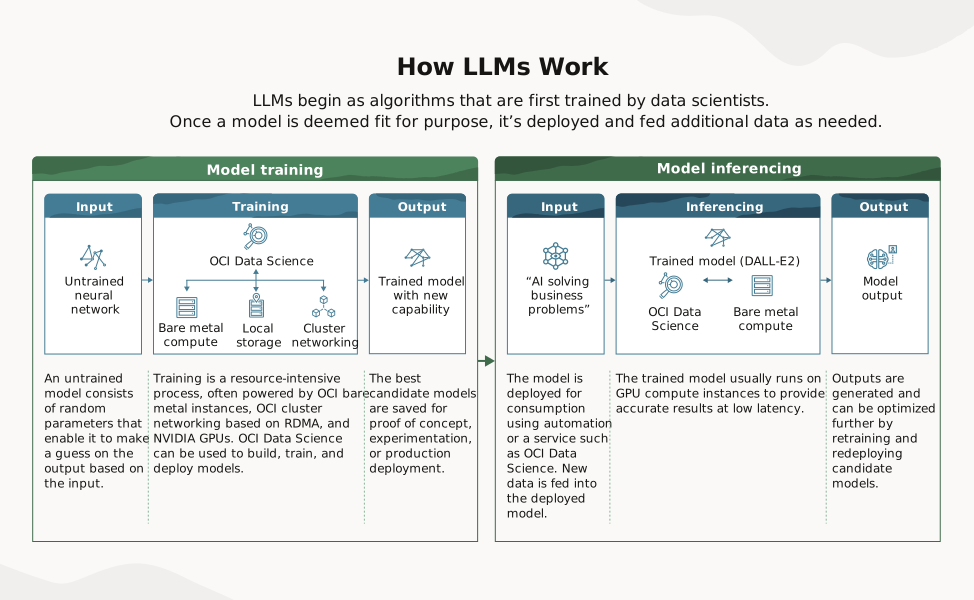
The diagram illustrates how large language models learn and then make predictions. In the
training phase, the model learns patterns. It then moves to the inferencing phase, where it processes
new data to generate insights or predictions.
LLMs are a type of language-generating AI that applies extensively trained neural networks to evaluate and
respond to prompts. “Large” doesn’t have a defined threshold—what qualifies for that attribute keeps
growing as models become more sophisticated and computing power, especially access to GPU clusters, more
abundant.
Before training begins, the language is converted into tokens, which are numeric representations of words
or parts of alphabets and speech that computers can understand.
Then an algorithm—which includes an extensive computer neural network—and data set are selected for
self-supervised learning. During the training phase, the algorithm adjusts its billions or even trillions
of parameters to accurately predict the next token in a sequence until the model responds appropriately to
prompts. As such, the parameters of the model contain the learning gained in the training phase.
Core Transformer Architecture: Transformers were the conceptual leap that ushered in
the current wave of enthusiasm around LLMs and generative
AI. Proposed in a groundbreaking paper by researchers at Google in 2017, the transformer
architecture strayed from previous approaches to creating language models. Instead of relying strictly on
a process called recurrence, which involves a sequential series of inputs and outputs, transformers
implement a mechanism called “self-attention” that simultaneously considers the relationship between
several words—even those distant from one another in a flow of text—as it processes sentences. It does
this by creating three different vectors: one for the word under consideration, another for surrounding
words to establish their importance in understanding the word, and a third vector that represents the
information the word contains. This third vector will have a different value depending on the context of
the word. For instance, blue might mean the color, or it might indicate a person’s mood, or it could mean
a great expanse of consideration, as in, “the thought came to her out of the blue.”
For example, the text string might be:
“How are you feeling?” she asked.
“I’m not sure,” he answered. “I can’t really get into work today, and it’s been this way for a while. I’m
just so blue.”
Before self-attention became part of the process, algorithms had no way to catch the relationship between
“feeling” and “blue,” so misinterpretation was likely. Self-attention provides a way to establish the
importance of the connection between the two words, even though they aren’t near each other in the word
sequence.
Further, by using self-attention, models can be trained on vast amounts of data in parallel, essentially
processing sentences at a time rather than going word by word. That takes further advantage of the
capabilities of GPUs. Transformers can also analyze tokens from a prompt simultaneously to deliver answers
faster and better resolve ambiguities.
Training and Fine-Tuning:
Foundation models, the current workhorse LLMs, are trained on a corpus of data often pulled from the
internet and other repositories of written information. Successful models resulting from this
self-supervised learning interval, in which billions of parameters are iteratively adjusted, tend to be
good at delivering generalized outputs: creating text across contexts, understanding meaning from
different styles of speech, and presenting complex or even abstract ideas.
A foundation model can be fine-tuned to improve its accuracy and optimize its performance within a
specific domain, such as healthcare or finance, or use case, such as translation or summarization. The
fine-tuning process starts with the foundation model, then further trains the final LLM on smaller, more
precise sets of labeled data to hone its ability to tackle specific tasks useful to a business sector or
application.
Importance of Model and Scalability:
LLM developers ultimately decide on the number of parameters to be trained with their algorithm and how
much data they need to do so effectively. The larger the number, the more complex the resulting model and,
usually, the more unique, accurate, and relevant the outputs. But with that superior performance comes
higher training and operational costs—and challenges in scaling to serve more users once the model is
trained.
The scalability of any LLM deployment is partially determined by the quality of the model. The training
algorithm, model architecture, and data set chosen by AI developers all affect how well their foundation
models optimize consumption of resources, such as memory, processors, and energy, to perform their desired
functions.
New techniques are also emerging for reducing the model size and corpus of training data, which eases the
cost and difficulty of scaling, without significantly affecting an LLM’s performance, particularly where
the LLM will be used for narrower use cases.
Benefits and Applications of Large Language Models
LLMs are the engine under the hood for many types of cutting-edge applications. The general public largely
discovered their jaw-dropping capabilities with the advent of ChatGPT, OpenAI’s browser-based release of the
GPT-3.5 model and more recent versions, including GPT-4o and GPT-4. But the benefits extend into and across
the enterprise, where LLMs are showcasing their skills in industries and business divisions that include
financial services, HR, retail, marketing and sales, software development, customer support, and healthcare.
Popular business applications of LLMs include customer service chatbots, customer sentiment analysis, and
translation services that are contextual, colloquial, and natural sounding. LLMs are also performing more
specialized tasks behind the scenes, such as predicting protein structures during pharmaceutical research,
writing software code, and powering the agents that enterprises are increasingly deploying to automate
business processes.
Versatility Across Applications:
LLMs are the core technology that powers a diverse and expanding number of consumer-facing and enterprise
applications. This versatility stems from the process of self-training the models on large data sets,
which yields an AI extremely adept at analyzing complex patterns within data to create relevant,
contextual outputs.
Cutting-edge applications take advantage of this attribute to do tasks like write unique marketing copy
and reports, gauge customer sentiment, summarize documents, and even generate outputs unrelated to
language, such as images and audio. AI
agents particularly exemplify the versatility of LLMs in their ability to interact with an
environment and perform tasks across domains without specialized knowledge.
The process of fine-tuning the models with supervised learning further expands the range of business
applications that can be built on generative AI. And RAG can make LLMs more effective in enterprise
environments as it improves the accuracy and relevance of their outputs by incorporating proprietary
business data that can be continually updated without changing the underlying model.
Enhanced Customer Interactions:
LLMs quickly proved their mettle in the domain of customer service. This is an obvious use case for anyone
who has experienced an LLM’s ability to hold a dialogue by answering one nuanced question after another
with clear, detailed, and useful outputs.
LLMs, however, can enhance customer interactions in many ways beyond chatbots. Some enterprises use them
to generate emails, text messages, or social media posts to customers addressing product, technical, or
sales-related questions. Others have put LLMs to work translating inquiries from customers who speak
foreign languages. LLMs can also be configured to assist sales and support agents—human and AI—by
providing them with actionable information and relevant documentation, summarizing previous interactions,
following up with customers, and documenting the interactions.
One of the world’s largest professional services firms doing business in more than 100 countries recently
increased its focus on customer relationship management by embracing generative AI applications powered by
LLMs. Looking to glean more insights from client feedback surveys, the company deployed LLMs
to analyze sentiment in those responses. The AI can now highlight trends and provide broad insights into
how products and services are received and how they can be improved.
Automation and Productivity:
LLMs are proving extremely effective at automating repetitive tasks, including those involving decisions
too complex for earlier AI models to take on. This automation can help boost employee productivity by
freeing workers to focus on more high-level endeavors that require creative and critical thinking.
Agents are an emerging technology at the forefront of taking advantage of the sophisticated reasoning
capabilities of LLMs to guide workflows with minimal human intervention. These applications, built on
foundation language models, are designed to make decisions as they interact with humans and other software
within enterprise environments, and they can autonomously perform tasks in various domains, generating
notifications of actions that need review or authorization to help ensure oversight.
LLMs are also enhancing productivity in other ways, including quickly surfacing relevant information for
business leaders and other decision-makers, creating drafts of copy for marketers, and writing software
code in tandem with developers.
Large Language Models Use Cases and Examples
LLMs are being applied to an ever-expanding number of business use cases. Many companies now use chatbots as part of their
customer service strategies, for example. But thanks to the versatility of these models, creative enterprise
software developers are applying the underlying technology to tackle a wide range of tasks that go beyond
simply generating linguistic responses.
1. Customer Support Automation
Customer support is the most evident application of LLMs in enterprise settings—especially to customers.
Conversational user interfaces, or chatbots, powered by language models can field a nearly unlimited number
of inquiries at all hours. This can help dramatically reduce response times stemming from overburdened call
center staff, a major source of customer frustration.
Integration of chatbots with other LLM-powered applications can automate follow-up actions after a support
call, such as sending a replacement machine part, document, or survey. LLMs can also directly assist human
agents, providing them with timely information, sentiment analysis, translation, and summaries of
interactions.
A funds manager operating in more than 50 countries and 80 languages has taken advantage of these
capabilities to make it easier for its customers to discover and choose the financial vehicles that best fit
their needs. The retirement account management specialist modernized its customer support with a custom
chatbot that delivered a 150% increase in service levels and 30% reduction in operational costs. Customers
now can visit the company’s webpage and ask the chatbot questions about their accounts at any time of day
and in many languages.
2. Content Generation and Summarization
LLMs can create original content or summarize existing content. Both use cases are extremely useful to
companies large and small, which are putting generative AI to work writing reports, emails, blogs, marketing
materials, and social media posts while taking advantage of LLMs’ ability to tailor that generated content
to specific groups or individual customers.
Summarization condenses large amounts of information, with sensitivity to the domain, into a format easier
for humans to quickly review and absorb. LLMs do this by either assessing the importance of various ideas
within a text and then extracting key sections or by generating concise overviews of what they deem the most
relevant and critical information from the original text.
LLMs are sometimes critiqued as “summarizing to average,” meaning their summaries are overly generic and
miss key details or important points of emphasis of the original material. It’s also tricky to gauge the
reliability of summaries and rank the performance of various models accordingly. Nonetheless, companies are
enthusiastically adopting this capability.
One leading cloud communications company deployed LLMs to automatically summarize transcripts of hundreds of support
tickets and transcripts of chats taking place daily in almost two dozen languages. Those summaries now help
support engineers resolve customer challenges faster and elevate the overall experience.
3. Language Translation
Google’s initial intent in developing transformers was to make machines better at translating between
languages; only later did the model impress developers with its broader capabilities. Those developers’
first implementations of this architecture achieved that goal, delivering unrivaled performance in
English-to-German translation with a model that took significantly less time and computing resources to
train than its predecessors.
Modern LLMs have gone well beyond this limited use case. Although most LLMs aren’t specifically trained as
translators, they still excel at interpreting text in one language and clearly restating it in another when
they’re extensively trained on data sets in both languages. This breakthrough in breaking down language
barriers is extremely valuable to enterprises that operate across borders. Multinational companies use
advanced language services to, for example, develop multilingual support for their products and services;
translate guides, tutorials, and marketing assets; and use existing educational assets to train workers when
expanding into new countries.
The Road Ahead for LLMs
Advancements in Multimodal Models
An active area of research is using LLMs as foundation models for AI that generates outputs in modalities
other than language. The impressive versatility of LLMs makes it possible, through a process of fine-tuning
using labeled data, to interpret and create audio, images, and even video. These models that receive prompts
or generate outputs in modalities other than language are sometimes called large multimodal models, or LMMs.
Environmental Considerations
LLMs typically require massive amounts of computing power to develop and operate at scale. Training a
single model on a cluster of hundreds or sometimes thousands of GPUs over many weeks can consume massive
amounts of energy. And once a successful model is deployed, the infrastructure that runs inference continues
to demand substantial electricity to field constant user queries.
Training GPT-4 required an estimated 50 gigawatt-hours of energy. In comparison, 50 gigawatt-hours of
energy could, theoretically, power 4,500 to 5,000 average US homes for a year. Now, ChatGPT is estimated to
consume hundreds of megawatt hours every day to respond to millions of queries. As language models get
bigger, concerns about energy consumption and sustainability may grow more pressing. For that reason,
artificial intelligence companies are at the forefront of seeking out alternative energy sources to reduce
their carbon footprints.
Build LLM Applications with OCI Generative AI
Oracle puts the power of LLMs in the hands of enterprises without requiring them to grapple with the nuts
and bolts—or power demands—of this exciting technology. Oracle Cloud Infrastructure (OCI) Generative AI is a fully managed
service that simplifies deployment of the latest LLMs in a way that’s customized, highly effective, and
cost-efficient while avoiding management of complex infrastructure. Enterprises can select from several
foundation models, then fine-tune them on dedicated GPU clusters with their own data, yielding custom models
that best serve their business needs.
Enterprises seeking to do more tinkering with the underlying technology are turning to Machine
Learning in Oracle Database. The platform empowers data scientists to build models quickly by
simplifying and automating key elements of the machine learning lifecycle without having to migrate
sensitive data from their Oracle databases. Features include popular machine learning frameworks, APIs,
automated machine learning (AutoML), and no-code interfaces, as well as more than 30 high performance
in-database algorithms for producing models to use in applications.
Many leading organizations also take advantage of Oracle AI infrastructure to build their own LLMs. AI
infrastructure is what underpins higher level AI services, such as OCI Generative AI, and can be used for
the most demanding LLMs with accelerated compute, networking, and storage.
The potential for LLMs to transform how businesses operate and engage with their customers is so great that
new breakthroughs and investments in the technology can move global markets and shake up enterprise
strategies. But it’s important for business and IT leaders to look beyond the hype—understand the basics of
how LLMs work, as well as their limitations and the challenges in adopting them—even as they strive to
identify the many tangible benefits they may gain from the technology.
LLMs are behind many of the game-changing technologies transforming the way we work.
How are large language models fine-tuned for specific applications?
LLMs are fine-tuned for specific applications by following the initial pretraining phase that employs
self-learning to develop a foundation model with a supervised learning phase on a smaller amount of more
domain-specific, labeled data.
What industries benefit most from using large language models?
Almost every industry is discovering the benefits of LLMs. Healthcare, financial services, and retail are
among those exploring a variety of use cases around improving customer support and automating business
processes.
Can large language models be integrated with enterprise systems?
Large language models are often integrated with enterprise systems by fine-tuning foundation models with
enterprise data and augmenting those models with proprietary data through retrieval-augmented generation.