Oracle Autonomous AI Lakehouse
Run AI, analytics, and business simulations on all your Oracle and non-Oracle data, right where it lives, with one open, governed lakehouse on any cloud.
 Bring the best of Oracle to your existing and new Data Lakes
Delivers a best-of-all-worlds lakehouse by bringing the power of Oracle AI and analytics directly to your data lake, without moving, migrating, or replacing existing infrastructure.
 Run AI and analytics at any scale on all data types
Runs on one converged engine for analytics, AI, and transactions across all data types, reducing complexity, strengthening end-to-end security, and delivering real-time analytics with high performance.
 Unified security and governance
Unifies governance, access controls, and end-to-end data lineage across sources, with enterprise-grade protection for sensitive data powered by Oracle Deep Data Security.
 Live AI Hub for all your real-time data
Run AI on real-time data across your entire data estate, without moving, replatforming, or upgrading. AI Lakehouse directly accesses real-time data across Oracle and non-Oracle sources, enabling users and AI agents to query current data where it resides.
What can you accomplish with Oracle AI Lakehouse?
Turn your on-premises data warehouse into a cloud-based open lakehouse
Retire aging data warehouse infrastructure without rewriting what runs on top of it, carrying forward existing schemas, SQL, and BI tools. Deploy on OCI, AWS, Azure, or Google Cloud, then extend to query data in any object store using open formats such as Apache Iceberg.
Run analytics and AI on all your Oracle data
Query your entire Oracle estate as one system, across operational databases, data warehouses, and Autonomous AI Database, on-premises or in any cloud. Register each source once to query live data with no additional setup, while preserving identity and data access controls across sources.
Run analytics and AI on your non-Oracle data
Query 100+ sources, including object stores, data warehouses, lakehouses, applications, and streams. Mount an external catalog once to query thousands of tables using standard SQL, with live results that reflect the current state of your business. No ETL to query, no second data copy to secure and reconcile.
Put Oracle application data to work for AI
Combine Oracle Fusion Applications, Oracle E-Business Suite, and Oracle NetSuite data with unstructured data on one analytics and AI foundation, without rebuilding business logic or security policies. Give users and AI agents the business context to understand what happened and why, shortening the path from raw data to insights.
Connect Your Data to Drive Actionable AI Outcomes
Join the webinar on November 3 to explore the latest Oracle AI World 2026 announcements for Oracle AI Lakehouse, see demos of new capabilities, and get practical guidance on connecting AI and analytics across your entire data estate.
What are the key capabilities of Oracle AI Lakehouse?
Connect data across your organization and query it where it lives
AI Lakehouse meets data where it already is, with native connectivity to more than 100 Oracle and non-Oracle sources across on-premises environments and major clouds, including OCI, AWS, Azure, and GCP. These include operational databases, data warehouses, Autonomous AI Database, Oracle Fusion and third-party applications, object stores, and Iceberg tables. This allows you to bring Oracle AI Lakehouse to your existing data sources without rebuilding your data estate around it.
When data needs to move or be refined, Oracle provides native pipelines. Oracle Data Transforms, built into Autonomous AI Lakehouse, offers no-code, drag-and-drop tools for bulk and incremental pipelines. It pushes transformation logic down to data sources to create analytics- and AI-ready tables and writes to governed Iceberg tables in Oracle AI Data Catalog. On the other hand, Oracle GoldenGate replicates data from Oracle Fusion Applications, Oracle databases, and non-Oracle sources into OCI Object Storage, enabling queries to run against that copy instead of reaching back to the source system to avoid remote-source latency. Further, Data Lake Accelerator delivers scale-out performance for data in object storage.
Everything registered in Oracle AI Data Catalog is immediately available to query using standard SQL, with no DDL required. Mount an external catalog once to access thousands of tables without special integrations or data movement. Data Hub federation joins live operational data with lakehouse tables, pushing processing to remote sources so only the required data crosses the wire. Many sources also support write-back, allowing lakehouse insights to flow directly into operational systems where decisions are made.
One converged engine for analytics, AI, and transactions across data types
AI Lakehouse runs on one multi-model engine rather than stitched-together services. Tables, JSON documents, graphs, spatial data, RDF, vectors, and XML share the same transaction manager, security model, optimizer, and governance layer. And this is not only a query engine - it is a transaction engine, built on the Oracle transaction processing technology used for demanding OLTP workloads. The same engine that queries data and provides answers to your analytical questions can also write data back and complete the transaction.
The benefit of this converged query and transaction engine is that it reduces the application complexity, improves end-to-end security posture, and provides real-time analytics. Applications don’t have to worry about integrating results from different query engines and ensuring that they remain in sync. Security posture improves because you no longer have to maintain another credential store and policy model for the different engines. Additionally, query performance is optimized because one optimizer plans across modalities on data that is already local and already current, with capacity scaling as one pool rather than degrading at whichever component was sized smallest.
This converged architecture makes AI Lakehouse a strong choice for real-time analytics. The moment a transaction commits in your operational system, the change is visible to analytics. It is quickly available for vector creation and vector indexing too, so semantic search and AI applications reason over the current state of the business, not previous day’s snapshot.
One authoritative catalog of catalogs for your entire data estate
The Oracle AI Data Catalog is the single source of truth for what data exists, where it lives, who owns it, and who can use it. It’s built on an Apache Polaris core and keeps an inventory of your data assets, with technical and business metadata and data profiling. Analysts, engineers, and AI agents can find trustworthy data without relying on tribal knowledge. Discovery, security, and governance work the same way wherever an asset sits: Autonomous AI Database, object storage, an application, or a partner platform.
You don’t have to move data or metadata into one system. The catalog federates with the catalogs you already run, giving you one governed view across clouds and data centers. Supported catalogs include Iceberg REST catalogs, AWS Glue, Databricks Unity Catalog, Snowflake Horizon, Microsoft Purview, and Oracle AI Data Platform. Register an external catalog with a single command and its tables are immediately queryable. The same catalog also powers data products, marketplaces, and open data shares.
Lineage is captured automatically as data changes and pipelines run, so you can trace where any table came from. Open APIs let BI tools, notebooks, pipelines, and machine learning platforms all work from the same metadata.
The same catalog can serve all AI agents. Oracle ships first-party agents out of the box - Select AI for natural language access to governed data, and Private Agent Factory for building, evaluating, and deploying your own with no code. You can also bring third-party agents and frameworks alongside them through MCP and open APIs. All of them retrieve data through the same governed catalog, so every agent gets context that is relevant and access-controlled based on the defined policies.
Full, native Apache Iceberg support - open architecture by design, fast performance by default
With AI Lakehouse, Iceberg tables work like native Oracle tables. You create them with the DDL you already know, load them with parallel DML through a native Parquet writer, and query them with the same SQL. Every operation is transactional and recoverable. One analytics model covers Oracle tables and Iceberg tables together. Iceberg data types stay intact, so the open table model stays consistent end to end. Delta Lake tables work the same way.
Iceberg is a native data type in AI Lakehouse and it is not bolted on. It connects through the Iceberg REST Catalog API, so you can use the Oracle AI Data Catalog or any compatible third-party REST catalog, over object storage in any cloud.
When Oracle manages your Iceberg tables, Data Transforms applies compaction and clustering. Compaction merges small files into larger, optimized ones, while clustering, including liquid clustering, organizes data so queries run faster. AI Vector Index support and universal Row ID extend Iceberg data into AI workloads.
Share tables across tenancies or with external partners without copying data using the open Delta Sharing protocol. Recipients read directly from object storage, so access adds no load or usage cost, while versioned shares and one-time tokens provide stable, auditable, and revocable access under Oracle lakehouse security.
A governed semantic layer that makes your data understandable to AI
Agentic AI is only as good as the business context it retrieves. AI Lakehouse defines business meaning once in Oracle AI Data Catalog, so that every engine, tool, and agent, including those built with Oracle Private Agent Factory, works from the same governed definitions across Oracle and non-Oracle sources. The semantic layer has three parts - enrichment that captures meaning, pruning that applies it at query time, and self-enrichment that keeps it current. These capabilities help deliver faster, more accurate answers.
Semantic enrichment captures what your data means across every source in Oracle AI Data Catalog, using annotations, descriptions, constraints, and join hints to explain how tables and columns relate. Governed tags control data discovery, while Analytic Views define shared measures, hierarchies, calculations, and KPIs, so business logic doesn't need to be rebuilt across tools.
Agentic pruning applies that context at query time, narrowing each request to the schemas and tables relevant to the question and authorized for that user. This reduces the context an agent must process by more than an order of magnitude, helping deliver faster answers, lower token costs, and fewer hallucinations.
Agentic self-enrichment keeps the semantic layer current by continuously enriching it with workload and access patterns, descriptions derived from Data Transforms logic, and security and audit signals. Retrieval results and user corrections feed the same loop, with improvements published through catalog governance and RBAC, so context reflects real usage rather than one-time documentation.
Warehouse-class performance on open data lake storage
Data Lake Accelerator gives object storage the throughput of a purpose-built analytics tier. It elastically spins up query servers close to the data, scaling out both network bandwidth and compute, filtering columns and rows at the source, and returning only the minimum data the query processor needs. In addition to improving the query performance, this also reduces egress costs. Partition pruning further limits what gets scanned. Serverless architecture ensures query servers are provisioned on demand for actively running queries and scale back down as workloads subside, so you pay only for what you use.
For frequently accessed data, Lake Cache delivers native Exadata performance on data lake tables (including Iceberg) at no extra charge. It caches hot data automatically or by policy, combines it with the latest updates, and persists it even when the database is down. Cached data uses Exadata Smart Scan for filtering and aggregation, plus Exadata Flash Cache for the hottest data, with I/O that scales independently of compute. Lake Cache sends current Iceberg manifest metadata and data-file statistics directly to the Oracle optimizer. This produces execution plans based on the table’s current contents and enables dynamic pruning without manual statistics gathering.
Native multidimensional planning and analysis, directly on lakehouse data
AI Lakehouse brings Essbase’s proven multidimensional engine to all your data. Build cubes over anything registered in Oracle AI Data Catalog - not only Autonomous AI Database and other Oracle systems, but non-Oracle sources too, including Apache Iceberg and other open table formats in object storage on any cloud. Planning, forecasting, financial reporting, and what-if simulation run against live fact tables wherever they sit, with no separate copy to maintain. Scenario modeling with write-back, allocations, dynamic hierarchy rollups, and advanced calculations shows the impact of changing assumptions right away, across revenue, demand, pricing, cost, and risk.
Business users can work in Excel through Oracle Smart View or ask questions in natural language. AI suggests relevant cubes based on your schemas, which helps teams build models faster. Because Essbase runs inside Autonomous AI Lakehouse, cubes inherit its identity, backup, and disaster recovery. Cube outlines are published to Oracle AI Data Catalog, so AI agents, BI tools, and Smart View all work from the same governed business definitions.
One workspace for data engineering, analysis, and AI - built around a shared catalog
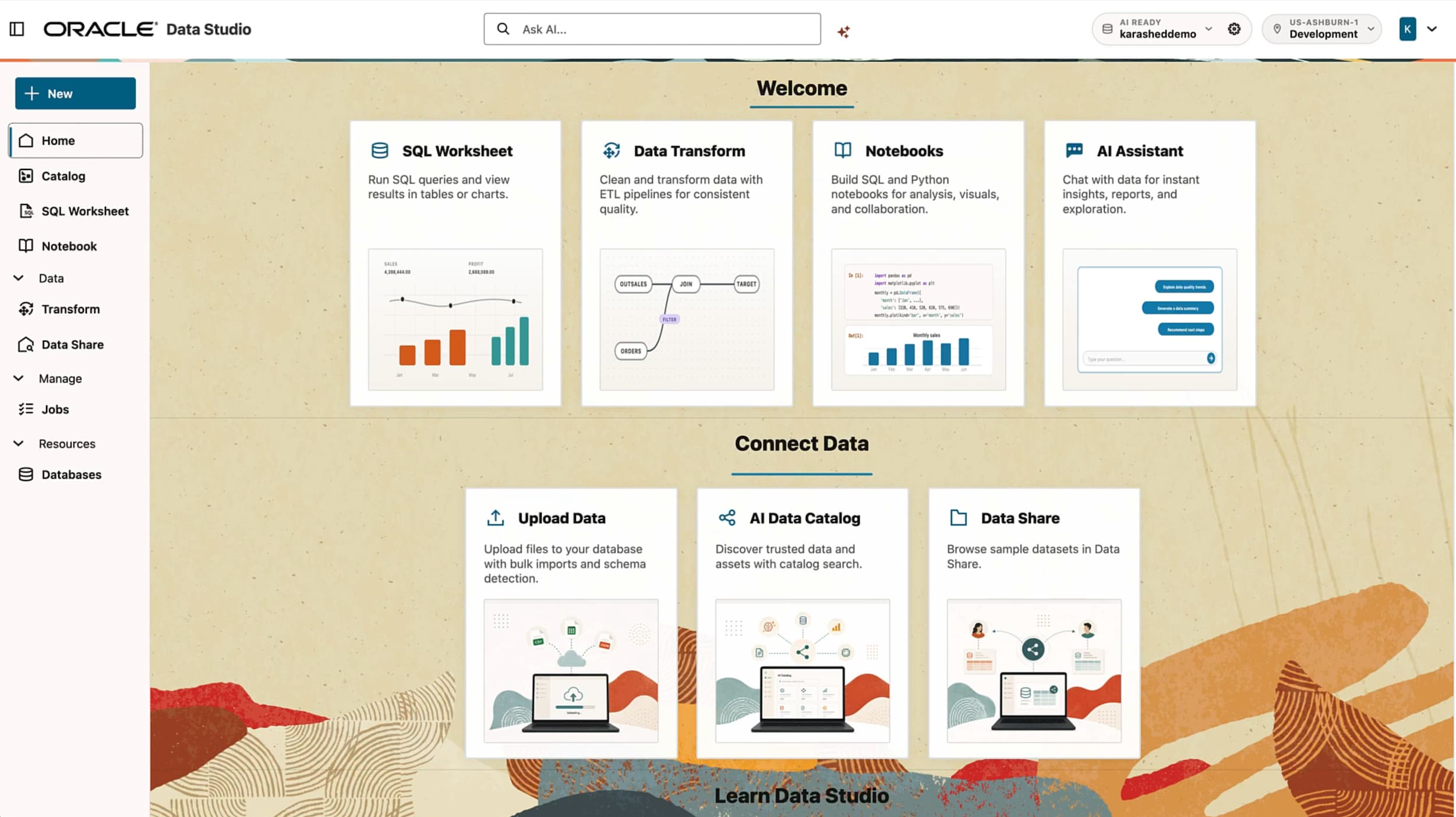
Data Studio is the native IDE for Autonomous AI Lakehouse, bringing natural language, SQL, Python notebooks, visualization, and Excel and Google Sheets add-ins into one governed environment. Its native chatbot combines NL2SQL, RAG, and MCP so users can turn plain-language questions into explainable results without switching tools. A shared catalog centralizes metadata, semantic information, project context, resource management, and provisioning across data sources and workflows.
Data Studio is a standalone web application you can open directly in a browser, without going through the OCI console and without provisioning an Oracle database first. Sign in and work straight against the AI Data Catalog and the sources already registered in it.
Data Transforms provides declarative, federated ELT pipelines through drag-and-drop tools or the Python SDK, with scale-out orchestration and support for AI and vector operations. Data Studio makes these capabilities available to AI clients through more than 200 MCP tools spanning Analytic Views, SQL, Data Transforms, and Essbase. These tools let AI build dataflows and analytic models, run queries, manage workflows and connections, and generate insights, supporting both data analysis and lakehouse operations.
Unified governance, end-to-end lineage, and enterprise-grade security across data sources
The Oracle AI Data Catalog provides a single governance and access layer across query engines and storage solutions. It unifies users, groups, service principals, and workload identities through database identity or providers such as OCI IAM and Microsoft Entra ID. Administrators define role-based access once and apply it across catalogs, schemas, tables, views, and semantic assets. Credentials are managed centrally, while authorization, privilege, credential, lineage, and access activity are recorded centrally for audit.
Oracle Deep Data Security extends governance to individual users by propagating their identity, roles, and attributes to the database. Existing SQL-native row, column, and cell controls can then enforce role-based, attribute-based, and context-aware policies across access paths. The catalog extends these protections beyond Oracle Database, including to Iceberg data, and supports consistent sensitive-data classification and encryption at rest and in transit.
Lineage provides additional visibility into where data comes from, how it changes, and what depends on it. Autonomous AI Lakehouse uses OpenLineage to capture table-, view-, and column-level lineage from Oracle Database SQL history, Data Transforms, and compatible third-party systems. Search it through Data Studio or REST APIs for impact analysis, compliance, and reproducibility, and use it to assess job status, data freshness, and quality.
Deploy on the cloud you choose—or in your own data center
Autonomous AI Lakehouse provides the same platform across OCI, AWS, Microsoft Azure, Google Cloud, Cloud@Customer, and on-premises, with consistent catalog, semantics, security, governance, and SQL. Combine the best of your preferred cloud with Autonomous AI Lakehouse to quickly build and modernize enterprise-scale applications, while leveraging native cloud services for AI, security, data integration, monitoring, and troubleshooting, along with your preferred business intelligence tools for immediate insights.
You can purchase Oracle AI Lakehouse through AWS, Azure, and Google Cloud marketplaces using existing cloud commitments, or take advantage of eligible Oracle AI Database licenses and agreements.
Helping organizations turn connected data into business results
- Mars Veterinary HealthAccelerated financial data updates from 4–6 hours to 30 minutes, enabling faster decisions across 3,000+ clinics.
- NHSAutomated financial operations to process 7.1 million invoices and £355 billion in NHS transactions annually.
- Liberty EnergyReduced manual reporting by 30% and accelerated analytics from days to seconds to scale beyond 700% growth.
- KDDIUnified data across cloud and on-premises systems to improve analytics, reduce development time and operational costs.
- BitronAccelerated EV charging station diagnostics by 5X and reduced production data access time by 90% using AI and analytics.
- CertegyUnified 850 million records across 15+ data sources to improve fraud detection and target a 10% reduction in fraud.
- MineSenseReduced database administration workloads by 65% and improved field engineering productivity by 5X.
- City of LohjaAutomated responses to approximately 85% of internal support questions, reducing support workloads.
Where can you learn more about Oracle AI Lakehouse?
AI Lakehouse Documentation
Explore Oracle Help Center for product documentation and other resources to deploy Autonomous AI Lakehouse.
AI Lakehouse DocumentationBlogs and Analyst Reports
Stay up to date on the latest Oracle Autonomous AI Lakehouse announcements, product updates, technical insights, and best practices.
LiveLabs
Get hands-on experience using Oracle AI Lakehouse with our free online tutorials.
Get startedMove your on-premises data warehouse to the cloud
Explore tools and guidance to plan and simplify your migration to Oracle Autonomous AI Lakehouse.
Learn moreGet Started
Try for Free
Get started with Oracle AI Lakehouse to run AI and analytics across your existing data estate.
Contact Us
Connect with an Oracle expert to discuss your analytics and AI requirements and how Oracle AI Lakehouse can help you connect data across your enterprise.