Real Application Clusters
Oracle Real Application Clusters (RAC) is the world’s only scale-everything, highly available database architecture. It transparently scales both reads and writes for all workloads, including OLTP, analytics, AI vectors, SaaS, JSON, batch, text, graph, the Internet of Things (IoT), and in-memory. RAC effortlessly scales complex applications, such as SAP, Oracle Fusion Applications, and Salesforce workloads. It provides best-in-class high availability through most hardware and software failures and maintenance events. This is why leading banks, stock exchanges, telecoms, retailers, governments, and utilities use RAC for their critical, 24/7 workloads—on-premises and in the cloud.
Why Oracle RAC's unqiue capabilities excel
Oracle RAC's unique capabilities
Unique scale everything architecture
Simple & complex workload scaling
The unique scale everything architecture of Oracle RAC benefits databases and workloads of all types, from simple use cases to workloads requiring hundreds of thousands of tables, indexes, and millions of SQL statements. Even the world’s most sophisticated applications, including SAP, Oracle E-Business Suite, Oracle PeopleSoft, and Oracle Fusion Cloud Applications, can benefit from Oracle RAC.
High throughput parallelization
Oracle RAC dramatically accelerates long-running workloads such as analytics, batch, indexing, data reorganization, and application schema changes by transparently distributing and parallelizing queries, updates, inserts, and deletes across multiple servers. This enables SQL requests to leverage all available CPU, memory, and I/O resources.
Ultra-fast response time
Oracle RAC delivers ultra-low SQL response times for online transaction processing (OLTP) workloads by enabling ultra-fast local data access and avoiding costly cross-server messaging. When running on Oracle Exadata, Remote Direct Memory Access (RDMA) across servers further boosts performance.
Many scale-out databases scale reads using replicas but route all writes through a single primary server, limiting OLTP scalability and increasing the risk of stale data. Other databases often parallelize queries only, limit write operations to one server, or can only parallelize based on a single sharding key.
Extreme mission-critical availability
Oracle RAC helps ensure application continuity by automatically and transparently failing over workloads from impacted servers to surviving servers in the cluster. It also enables online patching and updates with no downtime or disruption. This allows customers to swiftly and regularly update and protect their database systems against increasingly frequent and sophisticated security vulnerabilities.Oracle RAC delivers ultra-low SQL response times for online transaction processing (OLTP) workloads by enabling ultra-fast local data access and avoiding costly cross-server messaging. When running on Oracle Exadata, Remote Direct Memory Access (RDMA) across servers further boosts performance.
Optimized for developer adoption
Oracle RAC transparently delivers ultra-low latency, the highest throughput, the fastest SQL response time, and application continuity. It seamlessly integrates into the application development lifecycle, including continuous integration and continuous delivery (CI/CD) workflows, by allowing rolling database and application schema updates.
Unlike other databases, Oracle RAC does not require any code changes for its scalability, high availability, or performance improvement features. This makes it the most developer-friendly mission-critical database solution.Unlike other databases that abort workloads during failover or updates, often requiring restarts or causing user-visible errors, Oracle RAC enables uninterrupted operation by gracefully migrating sessions, avoiding restarts, errors, and brownouts during planned maintenance and unplanned downtime.

How Oracle RAC works - A quick overview
Oracle Grid Infrastructure, which consists of Oracle Clusterware and Oracle Automatic Storage Management (ASM), provides the foundation for RAC. RAC runs multiple database instances on clustered nodes that concurrently access a single shared database stored on shared storage managed by ASM.
If a clustered node fails, Oracle Clusterware automatically detects the failure, allowing RAC to continue processing database workloads using the remaining database instances. As workload demands increase, additional nodes can be added to the cluster without interrupting database operations, enabling high availability and horizontal scalability.
Dive deeper into Oracle RAC
![Thumbnail image for The New Generation Oracle RAC]() Oracle Real Application Clusters 26ai includes many improvements that enable applications to achieve significantly better levels of availability and scalability than previous versions.
Oracle Real Application Clusters 26ai includes many improvements that enable applications to achieve significantly better levels of availability and scalability than previous versions.New Generation Oracle RAC (PDF)
Read the technical brief (PDF)![Thumbnail image for Oracle Real Application Clusters cache fusion performance optimizations on Exadata]() Oracle Real Application Clusters 26ai uniquely delivers extreme reliability and scalability on Exadata.
Oracle Real Application Clusters 26ai uniquely delivers extreme reliability and scalability on Exadata.Oracle RAC 26ai Optimizations on Exadata (PDF)
Read the brief (PDF)


Oracle RAC customer successes








“Oracle RAC is instrumental in meeting our zero service disruption goals and has been able to transparently enable application continuity, database high availability, scalability, along with zero downtime rolling maintenance."
RAC One Node Overview
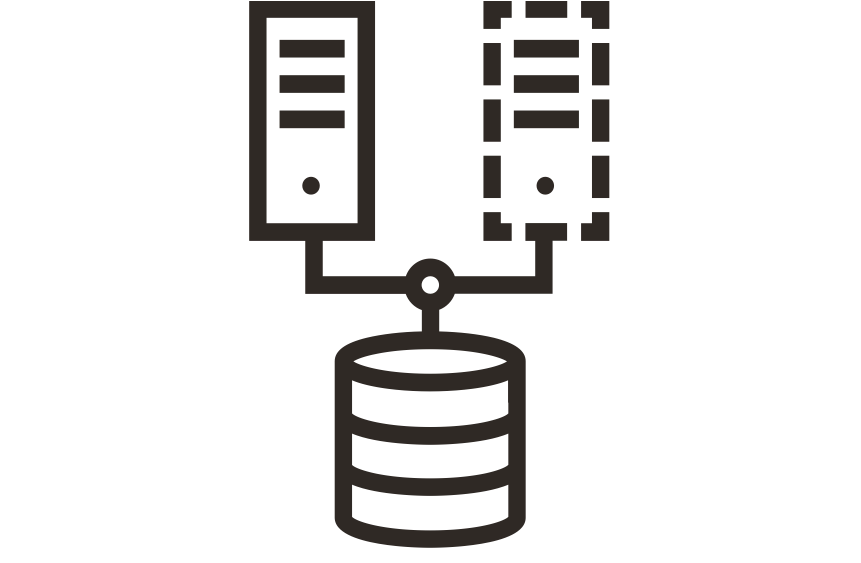
Oracle RAC One Node provides high availability for single-instance Oracle Database workloads by eliminating the database server as a single point of failure. It runs one active database instance in an RAC cluster, with automated failover and online database relocation to help maintain availability during planned maintenance. Like RAC, RAC One Node requires no application changes.
When applications require scale-out performance, Oracle RAC One Node provides an online path to a multi-instance Oracle RAC configuration. RAC One Node and Oracle RAC use the same Oracle Grid Infrastructure and shared-storage foundation, enabling organizations to deploy high availability for single-instance workloads today while maintaining a straightforward path to scale out with Oracle RAC as application demands grow.
Key Benefits
Cost-Effective High Availability
Deliver cluster-based high availability for database workloads that do not require the multi-instance scalability of RAC
Minimize Planned and Unplanned Downtime
Automatically fail over database workloads after server failures and use online database relocation to help maintain availability during planned maintenance.
Simplify Database Operations
Standardize database deployments on a common Oracle Grid Infrastructure foundation, simplifying management across clustered database environments.
Improve Infrastructure Utilization
Consolidate multiple databases on shared cluster infrastructure and relocate database instances between servers as workload and resource requirements change.
Key Capabilities
- Single Active Database Instance on a Cluster - Run a single active Oracle Database instance on one cluster node with automatic failover to another node.
- Online Database Relocation - Relocate a database instance and its services to another cluster node while maintaining application availability.
- Rolling Maintenance - Relocate the database between cluster nodes to perform planned maintenance while maintaining database availability.
- Database Consolidation - Consolidate multiple single-instance databases on shared clustered infrastructure and relocate them between cluster nodes as needed.
- Online Transition to Oracle RAC - Transition from a single-instance RAC One Node configuration to a multi-instance RAC configuration as workload requirements grow.
Architecture
RAC One Node uses the same Oracle Grid Infrastructure and shared storage architecture as RAC, including Oracle Clusterware and ASM.
A single Oracle Database instance runs on one node within the cluster and accesses the shared database storage.
For planned maintenance, the database can be relocated to another node within the cluster with minimal interruption.
If an unplanned outage occurs, the database instance automatically fails over to another node, helping maintain database availability.
| Requirement/Capability | Oracle RAC | Oracle RAC One Node |
|---|---|---|
| Active Database Instances | Multiple active database instances run concurrently across nodes | One active database instance runs on a node |
| Scalability | Provides horizontal scale-out across multiple active database instances | Supports workloads that require a single active database instance, with a path to RAC if scale-out is needed |
| High availability | Maintains database availability across multiple active instances and nodes | Provides high availability for a single active database instance on clustered infrastructure |
| Workload distribution | Distributes workloads across multiple active instances based on workload requirements | Runs workloads on a single active instance, which can be relocated between nodes |
| Planned maintenance | Supports seamless rolling maintenance across nodes, with workloads continuing on already-active database instances | Maintains availability during planned maintenance by first relocating the database and connections online to another node |
| Growth path | Scale out across additional active instances and nodes as workload requirements grow | Transition online to RAC when multi-instance scale-out is required |
| Best suited for | Mission-critical workloads requiring high availability and horizontal scalability | Workloads that need high availability today but do not yet require multi-instance scalability |
Hear more about Oracle RAC from customers and experts
Learn moreOracle RAC—The art of database options
Learn how Oracle RAC maximizes availability and enables horizontal scalability.
Simplify application development with Oracle RAC
Improve developer productivity with Oracle RAC.
Scaling PayPal workloads
Oracle RAC scales the most demanding online transaction processing workloads.
High Availability and Disaster Recovery Smart Features
Protect your applications from disruptions and downtime with high availability and disaster recovery.
Additional Resources
Learn more
Support and licensing
Oracle Database Licensing Information
Oracle Real Application Clusters is supported with Oracle Database Services in Oracle Cloud Infrastructure (OCI) and Oracle’s Multicloud AI Database solutions. Oracle does not support Oracle Real Application Clusters on Non-Oracle public cloud environments. For more information, refer to My Oracle Support Note below.
Note 2688277.1 - Oracle Database Support for Non-Oracle Public Cloud EnvironmentsRelated products and technologies
Autonomous Database
The future of Oracle Database
Oracle Engineered Systems
The best platform for Oracle Database
Application Continuity
Provide continuous availability
Autonomous Health Framework
Maintain database availability and performance
Oracle Clusterware
Use clustered servers as a single system
Automatic Storage Management
Simplified storage management
Advanced Cluster File System
POSIX and X/OPEN compliant cluster file system supports multiple OS
Oracle High Availability Database
Enhance database availability and resilience
Get started with Oracle RAC
Try Autonomous Database for free
Explore with $300 in free credits and always free instances of Autonomous Database.
Learn more
Attend webcasts and hands-on workshops hosted by Oracle Product Management.
Contact us
Interested in learning more? Contact one of our experts.