Oracle Fusion Cloud Marketing
Oracle Fusion Cloud Marketing helps organizations move from campaign execution to agentic growth orchestration. By combining unified customer and enterprise data, marketing orchestration, AI agents, and agentic applications, Oracle Marketing helps teams identify verified demand, launch coordinated growth programs, align with sales, and measure outcomes from one connected marketing foundation.

Customers improving engagement with Oracle Marketing
Explore Oracle Marketing
A customer data and intelligence foundation for understanding audiences and powering agentic marketing
- Unify customer, account, buying group, behavioral, product, and transactional data into governed profiles.
- Resolve identities across systems to create accurate customer and account views for segmentation, analytics, and activation.
- Enrich profiles with engagement, product ownership, usage, service, lifecycle, consent, and other enterprise signals.
- Use AI and machine learning models to identify product fit, buying group gaps, renewal risk, next-best actions, and growth opportunities.
- Build precise audiences using unified profiles, intelligent attributes, behavioral signals, and business-friendly segmentation tools.
- Activate customer intelligence across marketing, sales, service, analytics, advertising, and orchestration workflows.
- Govern data access, consent, privacy, security, and auditability so AI agents and marketing teams act from trusted customer context.
The agentic execution layer for turning customer signals into coordinated marketing programs
- Build, launch, and optimize reusable marketing programs and tactics using governed customer, account, and behavioral data from Oracle Unity.
- Use embedded AI agents to recommend tactic templates, assist with advanced segmentation, and create first-draft content for marketer review.
- Build audiences in the flow of work using unified profiles, intelligent attributes, buying group data, and behavioral signals.
- Trigger tactics from real-time behaviors such as form submissions, content engagement, product views, page visits, and other buying signals.
- Coordinate engagement across email, landing pages, forms, SMS, web, social, webinars, and external activation channels.
- Connect marketing programs to sales follow-up with shared account context, clearer handoffs, and measurable program performance.
- Continuously improve programs with tactic-level reporting, program analytics, success criteria, and feedback loops that inform future execution.
A B2B marketing automation platform that helps teams design personalized campaigns, qualify leads, and drive revenue with embedded AI
- Automate cross-channel campaigns across email, web, events, and social media.
- Score and nurture leads using AI-assisted workflows that identify the most sales-ready prospects.
- Deliver personalized content and adaptive journeys based on behavior and buying stage.
- Align marketing and sales with shared visibility into lead and account performance.
- Measure impact with advanced analytics, dashboards, and attribution reporting.
- Enable closed-loop revenue tracking via native integration with Oracle Sales and the broader Fusion Applications suite.
An enterprise-scale, cross-channel platform that helps B2C marketers deliver personalized, AI-assisted customer engagement
- Design, automate, and deliver campaigns across email, mobile, SMS, and push notifications.
- Use AI-assisted segmentation and predictive targeting to engage customers more effectively.
- Build event-triggered and behavior-based journeys to reach customers at the right moment.
- Optimize content, offers, and send times with built-in testing and machine learning models.
- Govern and secure customer data at scale to support compliance and reliability.
- Connect with Oracle Fusion Unity Data Platform and
Oracle CX applications for consistent, data-driven marketing execution.
Benefits of Oracle Marketing
1
Turn customer signals into revenue plays—automatically
Oracle Marketing uses AI agents to watch for real buying and expansion signals across your enterprise data. Not just clicks, but orders, renewals, product usage, and service history. The application surfaces the next-best plays and prepares the actions needed to move them forward, so teams don’t have to hunt for opportunities.
2
Launch programs faster by removing the busywork
Oracle Marketing AI agents can assemble audiences, draft variations, set up journeys, coordinate handoffs, and summarize results. Teams spend less time on list pulls, workflow setup, and reporting—and more time on strategy, offers, and customer outcomes.
3
Let the right person run the program (not just marketing)
With agentic apps, executing a program doesn’t require a marketing specialist every time. Approved plays can be launched by sales, customer success, service, or partners from their own workflows—using prebuilt audiences, messages, and steps—so execution happens where the work already lives.
4
Prevent wasted outreach by grounding actions in business reality
AI agents don’t just target more. They help target correctly. Oracle Marketing can apply operational and commercial rules—such as eligibility, contract terms, service status, renewal windows, region coverage, and more—so you can avoid out-of-policy outreach, reduce spend waste, and protect margins.
5
Connect marketing execution to follow-through and measurable outcomes
Programs don’t deliver results unless someone acts. Oracle Marketing ties actions to Oracle Sales workflows so handoffs are clear, timing is right, and follow-through is trackable. You can measure outcomes—such as pipeline created, renewals protected, expansion closed—not just activity.
6
Scale safely with built-in governance and approvals
Agentic execution only works when it’s controlled. Oracle Marketing keeps humans in charge with approvals, brand rules, consent/privacy controls, and auditability. Teams can move faster without turning the system into a free-for-all.
AI highlights in Oracle Marketing
- Agentic Application
An agentic app that turns enterprise demand signals into prioritized growth programs, helping teams identify opportunities, coordinate actions, and move programs forward.
- Agentic Application
Helps go-to-market teams identify expansion opportunities across the installed base, assemble buying groups, and orchestrate coordinated marketing and sales actions.
- AI Agent
Helps marketers generate campaign-ready copy across emails, landing pages, and web assets, so teams can move faster and maintain consistent messaging.
- AI Agent
Helps marketers identify and refine buying groups by mapping contacts to relevant roles and personas, so teams can target the right people in each account.
What analysts say about Oracle Marketing
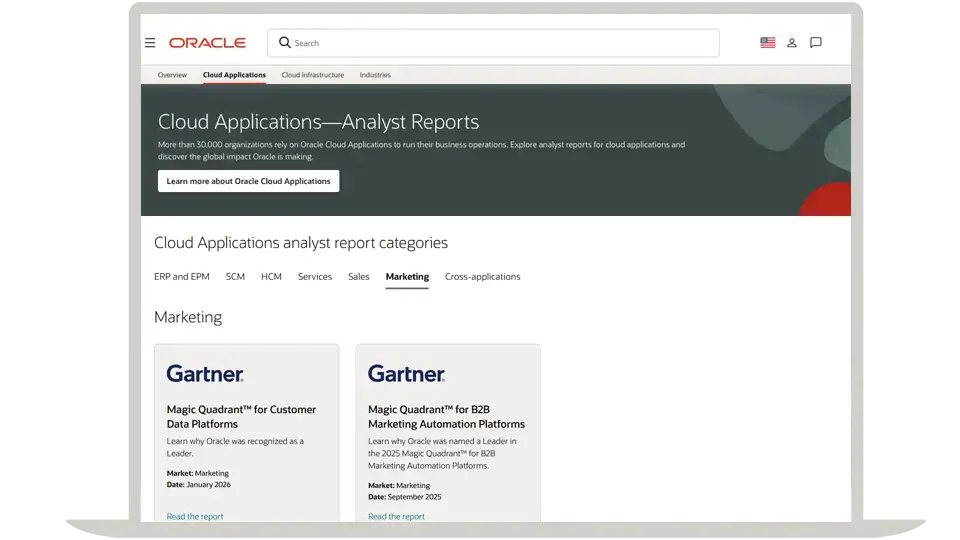
Oracle Marketing helps organizations unify customer data, orchestrate personalized campaigns, and coordinate marketing and sales action with built-in AI, agentic applications, and governed customer intelligence. Learn why industry analyst firms recognize Oracle for its leadership across customer data platforms, B2B marketing automation, and enterprise marketing execution.
Oracle Marketing resources
Get started with Oracle Marketing
Oracle Fusion Cloud Marketing FAQ
Open allClose allStrategic value and business impact
- What is Oracle Marketing?
- Who is Oracle Marketing for?
- What problems does Oracle Marketing solve?
- How is Oracle Marketing different from traditional marketing automation?
- What does agentic marketing mean in Oracle Marketing?
- How does Fusion Unity Data Platform differ from a traditional CRM or standalone data tool?
- What is the expected business impact of an enterprise deployment?
- How does Oracle Marketing use enterprise signals to improve profitability and margins?
- Can Oracle Marketing help reduce operational costs and technology sprawl?
- How quickly can teams launch programs and see value with Oracle Marketing?
- What outcomes can Oracle Marketing help improve?
Capabilities and AI
- What types of AI agents are available in Oracle Marketing?
- How does Oracle Marketing keep AI recommendations governed and explainable?
- How does Oracle Marketing support B2B installed-base growth?
- How does Oracle Marketing unify account and customer data?
- How do AI agents and agentic apps work together in Oracle Marketing?
- How does Oracle Marketing support signal-to-action execution?
Architecture and governance
- Does Oracle Marketing require replacing existing marketing execution tools?
- How does the platform eliminate the "integration tax"?
- How does Oracle Marketing support data governance and compliance?
- How does Oracle Marketing help AI agents act from trusted customer context?
- How does Oracle Marketing impact RevOps and marketing operations teams?
- How does Oracle Marketing keep humans in control of agentic execution?
Data management and usability
- What data does Oracle Marketing use?
- Why do we need Fusion Unity Data Platform if we already have an enterprise data lake?
- Can Fusion Unity Data Platform create master profiles for entities other than customers?
- Can Oracle Marketing handle diverse customer and enterprise signals?
- What are intelligent attributes in Fusion Unity Data Platform?
- How do business teams build audiences without relying on IT for data queries?
- How does Fusion Unity Data Platform help ensure the data driving campaigns is accurate?
- How does Oracle Marketing orchestrate handoffs to sales?
- Can Fusion Unity Data Platform incorporate third-party data into customer intelligence?
Other
- Is Oracle Marketing only for existing Fusion customers?
- Do we need both Oracle Fusion Unity Data Platform and Oracle Fusion Marketing Orchestration?
- How do Eloqua and Responsys fit into Oracle Fusion Marketing?
* Gartner®, Magic Quadrant for Customer Data Platforms, Lizzy Foo Kune, Rachel Dooley, Suzanne White, Benjamin Bloom, Audrey Brosnan, 26 January 2026.
**Gartner, Magic Quadrant for B2B Marketing Automation Platforms, 23 September 2025, Rick LaFond, Jeff Cohen, Alan Antin, Upasna Chandna, Nicholas Mortensen.
Gartner does not endorse any vendor, product or service depicted in its research publications, and does not advise technology users to select only those vendors with the highest ratings or other designation. Gartner research publications consist of the opinions of Gartner’s research organization and should not be construed as statements of fact. Gartner disclaims all warranties, expressed or implied, with respect to this research, including any warranties of merchantability or fitness for a particular purpose.
This graphic was published by Gartner, Inc. as part of a larger research document and should be evaluated in the context of the entire document. The Gartner document is available upon request from Oracle.
GARTNER is a registered trademark and service mark, and MAGIC QUADRANT is a registered trademark of Gartner, Inc. and/or its affiliates in the U.S. and internationally and are used herein with permission. All rights reserved.